
Sabitlenmiş Tweet
Liio
9.4K posts


Liio
@PedF10362
. Siempre con consciencia social. Conductor de trenes eléctricos | Linea Mitre.
Buenos Aires Katılım Aralık 2011
695 Takip Edilen334 Takipçiler
Liio retweetledi

-Hay todo UN CURRO en la educación pública así que me chupa un huevo
-Qué curro hay?
-Te digo la verdad, NI PUTA IDEA, no me interesa, es lo que escuché
Libertario promedio
Español

un fasito de tucas de koch
Stoner Barbie@stonersvilla
What do you call this from where you're from??
Español
Liio retweetledi

Liio retweetledi

Behind that ranger sits part of 105 tonnes of ivory worth roughly $150 million on the black market. Days after this photo, Kenya soaked the lot in jet fuel and burned it. Critics warned it would backfire. A decade on, ivory prices have crashed and poaching is at a 20-year low.
The piles held the tusks of around 7,000 elephants and the horns of 343 rhinos. It was the biggest ivory burn in history. The full stockpile was about 5 percent of all the ivory sitting in African government storerooms at the time. Kenya's entire annual environment budget was smaller than what they were about to set on fire.
The argument against burning was simple. Cut the supply, push up the price, poachers come back harder. One conservation economist compared the move to Iraq going offline during the Iran-Iraq war, when oil prices spiked. Burn $150 million of ivory and the same shock should hit.
None of that happened. Raw ivory in China peaked at around $2,100 per kilogram in 2014. Then Kenya burned its stockpile in April 2016, China shut its legal ivory market in December 2017, and similar bans rolled through the US, Europe, and elsewhere. The price broke. By 2020, the going price across Africa had fallen to about $92 per kilogram. In Kenya specifically, what a poacher could get for a kilo of raw tusk dropped from $190 in 2014 to $52 by 2018. Inside China, the share of people saying they would ever buy ivory fell from 43 percent before the ban to 18 percent by 2020.
The bet was based on an old number. A 2014 Sheldrick Wildlife Trust study found that one live elephant brings in around $23,000 a year in tourism revenue. Across a 70-year lifespan, that is roughly $1.6 million. Its tusks, ripped out, sell for around $21,000. That is the 76-to-1 ratio that gets thrown around in conservation circles. Kenya runs around 10 percent of its economy on tourism today, almost all of it built around live wildlife.
The numbers since have backed the call. The UN's 2024 wildlife crime report says the global ivory market is shrinking, with seizures and poaching both down. A 2024 Colorado State study found African elephant numbers fell 77 percent on average between 1964 and 2016. After 2016, things turned. Forest elephant decline slowed from 7 percent a year to under 1. Savanna elephant poaching is at its lowest level since global tracking started in 2003.
The ranger in this photo is guarding ivory Kenya was about to destroy on purpose. Within four years, the market for what he was guarding had collapsed.
.stuff@vintagestuff4
Kenyan Anti-Poaching Soldier stationed infront of Elephant Ivory
English
Liio retweetledi

Liio retweetledi

quisieron entrevistar gente por un local chino que abrieron y una respondió “vengo hace seis horas porque estoy buscando a mi novio porque sé que trajo a la puta de mierda que se coje” 😭😭😭 x.com/GordoEdicion/s…
Español
@_Facuu_paz_ @ens1996_ Estamos hablando del gobierno que se fue o del que está Facundo?
Español

@ens1996_ Bueno basa tu opinión en argumentos, pensa, justifica, podes informarte y ver el porque la gente sufre todo los que nos paso, gastaban plata imprimiendo como locos, se dejaban plata para ellos, le robaban a los jubilados, liberaban chorros con penas, si entendés como opinas...
Español
Esta es la gente que no entiende una pija, no tiene noción de lo que pasa o paso en su pais, dejaron a argentina con un 50% de pobres, ya con eso es suficiente para darte cuenta que la conciencia se le despertó recien ahora.
Eve@ens1996_
Che, sin que me funen, obviamente es mi opinión personal y no, no soy fanática de ningún político. Desde que tengo consciencia, nunca ví tanto desempleo, tanta gente quejándose de la guita, tantos negocios quebrando, salarios que se sientan tan bajos, y alquileres tan caros. Me angustia. Y bueno sí, bajo el riesgo país, pero, ¿Y la gente qué?
Español

@1128Goat @en_modo94638 @JMilei Hermano, vos no sabes leer o sos tarado? A los enemigos se lo respeta decís y éstas viendo una imagen con tweets que le dice imbécil al papa.
Español

Aquí con el argentino más importante de toda la historia...
Abrazo a la distancia Santo Padre.



Español
Liio retweetledi

Liio retweetledi
The gold-topped tower in image 3 took 24 years to build. By the time it was finished in 1997, the USSR had already collapsed. The clock on it didn't move until 2017, because when the Soviet Union fell apart, the parts to run it couldn't be found.
These are the exceptions. The Soviet Union built millions of buildings, and most of them looked nothing like this.
In 1955, Khrushchev (the Soviet leader after Stalin) signed a decree banning decorative ornaments in architecture. He said fancy buildings were eating up 30 to 33 percent of construction costs, and the country had a housing shortage it couldn't afford to decorate its way out of.
What came next was the largest housing construction project in history up to that point. Between 1955 and 1964, the Soviet Union moved 54 million people into new apartments. A single five-story block could go up in 12 days. Kitchens were set at 5 to 6 square meters, about the size of a parking space, designed around the exact movements needed to cook borscht. Ceilings dropped to about eight feet. Elevators were left out because climbing past the fifth floor was considered too hard on older residents, which is why so many Soviet blocks are exactly five stories tall.
The actual Soviet architectural output is millions of nearly identical concrete panel boxes, stretched across 11 time zones. Those boxes still house most of the people across the former USSR.
The sculptural buildings in the tweet came later, in the 1970s and 1980s, when central control was weakening and regional architects had more freedom. Most of them aren't in Russia. The Ministry of Highways tower is in Tbilisi, Georgia, and got sold to a commercial bank in 2007. The Druzhba Sanatorium, a Soviet beach hotel, was so strange that the Pentagon at first thought it was a rocket launch facility. It sits on the Crimean coast. The honeycomb tower in image 4 is in the Caucasus mountains of southern Russia. Construction was stopped in 1985, months before the building was set to open, and it has been sitting empty ever since.
The buildings that made the aesthetic famous are also the ones that failed: Dombay was abandoned before opening, the gold-topped tower finished six years after the Soviet Union no longer existed with a dead clock, and the Ministry of Highways ended up as a bank headquarters.
The buildings that actually got used are the 8,000 Soviet apartment blocks Moscow started demolishing in 2017. That project will displace 1.5 million people. Those are Russian brutalism too.
Sci-Fi Archives@SciFiArchives
Russian brutalism is on another level
English
Español

@EnzoBrado1 @AmbaTransporte Claro que los vagos de mierda de los sindicalistas son parte del problema
Si haces paro sorpresivo sin anunciar nada sos una mierda de ser humano por cagarte en la vida del laburante y de la gente que tiene obligaciones, por ej turnos médicos
#TrenMitre #TrenesArgentinos
Español

Mañana muy complicada para los trenes🚆
#TrenRoca eléctricos con demoras y cancelaciones por problemas técnicos🟠
#TrenMitre ramales Suarez-Mitre continúan totalmente interrumpidos por problemas operativos🔴
#TrenBelgranoSur ramales Marinos y Catan con demoras y cancelaciones
Español
Liio retweetledi


Liio retweetledi

BRILLANTE
Para mí las palabras de Karina, la trabajadora de la salud, son el testimonio del día, tal vez de la semana o del mes.
Pero quién soy yo para decirlo!
Sólo tienen que escucharla...
#MileiDestruyeArgentina
Español
Liio retweetledi


acá no aplica el arg. del costo marginal adorniano, se ve.
lo querían bajar a un padre con el nene porque había pagado un solo pasaje en vez de dos. el tipo le dice "con lo que juntan en multas podrían hacer algo para que no haya que viajar reventados todos los días" 🗣️🗣️🗣️
Español
en el san martin están subiendose a los vagones a controlar que hayas pagado y si les salta que no te cobran una multa de tres lucas o te hacen bajarte kjjj ya presencié 3 cagadas a puteadas ex país
Español
Liio retweetledi

4 o 5 millones de personas usan diariamente el transporte público en el AMBA (Conurbano+CABA) y representan un poco más de 10 millones de pasajes diarios.
Para ponerlo en escala: es como si Córdoba y Santiago del Estero, todos los putos días, movieran a toda su población.
Español

@AmbaTransporte Por qué no se ponen a laburar mejor? Se quejan de q aumenta el gasoil. TODO AUMENTA, los sueldos están congelados de hace rato. Q culpa tiene el usuario? Nosotros solamente queremos llegar al trabajo, hay gente que le descuentan hasta el día por llegar tarde.
Español
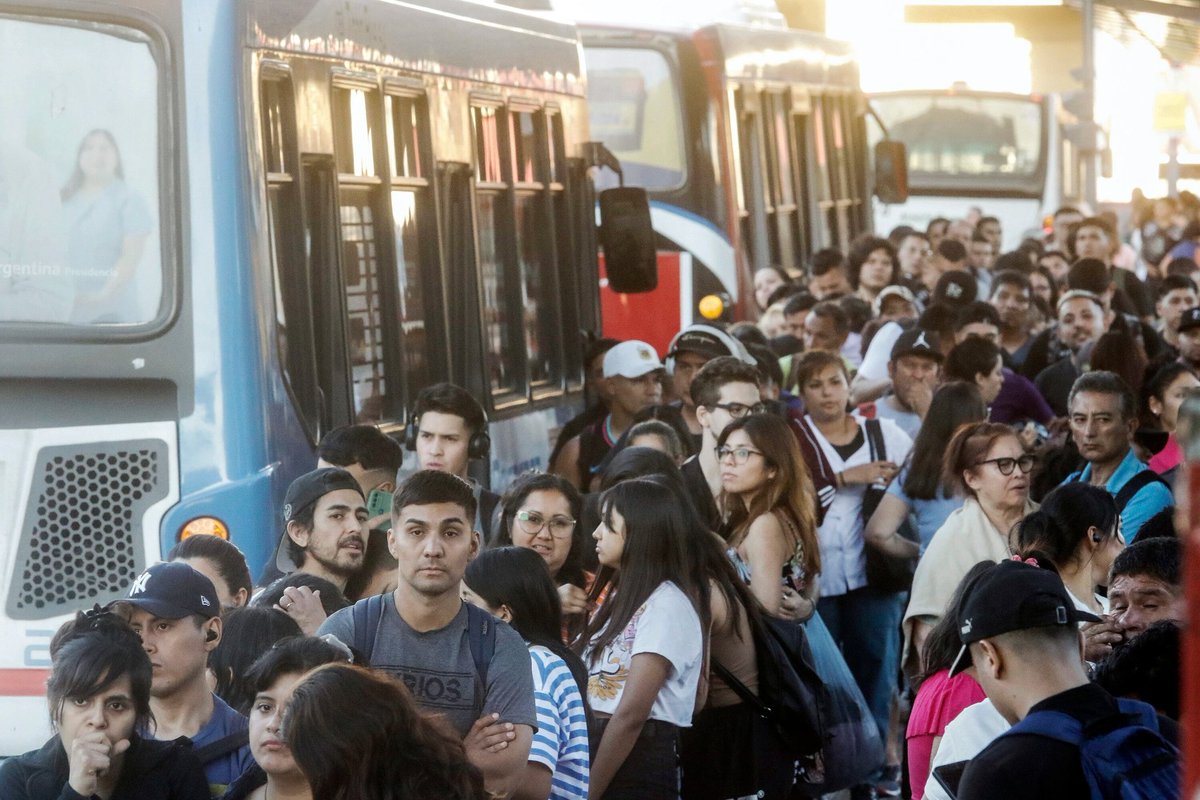
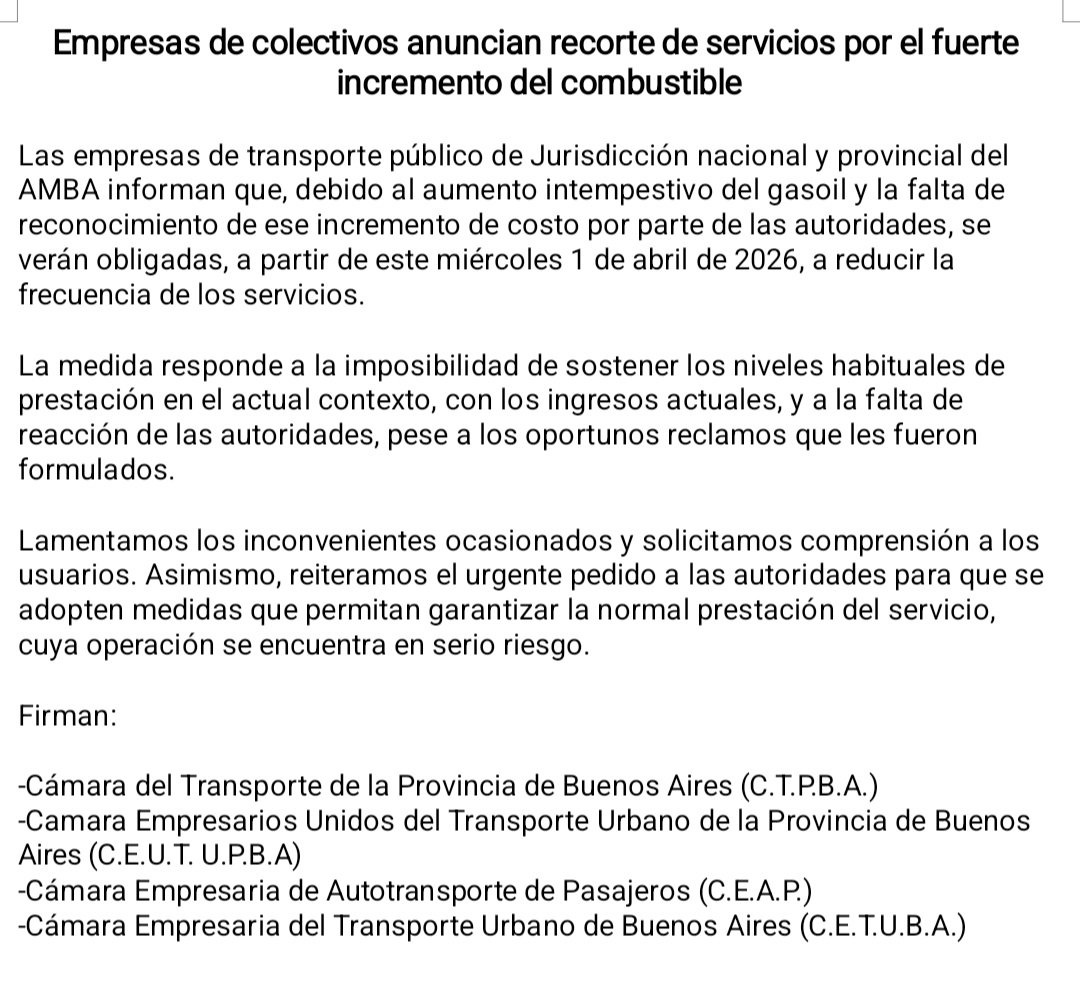
ATENCION⚠️ Todas las líneas de colectivos, a excepción de CABA, funcionan con diagramas reducidos. Algunas con frecuencia de dia SABADO, como la ex TALP, EEE y también con frecuencia de domingos como todas las líneas de DOTA y MOQSA🟠🚐
Es por aumento de gasoil, hasta nuevo aviso
Español