
Sabitlenmiş Tweet
Pengu 🎒
1.7K posts


Pengu 🎒
@PenguStack
just vibes, not advice | mod @backpack
World Katılım Haziran 2023
1.3K Takip Edilen2.3K Takipçiler

Pengu 🎒 retweetledi

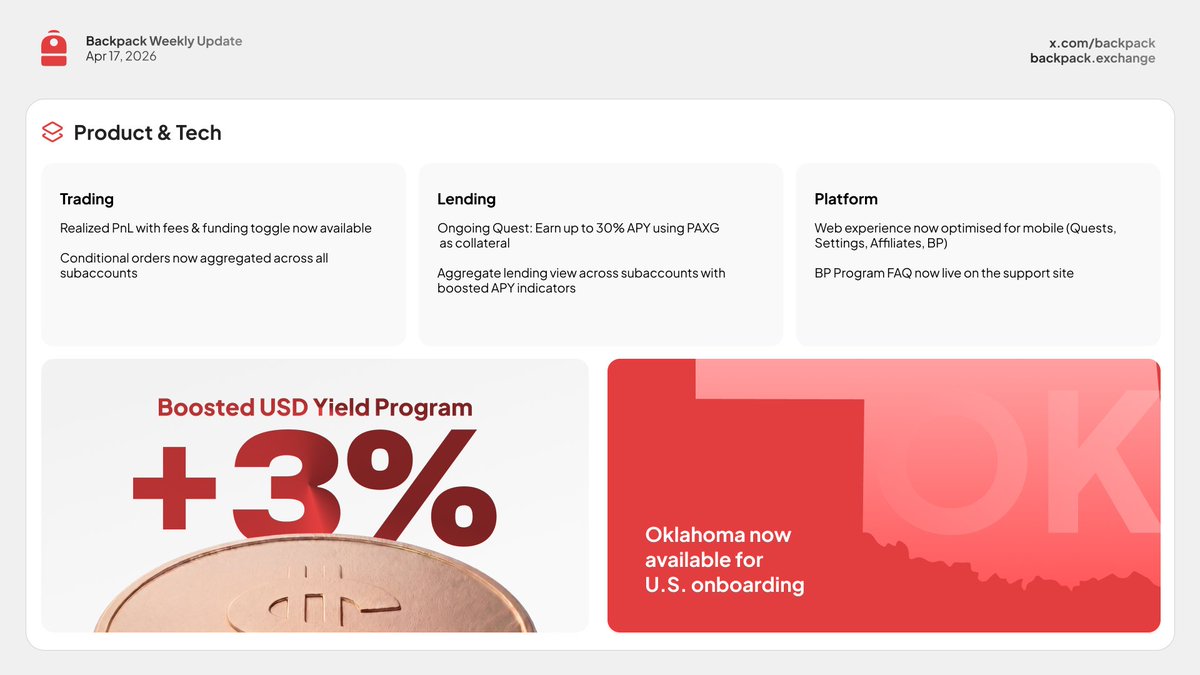
New this week at Backpack 🎒
Oklahoma now available for onboarding
English

New week, new opportunities
Time to get to work folks, let’s make luck ours
English
We're thrilled to welcome Nathan Smith as Backpack's Chief Operating Officer.
Nathan has been instrumental in building and scaling our exchange and wallet from the ground up. Before Backpack, he led Solana's integration at Coinbase and helped build infrastructure behind some of the industry's most critical systems.
As COO, he'll be leading operations as we continue scaling our regulated, global, on-chain financial platform.
Go big or go home 🫡🎒

English

Pengu 🎒 retweetledi

Pengu 🎒 retweetledi

Pengu 🎒 retweetledi
Token or Equity? "YES."
Users get priority allocation when Backpack IPOs - earned through stake, time and usage.
Don't choose. Yes to both.
English
Pengu 🎒 retweetledi
IPOs. Onchain.
Get IPO share allocations directly on Backpack, enabled by our infrastructure partner @SuperstateInc.
Real shares. Direct ownership. On @solana.
Join the waitlist: backpack.exchange/ipo-access
English
Pengu 🎒 retweetledi

Pengu 🎒 retweetledi
20% of Backpack equity given to users who stake for a year.
Don't just use the next big thing.
Own it. 🎒
English
Pengu 🎒 retweetledi
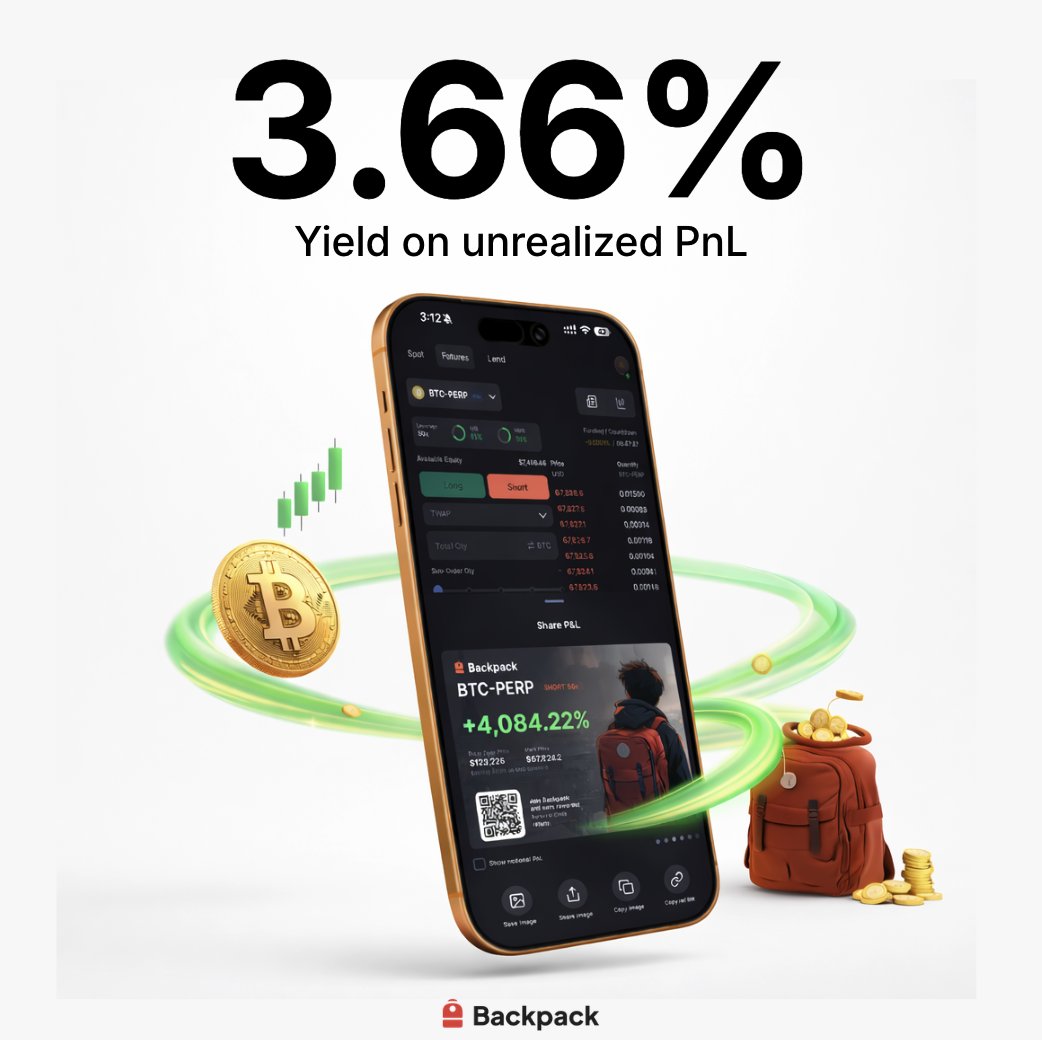
Earn 3.66% on unrealized pnl without reducing or closing your futures positions.
Only on Backpack.
English

Pengu 🎒 retweetledi

Wir haben auch ein Affiliate-Programm. Wenn du Interesse hast und Follower auf X oder eine geschlossene Community hast, kann ich dich in das spezielle Referral-Programm von Backpack aufnehmen – damit kannst du einen höheren Revenue Share verdienen.
Schick mir gerne eine DM oder antworte einfach hier.
Grussgott

Deutsch
Pengu 🎒 retweetledi

In the Backpack tokenomics, we have one guiding principle.
- Insiders "dumping on retail" should be impossible: no founder, executive, employee, or venture investor should receive wealth from the token until the product hits escape velocity.
Of course it begs the question, what does it mean to "hit escape velocity". Every project is different, and it's impossible to generalize. For Backpack, the answer is clear: we want to IPO in the USA. Going public might happen quickly, it might happen not so quickly, and in fact, it might not happen at all. In any case, we're going for it.
But before going public, we have to grow--a lot. The odd thing about Backpack's growth over the past year--and in fact one of the things that makes Backpack so different from basically every token project in crypto--is that, today, Backpack Exchange only serves about 48% of the world. We've been very slow, very intentional about opening up our product to the world, ensuring that we have every "i" dotted and ever "t" crossed as a regulated financial institution. Growth that sometimes feels like running with a parachute, but we are happy to take the long path, because it's precisely that parachute that will allow us to fly.
For those that don't know us, the reason for this is simple. Backpack is trying to not only build great crypto products, but we're also trying to build great TradFi products. We're trying to not only give our users access to every crypto asset, every blockchain, and every decentralized application, but we're also getting banking rails around the world, USD client money accounts in the USA, EUR in the EU, JPY in Japan--every currency on every major payment network you can imagine. We're trying to build a great securities product, whether that's getting access to your favorite stocks in a traditional brokerage or bidding on primary shares of a company about to go public on NASDAQ. We want to serve not only retail users worldwide, but we want to serve regulated products for regulated counterparties and regulated institutions around the world. All of this takes an enormous amount of time, effort, blood, sweat, and tears. We've been working on this for over three years at this point, laying an international foundation for the company and for the product slowly but surely, brick by brick. If we're lucky, we'll spend a lifetime.
What this all means is that, in the most literal sense--and I know this sounds silly--we're just getting started. We still have half the world to open up into. We still have some of our most exciting products to launch. And this leads to our next guiding principle in our tokenomics.
- Liquid tokens should exclusively go to users, fueling growth triggered by key product milestones.
Every time we open up a new region, every time we launch a new product, that's an opportunity to grow. Open up EU => grow. Open up Japan => grow. Open up the USA => grow. Open up predictions => grow. Open up stocks => grow. Open up card => grow. Like gasoline onto a fire, the token serves to continuously kickstart new markets in the same way points kickstarted Seasons 1-4.
With every growth lever we pull, tokens unlock in a predictable way to users, bringing in a new wave of token holders, growing the community, and allowing the product to soar to new heights. The objective constraint for this to work is precise: the value of added growth created by new token unlocks must always be greater than the dilution of those unlocks. As long as that condition holds, we can continue to unlock tokens direct to our most active users, growing along the way.
Last but not least is the question:
Ok so if all the liquid tokens are going to users, then what about the team? How exactly do you remain incentive aligned while ensuring the team cannot unlock, dump on retail, and become enormously wealthy without building something great?
And the answer is simple: not a single founder, executive, team member, or venture investor has been given a direct token allocation.
The entire "team allocation" sits in a "corporate treasury", i.e. on the balance sheet of the Backpack company--locked until at least one year post IPO. The team owns equity in the company, and the company owns a large percent of the token supply. It's not until the company goes public (or has some other type of equity exit event), that the team can earn any wealth from the project. It's not until the company has access to the largest, most liquid capital markets in the world by going public--and it's not until the company has done all the hard work to earn access to those markets--that the team can reap the rewards of the value created by the Backpack community from now until then.
We either go big, or we go home.
Backpack 🎒@Backpack
25% on TGE Here's the entire token distribution Utility coming next 🎒
English
Pengu 🎒 retweetledi
I tweeted this over a year ago. @Backpack is what's called a super app. WeChat is a super app, and Backpack is the super app for finance. But what does that mean?
Super apps allow to offer multiple services based on a common technical platform. They enable the team to promote different services to the same customer base. This offers the advantage of increasing revenue while optimizing companies' marketing efforts. By meeting diverse needs, it fosters customer retention and loyalty.
Having multiple services allows for cross-functional data analysis, paving the way for personalized recommendations, decision-making dashboards, or AI-driven automations. Very smart.
Designing a super-app is no simple task. This type of platform involves significant technical complexity and proven expertise in various areas, particularly in the following areas:
1. Modular and Scalable Architecture
Each mini-application or service must be developed as an independent yet interoperable module. This requires a robust and scalable architecture, designed from the outset.
2. Data Security & Privacy
By offering multiple (often sensitive) services, super-apps process a large volume of user data. They are therefore required to comply with strict requirements regarding cybersecurity, authentication, compliance, and user data protection.
3. Consistent and Flexible UX/UI
One of the major challenges of super-apps is to provide a seamless experience despite the functional diversity. This is an exciting challenge that our UX/UI experts are committed to meeting by designing clear, adaptable, and engaging interfaces.
All this seems complex, but using Backpack is very simple? That means the team is doing the job.
Is @Backpack on track to meet these requirements?
I think Backpack is incredibly ahead of the curve considering everything they've achieved in such a short time. Future is bright. Brick by brick.
English

Pengu 🎒 retweetledi
Quick capital efficiency check:
Binance/Bybit/OKX/Bitget/HL: mostly no yield on PnL + fragmented wallet models.
Backpack:
✅ yield on collateral
✅ yield on PnL
✅ margin from PnL
✅ cross margin
✅ one wallet for everything.

English