Philipp Denter

1.1K posts

Philipp Denter banner
Philipp Denter

Philipp Denter

@PhilippDenter

Associate Prof of Economics @uc3m. Research: Political Economy, Climate Change, IO, Contests. Pic: Lake Álftavatn, Iceland

Madrid Katılım Temmuz 2019
1.2K Takip Edilen514 Takipçiler
Philipp Denter retweetledi
Christian Lessmann
Christian Lessmann@econ_lessmann·
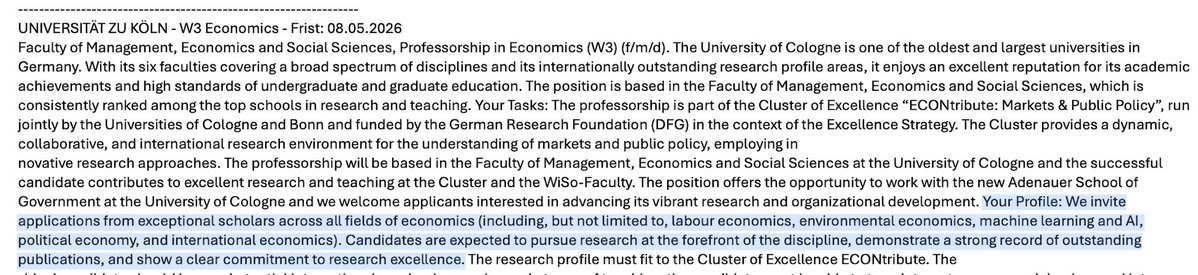
Echte Exzellenz ist übrigens, wenn eine Uni einfach nach den Allerbesten sucht. Keine Modethemen, kein Strategiegedöns, keine Matrixstruktur. Liebe Uni-Leitungen: Man macht das einfach wie die Uni Köln. #Exzellenzstrategie
Christian Lessmann tweet media
Deutsch
2
3
54
7.7K
Philipp Denter
Philipp Denter@PhilippDenter·
Last week I participated in a great workshop at Leuphana U Lüneburg and presented our paper “Feedback Effects or Regression to the Mean?” (w/ Jan Stuhler & Jonas Radl). Fantastic talks, a great keynote by Daniel Schunk, and many stimulating discussions with old and new friends.
Philipp Denter tweet mediaPhilipp Denter tweet media
English
0
0
4
104
Philipp Denter retweetledi
Luis Garicano 🇪🇺🇺🇦
Luis Garicano 🇪🇺🇺🇦@lugaricano·
I have followed Malmendier's work from a distance. She has been making an enormous effort to address the issues that the Draghi report pointed out and to drag Germany out of her current stagnation. The government is making a huge mistake, they will not find anyone better.
Julian Olk@olk_julian

Exklusiv @handelsblatt: Ulrike #Malmendier muss die #Wirtschaftsweisen verlassen. CDU blockiert ihre Verlängerung. Riesige Aufregung in der Bundesregierung, SPD ist erzürnt. Für die Nachfolge kursieren bereits erste Namen. @umalmend #Sachverständigenrat handelsblatt.com/politik/konjun…

English
4
38
238
40.9K
Philipp Denter retweetledi
1. FSV Mainz 05
1. FSV Mainz 05@1FSVMainz05·
Wir stehen als erstes deutsches Team in der Wettbewerbshistorie im Achtelfinale der Conference League! 🔥🏆 #mainz05
1. FSV Mainz 05 tweet media
Deutsch
20
34
1.7K
79.7K
Philipp Denter retweetledi
Alex Imas
Alex Imas@alexolegimas·
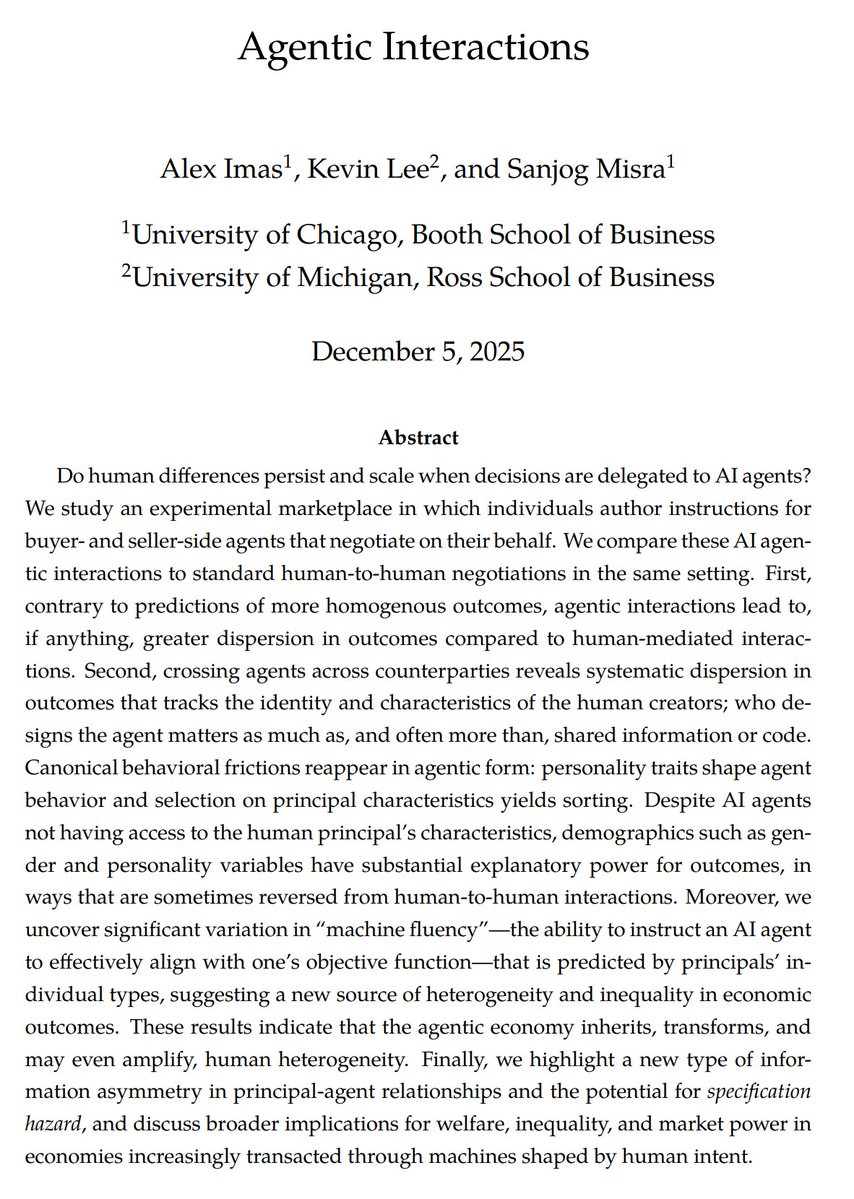
What will economic outcomes look like as transactions become delegated to AI agents? Will human differences be smoothed away, leading to more homogenous outcomes, or will they be recreated and potentially even amplified? Will AI agents mitigate inequality, or will it persist and potentially take on new forms? Will AI agents eliminate information asymmetry in principal-agent relationships, or introduce new frictions? New paper with K. Lee and @sanjog_misra provides some early answers: 1) AI-agentic interactions, if anything, generate more dispersion and heterogeneity in economic outcomes than human-human benchmarks. 2) Dispersion of agentic interactions can be directly traced back to non-instrumental traits and biases of human principals doing the prompting. Hypothesis of greater homogeneity from (AI)agentic interactions does not seem to hold. 3) There are substantial differences in “machine fluency” —the ability to write prompts that align the agent with the principal’s objective. Some principals are better at maximizing agentic outcomes than others. Principal characteristics predict performance of agent, suggesting new source of inequality. 4) Some traits have similar relationship to outcomes as human-human interactions, but others reverse, e.g., gender difference in negotiated outcomes. 5) Principal-agent relationship changes: prompt now acts as contract. But black-box objective function of agent implies new type of contract incompleteness, which we broadly term “specification hazard.” As economic activity shifts to autonomous agents, primary source of market distortion may shift from information asymmetries between parties, to principals’ mental models of the AI agents that they are delegating to.
Alex Imas tweet media
English
16
57
299
77.1K
Philipp Denter
Philipp Denter@PhilippDenter·
@alexgutzmer @schieritz @franke_media Zur Erklärung hilft ein Blick auf das Bevölkerungswachstum. Im Zeitraum 1980- heute USA plus ~50%, Europa plus ~8% (für die EU sähe das minimal besser aus).
Philipp Denter tweet media
Deutsch
0
0
0
16
Philipp Denter retweetledi
1. FSV Mainz 05
1. FSV Mainz 05@1FSVMainz05·
Riesen Respekt, Jungs! Wir nehmen einen Punkt aus München mit nach Mainz! 👏👏👏 #FCBM05
1. FSV Mainz 05 tweet media
Deutsch
67
30
450
49.8K
Philipp Denter retweetledi
Mark Schieritz
Mark Schieritz@schieritz·
Unser sehr schöner Rentenrechner zeigt, dass die Rente mit 72 das demografische Problem praktisch lösen würde zeit.de/wirtschaft/202…
Mark Schieritz tweet media
Deutsch
175
8
92
99.7K
Philipp Denter retweetledi
Jesús Fernández-Villaverde
Jesús Fernández-Villaverde@JesusFerna7026·
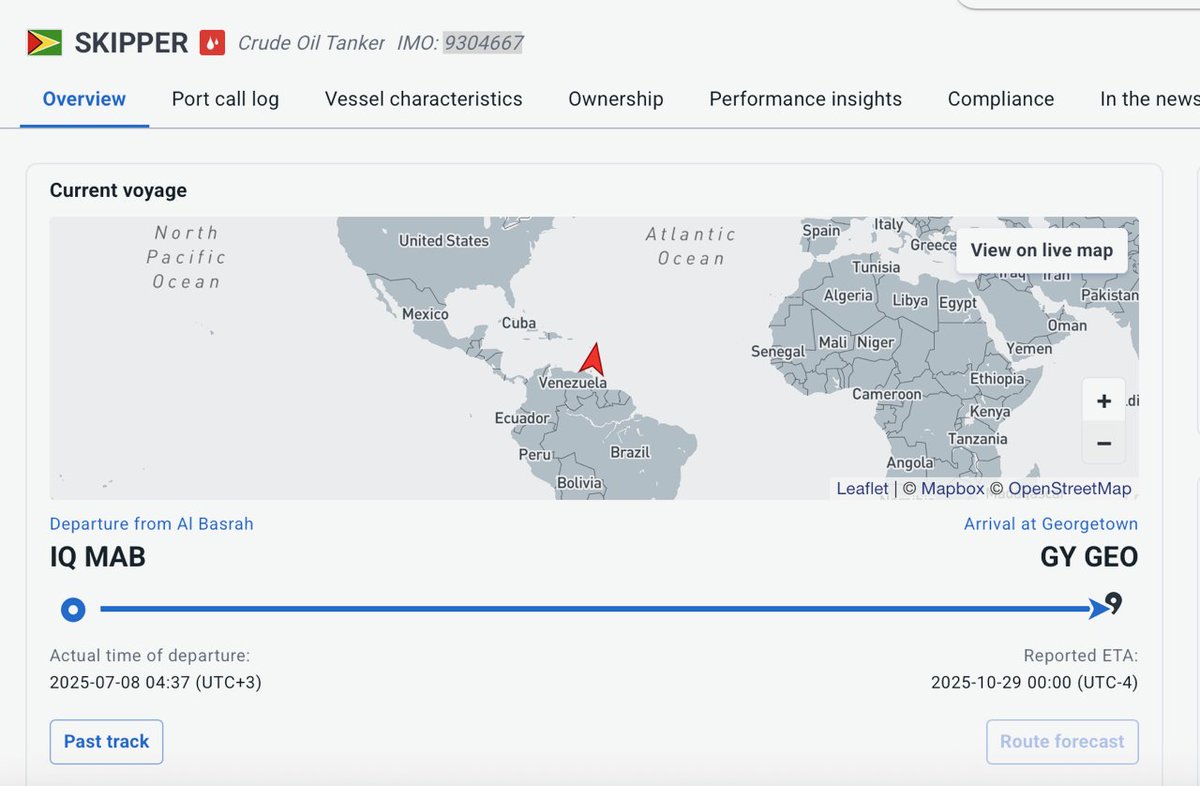
Yesterday, the U.S. seized the oil tanker Skipper off the coast of Venezuela (included pic). This seizure highlights the key role that the dark fleet plays in the global oil market. Together with @YiliangLi_, Le Xu, and @FZanettiOxford, I have spent much of the last year thinking about this market: sas.upenn.edu/~jesusfv/Dark_… While I have posted about this work before, given the recent discussion on X about modern economics, data, and artificial intelligence, I want to revisit it, as I believe it is also a perfect example of the marvelous findings that can be documented using machine learning in economics and how the future of economics goes, to a large extent, through artificial intelligence. Our punchline is that we designed a novel, powerful machine learning algorithm to show that dark oil tankers transported an estimated 9.3 million metric tons of crude oil per month between 2017 and 2023 (right now, before sending the paper back to the journal, we are extending the database to 2025). Let that sink in: nearly 10 million tons of crude every month off the books, outside official trade flows. And the economic impact? Surprisingly large for output and inflation in the U.S., the EU, and China. Let’s start today with how we gather the data. When oil sanctions hit, exporters don’t stop. They go dark: — Disable AIS transponders — Transfer oil ship-to-ship in open waters — Reflag vessels under shady jurisdictions — Use forged paperwork to mask identities And here’s the twist: Many of these tactics are quietly tolerated (sometimes even facilitated) by countries that don’t want to see tight energy markets or higher inflation. Nobody wants to rock the boat. So, we built the most comprehensive dataset to track this: ✅ Over 2,150 oil tankers, essentially the entire global crude fleet. ✅ Trips tracked from 2017 to 2023. ✅ Satellite AIS data + metadata (vessel age, flag, etc.). ✅ ~330 million observations. We then trained a machine learning model that detects sanction-busting trips with very high accuracy: — Patterns in AIS gaps. — Origins and destinations. — Temporal clues like navigation anomalies. — Vessel profiles. This isn’t sample data — it’s population-level tracking. We audited and validated the model using satellite images and independent checks. For instance, the oil tanker Roma (IMO: 9182291) was classified as “dark” by the algorithm, and sure enough, we found imagery of Roma loading oil at Kharg Island (Iran) on August 20, 2022 (see second included pic). You can’t argue with a photo. This process gives us confidence in the entire classification and enables us to identify every trip that violates sanctions. So what do we do with all these dark voyages? We construct time series of: 📈 Oil exports that violate sanctions. 📉 Oil imports that violate sanctions. 🌐 Their origin and destination. See the third and fourth included pics. Tomorrow, I will discuss these results and how we use them in what I think is a rather creative econometric exercise. P.d. By the way. Have you seen any “heterodox economist” doing anything like that? Of course not. The “heterodoxs” sit down and talk about the ontology of the oil markets, or what Sraffa would have said about the oil market, or even better, that mainstream economists do not look at the data (and write a whole book about that). Can you be any more empirical than this paper, where we actually look at every single oil tanker in the planet in real-time? Let’s be honest: “heterodox economics” is just an excuse to be a low performer and not having to face your own shortcomings as as a researcher.
Jesús Fernández-Villaverde tweet mediaJesús Fernández-Villaverde tweet mediaJesús Fernández-Villaverde tweet mediaJesús Fernández-Villaverde tweet media
English
59
163
800
176.4K
Philipp Denter retweetledi
UC3M Economics
UC3M Economics@EconomicsUc3m·
📢 @EconomicsUc3m launches CReMa, a one-year master’s in the analysis of competition and regulation. With strong training in micro, IO, econometrics & regulatory economics, it prepares students for economic consulting and regulated industries.
English
1
3
8
637
Philipp Denter retweetledi
Florian Ederer
Florian Ederer@florianederer·
When you cannot tell if a problem is hard or your idea is bad, the best strategy is to cycle: try a new idea, drop it, return later. Failures make old ideas look better. This is why breakthrough paths look messy and why optimal contracts may reward early failure.
Florian Ederer tweet media
English
5
22
121
8K
Philipp Denter retweetledi
Alex Imas
Alex Imas@alexolegimas·
Here is why I’m worried about AI-driven labor disruption and why I think economists should fight for a seat at the policy table. TL;DR: AI is general purpose tech, disruption can happen at diff scale than before. Step back, let ‘er rip and analyze later may be disastrous. 1/n
English
26
66
335
154.4K
Philipp Denter retweetledi
Jesús Fernández-Villaverde
Jesús Fernández-Villaverde@JesusFerna7026·
A guide for students of economics: Ten statements that demonstrate that someone does not understand modern economics or what an equilibrium is, and that you can safely ignore everything else they say. 1. “Equilibrium means the economy is stable or at rest.” Many assume that an equilibrium is a peaceful state with no forces at play. Instead, an equilibrium is just an arrangement of actions and expectations over time that are mutually consistent. It can be locally unstable, explosive, or fragile. Nothing in the definition of equilibrium implies stability. 2. “Equilibrium implies optimality or social efficiency.” Equilibrium is often conflated with efficiency, but equilibrium merely reflects decentralized consistency, not welfare maximization. Market power, externalities, incomplete markets, nominal rigidities, and frictions routinely produce inefficient equilibria. I often teach a first-year macro graduate course, and not a single one of the equilibria I define is efficient. 3. “Equilibrium is a unique outcome.” Many often expect models to have one equilibrium. In reality, multiple equilibria arise naturally in dynamic, strategic, and incomplete-market environments. Models of coordination failures, self-fulfilling expectations, bubbles, overlapping generations, and liquidity traps all hinge on the existence of equilibrium multiplicity. 4. “Equilibrium requires perfect foresight or perfect information.” Equilibrium does not assume agents know the future. In fact, equilibria are often stochastic. The definition of equilibrium only requires that beliefs are consistent with the (perceived) stochastic laws of motion implied by the model. Bayesian learning, noisy signals, ambiguity, and subjective uncertainty all fit well within an equilibrium framework, provided beliefs converge to an internally consistent (but possibly incorrect) distribution. Bonus point: equilibria are compatible with agents having diverging beliefs that never converge to a single Dirac distribution. 5. “Real economies are rarely in equilibrium, so the concept is unrealistic.” Equilibrium is not meant to describe the daily state of the world. It is a conceptual device used to understand the outcome of our models under the assumptions we make. Also, see point 1 above. 6. “Equilibrium requires agents to be fully rational in a psychological sense.” Equilibrium only assumes internal consistency: agents optimize given preferences and constraints. It does not assume realism about human cognition. We can and do define equilibria in models with behavioral biases, bounded rationality, inattention, or rule-of-thumb behavior. We only need to ensure that the resulting actions and beliefs are mutually compatible. 7. “Equilibrium eliminates dynamics or learning.” Equilibrium is sometimes misinterpreted as a static state in which nothing evolves. In fact, many equilibria are sequences of probability distributions over states driven by shocks, policy rules, and endogenous responses. Learning dynamics (Bayesian updating, adaptive rules, experience-based expectations) can occur within equilibrium if the evolution of beliefs is self-consistent. 8. “Equilibrium renders expectations unimportant.” A common misconception is that equilibrium mechanically determines outcomes. In reality, expectations are often central: they determine investment, consumption, asset prices, and policy responses. Many equilibria differ only in their expectations. This is why communication, credibility, and forward guidance matter even in fully rational models. 9. “Equilibrium excludes policy intervention.” Some interpret equilibrium as a laissez-faire concept. In fact, equilibrium analysis is the foundation of modern policy evaluation. Fiscal, monetary, and regulatory interventions work through equilibrium responses (prices, wages, interest rates, quantities) and must satisfy equilibrium conditions to be credible. Equilibrium is a tool for policy design, not a barrier to it. 10. “Equilibriums…” Aequilibrium is a Latin neuter noun of the second declension, which forms a nominative plural in “a”. It is composed of aequus (equal; the same root as equality or equity) and libra (balance or scales or the name of several currencies over history). A final thought: “equilibrium” is a term of art. Its meaning in economics differs from its use in the natural sciences or in everyday language. Terms of art are ubiquitous across academic disciplines, and the first act of intellectual diligence when one starts studying a discipline is to learn what they mean.
Jesús Fernández-Villaverde tweet media
English
78
496
1.9K
629.7K
Philipp Denter retweetledi
Justus Haucap
Justus Haucap@haucap·
Bundeskanzler Merz sagte zur #Rente, dass er vielleicht Lob der JU bekomme, wenn er nachgebe, aber Wahlen gewinne man damit "mit Sicherheit" nicht. Dass die Sachfragen an sich also total zweitrangig sind, hat wohl noch niemand so offen gesagt... welt.de/politik/deutsc…
Deutsch
24
49
299
14.6K
Philipp Denter retweetledi
Florian Ederer
Florian Ederer@florianederer·
Paul Goldsmith-Pinkham made a searchable database for the 20,000 text files of the Oversight Committee on Jeffrey Epstein. Check it out here: splendorous-chaja-f79791.netlify.app
Florian Ederer tweet media
English
5
40
188
83.9K
Philipp Denter retweetledi
Hasnain Kazim
Hasnain Kazim@HasnainKazim·
Es ist mir ein Rätsel, warum jemand wie dieser Nymoen, der nicht nur komplett talentfrei und unqualifiziert ist, sondern auch ein absolutes charakterliches Arschloch, so etwas am 9. November zu posten (aber auch an anderen Tagen macht er nicht viel mehr Bilder pro Minute), auch nur eine Sekunde Aufmerksamkeit, Bühne, Zeile, Sendezeit bekommt. Keine Bühne der Dummheit!
Ole Nymoen@nymoen_ole

Heute wurde mal wieder die Kunst vom Künstler getrennt.

Deutsch
117
152
2.4K
226.8K
Philipp Denter retweetledi
1. FSV Mainz 05
1. FSV Mainz 05@1FSVMainz05·
MAINZ 05 DU GEILE SAU!
1. FSV Mainz 05 tweet media
Deutsch
14
27
326
28.2K