Physical Review Fluids

1.5K posts

Physical Review Fluids banner
Physical Review Fluids

Physical Review Fluids

@PhysRevFluids

@APSPhysics journal publishing innovative research that will advance the fundamental understanding of fluids.

College Park, MD (HQ) Katılım Aralık 2015
94 Takip Edilen10.6K Takipçiler
Sabitlenmiş Tweet
Physical Review Fluids
Physical Review Fluids@PhysRevFluids·
Take a look at selected highlights from Physical Review Fluids in 2025, including research, awards, and community events. Thank you to all who contribute to advancing fluid dynamics! (Music from #Uppbeat: go.aps.org/3MV5DRz, license code: DAWZT3G3VWBT1SN6)
English
0
8
31
3K
Physical Review Fluids
Physical Review Fluids@PhysRevFluids·
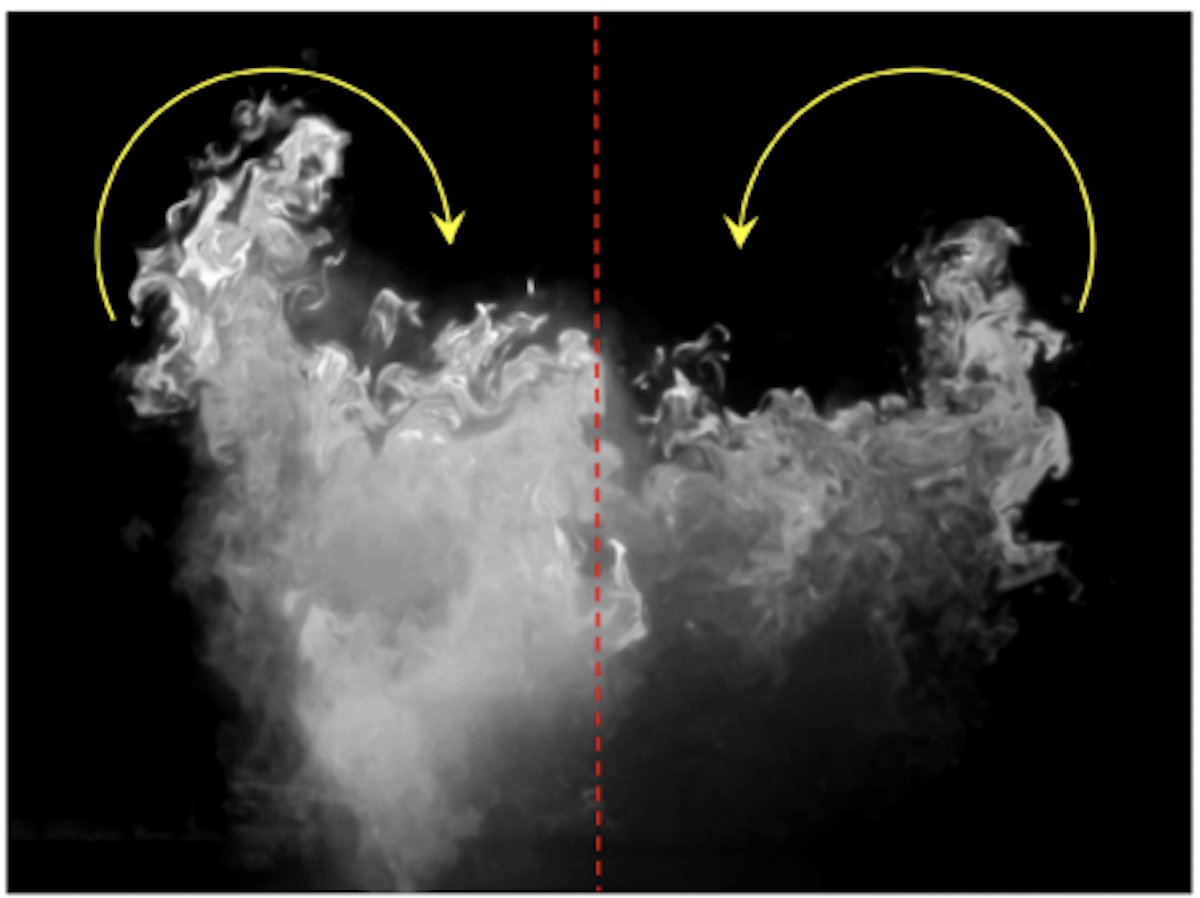
How do dolphins swim in the turbulent flow they generate? Simulations show that large vortex rings from the caudal fin contribute most to propulsion, while smaller vortices created through the energy cascade play a minor role. Editors' suggestion: go.aps.org/4n43WPg
Physical Review Fluids tweet media
English
0
7
21
711
Physical Review Fluids retweetledi
American Physical Society
APS Open Science’s first papers are here. Our new community-driven, open access journal supports research at every stage. Read its inaugural papers on controlling the geometry of 3D soliton knots and hybrid materials for ultrafast photonic and optical devices: journals.aps.org/apsos/recent
American Physical Society tweet mediaAmerican Physical Society tweet mediaAmerican Physical Society tweet media
English
0
35
81
6.5K
Physical Review Fluids
Physical Review Fluids@PhysRevFluids·
A droplet in a soft spring adopts complex shapes, compressing it via capillarity. Tuning the ratio between spring pitch and droplet size leads to different flow regimes, with vertical velocity linked to the droplet’s rotational motion. Editors' suggestion go.aps.org/3PdTVCG
English
1
15
97
9.5K
Physical Review Fluids
Physical Review Fluids@PhysRevFluids·
The dynamics of confined microswimmers depend strongly on their hydrodynamic flow fields. A Stokeslet-dipole model shows that versatile trajectories arise, from boundary sliding to oscillations, governed by their spatial arrangement. Editors' suggestion: go.aps.org/4d1iiMY
Physical Review Fluids tweet media
English
0
6
33
1.2K
Physical Review Fluids
Physical Review Fluids@PhysRevFluids·
Antibubbles are liquid cores enclosed by a thin gas shell. Producing multilayer antibubbles is challenging, but a method using soap films and soapy droplets achieves this, identifying optimal conditions across different viscosities. Editors' suggestion: go.aps.org/4tYZMun
English
0
6
30
1.5K
Physical Review Fluids
Physical Review Fluids@PhysRevFluids·
Ray tracing with calibrated illumination enables accurate simulation of complex-shaped transparent objects like drops, allowing extraction of 3D properties from experimental images and helping validate fluid dynamics models. Editors' suggestion: go.aps.org/4vGfwnJ
English
1
11
47
2K
Physical Review Fluids
Physical Review Fluids@PhysRevFluids·
In data-driven reconstruction of near-wall turbulence, the choice of loss function is crucial: a spectrally informed composite loss outperforms standard training techniques for reconstructing velocity fluctuations from wall-shear and pressure data. go.aps.org/4tjySxB
Physical Review Fluids tweet media
English
0
4
30
1.1K
Physical Review Fluids
Physical Review Fluids@PhysRevFluids·
Surface tension plays a key role in breaking inception in gravity waves. Simulations show a robust threshold in the local interface angle, twice that without surface tension, and explore the link to the kinematic inception parameter. Editors' suggestion: go.aps.org/4thvmDV
Physical Review Fluids tweet media
English
0
3
21
956
Physical Review Fluids
Physical Review Fluids@PhysRevFluids·
Rafts of bubbles at the surface modify how they burst. The presence of neighbors reduces the ejected droplet size and increases their upward velocity. This broadens the drop size distribution of the whole draft and shifts the peak toward smaller sizes. go.aps.org/3Q1KO8t
Physical Review Fluids tweet media
English
0
6
24
955
Physical Review Fluids
Physical Review Fluids@PhysRevFluids·
🚨 The Journal Club returns with author Valentin Skoutnev discussing their PRFluids paper "Stability of Propagating Plane Inertial Waves in Rotating Fluids” 🕒 April 20, 11 a.m. ET Read ahead: go.aps.org/3MEfSJR Free registration: go.aps.org/3Q8b4Oi
Physical Review Fluids tweet media
English
0
2
17
1.9K
Physical Review Fluids
Physical Review Fluids@PhysRevFluids·
Obstacle arrays affect detonation attenuation in channels. Obstacle spacing enhances attenuation, and a critical blockage ratio sets the transition from quasi-detonation to choking, reflecting a balance of shock attenuation and flame acceleration. go.aps.org/4tAuGcc
Physical Review Fluids tweet media
English
0
5
41
1.9K
Physical Review Fluids
Physical Review Fluids@PhysRevFluids·
We keep celebrating 10 years of PRFluids! In the second #PRF10 Author Reflections video, Jean-Baptiste Salmon reflects on his Frenkiel Award-winning paper, why it resonated within the fluid dynamics and soft matter communities, and why he chose PRFluids. youtube.com/watch?v=Bv9trK…
YouTube video
YouTube
English
0
4
11
1.3K
Physical Review Fluids
Physical Review Fluids@PhysRevFluids·
A buckled elastic sheet in a fluid relaxes via a balance of bending, inertia, and hydrodynamic forces. A minimal inviscid model captures the oscillation frequency about the stable mode and the growth rate of unstable modes, matching viscous simulations. go.aps.org/3OgjCSB
Physical Review Fluids tweet media
English
0
10
38
1.5K
Physical Review Fluids
Physical Review Fluids@PhysRevFluids·
Experiments and simulations explore the flow and interface dynamics near a moving contact line at obtuse angles, revealing a sharp flow deceleration along the interface, offering insight into the classical moving contact line singularity. go.aps.org/4cuk5tH
Physical Review Fluids tweet media
English
0
7
48
1.8K
Physical Review Fluids
Physical Review Fluids@PhysRevFluids·
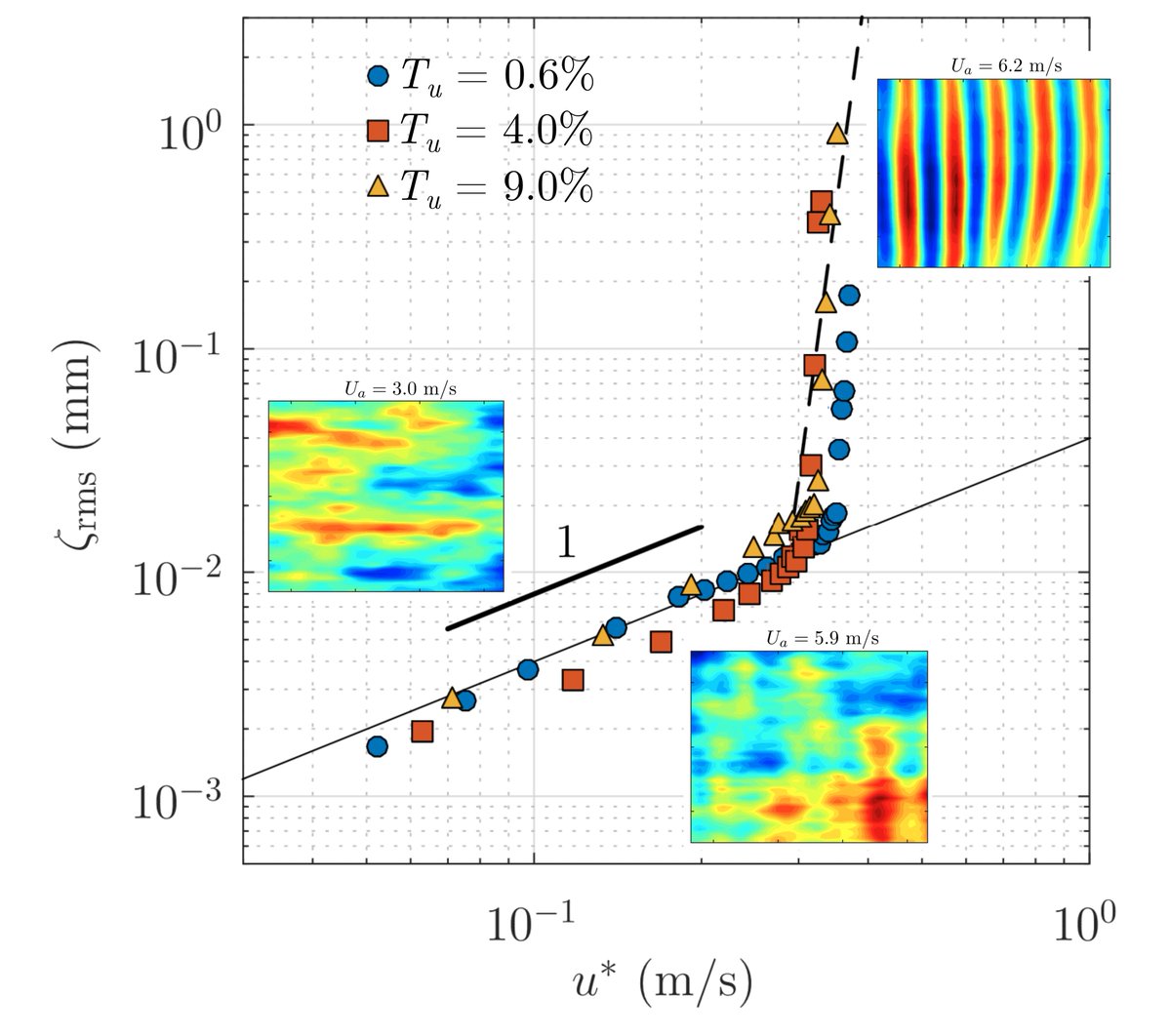
Shallow electrolyte flows, often used as quasi-2D flow analogs, can develop significant free-surface deformations. Experiments show these depend on combined Reynolds number and fluid layer height effects, challenging the assumption of two-dimensionality. go.aps.org/4dwmaXg
English
0
27
82
2.8K
Physical Review Fluids
Physical Review Fluids@PhysRevFluids·
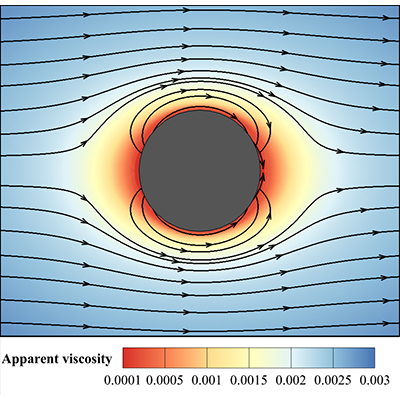
Convection in buoyancy-driven flows is modified when considering polymer-induced viscoelastic effects. Coupled effects of cavity aspect ratio and viscoelasticity determine if polymers enhance or suppress convection, affecting heat transfer performance. go.aps.org/4tLfARB
Physical Review Fluids tweet media
English
0
5
30
1.1K
Physical Review Fluids
Physical Review Fluids@PhysRevFluids·
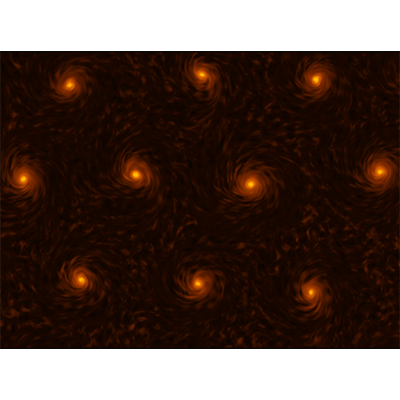
Helicity encodes flow topology but is hard to measure in turbulence. Chirality tomography, a particle-based method, reconstructs 3D helicity maps from particle trajectory entanglement, providing spatially resolved chiral structures. Editors' suggestion: go.aps.org/3Ns1G7r
Physical Review Fluids tweet media
English
1
9
49
2.5K