Physics Magazine

7.4K posts

Physics Magazine banner
Physics Magazine

Physics Magazine

@PhysicsMagazine

Reporting physics research advances. Also https://t.co/xpdUZRYzEB & https://t.co/x53DCGecVz

Ridge, NY Katılım Kasım 2011
525 Takip Edilen75.6K Takipçiler
Physics Magazine
Physics Magazine@PhysicsMagazine·
Magic states enable a quantum computer to carry out the operations that confer its prodigious computing power. Now researchers have demonstrated a method for simulating and optimizing the preparation of magic states on a classical computer. go.aps.org/4uh45BU
Physics Magazine tweet media
English
0
4
23
858
Physics Magazine
Physics Magazine@PhysicsMagazine·
When tritium nuclei beta decay, the mass of the emitted neutrinos can be inferred from the spectrum of the emitted electrons. Embedding tritium in graphene boosts the sensitivity of the measurement and the prospect of finally measuring the neutrino mass. physics.aps.org/articles/v19/67
Physics Magazine tweet media
English
3
10
38
3.3K
Physics Magazine
Physics Magazine@PhysicsMagazine·
Researchers have designed a thermal invisibility cloak that lets heat pass through it smoothly. The metamaterial shell could be adapted to noninvasive sensors and to thermal isolation for quantum circuits. go.aps.org/4f3g7Kz
Physics Magazine tweet media
English
0
4
21
791
Physics Magazine
Physics Magazine@PhysicsMagazine·
The use of ultrashort x-ray pulses to probe atomic dynamics has been hampered by the difficulty in knowing how the profiles of individual pulses vary. Now researchers have overcome this limitation by eliminating the background light that blurs profiles. go.aps.org/4femN8r
Physics Magazine tweet media
English
1
6
23
920
Physics Magazine
Physics Magazine@PhysicsMagazine·
Last July Physics Magazine asked readers to weigh in on some of the biggest controversies in cosmology, particle physics, and general relativity. The survey results are now available. Only one topic achieved near consensus: how to think about the big bang. go.aps.org/4tA2qq3
Physics Magazine tweet media
English
2
1
6
548
Physics Magazine
Physics Magazine@PhysicsMagazine·
It’s long been established that neutrinos help drive core-collapse supernovae. By incorporating neutrino-flavor oscillations into simulations, researchers have shown that such oscillation can profoundly influence the course of these cosmic explosions. go.aps.org/4u5Ygac
Physics Magazine tweet media
English
5
18
42
1.6K
Physics Magazine
Physics Magazine@PhysicsMagazine·
Foamy materials can absorb the energy of intense electron beams more effectively than materials that contain less empty space. The finding suggests that the microstructure of a material fundamentally changes its ability to stop electrons. go.aps.org/4niJ2Mr
Physics Magazine tweet media
English
1
6
21
1.2K
Physics Magazine
Physics Magazine@PhysicsMagazine·
Stealthy hyperuniform materials are disordered structures that look uniform on large length scales. That property should make them transparent to light, but researchers have shown that the materials can scatter light after all. go.aps.org/4uyAZOa
Physics Magazine tweet media
English
0
5
19
1K
Physics Magazine
Physics Magazine@PhysicsMagazine·
A new bibliometric index aims to do a better job of identifying whether a paper is a breakthrough by looking at both the papers it cites and the papers that cite it. go.aps.org/48SdWpd
Physics Magazine tweet media
English
1
2
16
786
Physics Magazine
Physics Magazine@PhysicsMagazine·
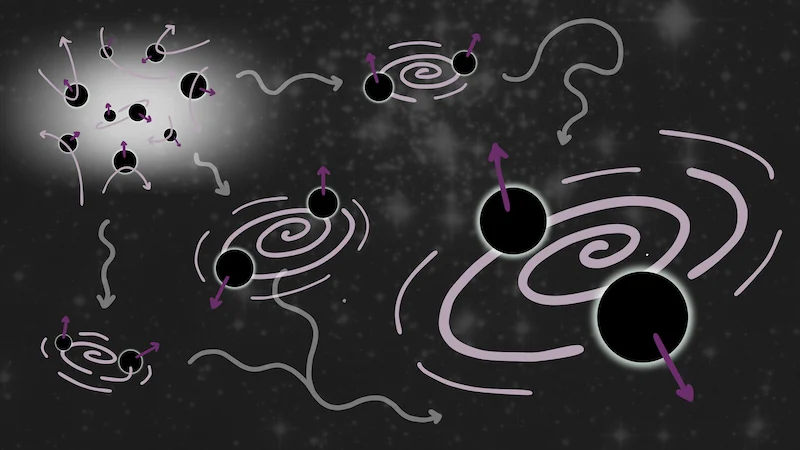
Cosmic rays with energies up to 4 PeV are thought to originate largely from supernovae. Now it appears that some of these energetic cosmic rays could be accelerated by binary systems comprising one massive star and one neutron star or black hole. go.aps.org/4wfa4IP
Physics Magazine tweet media
English
0
5
15
985
Physics Magazine
Physics Magazine@PhysicsMagazine·
Cellulose has previously been turned into a soft plastic. Now researchers have devised a way to turn the abundant biopolymer into a durable, rigid, and environmentally friendly plastic. go.aps.org/4diVJTb
Physics Magazine tweet media
English
1
0
7
674
Physics Magazine
Physics Magazine@PhysicsMagazine·
Researchers have shown that superconducting qubits designed to be less sensitive to radiation-induced bit-flip errors are still vulnerable to phase errors, highlighting the need for improved strategies for safeguarding qubit coherence. go.aps.org/3RdU3CR
Physics Magazine tweet media
English
1
8
48
2.3K
Physics Magazine
Physics Magazine@PhysicsMagazine·
Henry Cavendish first measured the gravitational constant G in 1798. Over the past 40 years, high-precision experiments have reported values of G that don’t line up well with each other. The latest NIST measurement has not resolved the discrepancies. go.aps.org/42XYx2Y
Physics Magazine tweet media
English
4
21
60
8.4K
Physics Magazine
Physics Magazine@PhysicsMagazine·
Researchers have incorporated continuous error correction in an end-to-end quantum computation of a molecule’s lowest energy. Although the precision was lower than what leading classical computers can achieve, the quantum computation used just 23 qubits. go.aps.org/42C49zU
Physics Magazine tweet media
English
0
9
35
2.1K
Physics Magazine
Physics Magazine@PhysicsMagazine·
Entanglement is crucial to quantum computing and quantum sensing. Now researchers have demonstrated a technique to validate entanglement in a wide range of scenarios, notably ones where only a limited set of measurements can be made. go.aps.org/49tNQsE
Physics Magazine tweet media
English
1
6
39
1.6K
Physics Magazine
Physics Magazine@PhysicsMagazine·
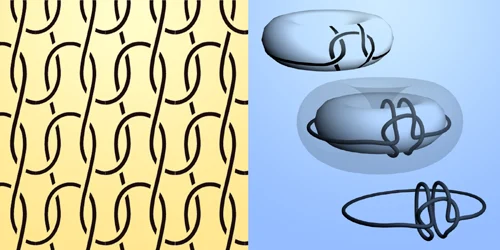
Hopfions are knot-like arrangements of a magnetic material’s spin texture characterized by a topologically invariant Hopf number H. Theorists have found a way to split high-H hopfions into multiple lower-H hopfions, which could be useful in spintronics. go.aps.org/4d6UYMN
Physics Magazine tweet media
English
1
24
101
4.2K
Physics Magazine
Physics Magazine@PhysicsMagazine·
A recent study of one of the simplest molecules in nature, hydrogen, has shown that the allowed pathways between quantum states are determined not just by the molecule’s internal symmetries but also by its surroundings. go.aps.org/4cEgZnb
Physics Magazine tweet media
English
3
14
49
2.2K
Physics Magazine
Physics Magazine@PhysicsMagazine·
Tiny, small-scale eye movements persist even when a human stares at a fixed point. Now researchers have shown how those seemingly random eye movements serve to couple the spatial structure of a stimulus to a time-dependent visual response. go.aps.org/4tl7UVk
Physics Magazine tweet media
English
0
4
11
807
Physics Magazine
Physics Magazine@PhysicsMagazine·
In statistical physics, boundaries generally do not affect bulk behavior in large systems. But now theorists have shown that in specially constructed quantum lattice models, the shape of the boundary can determine which phases exist deep inside the system. go.aps.org/4dmWKdU
Physics Magazine tweet media
English
5
23
138
7.5K
Physics Magazine
Physics Magazine@PhysicsMagazine·
Four attendees at this year’s Global Physics Summit told APS News how they use AI to write code. Among them was a postdoc working on quantum simulations. He said AI can transform a five-hour coding task into a 15-minute chatbot conversation. go.aps.org/4ush8A0
Physics Magazine tweet media
English
0
1
14
877