Pinaki Bhattacharya

4.5K posts

Pinaki Bhattacharya banner
Pinaki Bhattacharya

Pinaki Bhattacharya

@PinakiTweetsBD

Exiled blogger, online activist and human rights defender from Bangladesh

Paris, France Katılım Ağustos 2012
202 Takip Edilen176.3K Takipçiler
Pinaki Bhattacharya
Pinaki Bhattacharya@PinakiTweetsBD·
Witnessing #Bangladesh Prime Minister Tarique Rahman’s newfound fondness for those who once supported Sheikh Hasina's authoritarian regime, it becomes clear that the very fascism which was toppled in the #JulyUprising has returned to the country. On the day of Eid, @trahmanbnp telephoned journalist Anis Alamgir to extend his special Eid greetings.   During Sheikh Hasina’s tenure, Alamgir worked as a loyalist journalist in her favour. In 2024, he opposed the July Uprising led by students and ordinary citizens, and also criticised activists and supporters of Mr. Rahman’s Bangladesh Nationalist Party and Jamaat-e-Islami who took part in the anti-fascist July Uprising. In a Facebook post, dated July 23, 2024, he labeled the protests by the two political parties as “hellish terrorism” and openly expressed his support for Hasina’s rule. Earlier, in 2021, Alamgir had publicly said that Tarique Rahman should be removed from the BNP’s top leadership. This comment was published in the Bangla Tribune on June 29 of that year. In a column for the Bangla Tribune, he described Mr. Rahman as a “corrupt and terrorist” leader. Rahman called this very journalist to wish him Eid Greetings.  Does the PM not know how Alamgir spoke negatively against him some time ago? Has the PM forgotten how this journalist fawned over Hasina and shamelessly supported her fascist rule? Had Hasina’s authoritarian rule not been overthrown by the July uprising, the @bdbnp78 would not have been able to come to power in Bangladesh. On this Eid day, did the Prime Minister make out any phone calls to offer greetings to even a few of the families of those martyred in the July Revolution, or to the fighters who were injured or left disabled during the movement? No, he did not.   The Prime Minister owes the public an explanation as to why Anis Alamgir holds such importance in Tarique Rahman’s eyes. @tariquebd78
Pinaki Bhattacharya tweet mediaPinaki Bhattacharya tweet media
English
12
11
116
2.7K
Pinaki Bhattacharya
Pinaki Bhattacharya@PinakiTweetsBD·
“Over the past one and a half years, Bangladesh has witnessed the rise of a new political breed that has been engaged in heinous campaigns of lies, bullying, harassment, and psychological abuse of opponents. This has nothing to do with politics. It is weaponised harassment and premeditated psychological destruction. Their single objective is to mentally break their political opponents…Most alarming is that these politicians have received active backing from a network of radical right-wing figures, including intellectuals, celebrities, social media influencers, writers, singers, actors, and self-proclaimed journalists, among others.   If Bangladesh were a civilised nation, one might wonder where these individuals would have ended up,” Shamaruh Mirza—the daughter of Bangladesh Nationalist Party Secretary General Mirza Fakhrul Islam Alamgir—wrote in a Facebook post a few days ago. This is my response to a Facebook post by the daughter of the BNP Secretary General.   If #Bangladesh were a civilised nation:   Would political parties like the Awami League or the BNP even exist there?   Would a senior politician of Mirza Fakhrul’s age be serving as Secretary General under Tarique Rahman—a man young enough to be his son?   Would Mr Fakhrul have remained active in politics for so long?   Would he and his party have resorted to such overt and shameless election manipulation—or 'engineering'—in the recent general election?   Could he and his party have betrayed the “July Charter” in such a manner?   Could he and his party’s top leadership have nominated general election candidates as many as 59% of whom are loan defaulters?   Would a untrustworthy and treacherous party like the BNP even have continued to exist?   I ask Mirza Fakhrul’s daughter to take a look at the comments by the supporters of her father’s party under my March 16 Facebook post on this issue. She should also see the comments posted by supporters of the opposition party under her husband’s related Facebook post.      Let’s have a face-off and see who is actually civilised.
Pinaki Bhattacharya tweet media
English
8
11
93
2.3K
Pinaki Bhattacharya
Pinaki Bhattacharya@PinakiTweetsBD·
“After long years, a democratic election has been held. The persistent attempt to undermine this election—as Jamaat-e-Islami is doing— is a crime. Speaking about it once or twice to save face is understandable, but to keep it repeating continuously is truly a crime,” Zahed Ur Rahman, who is serving as an adviser to the Prime Minister of #Bangladesh, said. Why is nobody stopping this man? There is no need to bring up Jamaat to say that the last national election in Bangladesh was questionable. After all, it was the BNP people themselves who cast doubt on this election.   #BNP MP Mirza Abbas himself said that the election was rigged. The very BNP candidate in Comilla who was defeated by Jamaat’s Dr. Syed Abdullah Mohammad Taher has also alleged that the election was rigged. Furthermore, in Chapainawabganj, BNP leader Harunur Rashid has been repeatedly claiming that the election was questionable.   It is a glaring double standard: Members of the party he is aligned with are freely allowed to call the election questionable or flawed, yet Jamaat cannot do the same. What kind of logic justifies this hypocrisy? To him, merely raising the issue amounts to a crime. That is outright fascism! Even Sheikh Hasina was not this much of a fascist.
English
9
12
100
3.1K
Pinaki Bhattacharya
Pinaki Bhattacharya@PinakiTweetsBD·
An audio recording has recently surfaced in #Bangladesh in which Saimum Reza Talukdar, a prosecutor at Bangladesh’s International Crimes Tribunal, is heard demanding a bribe of 10 million taka (about $81,500) from the family of a jailed Awami League leader, in exchange for securing his bail in a crimes-against-humanity case.   Following the controversy and mounting pressure, Talukdar was forced to resign from his position about a week ago. He, however, has not yet said that the voice in the audio is not his.   In their reporting on the case of former prosecutor Talukdar, Bangladeshi newspaper @ProthomAlo and Sweden-based media outlet @NetraNews notably omit his role as the Legal Affairs Secretary of the ruling BNP’s Information and Communication Technology (ICT) Forum.   Interestingly, they are quick to highlight that the former Chief Prosecutor of the International Crimes Tribunal, Mohammad Tajul Islam, was once associated with Jamaat-e-Islami. This is despite the fact that Islam left Jamaat long ago to join the AB Party— an organisation that has itself always had a troubled relationship with Jamaat. Can this truly be described as objective journalism?   However, they never introduce me as someone associated with the CPB (Communist Party of Bangladesh). They do not even present Matiur Rahman, the editor of Prothom Alo, as a member of BAKSAL (Bangladesh Krishak Sramik Awami League), even though he was this party’s member until it was dissolved.   Talukdar continues to serve as the Legal Affairs Secretary of the BNP’s ICT Forum, a wing overseen by the party's online brigade and featuring prominent figures such as Wahiduzzaman Apollo, Imtiaz Mirza, and Maroof Mallick. Considering Talukdar's “impressive talent”, his connection to the BNP comes as no surprise.
Pinaki Bhattacharya tweet media
English
12
45
226
5.5K
Pinaki Bhattacharya
Pinaki Bhattacharya@PinakiTweetsBD·
I always encourage my readers to approach everything with critical thinking. You should avoid coming to specific conclusions on any issue based solely on personal assumptions.   As soon as I saw the news about the arrest of Osman Hadi’s killers I shared it on social media. Hadi was a very popular youth icon in #Bangladesh. If those responsible for his murder have truly been arrest, are brought back to Bangladesh, and made to face trial, people across the country—men, women, children, and the elderly alike—will undoubtedly feel a sense of relief and satisfaction. However, if you look closely at the related news published across the media, several inconsistencies begin to appear in the reports.   Inconsistency 1:   I shared the news of the arrest after it was initially reported by the Indian news agency ANI. However, we are aware that ANI is seen as a pro-BJP media outlet. So, many tend to be sceptical of reports circulated by this pro-government Indian news source.   Inconsistency 2:

According to Deutsche Welle and the Indian news agency PTI, Hadi’s killers were presented in a court in West Bengal on Sunday before being sent to remand. However, courts in the Indian state typically remain reclosed on Sundays.   Inconsistency 3:   “The West Bengal Police has an official website where all its press releases and updates— including information about the arrests of foreign nationals— are published. However, there is no information on that site regarding the arrest of these two Bangladeshi individuals.   Inconsistency 4:   What has been circulated as a press release of Kolkata Police is not on any official letterhead. There is no signature of any competent authority under that "press release". Anyone can forge such a press release. This can also be fake.   Inconsistency 5

 None of the media reports carried any comment on the arrests from any senior official or spokesperson of the Kolkata Police.   Inconsistency 6:   The Inter-Services Public Relations (ISPR, Bangladesh) stated in a WhatsApp text message that the arrest of the killers of Hadi was made on the basis of intelligence provided by the DGFI. Citing the ISPR, Prothom Alo initially published a report including that statement, but the report was later edited and the ISPR reference was removed. This raises questions: why was the statement from the ISPR deleted, and why did the agency issue it in the first place? After all, this is a civilian matter. Normally, such issues are addressed by the Ministry of Home Affairs or the police, and certainly not the military.   Inconsistency 7   Why has the Ministry of Home Affairs in Bangladesh not issued a statement on such a major development as the arrest of Hadi’s killers?   Inconsistency 8   Indian media ABP Live reported that when the Kolkata Police arrested the two, they did not know that they had caught Hadi's killers. However, the ISPR said in a statement that the Indian police arrested the two men on the basis of specific information provided by the Bangladeshi authorities.   One more point: Hadi frequently spoke out against what he described as India’s ‘chain of slavery’ in his statements. After his assassination, most mainstream Indian media outlets portrayed him as a ‘vehemently anti-India’ politician. In that context, if his killers have indeed been arrested in India, many may question how sincerely or responsibly India will cooperate in ensuring their extradition to Bangladesh and bringing them to justice.   Bringing Hadi’s killers to justice is a national priority for us. However, the aforesaid inconsistencies have created many confusions in my mind. Here, I have simply shared my thoughts on the matter. I encourage you to carefully examine, analyse, and judge all the media reports regarding the arrest of Hadi’s killers.
English
8
12
104
3.2K
Pinaki Bhattacharya
Pinaki Bhattacharya@PinakiTweetsBD·
Balendra Shah, the rapper-turned-politician and a popular figurehead of #Nepal's Gen Z-driven revolution, looks poised to become the country's next prime minister following his Rastriya Swatantra Party's (RSP) historic landslide victory.   The Gen Z leader achieved a sweeping win in Nepal's general election—the first since massive youth-led protests last year that toppled the previous KP Sharma Oli-led government.   I dream of the day—hopefully very soon—when the Gen Z of #Bangladesh will succeed in propelling their own political force to power, just as their counterparts have done in Nepal. I am not yet sure who might emerge as the #Bangladeshi equivalent of #BalendraShah, though.
 
 bbc.com/news/articles/…
English
13
7
160
3.4K
Pinaki Bhattacharya
Pinaki Bhattacharya@PinakiTweetsBD·
Some of my predictions about the current #BNP tenure: As large-scale embezzlement of public funds occurred during Sheikh Hasina’s tenure, such large-scale theft will not happen during the present tenure of the Bangladesh Nationalist Party, or BNP. That does not mean the BNP has suddenly become a clean or virtuous party that will never engage in corruption. Rather, theft on the scale seen during Sheikh Hasina’s rule requires a large amount of money in the state treasury—and that level of funds simply is not there now. The coffers still do not contain that much money. Ministers and MPs in the BNP-led government in #Bangladesh will be busy with populist projects aimed at pleasing people. They will be focused on polishing their own images, and the public-service work they do will be made to go viral in the media. Leaders and activists of the BNP will cultivate Tarique Rahman’s image as a cult figure. A severe economic crisis will grip the country, with the cost of goods skyrocketing. The extreme level of human rights violations—such as enforced disappearances and killings — seen during Sheikh Hasina’s rule is unlikely to occur under the current regime. However, new “scientific” methods of repression will be developed to silence dissent. Political opponents will be harassed with a barrage of lawsuits and cases to try to shut down their activities. Later, they may realize this approach will not bring much political benefit to the BNP either. The entire cadre base of the Awami League, Jubo League, and Chhatra League will be absorbed by the BNP and used to suppress dissent and intimidate political opponents. The BNP-led government may attempt to silence dissidents on social media. However, if the government tries to suppress dissent, the move will backfire. Those targeted for silencing will instead gain widespread popularity nationwide. Many websites and online channels in Bangladesh will be shut down, and the government might attempt to take down numerous pages through cyberattacks. As a result, the number of VPN users in the country is likely to increase dramatically. At the street level and in organisational terms, the #NCP will grow stronger. In particular, it will gain widespread support among young people in urban areas. Disillusioned with the BNP, many young men and women will leave the party and join the NCP. Several of the NCP’s women leaders are also likely to emerge as national figures.

The parliament may face a deadlock over the July Charter and the ordinances introduced by Muhammad Yunus’s interim government. The July Charter is a political declaration signed in Bangladesh on October 17, 2025, by several political parties and the interim government, outlining proposed constitutional, electoral, and administrative reforms following the July 2024 uprising.

 The opposition may stage a walkout from parliament during the speech of President Mohammed Shahabuddin.
English
11
14
78
3.2K
Pinaki Bhattacharya
Pinaki Bhattacharya@PinakiTweetsBD·
Only a day after #Bangladesh’s national election on February 12, a complaint surfaced from Hatiya, Noakhali – rape.   A mother of three reported at a local hospital that she had been beaten by activists belonging to the newly elected Bangladesh Nationalist Party (#BNP). She alleged that one of them, identified only as “Rahman”, had also sexually assaulted her. The woman said she was raped as “punishment” for the “crime” of working for and voting in support of the opposition National Citizen Party (#NCP).   Following the complaint, the woman was medically examined and treated at Noakhali Government Hospital. Although the BNP claimed that no rape had occurred, Netra News reported that even two weeks after the incident, no official medical report had been prepared or submitted to the relevant authorities.   The accused BNP activists have also not been arrested. Fearing for their safety, the woman, along with her husband and three children, has moved to an undisclosed location away from their neighbourhood. This Netra News report reveals the details of the assault and the alleged police inaction against those accused in the case.   The mainstream media in Bangladesh has practically ignored the Hatiya rape incident. In such a situation, this investigative ground report by Netra News is undoubtedly commendable.
English
7
40
251
5.6K
Pinaki Bhattacharya
Pinaki Bhattacharya@PinakiTweetsBD·
Much like the Awami League’s student wing, Chhatra League, once used violence to intimidate leaders, members, and supporters of rival student organisations during the rule of Sheikh Hasina in #Bangladesh, Chhatra Dal has now begun attacking students with opposing political views. Chhatra Dal is the student wing of the ruling Bangladesh Nationalist Party or #BNP. In the early hours of Tuesday, a group of Chhatra Dal activists entered a hostel at Dhaka Polytechnic Institute and attacked students affiliated with a rival student wing using sticks, iron rods, and machetes, leaving many injured. Their target was Chhatra Shibir, the student organisation of Jamaat-e-Islami, Bangladesh’s largest opposition party. During the attack, some Chhatra Dal activists also assaulted at least one Hindu student in the hostel, who was later taken to the hospital. The student, Shanto Sarkar, told the media that armed leaders and supporters of Chhatra Dal entered his room and violently beat his roommates, who were affiliated with Chhatra Shibir. “After some time, members of Chhatra Dal returned while I was alone in my room. They banged on my door, but I did not open it. They then forced open the door and attacked me. One student leader told the others to bring a machete and kill me,” Shanta told the local media. “Scared of my life I jumped off the building…I told them I was a Hindu. I had no disputes with them, yet they attacked me.” Across the country, public life has been disrupted by murder, rape, and extortion. Meanwhile, campuses are witnessing attacks and takeovers carried out in a manner reminiscent of the tactics once used by the Chhatra League. Just as Awami League supporters enjoyed impunity during the rule of Hasina, BNP and Chhatra Dal leaders and their followers now seem to be acting without accountability.
English
18
39
301
4.2K
Pinaki Bhattacharya
Pinaki Bhattacharya@PinakiTweetsBD·
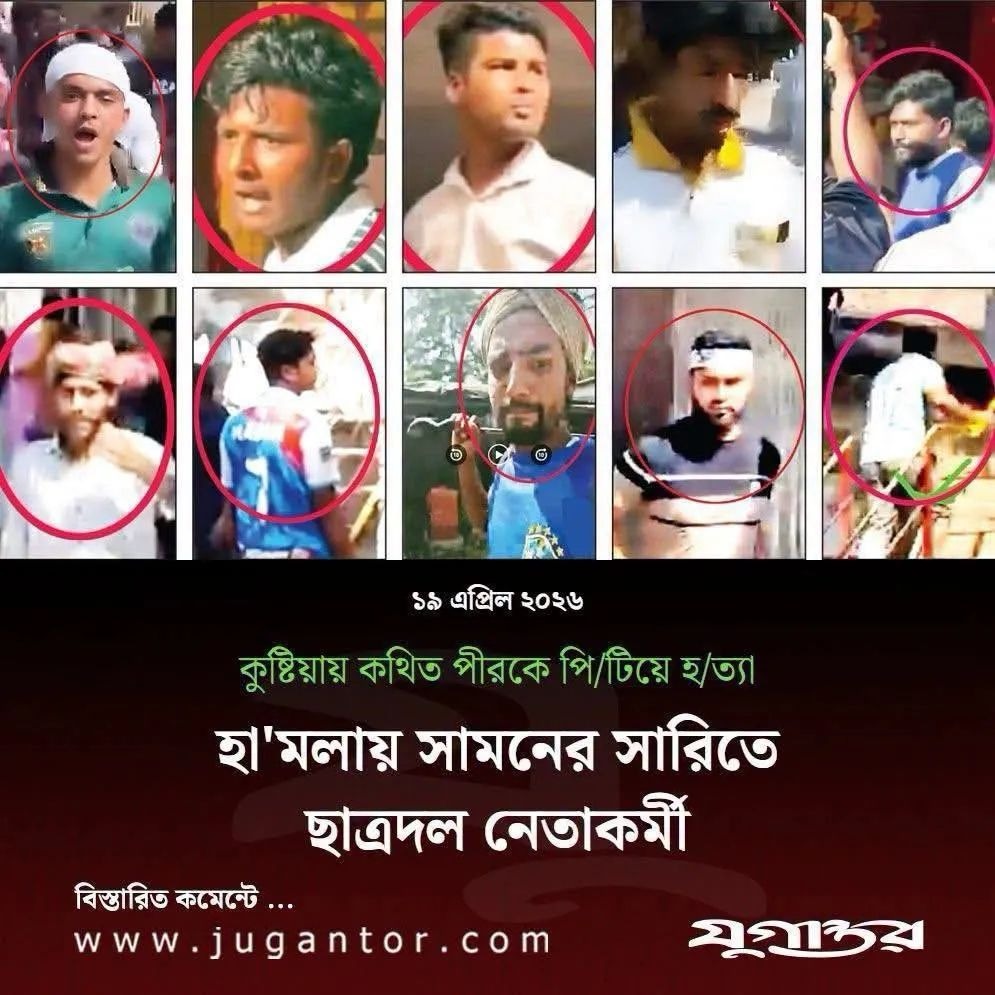
Mohammad Idris, a vegetable vendor in Patuakhali, #Bangladesh, was beaten to death by a leader of the Chhatra Dal—the student wing of the ruling Bangladesh Nationalist Party (#BNP)—and his followers. Chhatra Dal leader Jahirul Islam attacked Idris after he wrote a Facebook post accusing the leader of stealing a cow and engaging in other corrupt activities.   According to the Bengali language national daily Jugantor, Idris, who sold vegetables in Dhaka, wrote about the anti-social activities of Islam, a resident of Patuakhali, about a month ago. After Idris returned to his native village in Patuakhali last week, Islam attacked him. Idris later died on March 2 from the injuries he sustained in the beating.   It has been widely reported that after the fall of Sheikh Hasina, leaders and activists of BNP and Chhatra Dal have been engaged in different sort of violent and corrupt activities the way Awami League leaders and their followers had done. Awami goons enjoyed impunity during the regime of Hasina. In the same way, the leaders of the BNP and their followers are enjoying impunity now.     It has been widely reported that following the fall of Sheikh Hasina, leaders and activists of the BNP and Chhatra Dal have engaged in various acts of violence and corruption, similar to those previously carried out by leaders and supporters of the Awami League. During Hasina’s tenure, Awami League supporters were seen as enjoying impunity. In much the same way, BNP leaders and their followers are now operating without accountability.
Pinaki Bhattacharya tweet media
English
23
61
327
5.8K
Pinaki Bhattacharya
Pinaki Bhattacharya@PinakiTweetsBD·
“Petrol bomb diye jaliye dao, puriye dao…Ei jongeeder jaliye dao, puriye dao.”   [“Set it on fire with petrol bombs” (gesturing toward a mosque in central Kolkata). “Reduce these Islamic militants (pointing at Muslim passersby) to ashes.”]   This video clip shows a #Hindu Jagaran Mancha, or “Hindu Awakening,” rally organized by a right-wing Hindu group in #Kolkata last week. During the rally, Hindutva activists openly threatened to set mosques on fire and burn #Muslims to death. In their slogans, they referred to Muslims as “jongis,” or (Islamic) militants.   Since Narendra Modi assumed office in 2014, #India has witnessed a rise in violent Hindutva activities nationwide. Modi’s #BJP, along with other right-wing Hindu groups, has repeatedly targeted Muslims as well as Christians in recent years.   Leaders of the BJP and other right-wing Hindu groups in India have frequently delivered anti-Muslim hate speeches across the country, aiming to incite the Hindu majority against the Muslim minority. Through this approach, Hindutva forces seek to unify Hindus and consolidate support for Narendra Modi’s BJP. The Hindutva groups have also openly called for transforming India into a Hindu Rashtra, or Hindu nation.   Muslims and Christians have been facing persecution, particularly in BJP-ruled states such as Uttar Pradesh, Madhya Pradesh, Rajasthan, Uttarakhand, and Assam, as well as in other regions where Hindutva forces are highly active.   In West Bengal, where the BJP is currently in the opposition, these groups have nonetheless become increasingly active in recent months. With state elections approaching in a few months in this eastern Indian state, the BJP is making an all-out effort to come to power in the state. This suggests that we may witness an increase in anti-Muslim Hindutva activities in West Bengal in the coming weeks.
English
24
120
489
9.6K
Pinaki Bhattacharya
Pinaki Bhattacharya@PinakiTweetsBD·
Last month, shortly after the #Bangladesh Nationalist Party (#BNP) formed the government, Tarique Rahman—often referred by many critics as the “Luther King of Bangladesh”—set up a network involving individuals engaged in large-scale corruption across the country. A mob linked to this network forcibly removed Ahsan Mansur, the governor of Bangladesh Bank, from his position last week. Bangladesh Bank is the country’s central bank.   While fleeing Bangladesh in 2024, Sheikh Hasina left Bangladesh’s banking sector in a critical condition. Over the past year and a half, however, Mansoor, an economist and former senior IMF official, significantly revived and stabilised the sector under his stewardship and drew admiration from many quarters global quarters.   Now this economist has been removed from his position by Bangladesh’s Luther King in a manner many described as quite disgraceful. The BNP-led government has replaced the highly competent economist with Mostaqur Rahman, a small-scale garment businessman, widely identified as a bank loan defaulter.     According to multiple reports, private lender Mutual Trust Bank restructured Tk 89 crore (USD 7.2 million) in stressed loans for export-oriented Hera Sweaters Ltd, owned by Rahman, just two months before he was appointed as governor of Bangladesh Bank. In December, the bank granted the company a 10-year repayment plan, including a two-year grace period, under the central bank’s special loan rescheduling policy.   The Citizens Coalition, a body of noted citizens in Bangladesh, has voiced strong objections to the appointment of a businessman and active politician as the new governor of Bangladesh Bank, pointing to a clear conflict of interest. It has called for the decision to be reconsidered and urged that a new governor be chosen through hearings overseen by an expert-led search committee and a parliamentary committee.   Rahman, the newly appointed governor of Bangladesh Bank, is affiliated with the ruling BNP and recently served as an active member of the party’s election planning committee. He has also represented influential business groups, including those in the ready-made garment industry and the housing sector. In its election manifesto, the BNP pledged to promote good governance and transparency in the banking sector. Appointing someone with a conflict of interest as governor clearly contradicts that commitment.   Although the domestic media has shown little criticism over the removal of an expert economist and the appointment of a defaulting businessman close to the ruling BNP as governor of the country’s central bank, mainstream media outlets in neighbouring India have published sharply critical reports on the matter. India Today covered the development under the headline, “Loan-defaulter made Bangladesh central bank chief; Jamaat trains guns on BNP govt.” NDTV Profit reported it with the headline, “Bangladesh's Removal Of Central Bank Chief, Credited For Economic Revival, Sparks Criticism.” In contrast, Bangladesh’s Daily Star, which profiled Rahman, made no mention of his loan defaults in its report under the headline “Who is the new governor of Bangladesh Bank?” Rahman, the newly appointed governor of Bangladesh Bank is affiliated with the ruling BNP and recently served as an active member of the party’s election planning committee. He has also represented influential business groups, including those in the ready-made garment and housing sectors.   In its election manifesto, the BNP committed to promoting good governance and ensuring transparency in the banking sector. Appointing an individual with a conflict of interest as governor plainly contradicts that pledge.
English
15
19
189
8.5K
Pinaki Bhattacharya
Pinaki Bhattacharya@PinakiTweetsBD·
Last month, shortly after the #Bangladesh Nationalist Party (#BNP) formed the government, Tarique Rahman—often referred by many critics as the “Luther King of Bangladesh”—set up a network involving individuals engaged in large-scale corruption across the country. A mob linked to this network forcibly removed Ahsan Mansur, the governor of Bangladesh Bank, from his position last week. Bangladesh Bank is the country’s central bank.   While fleeing Bangladesh in 2024, Sheikh Hasina left Bangladesh’s banking sector in a critical condition. Over the past year and a half, however, Mansoor, an economist and former senior IMF official, significantly revived and stabilised the sector under his stewardship and drew admiration from many quarters global quarters.   Now this economist has been removed from his position by Bangladesh’s Luther King in a manner many described as quite disgraceful. The BNP-led government has replaced the highly competent economist with Mostaqur Rahman, a small-scale garment businessman, widely identified as a bank loan defaulter.     According to multiple reports, private lender Mutual Trust Bank restructured Tk 89 crore (USD 7.2 million) in stressed loans for export-oriented Hera Sweaters Ltd, owned by Rahman, just two months before he was appointed as governor of Bangladesh Bank. In December, the bank granted the company a 10-year repayment plan, including a two-year grace period, under the central bank’s special loan rescheduling policy.   The Citizens Coalition, a body of noted citizens in Bangladesh, has voiced strong objections to the appointment of a businessman and active politician as the new governor of Bangladesh Bank, pointing to a clear conflict of interest. It has called for the decision to be reconsidered and urged that a new governor be chosen through hearings overseen by an expert-led search committee and a parliamentary committee.   Rahman, the newly appointed governor of Bangladesh Bank, is affiliated with the ruling BNP and recently served as an active member of the party’s election planning committee. He has also represented influential business groups, including those in the ready-made garment industry and the housing sector. In its election manifesto, the BNP pledged to promote good governance and transparency in the banking sector. Appointing someone with a conflict of interest as governor clearly contradicts that commitment.   Although the domestic media has shown little criticism over the removal of an expert economist and the appointment of a defaulting businessman close to the ruling BNP as governor of the country’s central bank, mainstream media outlets in neighbouring India have published sharply critical reports on the matter. India Today covered the development under the headline, “Loan-defaulter made Bangladesh central bank chief; Jamaat trains guns on BNP govt.” NDTV Profit reported it with the headline, “Bangladesh's Removal Of Central Bank Chief, Credited For Economic Revival, Sparks Criticism.” In contrast, Bangladesh’s Daily Star, which profiled Rahman, made no mention of his loan defaults in its report under the headline “Who is the new governor of Bangladesh Bank?” Rahman, the newly appointed governor of Bangladesh Bank is affiliated with the ruling BNP and recently served as an active member of the party’s election planning committee. He has also represented influential business groups, including those in the ready-made garment and housing sectors.   In its election manifesto, the BNP committed to promoting good governance and ensuring transparency in the banking sector. Appointing an individual with a conflict of interest as governor plainly contradicts that pledge.
English
4
17
163
5.9K
Pinaki Bhattacharya
Pinaki Bhattacharya@PinakiTweetsBD·
“First, we have to save the #Hindus. If they survive, everything will be fine. All Hindus have to put up the (saffron) flags on top of their houses. Separate the jihadis (#Muslims) from our Hindus completely... (Muslims) will have to change their religion.”
 Suvendu Adhikari, a senior #BJP leader in West Bengal, is seen addressing a group of Hindu villagers in the state. Since joining the Hindu nationalist party in 2020, Adhikari has been known for often delivering speeches attacking Muslims, frequently asserting in public that the minority community poses a significant threat to the Hindu majority.
 In this video, he urges villagers to distance themselves from their Muslim neighbours. By labeling the entire community as “jihadis,” he is effectively identifying all Muslims as Islamic militants. He is also heard making remarks in a threatening tone, suggesting that Muslims would have to convert to Hinduism.
 In several BJP-ruled states in India, militant Hindu groups have advised Hindus to display saffron flags atop their homes to mark them as Hindu households. During the outbreaks of anti-Muslim violence, armed rioters—often arriving from outside the area—can use these flags to identify Hindu homes and avoid targeting them. Against this backdrop, can Suvendu’s advice to put up saffron flags not be interpreted as a subtle signal of potential anti-Muslim violence in the area?
 State elections in West Bengal are scheduled to take place in the next two to three months. In the run-up to the polls, Suvendu and several other senior BJP leaders have frequently delivered hate speeches targeting Muslims, clearly intended to whip up anti-Muslim passion and deepen communal polarisation. In a sharply divided, Hindu-majority region, a party like the BJP benefits electorally from such polarisation.
 As the largest opposition party in West Bengal, the BJP is making an intense push to come to power following the upcoming elections. As part of this effort, some of its leaders are seeking to mobilise support by demonising Muslims and appealing to Hindu voters through communally charged rhetoric.
 The surge of #Hindutva ideology continues across India, and there is little chance that anti-Muslim hate speech in the country will diminish anytime soon.

 #HateSpeech@USCIRF
English
21
131
480
12.2K
Pinaki Bhattacharya
Pinaki Bhattacharya@PinakiTweetsBD·
The entire nation of #Bangladesh is suffering under the grip of extortionists who operate with the protection of powerful political leaders and segments of the police administration. As a result, both society and state institutions have descended into a state of profound lawlessness and moral decay.   In Bangladesh, a person who extorts money from others — including traders and owners of passenger and goods vehicles — is known as a chandabaz. Such extortionists frequently assault and torture those who refuse to pay the demanded sums, or chanda. On Friday in Dhaka, a leguna driver was beaten to death after he refused to hand over the chanda to a gang of chandabazes. A leguna is a four-wheeled passenger vehicle commonly used for public transport in Bangladesh.   According to news portal deshrupantor.com, Nure Alam, a local leguna driver, was beaten in the Jatrabari area of the city following an earlier dispute over extortion. The portal reported that he was assaulted for failing to pay outstanding chanda (extortion money). Citing unidentified police officers, national daily Jugantor confirmed that the attack stemmed from an extortion-related conflict. Alam later succumbed to his injuries at a hospital.   Chandabazi was widespread during the tenure of Sheikh Hasina. It was widely alleged that leaders of her party, along with members of the police, operated extortion rackets across the country. At the grassroots level, those involved in chandabazi often said they were “collecting” money on behalf of party leaders and the police.   After Hasina and her Awami League lost power in 2024, their rival party, the #BNP, allegedly took control of extortion networks nationwide. Numerous videos surfaced over the past one a half years showing BNP leaders and their associates demanding money from individuals and, in many cases, assaulting those who failed to comply.   Following the BNP’s victory in the recent general election and the formation of a new government, there were widespread calls for action against extortion networks. However, no clear plans to dismantle these rackets were announced. Several recent media reports have revealed that extortion networks continue to operate across the country, involving BNP leaders in of a section of the police.   Today, Jugantor reported that at least 3,000 extortion networks are currently operating across Bangladesh, collectively extorting no less than 100 crore takas —approximately $8.2 million—each day.
Pinaki Bhattacharya tweet media
English
40
64
410
11.7K