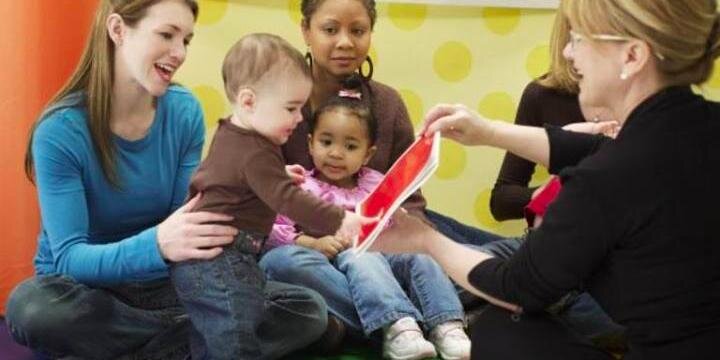
Parents/grandparents: this post could save your family hundreds of dollars.
Did you know it’s possible for young children to have TOO MANY toys? 🧸 🎁
As Christmas approaches, grown ups often feel pressured to make the big day extra special - which can lead not only to over spending, but to more gifts than your little one can meaningfully engage.
In a 2018 study, researchers observed two different toddler play settings - one with 16 toys and the other with only 4.
What they found was that the children presented with fewer options actually engaged more deeply in play.
They stayed focused longer and used the toys available to them in more imaginative ways.
Which is just what we want, developmentally.
Parents participating in the study were asked, meanwhile, to estimate the number of toys available in their homes. Some self reported 90 or more.
90 different choices!
This holiday season I want to help both your baby and your credit rating… and assure you that this is a case where LESS can actually be more.
When purchasing toys, focus on quality, not quantity.
Here’s how:
As you consider an item, take a moment to brainstorm a list of its potential uses.
Is it something that your child might, with a little imagination, use in multiple types of play?
Does it lend itself to sustained engagement?
Will it help them to think, build, imagine, create, or problem solve?
If the answer is yes, you have a winner.
If the answer is no, leave it on the shelf.
Your little one doesn’t require dozens of gift wrapped boxes.
And buyer beware: they’re likely to be just as thrilled with the box as the item inside.
This little guy and his favorite plaything were shared by mariavmcauley on TT.
Between 4 and 6 months of age, babies' balance and movement dramatically improve as they gain use and coordination of large muscles.
During this time, babies roll over on purpose and learn alternative locomotion methods.
Your face is your baby’s most important information source.
Infants use faces for a whole host of purposes - not least of which are gauging our moods and assessing their safety.
I just love this video shared recently to TT by kuuipodawn.
In it, we get a glimpse of baby assessing not only what mom is up to as she washes dishes in the sink - but what mom thinks of it.
Is this safe?
Is it scary?
Is it fun?
Like a little detective, our hero cycles back and forth between checking out mom’s actions and mom’s face in an effort to assess the full picture of just what happens at the sink.
What a keen observer she is! And kudos to mom for providing a new vantage point for her learning.
Your baby is studying your every move.
Why?
To become just like you, of course.
From your facial expressions to the language you use and the ways you carry yourself, your baby is watching with a keen eye - and begins imitating you within weeks after birth.
One of the earliest forms of imitation is the tongue thrust, illustrated here.
Watch as our hero mimics his father, sticking out his own tongue in response to the example set by his father.
It’s a great reminder that even before your child can speak conventionally, they’re watching and learning.
In fact, they’re watching your mouth to figure out just how you make those amazing sounds!
Never assume your little one is too little to learn from your words and actions. You might be surprised by all they’re taking in.
This fantastic back and forth was shared by Hannah Choi.
@TeslaAUNZ@elonmusk I just got this exact car and it is so amazing 🤩 beyond my wildest dreams! How did I ever drive without FSD?! So intuitive and a much better driver than me 😆
“Mali, say “hurry!””
As I share child development lessons, I often frame up interactions between parents and their children as they model concepts like “serve and return” and “parentese.”
But parents aren’t the only ones who contribute to brain building and other developmental outcomes.
Check out this lovely video of 7-year-old Ben and his 4-month-old brother Mali.
Mali is hungry and mom has charged Ben with keeping him engaged momentarily while she prepares to feed him.
I love the attunement between the pair. Ben knows Mali is hungry and so engages him with a language lesson to communicate just what he’s feeling: “Hurry please, mom. I’m hungry.”
Between the siblings we see so many of the same lovely interactions that I so often highlight between parents and children.
Ben serves and then waits as Mali takes his turn to vocalize. His voice varies in intonation in a way we might easily call “parentese” were he Mali’s father - but are better served calling by its formal name in this case: infant-directed language.
Ben is down at Mali’s level. Face-to-face and eye-to-eye.
What a blessing to have a sibling so well prepared to contribute to his optimal development… and another family member with whom secure attachment is being established.
Mali’s a lucky guy.
This lovely video was shared with me by another lucky guy, their dad, Curtis Meier.
Baby talk vs “parentese” - what’s the difference?
Often in my replies I see parents explaining why - as a method of promoting language acquisition - they never use “baby talk.”
I generally agree with this sentiment, but there are some important distinctions to be made here.
If by “baby talk” you mean using cutesy nonsense words (like wa-wa for water or ba-ba for bottle) you’re on the right track. There’s no need for you to make up incorrect or overly simplified vocabulary on your child’s behalf. Use real words, even if your child isn’t quite ready to do so themself. It’s how they learn.
But sometimes I see confusion between “baby talk” and what is known as “motherese” or “parentese” - which isn’t nonsensical, but simply slower and more varied in intonation. (Think of Ms. Rachel’s sing-songy voice.)
And this isn’t something you need to shy away from at all.
In fact, research suggests that parentese - with its prolonged vowel sounds and expressive facial expressions - can be a social hook that attracts children’s attention, encouraging them to attune not only to the language to which they are being exposed but how it is produced.
Importantly, it’s complete and grammatically correct… just a little more performative than you might use elsewhere.
This lovely video, shared to IG by tommypadula, is a nice example. Everything mom says is 100% correct… it’s simply exaggerated in ways that are clearly capturing her daughter’s rapt attention. Just look at the smiles and eye contact it’s attracting.
This isn’t baby talk. It’s parentese. And it’s fantastic.
Want to give your child a leg up in kindergarten (and life)?
Expose them to a million extra words. It’s easier than it sounds.
I wrote recently about the vocabulary building power of reading aloud to your child.
Books expose children to new worlds through their storytelling - and with those new worlds come new WORDS. Words that you may not have had occasion to use otherwise.
Reading develops this vocabulary quality in part through vocabulary quantity.
A recent study from Ohio State University suggests that children who are read five books a day from infancy will be exposed to 1.4 million more words by kindergarten than those who lack this advantage.
If five books seems like a lot, rest assured that there’s advantage to any reading at all. Children read a single book a day will benefit to the tune of 290,000 more words.
A rich vocabulary lends itself to explosive reading growth when the time comes. That’s because you can’t truly decode words you don’t know.
So read, read, read with your little one. You’ll be amazed by the return on investment.
This adorable little book worm was shared to IG by pitterpatterpals_.
Dad’s home! 🏠
Because it’s one of the most frequent questions I receive, here’s your periodic reminder that your baby doesn’t forget you when you go to work.
There’s a developmental milestone known as object permanence and sometimes parents overthink it.
In a nutshell it’s the understanding that things continue to exist even when they’re out of sight - and it typically develops somewhere between 6-9 months.
Does that mean you cease to exist (to your baby) when you go to work or the grocery store? It can be kind of a scary thought to new parents.
The answer, even before the development of object permanence, is no. But it may mean that (even for your toddler) you’re misattributing adult forms of memory to your little one.
Infants and toddlers both live very much in the moment and are still developing the type of robust narrative memory we possess as adults.
So while you’re gone, it’s not that you cease to exist. It’s more a case of “out of sight, out of mind.”
Will they recognize you when you return? Will they be excited to see you?
I’ll let this beautiful video from beingritty on IG show you the answer.
Toddler at work!
Young children love to participate in the activities of adults and can find success with your assistance. The key is finding tasks that are just right for their abilities.
Loving how this family (shared to IG by thecooleats) breaks down the process of putting away groceries to allow their daughter to participate in developmentally appropriate ways.
Her jobs: handing items to dad and letting him know what each item is. Does it take a little extra time? Sure. But notice all the motor and language development opportunities involved.
When the bacon is unfamiliar, dad introduces new vocabulary. And when the watermelon is too large for her to lift independently, dad still encourages her to name it - which she does, adding extra description (perhaps to compensate for dad’s assist on Job #1?).
Very cool.
What types of household chores do/did your toddlers assist with? Are there ways you adjusted them to accommodate for your toddler’s ability?
Your baby is a natural born dancer. (And so are you.)
Music simultaneously activates multiple regions of the brain, not least of which the motor cortex which guides rhythm and movement.
This is especially true of uptempo music, which matches or exceeds your baby’s heart rate. Here you’re likely to see your baby react, from even the earliest stages of development.
Check out this little guy, shared to IG by ernhanatha24, who’s moved to dance in response to a song improvised by his mom.
We can’t see her off screen, but my bet is that she is modeling some of these very same dance moves as she sings.
Either way, little man’s got the beat!
Your baby understands language well before they can use it. 🧠
Watch this little one’s reaction when she hears the word “eat.”
Her excitement is a good reminder that language development happens on two different planes simultaneously.
Receptive language refers to what your baby hears and comprehends, while expressive language refers to the language they can actually produce (speak aloud).
Particularly at this age, there can be a wide gulf between what is understood and what can be expressed - which is an important reminder for parents.
Never assume your little one is too young to begin absorbing the adult language around them - either spoken aloud in the home or delivered via TV, music, or other media.
They understand more than you think.
This adorable little language learner was shared to IG by growingupkoreanamerican.
The period from prenatal to three is the most uniquely consequential window in all of human development.
It is during this period that the fundamental architecture of the brain is “wired” in ways that will serve to support - or hinder - your child’s longterm success in school and life.
Optimal development depends on stable, nurturing and attentive relationships.
In other words, it depends on YOU.
Talk, sing, and read to your baby.
Look them in the eyes.
Play.
Then do it some more.
The dividends will be lifelong.
This fantastic mother-baby interaction via guadasavarino on IG.
Babies 🧵
This wholesome thread is the happiness refresh button you didn’t know you needed
1. When you realize that even your legs are under your own control
“Mirror, mirror on the couch…”
Check out the complexity of this serve and return interaction between father and son (shared to TT by JD Eicher).
Our hero not only mimics dad, but does so across multiple actions… before turning the tables and leading the game himself. Just fantastic.
Fascinating to see his developing mind at work.
Your baby learns to speak - not just from listening - but from watching. 👀
I’ve written many times about the keen observational powers of babies. Infants are expert observers of their parents’ faces, which (among other lessons) provide important clues as to how mom and dad manage to make those wonderful sounds that come out of their mouths.
But I’ve rarely seen this point better illustrated than in this fantastic video shared to TT by goldenlvngz.
Watch carefully and you’ll note that our hero’s eyes remain laser focused on Mom’s mouth. It’s not as simple as hearing the word “mama” and replicating it quite yet.
First there’s the question of just how exactly one uses their mouth to make the “ma” sound.
Watch as baby makes multiple, silent attempts to mimic the movement of mom’s mouth, before attempting to voice the word himself.
The first couple tries produce a visually similar sound: “ba.”
But after several more attempts and a little more modeling from Mom, the sound rings out at last: “Ma.”
One of the most interesting videos I think I’ve ever shared. A fascinating window on his language learning.
Want to see a baby make 60 million neural connections? 🧠
Look no further than this fantastic video.
As they bide a little time in the car, our hero and his dad engage in this lovely “serve and return” interaction.
And it’s hard to tell which of them is loving it more.
If you’re a new parent or grandparent, know that these face-to-face, back-and-forth interactions are one of the very best ways to light up your baby’s developing brain.
At birth your baby’s brain is home to up to 100 billion neural (nerve) cells - but depends heavily on early experiences and interactions to help create the connections between them that will go on to undergird language and more sophisticated forms of cognition.
During the earliest months of life researchers estimate that these neural connections occur at a rate of one million per second - meaning that 60 million or more occur over the course of this beautiful one minute conversation.
Talk, talk, talk to your baby. The payoff will be huge.
This loving father and son duo was shared to TT by smileybunch.
Did you know that your baby’s brain remains hard at work, even as they sleep? 🧠
While at rest, your baby consolidates new learning and memories, reprocessing and categorizing all they have learned while awake and converting these recent experiences into knowledge.
Research suggests that toddlers remember newly presented vocabulary better after napping - and that sleep aids in their subsequent ability to transfer use of these new words to similar objects.
Infants sleep a lot. But it’s partly because they have so much to learn.
This adorably drowsy little one was shared to IG by ernhanatha24.
Baby’s first geology lesson!
Many of you have reached out to share this fantastic video from thejesstayls on TT, depicting a new grandfather as he lectures his grandson on volcanoes and tectonic plates.
It’s not only a surefire smile, but a great opportunity to answer a question I often receive about whether it’s okay (and/or beneficial) to talk or read to your baby about ANY topic of interest (no matter how far removed from traditional “baby talk”).
My answer is a qualified yes.
As newborns enter the world (and as they grow), exposure to rich and varied vocabulary is pure benefit.
So talk, talk, talk… read, read, read. Share your interests. Narrate your day. Reenact the contents of your junk mail!
My only caveat here is to never underestimate the extent to which your baby is soaking up your language like a sponge.
Receptive vocabulary (that which we comprehend) is a precursor to expressive (or spoken) language… and begins early.
As babies approach 6-9 months they are already associating meaning with some spoken words… which is a gentle reminder that it’s best to be thoughtful about what content you are exposing them to.
My general rule of thumb is to never assume your baby is too young to begin absorbing the content of your language. While you won’t find me sharing it, the internet is chock full of videos of toddlers unleashing strings of profanity and other inappropriate content to which they’ve been exposed in their environments.
And ask just about any parent and they’ll likely have a story about something their toddler has repeated unexpectedly. Generally in public. At precisely the wrong time.
Perhaps the best guidance here is to share complex language and content liberally, but take heed of any content you’d be uncomfortable having your toddler repeating to others.
Babies are always watching and listening. It’s their job!
Well done, Pop-Pop!