When Jesus died, the sky went dark at noon.
Not an eclipse — that’s impossible during Passover’s full moon.
Seven impossible things happened in those hours.
We broke them all down.
Full episode on YouTube 👇
Link in comments!
You believe that crap?
Grace is for unintended sin or ignorant sin. This grace you people preach is lawlessness by other means.
There's nothing like you are not under law. Every king has laws. In God's kingdom everyone is under his law. There's no one under grace. That is pure lawlessness theology. Just ask ananias and Saphira. Christ himself said whoever teaches people not to follow the law (that he himself followed) will be the least in the kingdom. If Jesus had said that he has come so that we are no longer under the law then i would have listened to Paul.
Epistles are opinions of men. Commentaries that were taken as tradition and people took that tradition and turned it into "God has said. " They are not the word of God.
x.com/i/status/20084…
How many Christians know that the Antichrist is called the "Man of Lawlessness" because he will oppose the Torah? (God's eternal law)
👉 "For that day will not come, unless the rebellion comes first, and the man of LAWLESSNESS is revealed" - 2 Thess 2:3
"For sin will have no dominion over you, since you are not under law but under grace." - Rom 6:14
Paul equates sin having dominion over us to being under the law. When you submit to a lifestyle of sin without Christ's atonement, you are under the dominion of sin (under the law). Does that mean believers are free to now sin (which is breaking God's law, per 1 John 3:4) without repentance? No, because that would place us under the law.
"For the mystery of lawlessness is already at work. Only he who now restrains it will do so until he is out of the way. And then the lawless one will be revealed, whom the Lord Jesus will kill with the breath of his mouth and bring to nothing by the appearance of his coming" - verses 7-8
@Ricardo89952433@timhopkins23 Sounds like you have your mind made-up that God's law is not eternal. It is (Psalm 119:160). And it's a shame that you think scripture contradicts itself. Best of luck to you.
@PolycarpsPen@timhopkins23 But Paul says he went and stayed with Peter for 15 days (who was afraid of him?), only saw James and Peter, and not to mention his statements in Galatians 1 was to show he was completely independent and did not need permission to be what he was. 8/8
How many Christians know that unclean animals are mentioned in the New Testament?
👉 “[Babylon] has become a dwelling place for demons, a haunt for every unclean spirit, a haunt for every UNCLEAN bird, a haunt for every UNCLEAN and detestable beast." - Rev 18:2
The angel quoted in Rev 18:2 is describing the fall of Babylon and how the unclean animals are eating the dead corpses. There's no symbolism here, which is evidenced by the fact that you don't provide any interpretation for what the supposed "symbols" mean.
Again, the angel is describing a literal event that will happen. If you don't believe that, then the text becomes incoherent.
People who embrace antinomianism love to dismiss text that clashes with their dogma as "symbolic" without any interpretation or textual support.
@PolycarpsPen@timhopkins23 No, he placed Revelation in context—because it is conveyed in symbols. The symbols used—over 1,000 of them—are used elsewhere in Scripture and that is how we put them in context—to understand the symbol and the meaning.
"That quote proves nothing" - It literally states that Paul didn't eat pork, soooo yeah it actually proves everything.
And no, there's not a contradiction. In Gal 1:16–18, Paul explains that after his Damascus conversion he did not immediately go to Jerusalem but went to Arabia, returned to Damascus, and only after three years visited Peter. In Acts 9, Luke simply compresses the timeline, saying “many days passed” before Paul went to Jerusalem - this is a phrase broad enough to include those three years. Acts doesn’t mention Arabia, but omission isn’t contradiction. It’s just a summary.
@PolycarpsPen@timhopkins23 That quote proves nothing, and it also assumes Acts is a leg history. It isn't, since it contradicts the history provided by the letters considered legit Pauline. E.g. Paul said he didn't go directly to Jerusalem after Damascus, and waited 3 years to go, but Acts contradicts
No, Paul did not eat pork... He was merely saying that he was willing to practice cultural customs to preach the gospel, such as washing his hands before eating, etc.
Paul literally said he did NOT eat pork...
Paul argued in his defense, “Neither against the law of the Jews, nor against the temple, nor against Caesar have I committed ANY offense.” - Acts 25:8
Was it against Israel's laws to eat pork? Yep, sure was.
@PolycarpsPen@timhopkins23 2/3 And 1 Cor 10 also refutes you, because Paul said "all [food] is lawful" to him, and since the Romans didn't keep kosher, you can't just eat whatever is offered "asking no questions." Dietary law also required ritual slaughter, inspection of the organs, and blood removal.
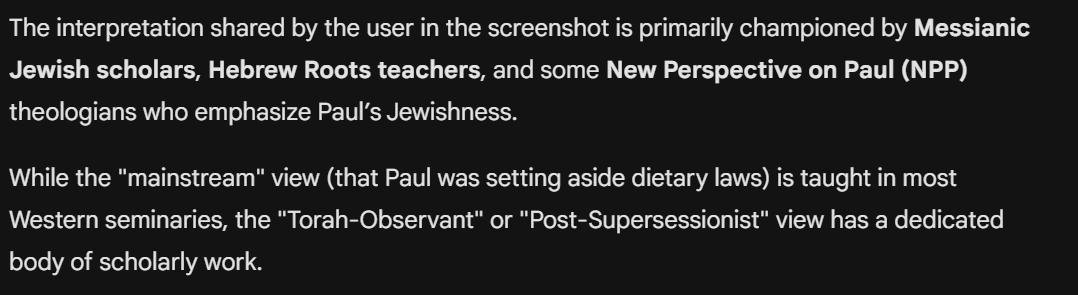
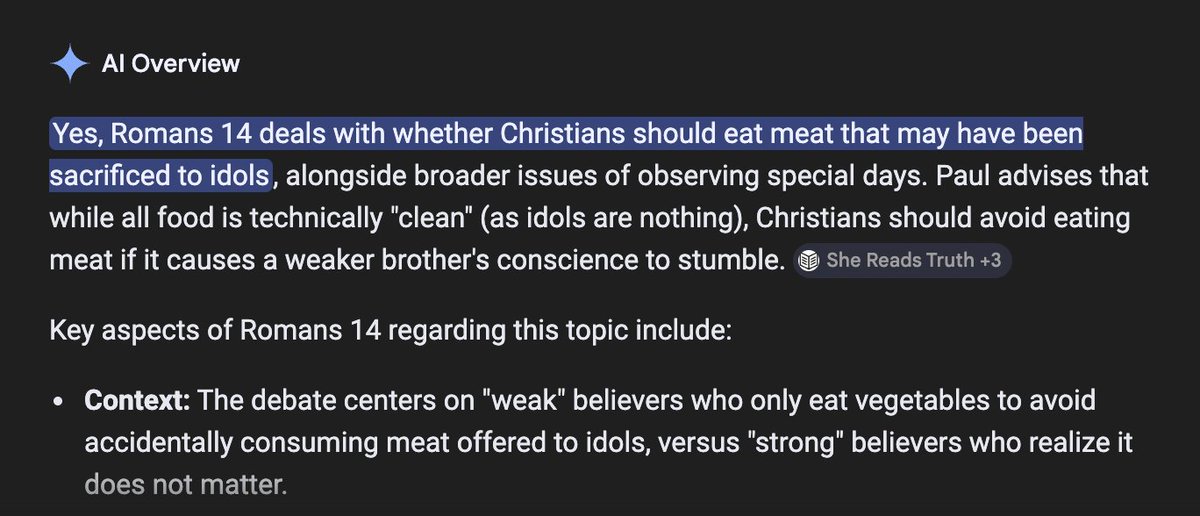
I'm merely attaching this screenshot to show the scholarly consensus on the chapter. Again, "food" is defined by Leviticus 11. You're stripping out the context of Romans 14 so that it contradicts Christ's words:
"But it is easier for heaven and earth to pass away than for one dot of the Law to become void." - Luke 16:17
@PolycarpsPen@timhopkins23 "The context is alllll about meat offered to idols"
You're conflating different books. Romans 14:14 does not mention meat offered to idols. You're thinking of of 1 Cor 10. In Romans, Paul says all meats and drinks are pure, and the only sin is eating to cause offense.
You're assuming that because John uses the word "unclean" then it must be symbolic. That's eisegesis. He used that word because he knew his audience perfectly understood what that meant.
I don't disagree that Rev 18 is alluding back to the OT. So? My point is that the OT and NT agree. And let's not forget that John is describing what he saw an ANGEL say: "After this I saw another angel coming down from heaven, having great authority, and the earth was made bright with his glory. And he called out with a mighty voice..." The ANGEL used the word "unclean". Why? Because the animals are unclean. It's that simple.
Right, Babylon is LITERALLY a...
•dwelling place of demons •haunt of every unclean spirit •haunt of every unclean bird •haunt of every unclean and detestable beast
That's the whole point of the passage. The angel is describing the destruction of Babylon. It's all literal. You want this to be symbolic when the text does not say what the elements symbolize. And you say this without ever interpreting the supposed symbolism. The text wouldn't work as symbolic anyways, since it is describing the literal fall of Babylon.
- Mark 7 - what is "food"? Is a dead human "food"? Nope. Why? Because Lev 11 tells us what food is. And what's the context here? The pharisees saying that any meat is not clean unless you wash your hands first (a man-made tradition). Verse 2 proves this without question: "they saw that some of his disciples ate with hands that were DEFILED, that is, UNWASHED." Verse 2 is the entire context of verse 19. This nullifies your position.
- Acts 10 - Let's try this again... We are provided the interpretation of the vision twice, which is that the gentiles can receive the Gospel. There's literally no mention of food laws being abolished whatsoever. You're inventing that out of thin air. It's ironic that you think Rev 18 is symbolic but the Acts 10 vision is literal. You have it backwards. Crazy.
- Romans 14 - You completely ignored my point about verse 3. And the scholarly consensus on this chapter agrees with me, not you. If Paul used sweeping language to include ALL meat, then you have to conclude that human flesh is on the menu as well, along with poisonous snakes, etc. It's not. The context is alllll about meat offered to idols. Btw, the Torah is written on our hearts in the New Covenant (Jer 31:33).
- 1 Timothy 4 - You completely ignored my point about verse 5. This is like talking to a wall. Did God create chicken? Yep. Did God's word (verse 5) say that we can eat chicken? Yep. Lev 11.
- Psalm 119:160 - You literally want to believe the words on the page mean the exact opposite of what they say. This is how yo know you're falling into a cultish mentality. Again, it says that every single law is eternal. You blatantly disagree. And Ezekiel 43-47 state that the temple returns in the Millennial Reign of Christ, along with the Levites (Isaiah 66:21) and the sacrifices. Hebrews simply states that Christ is our High Priest and His perfect sacrifice justifies us. The temple sacrifices allow humans to have a meal with the Father.
- You dodged my points and verses about Christ enforcing the Torah in the Millennial Reign. This is highly typical for antinomians.
"The deeper issue isn’t whether God’s law is good. It is. The issue is how the New Testament understands fulfillment and covenant transition." - Psalm 19 states that the law is perfect, but that can't be true if it had to be removed. Again, you think the New Covenant = abolishing God's law (Jesus said the opposite in Luke 16:17). Jeremiah 31:33 literally states the exact opposite as well. The Torah is written on our hearts in the New Covenant.
"That raises far larger theological tensions" regarding Ezekiel. For you it does, not for me. You view scripture as contradictory and "symbolic" when it clashes with your antinomian dogma. That's unwise.
"The question isn’t whether 'unclean still means unclean.' The question is: under which covenant administration are we reading the term?" - Annnnd again... Jeremiah 31:33 states that the Torah is written on our hearts in teh New Covenant. The word "law" appears 11 times in Jeremiah and every single time it's referring to the Torah.
This blends perfectly with what Jesus said here:
"Therefore whoever relaxes one of the least of these commandments and teaches others to do the same will be called least in the kingdom of heaven, but whoever does them and teaches them will be called great in the kingdom of heaven." - Matt 5:19
At the end of the day, you don't agree with Jesus in this verse.
I'm done here. Enjoy your evening.
You’re assuming that because John uses the word “unclean,” he must be affirming the ongoing binding nature of dietary law. That’s a category jump.
Revelation 18:2 is deliberately echoing prophetic judgment language (Isaiah 13:21–22; Jeremiah 50:39). In those passages, ruined cities become desolate wastelands inhabited by scavengers and wild animals. The imagery communicates curse, chaos, and abandonment.
That’s not “antinomian dogma.” It’s intertextual reading.
If Rev 18 is purely descriptive of carrion animals eating corpses, then why is the verse structured as:
•dwelling place of demons
•haunt of every unclean spirit
•haunt of every unclean bird
•haunt of every unclean and detestable beast
That’s escalating symbolic parallelism. Demons aren’t literal squatters in abandoned buildings either. The whole verse is theological imagery about spiritual corruption and judgment.
On Mark 7 yes, Jesus confronts Pharisaic traditions. But Mark 7:19 explicitly adds the editorial comment that He declared all foods clean. That’s Mark interpreting Jesus’ teaching for his audience. It’s not about handwashing anymore once you reach verse 19.
On Acts 10 Peter’s vision does apply to Gentiles. But the symbolism works because the food distinctions are being dismantled. God says, “What God has cleansed, do not call common.” The language of cleansing is applied to what was formerly unclean. The categories are shifting.
On Romans 14 Paul says, “I know and am persuaded in the Lord Jesus that nothing is unclean in itself.” That’s sweeping language. If pork were ontologically unclean under the New Covenant, that statement would be false.
On 1 Timothy 4 Paul says certain teachers forbid foods “which God created to be received with thanksgiving.” He grounds the argument in creation theology, not Leviticus.
As for Psalm 119:160 affirming the truthfulness and enduring validity of God’s word does not require every covenantal stipulation to remain unchanged across redemptive history. The sacrificial system was also “law.” Hebrews argues it is fulfilled in Christ.
The deeper issue isn’t whether God’s law is good. It is. The issue is how the New Testament understands fulfillment and covenant transition.
If Revelation’s imagery must be read as reaffirming Torah observance, then consistency would require us to reinstate temple sacrifice when Christ returns (Ezekiel 40–48). That raises far larger theological tensions.
The question isn’t whether “unclean still means unclean.” The question is: under which covenant administration are we reading the term?
That’s the real conversation.
John used the phrase "unclean" because he knew his audience perfectly understood that certain animals were still unclean. It wouldn't make any sense otherwise.
Just because scripture uses apocalyptic language does not mean it contradicts dietary laws. That's a moot point. There's plenty of apocalyptic language in the OT, and you believe the dietary laws applied back then.
And I love how you dismiss this as "symbolic" language. It's not. It's *descriptive* language that you need to be symbolic so it blends with your antinomian dogma. What do the unclean beasts supposedly "symbolize"? Nothing. The passage is describing how unclean animals will descend on Babylon because it has fallen. Unclean animals eat dead bodies. Thats the whole point. If this language were symbolic, the text would be incoherent.
And yeah, I'm well aware that evil spirits are also called "unclean". Did they suddenly become clean after Jesus died, like you think pork did? Nope. Unclean still means unclean.
Annnnd thanks for regurgitating the usual verses that you think contradict God's law... Classic.
- Mark 7 shows Jesus refuting Talmudic traditions regarding handwashing, not Torah. In that same passage, Jesus also rebukes the Pharisees for NOT following God's law. See verses 9-13.
- Peter's vision was interpreted for us, which you reject. The interpretation was given to us twice in Acts 10:34 and Acts 11:18. There's literally no mention of food laws being repealed. None.
- Romans 14 is all about whether or not believers should eat meat sold in the marketplace, since much of the meat was the result of animals sacrificed to idols in pagan temples. Some people were saying that all meat should be avoided, advocating for a vegetarian diet (see verse 3). Paul said to not ask questions about it and just eat the meat. That's it. Is human flesh clean to eat? Nope. You probably think it is, though.
- In 1 Timothy 4, you should look at verse 5 again. What is the word of God that designates food as holy? Leviticus 11. In Paul's day, some people were advocating for a vegetarian diet, like the ascetics. Paul shot that down.
"Revelation is prophetic poetry. It doesn’t overturn the clear teaching of the rest of the New Testament on ceremonial law." - Would prophetic scripture ever contradict God's law? No. If it did, it wouldn't be scripture (Deut 4:2). The NT does not contradict God's law. You just think it does. And btw, there's no such thing as "ceremonial law" in scripture. That's an invented term. Psalm 119:160 literally states that every single law of God is eternal.
"Genre matters. Context matters. Theology isn’t built on isolated phrases." - This is incredibly ironic coming from someone who cherry-picked verses and stripped their context away to advance a lawless theology.
When Christ returns, He will rule with the Torah (Micah 4:2), including the food laws (Isaiah 66:17), sabbath (Isaiah 66:23), and feast days (Zech 14:16-19).
Revelation 18:2 is apocalyptic imagery, not dietary law.
John is echoing the prophets (Isaiah 13; Jeremiah 50–51), where a judged city becomes a desolate wasteland inhabited by scavenger birds and wild beasts. It’s symbolic language of total corruption and ruin.
The Greek word akathartos (“unclean”) in Rev 18:2 is used alongside “demons” and “unclean spirits.” The point isn’t food laws it’s spiritual defilement and judgment imagery.
If mentioning “unclean birds” means Mosaic dietary law is still binding, then mentioning dragons would require zoological adjustments too.
Meanwhile, the New Testament is explicit:
Mark 7:19 — Jesus declares all foods clean.
Acts 10 — Peter’s vision removes food distinctions.
Romans 14:14 — Nothing is unclean in itself.
1 Timothy 4:3–5 — Food is to be received with thanksgiving.
Revelation is prophetic poetry. It doesn’t overturn the clear teaching of the rest of the New Testament on ceremonial law.
Genre matters. Context matters. Theology isn’t built on isolated phrases.
Never said He wasn't, bud.
It may come as a surprise to you, but Jesus said this:
"Therefore whoever relaxes one of the least of these commandments and teaches others to do the same will be called least in the kingdom of heaven, but whoever does them and teaches them will be called great in the kingdom of heaven." - Matt 5:19
What is the "law of Christ"? 🤔
At the time the NT was written, there were two dominant schools regarding proper Torah observance: Hillel and Shammai.
If you followed Shammai, you would say you follow the "law of Shammai". The apostles of course followed Jesus' interpretation of the Torah, which is why Paul advocated the "law of Christ" in his letters.
In Galatians 6:2, Paul said that bearing one another's burdens fulfills the law of Christ. Why? Because Christ taught that one of the greatest commandments was to love others (Lev 19:18).
Therefore, the "law of Christ" refers to Jesus' proper interpretation of the Torah, as taught and lived by Jesus. It does NOT convey the creation of a whole new law; rather, it conveys the proper interpretation of God's eternal law: the Torah.
@PolycarpsPen What are you talking about this is just gibberish. If I had u correct your just trying bind people back under the old ways but following Jesus is greater than that. I also mentioned book of Hebrews how those old laws pertained to their conscience because Isreal were weaklings
@computerman8168 With all due respect, this thread is intended for discussion regarding the Torah. I always love diving into other Biblical topics, but this thread system helps me stay organized.
I'm fully convinced that the church is under a Satanic spell that causes them to reject God's law.
It's downright creepy seeing the canned and uninformed responses from "Christians" who think God was a tyrant who enslaved His own people with a burdensome law. Insanity abounds.