Position Journal

2.2K posts

Position Journal banner
Position Journal

Position Journal

@PositionJournal

I journal on my stock positions before buying. Mag7 Product leader. Concentrated portfolio and evidence-based research. Follow along on my transparent journey

Katılım Şubat 2023
237 Takip Edilen982 Takipçiler
Sabitlenmiş Tweet
Position Journal
Position Journal@PositionJournal·
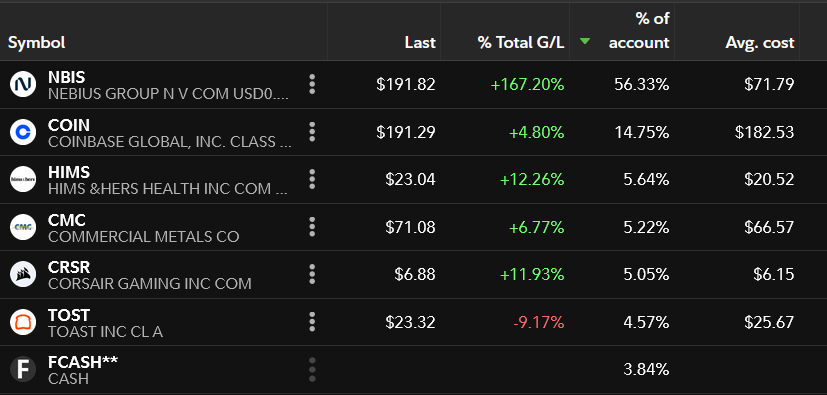
Portfolio & Accountability Update My public record thread. I do this so I can be a voice of transparency and look back at my own decisions and thoughts. Q2 - Year to Date. YTD: +37.6% SP500: +7.9% Holds: - $NBIS portfolio position grew from 45% to 56%. Unfortunately had some shares called away, before that it was well above 65% - $TOST my only remaining SaaS. If you look at the price, you'd think its a dead stock. But if you look under the hood, they are growing healthily. In this environment look for SaaS that's aggressively growing, nothing less. Sells: - $FRMI sold for about -40% loss on the position. The company vision is solving a real power bottleneck through behind-the-meter solution offering 11GW in Texas. But the house is a mess, CEO fired and halfway through 2026 they still don't have a tenant. Ridiculous. - $DOCS sold for about -12% loss. SaaS with an additional factor of having a regulatory moat. Nope. Still slow growth. Still too much unclarity and still no monetization or path to DoxGPT. In today's world, SaaS needs to be hypercompetitive and there's no room for this. Buys: - $COIN I've been adding every time when <$200 and it is now firmly 15% of my portfolio. Check my pinned post on my conviction. - $RIVN my focus as of late and now 8% of portfolio, buying under $13 (in Robinhood port). Production -> Software -> Robotics is the entire lifecycle that I foresee for them. - $CMC doubled my position and now 5% of portfolio. Data center and infrastructure build out in United States will be massive and CMC focuses on high margin build outs - $ABSI bought more. Insider Director bought 100,000 shares and they have enough runway until 2028 - $CRSR doubled position and now also 5% of port. Huge insider buys, push to profitability, big institutional buys and an upcoming gaming sector tailwind - $HIMS bought more and also 5% port at $20 cost average. These guys have a lot of problems but the product marketing, no matter what way I look at is, is clean and the health trend behind it, is real.
Position Journal tweet media
Position Journal@PositionJournal

PORTFOLIO (and transparency) UPDATE✍️ For Q1 2026 Year-to-date: -3% S&P 500: -3.6% Outperformed by 0.7%. This number fluctuates violently because of my position sizing, sometimes I'm green, sometimes I'm worse off. New/Increased Positions: $COIN $TOST $HIMS $CMC $CRSR $FRMI + some 1-2% positions like $RXRX and $ABSI Trimmed/Exited positions: $DOCS trimmed down to fund more Coinbase ----- Holdings Update $NBIS: 45% of account (inc. calls) and effectively holding my portfolio up. My dedicated position. Be warned: too many short-sighted posts and "analyses" about Nebius on X. People, including influential X investors, are focused on nonsensical 2026 price targets, which will be critically wrong, just like their 2025 price targets the year before. If you want to understand the end-game as someone whose been invested in them since 2021 (Yandex days) then you can read about it in my X article. $VTI: 19% of account. Continued steady monthly deposits. Nothing fancy but contributed to me under performing this year (ironically) $COIN: Increased to ~10% of account. Newest add of 2026. I expanded on the bull, bear and current state of Coinbase in my X article. I'm still critical of Brian for being too late on stock trading. But anything <$200 is a well-adjusted risk to reward entry. $TOST: 6% of account. My one of two SaaS bets. Vertically integrated software with a sticky platform and high-switching costs. There are positive signs that the economy (measured as spending power vs debt) is improving, a tailwind for Toast. $DOCS: 3% of account. My other SaaS bet. This one is strengthened by $500M buybacks (12% of MC) and a regulatory moat (FDA/Health) $HIMS: 3% of account. Personalized distribution platform with incredible product marketing. Litigation with NVO turned to partnership and the only overhang now is DOJ, which I'm not worried about. People love to hate on HIMS, and at the prices it was at previously, $70, I wouldn't blame them, but at my entry of $16? I'm totally relaxed. $CMC: 2.6% of account. Steel manufacturing company whose niche is focused on foundations and kickstarting projects. Trades lower P/E compared to Nucor and has a massive backlog of data center build-outs. Also something I covered as a deep-dive separately $FRMI: 1.3% of account, down -37%! High risk, high reward. I give them one full year, until 2027 to execute and deliver their 1GW promised capacity (eventual 11GW!). If nothing, then I'm out

English
1
1
6
1.1K
Position Journal
Position Journal@PositionJournal·
If gun to my head and I had to choose three stocks to make me a multi millionaire: $NBIS $COIN $RIVN They already make up 80% of my portfolio Curious on other peoples three
English
3
0
8
797
Position Journal
Position Journal@PositionJournal·
@pepemoonboy I wonder what it is about free content not getting attention it deserves. I think it’s because psychologically it lacks exclusivity (if it’s free then it’s worthless, but if I’m paying then it’s hidden alpha) which is brain dead take
English
1
0
0
71
Pepe Invests
Pepe Invests@pepemoonboy·
If you like making money, and you aren’t following me, why not? I gave you this alpha on $SHAZ before market open, and now the stock is up 16%. The goal of my content is for you to use it as a starting point in your research. And the best part of all? I do it all for FREE, right here, and I show you that I am putting my very own money behind the things I talk about. Furus can talk about this and that, but they’ll never show themselves actually buying the stock they’re talking about… Wonder why? Lets keep climbing 🚀
Pepe Invests tweet media
Pepe Invests@pepemoonboy

I initiated a position in $SHAZ this week after seeing that Leopold had added it to his Situational Awareness Fund. I will admit, I initially bought 250 shares without doing much research... But then I started to dive deeper into the stock and what I uncovered is...well, interesting. $933M mcap on $1.5M TTM revenue, but a $2.2B signed backlog where customers are locked into paying for reserved GPU capacity whether they use it or not, across Canva, GMI, ESDS, and an undisclosed Asia-Pac tech giant. Street consensus has revenue going from $134M FY26E to $746M FY27E to $1.2B FY28E at ~67% EBITDA margins. If they execute, the math on FY28 numbers at 8x sales or 12x EBITDA pencils to ~$430/share fully diluted, roughly 7x from here. The catch: > most of the bull case leans on one Indian customer, ESDS, who owes SharonAI more per year than they did in total revenue last year, by 6x... > On top of that, FY27 and FY28 free cash flow is modeled at negative $1.7B and $1.2B, so billions in new capital and material dilution are coming. > And the CEO carries baggage. Bleecker Street tied him to self-dealing allegations from his Mawson days. Not undervalued, not overvalued. Honestly not sure what it is. This play has the potential to be a moonshot...or plummet. Tons of risk. But you know me, I've never been one to shy from risk every now and then...

English
17
3
109
13.5K
Position Journal
Position Journal@PositionJournal·
$CRSR Is it finally ready to run higher?
Position Journal@PositionJournal

As promised here's the $CRSR story. The bull and bear cases and why I think Corsair is mispriced at $5 a share (0.4x P/S) and 600M market cap. I hold about 2% of port in Corsair. WHAT THEY DO Corsair provides performance components, peripherals, and computing solutions across consumer, education, government and engineering/manufacturing segments. Corsair splits its business into two segments: peripherals and components. The peripherals segment covers everything a gamer or creator touches directly, including keyboards, mice, headsets, controllers, capture cards, Stream Decks, microphones, cameras, and sim racing gear. This segment captures 33%, or $492M for FY25 total revenues. The components segment covers the hardware inside and around the machine, including PSUs (power supply unit), cooling, cases, DRAM, prebuilt gaming PCs, laptops, and AI workstations. This captures 67% of their total revenues, or $980M FY25 revenue. Before we go further, let's address the elephant in the room. Corsair is down -83% in the last 5 years, from $33 to just $5 a share. SO WHAT IN THE WORLD HAPPENED? In short, they could not sustain a positive operating income. FY22: -$55M loss FY23: +$9.7M profit FY24: -$50M loss 2023 saw strong demand for gaming following post-pandemic recovery and 2024 saw regression to the mean. If you can't sustain net-positive operating income, then it signals operational weakness either due to execution or cyclical demand, and raises doubts about the company's long-term viability, signalling if this company will even exist in the future. WHAT HAPPENED IN 2025? Corsair achieved positive GAAP operating income of $2.1M, that's a +104% YoY swing to positive. They achieved this through a combination of operational efficiency improvements, better inventory holding, improved supply chain management and aided by a tailwind of increasing demand by consumers. Internally it's likely they cut down on bureaucracy, accelerated decision making, reduced weeks of cover for their inventory and held their vendors or logistics team to a higher bar. Many reasons hide behind "operational efficiency" and "strategic inventory" which is why I don't like to focus on it if management themselves aren't clear about it. But let's move on to something that management IS clear about: Product innovation. They launched over 100 products in 2025 including new PC cases, pre-built desktops, controllers, voice focus software and their Galleon 100 SD Keyboard with built-in stream deck. This is a company that is focused on leading not with accounting gimmicks but with value added products. But let's not butter them up completely and address some meaningful tailwinds that was out of Corsair's control, but benefited Corsair. Demand is picking up again. A critical component in gaming is GPUs, and the two biggest players, AMD and NVIDIA have confirmed that the gaming segment is ramping back up: -AMD: "Gaming business revenue was $843 million, up 50% year-over-year, primarily driven by higher semi-custom revenue and strong demand for AMD Radeon GPUs." -NVIDIA: "Gaming revenue $3.7 billion, up 47% YoY, driven by strong Blackwell demand" Now that we know what happened in 2025, let's move on to BULL CASE🐂 Gaming segment is cyclical, we see accelerated in demand and Corsair has both the branding, distribution and inventory to deliver the demand and maximize this cycle. Additionally, from a product perspective, they want to shift the focus to the Elgato brands Stream Deck: Thi La (CEO): "Stream Deck is a central component of our plan, evolving from a creator tool into a shared control layer across productivity, gaming and sim racing. The successful launch of our Galleon keyboard at CES 2026, one of the most awarded product launches in our history" Stream deck has a broad appeal: -Content creators and streamers (switch scenes, trigger sound effects, better overlays) -Podcast and radio hosts -Video editors -Corporate presentors They're trying to decouple themselves from the tight cyclical grasp of the gaming segment. Additionally, they authorized a $50M stock repurchase program. Its first in history. If executed at today's prices would be almost 10% of their market cap. But unfortunately, this only gives about 1.5 years benefit since stock-based-compensation (SBC) was about 33M in 2025. Further, they are guiding to $1.3 to $1.5B revenue and $100-115M adjusted EBITDA for 2026. This translates to: -5% revenue YoY driven from global semiconductor shortages and +6.9% growth YoY from the midpoint $107M. It's important to note that the +6.9% YoY growth comes at the backdrop of an already +84% improvement in adjusted EBITDA. Finally, institutions are all making small bets on Corsair. Top funds like DE Shaw, Millennium Management, State Street and Point72 Asset management and many others all either initiated new positions or bought millions in shares (see snip). BEAR CASE 🐻 The reason why the market has not rotated into Corsair is because they are afraid this is simply a repeat of 2023. 2023 saw a positive operating income on the tailwind of high demand, and 2024 saw all that money evaporate and then some. What if the same thing happens again? It very well could. I don't want to expand too much on other bear cases because just this one captures multitude of factors: -Company value tied to cyclical demand -Compressing margins due to competitions -Lack of execution by management -Being majorly controlled by EagleTree at 50% ownership But ultimately, all of it is represented in the metric of operating income. THE BOTTOM LINE The company needs to prove itself. Operating income is fragile at just $2.1M, already guiding 2026 revenue lower and its unclear whether the shift of focus to D2C and non-gaming segments will work. But this is a company that is STILL guiding to $1.4B revenue at a 600M market cap. They are priced to near bankruptcy and I fundamentally believe they are mispriced. I do not think they will go bankrupt, and I do not think they will become innovators overnight. I think they will remain a household name with brand recognition that will carry them into new segments and I believe that because of that they will go higher. Also, both La and Szteinbaum bought 50,000 and 100,000 shares in Nov 2025, so that helps my bottom line statement too 😉


English
0
0
1
627
Position Journal
Position Journal@PositionJournal·
$SBUX This is why user research is important. Baristas on Reddit were all complaining AI forecasted inventory was either understocking or overstocking and causing churn. I remember reading that at least over a year ago. Remember Starbucks “all in on AI”? Now they’re all out?
unusual_whales@unusual_whales

Starbucks, $SBUX, is retiring its AI inventory system across North America after the tool reportedly miscounted and mislabeled store inventory.

English
0
0
3
416
Kevin Melnuk
Kevin Melnuk@KevinMelnuk·
What’s going on with $RIVN options for tomorrow? It’s not a special options day or witching or whatever. Stacked $14-$15+. Normal Rivian would have like 4,000 options max per strike.
Kevin Melnuk tweet media
English
6
0
35
4.4K
Position Journal
Position Journal@PositionJournal·
A clear articulation by @DJ_CURFEW of the bottlenecks and where future value will come from. From a synergistic partnership between builder and AI. I recommend picking up the book AI Engineering - building applications with foundation models by Chip Huyen A great starter book on your AI design and builder journey that I insist you begin today if you haven’t already.
Position Journal tweet media
Zeb Evans@DJ_CURFEW

Today we reduced headcount by 22%. The business is the strongest it's ever been. So I think it's important to be direct about what I'm seeing and why. First, I made this decision and I own it. I did it because the way to operate at the highest level of productivity is changing, and to win the future, ClickUp needs to change with it. Second, this wasn't about cutting costs. Most savings from this change will flow directly back into the people who stay. We'll be introducing million-dollar salary bands. If you create outsized impact using AI, you'll be paid outside of traditional bands. Most importantly, I have the deepest gratitude for those affected. We're doing this from a position of strength specifically so we can take care of people properly. Everyone affected receives a package aimed at honoring their contributions and easing the transition. I only see two options: wait for this to play out gradually in the market or be honest about what I'm seeing and act proactively. THE 100X ORGANIZATION The primary change is that we're restructuring around what I call 100x org. The goal is 100x output. The roles required to build at the highest level are fundamentally different than they were a year ago. Incremental improvements to existing systems won't get us there. We need new ones. That means creating enough disruption to rebuild rather than iterate on what's already broken. The common narrative is that AI makes everyone more productive. It doesn't. Many of the workflows of today, if left unchanged, create bottlenecks in AI systems. These roles will evolve. But waiting for that to happen naturally means falling behind now. The 100x org is actually heavily dependent on people - infinitely more than today. This is only possible with 10x people that have embraced and adopted new ways of working. THE BUILDERS, AGENT MANAGERS, AND FRONT-LINERS — THE BUILDERS: 10X ENGINEERS I don't think most companies have internalized what's actually happening with AI in engineering. The common narrative is that AI makes all engineers more productive. That may be true in isolation, but at an organization level - that is the farthest thing from reality. Here's what we've validated recently at ClickUp: the great engineers, the ones who can orchestrate, architect, and review, are becoming 100x engineers. They're not writing code. They're directing agents that write code. The skill is judgment. AI makes the best engineers wildly more productive, and everyone else using AI slows these engineers down. Think about it - the bottlenecks are (1) orchestration - telling AI what to do, and (2) reviewing - what AI did. Everything is leapfrogged and no longer needed. So who do you want orchestrating and reviewing code? And how do you want your best engineers to spend their time? If your best engineers are spending time reviewing other people's code, then this is inherently an inefficient bottleneck. These engineers can review their agent's code much faster than reviewing human code. The new world is about enabling your 10x engineers to become 100x. The wrong strategy is to push every engineer to use infinite tokens. Companies doing this are celebrating 500% more pull requests. But customer outcomes don't match the volume of code being generated. I call this the great reckoning of AI coding, and every company will face this soon if not already. More code is just another bottleneck to the best engineers, and ultimately to your company's impact as well. — THE BUILDERS: 10X PRODUCT MANAGERS Product management and design roles are merging. Designers that have customer focus, become more like product managers. And product managers that have intuition for UX become more like designers. The bottleneck of user research is gone. It takes us just one mention of an agent to kickoff research and analyze results. The bottleneck of product <> design iteration is also gone. The product builder iterates on their own, along with agents and skills that ensure alignment with quality and strategy. Also controversial today - I believe that the wrong strategy is to have your PMs shipping code - that just introduces another bottleneck that the best engineers will waste their time on. To be clear, PMs should be coding but they should do this in a playground to iterate, validate, and scope. That code should not go to production. Everything outside of managing systems, orchestrating AI, and reviewing output becomes a bottleneck. That's why the other roles that are critical along with these are the systems managers (to reduce bottlenecks) along with a bottleneck you can't replace - customer meeting time. — THE SYSTEM MANAGERS Ironically, the people that automate their jobs with AI will always have a job. They become owners of the AI systems - agent managers. We have many examples of these people at ClickUp. The underlying systems in which we operate are absolutely critical to get right. I think most companies are delusional to think they can iterate on existing systems and compete in this new world. You must create enough disruption so that old systems are deprecated entirely. If there's any definition for 'AI native' that's what it is. — THE FRONT-LINERS In a world that will become saturated with AI communication, the human touch will matter more than anything to customers. This is a bottleneck that you shouldn't replace - even when agents are high enough quality to do video meetings. One-on-one meeting time with customers is something that shouldn't be automated. The systems around the meetings should be - so that front-liners spend nearly 100% of their time with customers. REWARDING 100X IMPACT In a world where companies are able to do so much more with less, where does that excess money go? In our case, much of the savings in this new operating model will flow directly back to those that enabled it. We must reward people that create productivity accordingly. This aligns incentives on both sides. Plus, in a world where your best people create 100x impact, you can't afford to lose them. You should aim to retain these employees for decades. The context they have and their ability to efficiently orchestrate and review will be nearly impossible to replace. Compensation bands of today should be thrown out the door. We're introducing $1 million cash/year salary bands with a path available to nearly everyone in the company if they produce 100x impact by creating or managing AI systems. THE FUTURE Nearly every company will make changes like these. The ones that do it proactively will define what comes next. The future is not fewer people. It's different work, new roles, and better rewards for those who embrace it. We're already seeing entirely new roles emerge, like Agent Managers, that didn't exist a year ago. ClickUp is positioning to lead this shift, not just internally, but for our customers too. I've never been more certain about where we're headed.

English
0
0
1
322
Position Journal
Position Journal@PositionJournal·
@DJ_CURFEW 100x seems unlikely, but you articulated your positions well. They're also defensible, I see these bottlenecks in my line of work daily. Sad to hear about the lay offs, but glad it flows back into the employees, I just hope there is an achievable parameter you set for them.
English
0
35
106
2.4K
Zeb Evans
Zeb Evans@DJ_CURFEW·
Today we reduced headcount by 22%. The business is the strongest it's ever been. So I think it's important to be direct about what I'm seeing and why. First, I made this decision and I own it. I did it because the way to operate at the highest level of productivity is changing, and to win the future, ClickUp needs to change with it. Second, this wasn't about cutting costs. Most savings from this change will flow directly back into the people who stay. We'll be introducing million-dollar salary bands. If you create outsized impact using AI, you'll be paid outside of traditional bands. Most importantly, I have the deepest gratitude for those affected. We're doing this from a position of strength specifically so we can take care of people properly. Everyone affected receives a package aimed at honoring their contributions and easing the transition. I only see two options: wait for this to play out gradually in the market or be honest about what I'm seeing and act proactively. THE 100X ORGANIZATION The primary change is that we're restructuring around what I call 100x org. The goal is 100x output. The roles required to build at the highest level are fundamentally different than they were a year ago. Incremental improvements to existing systems won't get us there. We need new ones. That means creating enough disruption to rebuild rather than iterate on what's already broken. The common narrative is that AI makes everyone more productive. It doesn't. Many of the workflows of today, if left unchanged, create bottlenecks in AI systems. These roles will evolve. But waiting for that to happen naturally means falling behind now. The 100x org is actually heavily dependent on people - infinitely more than today. This is only possible with 10x people that have embraced and adopted new ways of working. THE BUILDERS, AGENT MANAGERS, AND FRONT-LINERS — THE BUILDERS: 10X ENGINEERS I don't think most companies have internalized what's actually happening with AI in engineering. The common narrative is that AI makes all engineers more productive. That may be true in isolation, but at an organization level - that is the farthest thing from reality. Here's what we've validated recently at ClickUp: the great engineers, the ones who can orchestrate, architect, and review, are becoming 100x engineers. They're not writing code. They're directing agents that write code. The skill is judgment. AI makes the best engineers wildly more productive, and everyone else using AI slows these engineers down. Think about it - the bottlenecks are (1) orchestration - telling AI what to do, and (2) reviewing - what AI did. Everything is leapfrogged and no longer needed. So who do you want orchestrating and reviewing code? And how do you want your best engineers to spend their time? If your best engineers are spending time reviewing other people's code, then this is inherently an inefficient bottleneck. These engineers can review their agent's code much faster than reviewing human code. The new world is about enabling your 10x engineers to become 100x. The wrong strategy is to push every engineer to use infinite tokens. Companies doing this are celebrating 500% more pull requests. But customer outcomes don't match the volume of code being generated. I call this the great reckoning of AI coding, and every company will face this soon if not already. More code is just another bottleneck to the best engineers, and ultimately to your company's impact as well. — THE BUILDERS: 10X PRODUCT MANAGERS Product management and design roles are merging. Designers that have customer focus, become more like product managers. And product managers that have intuition for UX become more like designers. The bottleneck of user research is gone. It takes us just one mention of an agent to kickoff research and analyze results. The bottleneck of product <> design iteration is also gone. The product builder iterates on their own, along with agents and skills that ensure alignment with quality and strategy. Also controversial today - I believe that the wrong strategy is to have your PMs shipping code - that just introduces another bottleneck that the best engineers will waste their time on. To be clear, PMs should be coding but they should do this in a playground to iterate, validate, and scope. That code should not go to production. Everything outside of managing systems, orchestrating AI, and reviewing output becomes a bottleneck. That's why the other roles that are critical along with these are the systems managers (to reduce bottlenecks) along with a bottleneck you can't replace - customer meeting time. — THE SYSTEM MANAGERS Ironically, the people that automate their jobs with AI will always have a job. They become owners of the AI systems - agent managers. We have many examples of these people at ClickUp. The underlying systems in which we operate are absolutely critical to get right. I think most companies are delusional to think they can iterate on existing systems and compete in this new world. You must create enough disruption so that old systems are deprecated entirely. If there's any definition for 'AI native' that's what it is. — THE FRONT-LINERS In a world that will become saturated with AI communication, the human touch will matter more than anything to customers. This is a bottleneck that you shouldn't replace - even when agents are high enough quality to do video meetings. One-on-one meeting time with customers is something that shouldn't be automated. The systems around the meetings should be - so that front-liners spend nearly 100% of their time with customers. REWARDING 100X IMPACT In a world where companies are able to do so much more with less, where does that excess money go? In our case, much of the savings in this new operating model will flow directly back to those that enabled it. We must reward people that create productivity accordingly. This aligns incentives on both sides. Plus, in a world where your best people create 100x impact, you can't afford to lose them. You should aim to retain these employees for decades. The context they have and their ability to efficiently orchestrate and review will be nearly impossible to replace. Compensation bands of today should be thrown out the door. We're introducing $1 million cash/year salary bands with a path available to nearly everyone in the company if they produce 100x impact by creating or managing AI systems. THE FUTURE Nearly every company will make changes like these. The ones that do it proactively will define what comes next. The future is not fewer people. It's different work, new roles, and better rewards for those who embrace it. We're already seeing entirely new roles emerge, like Agent Managers, that didn't exist a year ago. ClickUp is positioning to lead this shift, not just internally, but for our customers too. I've never been more certain about where we're headed.
English
1.6K
1.1K
11.8K
7.6M
Position Journal
Position Journal@PositionJournal·
@OpenAI This reminds me of Peter Thiel stating that those who will be in most trouble and risk of displacement, will actually be mathematicians and such, not authors, or writers and language-oriented domains
English
0
0
1
593
OpenAI
OpenAI@OpenAI·
Today, we share a breakthrough on the planar unit distance problem, a famous open question first posed by Paul Erdős in 1946. For nearly 80 years, mathematicians believed the best possible solutions looked roughly like square grids. An OpenAI model has now disproved that belief, discovering an entirely new family of constructions that performs better. This marks the first time AI has autonomously solved a prominent open problem central to a field of mathematics.
English
983
3.7K
25.9K
12.7M
Position Journal
Position Journal@PositionJournal·
@SixSigmaCapital I really believe the implicit "China-based" price pressure that is permanently applied to Chinese stocks listed in US will always be there unless there is a shift in sentiment from future administrations.
English
0
0
0
76
Position Journal
Position Journal@PositionJournal·
Portfolio & Accountability Update My public record thread. I do this so I can be a voice of transparency and look back at my own decisions and thoughts. Q2 - Year to Date. YTD: +37.6% SP500: +7.9% Holds: - $NBIS portfolio position grew from 45% to 56%. Unfortunately had some shares called away, before that it was well above 65% - $TOST my only remaining SaaS. If you look at the price, you'd think its a dead stock. But if you look under the hood, they are growing healthily. In this environment look for SaaS that's aggressively growing, nothing less. Sells: - $FRMI sold for about -40% loss on the position. The company vision is solving a real power bottleneck through behind-the-meter solution offering 11GW in Texas. But the house is a mess, CEO fired and halfway through 2026 they still don't have a tenant. Ridiculous. - $DOCS sold for about -12% loss. SaaS with an additional factor of having a regulatory moat. Nope. Still slow growth. Still too much unclarity and still no monetization or path to DoxGPT. In today's world, SaaS needs to be hypercompetitive and there's no room for this. Buys: - $COIN I've been adding every time when <$200 and it is now firmly 15% of my portfolio. Check my pinned post on my conviction. - $RIVN my focus as of late and now 8% of portfolio, buying under $13 (in Robinhood port). Production -> Software -> Robotics is the entire lifecycle that I foresee for them. - $CMC doubled my position and now 5% of portfolio. Data center and infrastructure build out in United States will be massive and CMC focuses on high margin build outs - $ABSI bought more. Insider Director bought 100,000 shares and they have enough runway until 2028 - $CRSR doubled position and now also 5% of port. Huge insider buys, push to profitability, big institutional buys and an upcoming gaming sector tailwind - $HIMS bought more and also 5% port at $20 cost average. These guys have a lot of problems but the product marketing, no matter what way I look at is, is clean and the health trend behind it, is real.
Position Journal tweet media
Position Journal@PositionJournal

PORTFOLIO (and transparency) UPDATE✍️ For Q1 2026 Year-to-date: -3% S&P 500: -3.6% Outperformed by 0.7%. This number fluctuates violently because of my position sizing, sometimes I'm green, sometimes I'm worse off. New/Increased Positions: $COIN $TOST $HIMS $CMC $CRSR $FRMI + some 1-2% positions like $RXRX and $ABSI Trimmed/Exited positions: $DOCS trimmed down to fund more Coinbase ----- Holdings Update $NBIS: 45% of account (inc. calls) and effectively holding my portfolio up. My dedicated position. Be warned: too many short-sighted posts and "analyses" about Nebius on X. People, including influential X investors, are focused on nonsensical 2026 price targets, which will be critically wrong, just like their 2025 price targets the year before. If you want to understand the end-game as someone whose been invested in them since 2021 (Yandex days) then you can read about it in my X article. $VTI: 19% of account. Continued steady monthly deposits. Nothing fancy but contributed to me under performing this year (ironically) $COIN: Increased to ~10% of account. Newest add of 2026. I expanded on the bull, bear and current state of Coinbase in my X article. I'm still critical of Brian for being too late on stock trading. But anything <$200 is a well-adjusted risk to reward entry. $TOST: 6% of account. My one of two SaaS bets. Vertically integrated software with a sticky platform and high-switching costs. There are positive signs that the economy (measured as spending power vs debt) is improving, a tailwind for Toast. $DOCS: 3% of account. My other SaaS bet. This one is strengthened by $500M buybacks (12% of MC) and a regulatory moat (FDA/Health) $HIMS: 3% of account. Personalized distribution platform with incredible product marketing. Litigation with NVO turned to partnership and the only overhang now is DOJ, which I'm not worried about. People love to hate on HIMS, and at the prices it was at previously, $70, I wouldn't blame them, but at my entry of $16? I'm totally relaxed. $CMC: 2.6% of account. Steel manufacturing company whose niche is focused on foundations and kickstarting projects. Trades lower P/E compared to Nucor and has a massive backlog of data center build-outs. Also something I covered as a deep-dive separately $FRMI: 1.3% of account, down -37%! High risk, high reward. I give them one full year, until 2027 to execute and deliver their 1GW promised capacity (eventual 11GW!). If nothing, then I'm out

English
1
1
6
1.1K
Position Journal
Position Journal@PositionJournal·
$META is implementing a forcing function with all these layoffs. You will integrate your work style and self with AI to improve productivity out of necessity, not optionality, and you no longer have a team to rely on. I feel very sorry for those laid off.
English
0
1
6
508
Position Journal
Position Journal@PositionJournal·
@KevinMelnuk Speaking from experience, it is a slow and painful process to get a building humming. Everything on paper is great, launch engineers hand it off, only for equipment to break at the slightest pressure and they come back to fix it. Most of this will never be known to the public
English
0
0
2
132
Kevin Melnuk
Kevin Melnuk@KevinMelnuk·
Geniuses of Twitter who have never ramped up an auto plant (I haven't so I don't act like a genius I use Gemini or Grok or ChatGPT to help). Factories take 6+ months to ramp... Rivian making around 500 R2s and 30+ per day at this point is great in a production ramp. $RIVN
Kevin Melnuk tweet media
English
2
1
33
1.7K
CNBC
CNBC@CNBC·
Jeff Bezos: "If I do my job right, the value to society and civilization from my for-profit companies will be much, much larger than the good that I do with my charitable giving."
English
3.8K
5.1K
44.4K
76.1M
Position Journal
Position Journal@PositionJournal·
@DavidKahoun24 On Mind Robotics, its the same thing - the software and hardware can all be licensed to all the manufacturers who are going through the same issues of labor shortages and high labor costs
English
1
0
1
20
Position Journal
Position Journal@PositionJournal·
Exactly, let's take Volkswagen as the most obvious example. What VW gets: -Blueprint and designs for the physical architecture like ECUs, motherboards, connectors, and wiring layouts. -Software (ie the operating system) Volkswagen loves this deal because previously they failed when they launched CARIAD that cost billions and failed attempting to make VW a software company. Essentially VW now decided Rivian built it better, and they want the right to use it
English
1
0
1
95
Position Journal
Position Journal@PositionJournal·
@moontasia18491 Thanks for the feedback, I've been holding since 2022 for a "what if" moonshot, but with all these recent developments, I increased it to be 8% of my portfolio
English
0
0
1
45