Your crypto deserves better protection than a password you reuse everywhere.
Meet the @DCENTWALLETS Biometric Wallet, a hardware wallet that uses your actual fingerprint to approve transactions. Not a PIN, Not a password.
Your private keys never leave the device. No internet connection needed to sign transactions. And the only person who can authorise a move? The one with your fingerprint, which is you, and only you.
It's the kind of security that used to feel like overkill, until you hear about someone losing everything to a compromised password.
Hardware wallets are already the gold standard for storing crypto safely. @DCENTWALLETS just made them smarter.
And right now? It gets even better.
🚚 FREE DELIVERY WEEK is live, April 6–12 UTC.
Every order, Every country, Zero shipping costs, automatically applied.
Oh, and one more thing, if you actually take a scroll through the product page, there's a little surprise waiting.
Find Vaulty and unlock an extra 10% off.
Honestly, if you've been sitting on the fence about getting a hardware wallet, this is probably the most obvious week to finally do it.
🔗 Go explore: store.dcentwallet.com
D'CENT, Your keys, Your fingerprint. Your crypto.
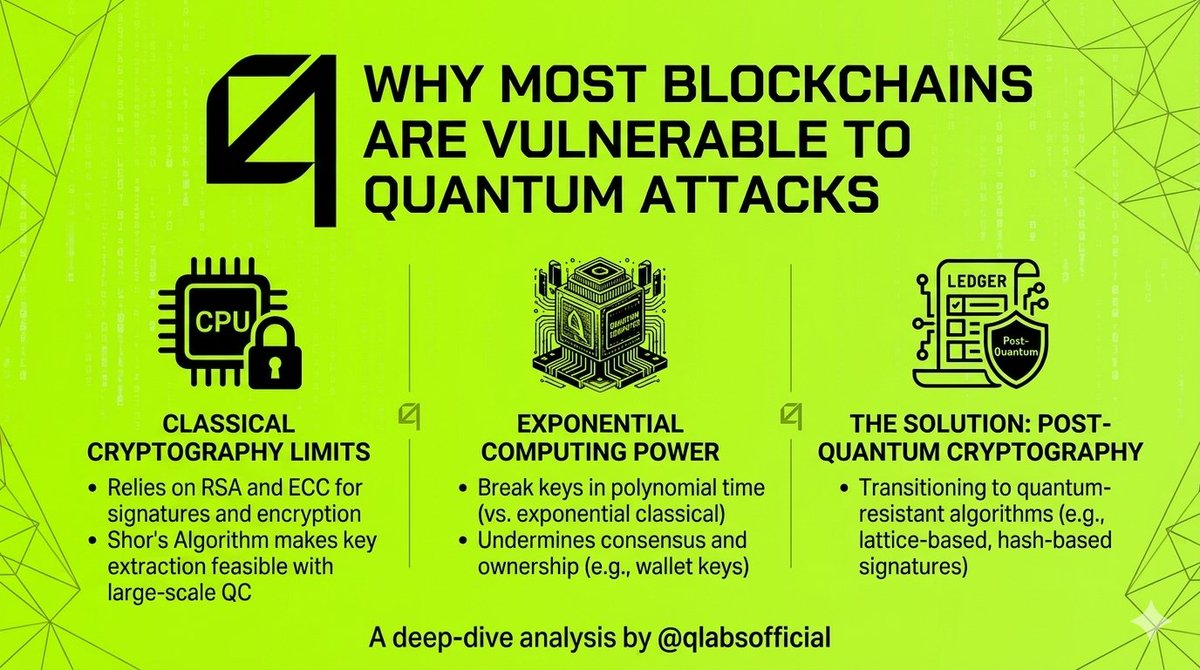
Why most blockchains are vulnerable to quantum attacks
Most people in Web3 spend a lot of time debating scalability, gas fees, and adoption. But one conversation that doesn’t get enough attention is the long-term security of the cryptography that protects our wallets and transactions.
The reality is simple: many blockchains rely on cryptographic systems that were designed for classical computers. These systems have been extremely reliable for decades, which is why they became the backbone of blockchain security in the first place. However, the technological landscape is evolving faster than most people expected.
Quantum computing introduces a new type of computational power. Instead of processing information in the traditional binary way, it can analyze complex mathematical problems in ways that current computers simply cannot. The same cryptographic puzzles that secure digital signatures and wallet keys today could eventually become solvable much faster in a quantum environment.
For blockchains, this creates a potential vulnerability. If a sufficiently powerful quantum computer were able to derive private keys from public keys, the trust model that protects ownership on many networks could be challenged. Even though that level of capability may still be years away, the time to think about the solution is long before the threat becomes practical.
This is why the conversation around quantum-resistant infrastructure is becoming increasingly important across the Web3 ecosystem. Some projects are already exploring new cryptographic approaches designed to remain secure even in a quantum future.
That’s where @qlabsofficial enters the discussion, focusing on building systems that consider the next era of computing rather than only the current one. Preparing blockchain security for the quantum age may not be the loudest topic in Web3 today, but it could easily become one of the most important.
If Web3 is meant to secure value for decades, then the technology protecting it must be built with the future in mind.
Learn more: linktr.ee/qLABS.tech
You’ve been training AI your whole life.
You just never got paid.
spot inconsistencies
judge quality
decide under uncertainty
That’s exactly where models still fail.
@codatta_io turns that into income:
think better → earn more
New meta:
cognition is monetizable.
The internet was always economic… most people just weren’t getting paid
That’s shifting fast:
Users→ Contributors
Consumers→ Validators
Clickers→ Decisionmakers
@codatta_io is fixing the hardest part: who earns, why they earn, and how it stays fair
Same internet. New rules
The next wave of Web3 will be shaped by trust, privacy, and accountability. Exploring how infrastructure like Concordium is helping move the space in that direction.
The next phase of Web3 will likely be defined by trust, not noise. As the ecosystem matures, the conversation is slowly shifting away from speculation toward infrastructure that can actually support real-world use.
That shift requires a delicate balance: systems that protect privacy while still allowing accountability. For years, the industry treated these two ideas as opposites. But the future of decentralized technology depends on proving they can coexist.
That’s where thoughtful protocol design begins to matter.
@Concordium approaches this challenge with a structure that prioritizes verifiable identity at the protocol level while still preserving user privacy. Instead of forcing users to choose between transparency and confidentiality, the network introduces a model where identities are verified off-chain and represented on-chain without exposing personal data.
For developers and builders, that creates something rare in Web3: an environment where applications can scale into regulated spaces without compromising decentralization. From digital finance to enterprise use cases, the foundation becomes more adaptable because trust is embedded into the system itself.
What stands out most is the long-term thinking behind it. While many networks focus on short-term momentum, @Concordium seems focused on building the kind of infrastructure that can quietly power real adoption over time.
And in an industry often driven by trends, that kind of deliberate architecture might end up being one of the most valuable innovations of all.
Learn more: concordium.com#ConcordiumAmbassador