Sabitlenmiş Tweet

A thread of all social-media mentions of infections associated with Kumbh Mela 2025 visit (1)
English
PriyankaPulla
25.6K posts
@PriyankaPulla
Journalist. Not on Twitter much. https://t.co/6yZC8zHngA
Air India has started inspecting the fuel control switches across its Boeing 787 Dreamliner fleet. Inspections of half the fleet have been completed with no glitches found, but inspections of the remaining aircraft of Air India are still underway. Following the reported defect involving a Fuel Control Switch on one of Air India's B787 aircraft, the airline company's engineering department has escalated the matter to Boeing for priority evaluation: Sources
A few thoughts The generics vs. branded drugs quality study has stirred up a hornet's nest and with it, multi-pronged criticisms... ...mostly from a section of doctors who have been prescribing expensive branded drugs all their lives... ...also from people who, have all their lives believed that generics (especially from Government) was poor quality (based on cherry picked studies, personal experiences, second- and third-hand stories)... ...and also those who are always critical of whatever Government does. Because of this, the whole discussion has now moved into the "regulation of drugs" space, and completely misinterpreted what the Citizens project actually looked at. We looked at the same medicine (single batch, 22 different types, based on 8 therapeutic categories) from different sources for non-inferior pharmaceutical quality, as prescribed by national standards. Batch-to-batch variation was not our objective (we can take this up in the future with larger funding). The study does not claim to fix the regulatory system; it claims to test the product the patient holds in their hand. The data shows those products were not inferior to similar expensive brands. The study was on "quality assurance" which relies on established scientific standards and protocols. It was not on why we have different regulations and why we should improve regulations - this is a different argument. We have shown independently, that commonly prescribed generics were good enough as the branded counterparts. The testing was done as per IP 2022 standards. There is no other methodology apart from what the standards warrant. Clarifying a common argument here in brief: For example in-vitro dissolution is the internationally accepted quality control standard (USP, BP, IP) precisely because it mimics the release of the drug in the physiological environment. Asking for in-vivo on top of this is "crass argument." On the question of in-vitro in-vivo correlation, for many drug classes, particularly those we tested, there is a robust, scientifically proven correlation between how a drug dissolves in the lab and how it is absorbed in the body. Dismissing this fundamental tool of pharmaceutical science ignores decades of evidence that links dissolution profiles to clinical performance. Due to a hectic clinical schedule, teaching programs, research writing and meetings, I was unable to prepare the final summary document of the study and the full original reports of all 131 drugs evaluated. I just completed my outpatient for the day and will complete the documents tonight. It will be up on the meshindia.org website latest by Thursday night. The manuscript to be sent for peer review was completed a day before (I spend most of the weekend writing it) and is now circulated among my co-authors for suggestions, revisions and modifications. We will submit the paper (to an open access journal) for peer-review the coming week. Once again, our study is an independent quality assessment for the end consumer, not a regulatory body granting market authorization. When a generic drug passes these stringent dissolution and assay tests, it objectively demonstrates that it is not 'inferior' in its physical and chemical properties. Denying this data hurts patients by perpetuating an unfounded fear of affordable medicines that have been proven to meet quality standards. Yes, generics fail quality. Sometimes brands also do. But these must be considered rare events and not the routine. This is what the study showed. The study was cross-sectional and it never claimed everyone need to opt for generics now. It just showed that for people who cannot afford expensive brands, there are choices for them to continue their deserving treatments. Cross-sectional studies have their limitations, but for now, this is the best evidence we have against all the negative testimonials and second-hand anecdotes.
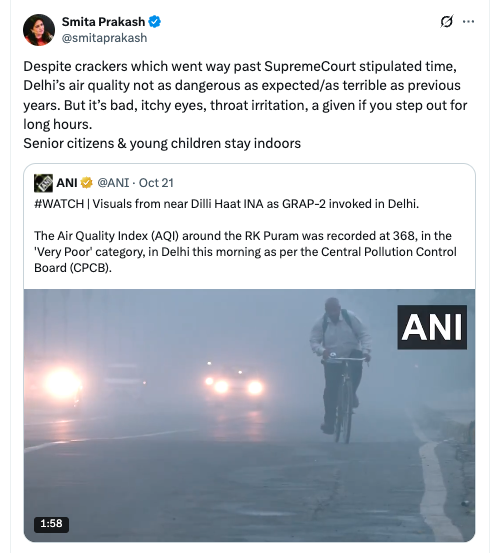
STORY | No conclusive data linking higher AQI to lung diseases: Govt There is no conclusive data establishing a direct correlation between higher air quality index (AQI) levels and lung diseases, the government has told Parliament. READ: ptinews.com/story/national…

Bombshell: Oliver Sacks (a humane man & a fine essayist) made up many of the details in his famous case studies, deluding neuroscientists, psychologists, & general readers for decades. The man who mistook his wife for a hat? The autistic twins who generated multi-digit prime numbers? The institutionalized, paralyzed man who tapped out allusions to Rilke? Made up to embellish the stories. Probably also: the aphasic patients who detected lies better than neurologically intact people, including Ronald Reagan's insincerity. newyorker.com/magazine/2025/…