
Jason Potts

32.2K posts

Jason Potts banner
Jason Potts

Jason Potts

@profjasonpotts

accelerate

Melbourne, Victoria Katılım Aralık 2015
2.1K Takip Edilen5.4K Takipçiler
Jason Potts retweetledi
Thibault Schrepel
Thibault Schrepel@ProfSchrepel·
Here are my monthly reading suggestions. Topics include AI agents and complexity economics in antitrust, the limits of the waterbed effect, Europe’s regulatory drift toward American dependence, the consumer value and 2026 trajectory of generative AI, agentic reproduction of social-science results, AI adoption among federal judges, the economics of long-running institutions like universities, the Hayek archive going online, and Barabási on the hidden order of networks. With @BrianCAlbrecht @ErikHovenkamp @MZunigaP @Dschwarcz @NicholasBednar @DavidKiron1 @erikbryn @SophiaKazinnik @avi_collis @ellliottt @david_rzs @__jae_1 @miserlis_ and others! networklawreview.org/april-2026/
Thibault Schrepel tweet media
English
1
5
8
819
Jason Potts retweetledi
Gaurab Chakrabarti
Gaurab Chakrabarti@Gaurab·
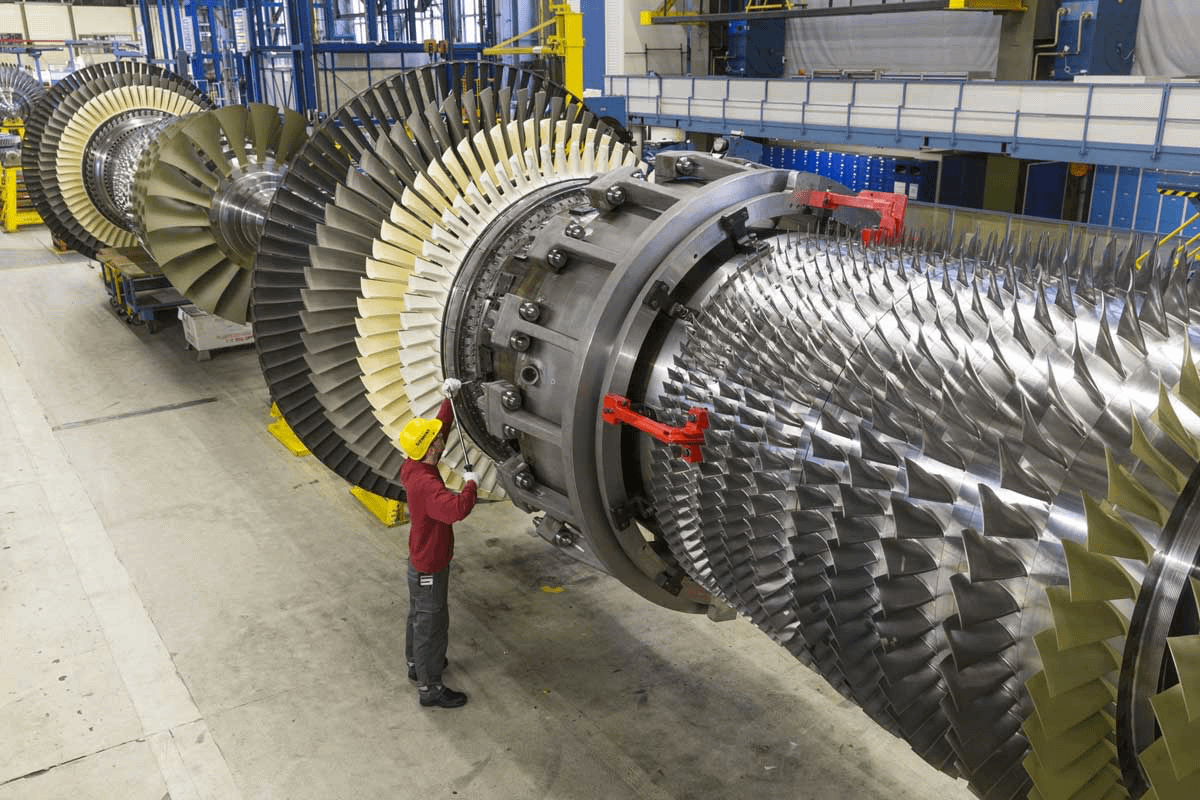
You cannot buy a new gas turbine until 2030. Order books at GE, Siemens, and Mitsubishi stretch to 2029. Turbine prices have nearly tripled since 2019. Every AI data center needs power and every gas plant needs a turbine. And every turbine has one part that bottlenecks the entire industry: The blade. It has to survive in gas 500°C above the melting point of the metal it's made from and spin at up to 20,000 RPM under 10,000 g of centrifugal force. Each blade is grown as a single crystal of nickel superalloy, pulled through a vacuum furnace at 3 mm per minute. A set of blades costs $600,000 and takes 90 weeks to grow. The same metallurgy powers modern jet engines. Only 3 companies on Earth can build one. China spent $42 billion trying to catch up. They bought a Russian fighter engine, took it apart, and copied every part. Their copy ran 30 hours between overhauls versus 400 for the original. Modern Western engines run 4,000. You can reverse engineer the shape of a turbine blade. You cannot reverse engineer 60 years of metallurgy.
Gaurab Chakrabarti tweet media
English
966
5.4K
25.8K
2.4M
Jason Potts retweetledi
Rohan Paul
Rohan Paul@rohanpaul_ai·
Beautiful new paper from Harvard, Stanford, UC Berkeley and other top labs. Shows that DeepLearning is finally becoming the kind of thing science can explain, not just optimize. Because we still do not have a compact, predictive theory that tells us ahead of time how a neural network will learn, scale, and respond to training choices without mostly testing it first. Not that we will soon explain every weight, but that we may learn the coarse laws governing training, representation, and performance. That shift matters because neural nets are not hidden systems. We know the architecture, the data, the objective, and the update rule. The obstacle is not secrecy. It is the complexity of many simple parts interacting at once. So the authors propose “learning mechanics,” a physics-like program that studies the motion of learning itself. “Learning mechanics” is their name for a hoped-for set of broad laws, similar to how physics explains gases without tracking every molecule, that explains the overall behavior of neural nets instead of just describing one model at a time. Physics became useful by ignoring microscopic detail when the right aggregate variables were enough, and this paper says deep learning theory is maturing in exactly that direction through solvable toy models, infinite limits, scaling laws, hyperparameter theories, and universal behaviors. The claim is that training a neural net may be less like recipe tweaking and more like physics, where you stop tracking every tiny part and instead predict the large patterns that keep showing up. That means studying how gradients move parameters, how representations form, and why behavior changes in regular ways as model size, data, and compute grow. The paper says this theory is taking shape through 5 routes: solvable toy models, simplifying limits like infinite width, simple laws like scaling laws, theories of hyperparameters, and behaviors that look universal across many systems. The central bet is that useful laws can exist even when full microscopic detail is hopeless, just like thermodynamics explains gases without tracking every molecule. This also fits neatly beside mechanistic interpretability, because one tries to find local circuits while the other tries to find global laws of learning. ---- Paper Link – arxiv. org/abs/2604.21691 Paper Title: "There Will Be a Scientific Theory of Deep Learning"
Rohan Paul tweet media
English
17
61
277
15.8K
Jason Potts retweetledi
Steve Stewart-Williams
Steve Stewart-Williams@SteveStuWill·
Smarter people tend to be more supportive of freedom of speech. A big part of this is intellectual humility: Higher IQ is associated with greater intellectual humility, which in turn is associated with greater support for freedom of speech. stevestewartwilliams.com/p/self-esteem-…
English
8
87
365
12.3K
Hunter📈🌈📊
Hunter📈🌈📊@StatisticUrban·
Wealth permits a morality to exist that would be incomprehensible to our ancestors. E.g. Germany yesterday finally captured the stranded whale whose story had gripped the nation, and is now escorting him via barge back to the deeper Atlantic. An enormous, multiday operation.
Hunter📈🌈📊 tweet media
English
103
540
8.7K
320.4K
Jason Potts
Jason Potts@profjasonpotts·
Pleased to meet with the team at @rain today to discuss crypto research in Saudi Arabia
English
1
0
2
68
Brivael
Brivael@brivael·
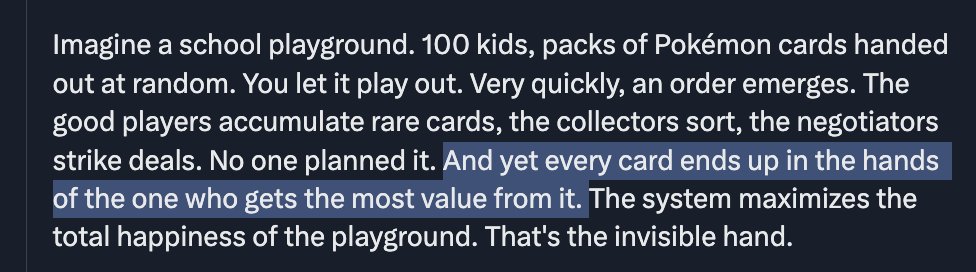
Elon Musk avait dit un truc qui m'avait marqué sur l'allocation de ressources. En substance : passé un certain niveau de richesse, l'argent n'est plus de la consommation, c'est de l'allocation de capital. Cette phrase change tout. L'économie, dans le fond, c'est juste un problème d'allocation. Tu as des ressources finies et des usages infinis. Qui décide où va quoi ? Imagine une cour de récré. 100 enfants, des paquets de cartes Pokémon distribués au hasard. Tu laisses faire. Très vite, un ordre émerge. Les bons joueurs accumulent les cartes rares, les collectionneurs trient, les négociateurs trouvent des deals. Personne n'a planifié. Et pourtant chaque carte finit dans les mains de celui qui en tire le plus de valeur. Le système maximise le bonheur total de la cour. C'est ça, la main invisible. Maintenant fais entrer la maîtresse. Elle trouve ça injuste. Léo a 50 cartes, Tom en a 3. Elle confisque, redistribue, impose l'égalité. Trois effets immédiats. Les bons joueurs arrêtent de jouer, à quoi bon. Les mauvais n'ont plus de raison de progresser, ils auront leur part. Les échanges s'effondrent. La cour est égale, et morte. Elle a maximisé l'égalité, elle a détruit le bonheur. Le problème de la maîtresse, c'est qu'elle ne peut pas avoir l'information que la cour avait collectivement. C'est le problème du calcul économique de Mises, formulé en 1920. L'URSS a essayé de le résoudre pendant 70 ans avec le Gosplan. Résultat : pénuries, queues, effondrement. Pas parce que les Soviétiques étaient bêtes, parce que le problème est mathématiquement insoluble en mode centralisé. Quand Musk a 200 milliards, il ne les consomme pas, il les alloue. SpaceX, Starlink, Neuralink, xAI. Chaque dollar est un pari sur le futur. Et lui a un track record. PayPal, Tesla, SpaceX. Il a démontré qu'il sait identifier des problèmes immenses et y allouer des ressources avec un rendement spectaculaire. L'État aussi a un track record. Hôpitaux qui s'effondrent, éducation qui décline, dette qui explose, services publics qui se dégradent malgré des budgets en hausse constante. Le marché identifie les bons allocateurs, la politique identifie les bons communicants. Le profit n'est pas une finalité, c'est un signal. Il dit : tu as alloué des ressources rares vers un usage que les gens valorisent suffisamment pour payer. Plus le profit est gros, plus la création de valeur est grande. Quand Starlink est rentable, ça veut dire que des millions de gens dans des zones rurales ont enfin internet. Quand un ministère est en déficit, ça veut dire qu'il consomme plus qu'il ne produit. L'un crée, l'autre détruit, et on appelle ça redistribution. Dans nos sociétés il y a deux catégories d'acteurs. Les entrepreneurs et les bureaucrates. L'entrepreneur prend un risque personnel pour identifier un problème, mobiliser des ressources, créer une solution. S'il se trompe il perd. S'il a raison, ses clients gagnent, ses employés gagnent, ses fournisseurs gagnent, l'État collecte des impôts. Il est la cellule de base du progrès humain. Le bureaucrate ne prend aucun risque personnel. Son salaire est garanti. Au mieux il maintient une rente existante. Au pire il la détruit par excès de réglementation, mauvaise allocation forcée, incitations perverses qui découragent ceux qui produisent. Mais dans aucun cas il ne crée. Regarde les 50 dernières années. iPhone, internet civil, SpaceX, Tesla, Google, Amazon, Stripe, mRNA, ChatGPT. Toutes des inventions privées, portées par des entrepreneurs, financées par du capital risque. Pas un seul ministère n'a inventé quoi que ce soit qui ait changé ta vie au quotidien. La France est devenue le laboratoire mondial de la dérive bureaucratique. 57% du PIB en dépenses publiques, record absolu. Une administration tentaculaire, une fiscalité qui pénalise la création de richesse. Résultat : décrochage face aux États-Unis, à l'Allemagne, à la Suisse. Fuite des cerveaux. Désindustrialisation. Dette qui explose. Et le pire c'est que la mauvaise allocation s'auto-renforce. Plus l'État prélève, moins les entrepreneurs créent. Moins ils créent, moins il y a de base fiscale. Plus l'État s'endette et taxe. Boucle de rétroaction négative parfaite. La maîtresse pense qu'elle aide, et chaque année la cour produit moins. Dans nos sociétés, ce sont les entrepreneurs, toujours, qui font avancer la civilisation. Les bureaucrates au mieux maintiennent une rente, au pire la détruisent. Aucune société n'a jamais progressé en taxant ses créateurs pour subventionner ses gestionnaires. La question n'est jamais qui a combien. C'est qui alloue le mieux la prochaine unité de ressource pour maximiser le futur de l'humanité. La réponse depuis 200 ans n'a jamais changé. Ce ne sont pas les fonctionnaires.
Français
3K
14.8K
55.4K
71.6M
Jason Potts retweetledi
𝕃𝕒 𝕊𝕥𝕠𝕣𝕚𝕒 𝓮 𝓵𝓮 𝓘𝓭𝓮𝓮
C'è un sacco di gente che parla degli Emirati (UAE United Arab Emirates) senza bene sapere di cosa si tratti. Innanzi tutto è una federazione di sette sceiccati, ognuno governato da una sua dinastia, che per accordo fra loro vede come presidente lo sceicco di Abu Dhabi, e... /1
𝕃𝕒 𝕊𝕥𝕠𝕣𝕚𝕒 𝓮 𝓵𝓮 𝓘𝓭𝓮𝓮 tweet media
Italiano
49
704
3.9K
967.7K
Jason Potts
Jason Potts@profjasonpotts·
@anup_malani Complementarity also works as boundary formation through value capture, viz Teece 1986. Seeing this also play out in new Chinese 2nd and 3rd tier city cluster fast innovation now too
English
0
0
1
61
Anup Malani
Anup Malani@anup_malani·
Milgrom and Roberts (AER 1990) noticed something that should have been obvious but wasn't. Firms modernizing their factories don't pick management practices off a menu one at a time. Just-in-time delivery, flexible machines, statistical process control, cross-trained workers; these arrive in clumps, or barely at all. The standard intuition is that you optimize each practice on its own and adopt what pays. The data suggested the practices were linked, not independently evaluated. Their answer, formalized using lattice methods from Topkis (1978), is that the practices are complements: each one raises the payoff of the others. Cross-trained workers gain little without flexible machines, and process control is wasted without just-in-time. The right unit of analysis is the bundle, not the individual practice. With complementary practices, the optimum moves coherently. When conditions favor modernization, all of them rise together, and mixed configurations underperform either coherent system. That much is the paper. What I find more interesting, three decades on, is what it points to. Complementarity is one of the forces that pulls attributes inside a single boundary. Features get bundled into one product when they're complementary in consumer use. Practices get bundled into one management system when they're complementary in production. Activities maybe get bundled into one firm when they're complementary in some deeper sense. Where attributes are independent or substitutable, they tend to separate out and trade through markets. So there's a unifying meta-theme: complementarity is one driver of where we draw circles. But here's where I get less sure. The classical theory of the firm (Coase, Williamson) doesn't explain firm boundaries with complementarity. It explains them with transaction costs and asset specificity, the friction of contracting and bargaining when people can hold each other up. Hart's incomplete-contracts work gets closer to a unified picture, since residual rights matter precisely when complementary investments need protection. But the transaction-cost story and the complementarity story aren't obviously the same story. Or maybe they are. The right primitive may not be either of them in isolation. Transaction costs in the Williamson sense include haggling, information asymmetry, and adaptation costs. Once you allow information asymmetry into the picture, what looks like "complementarity" might just be an artifact of imperfect information about how attributes actually interact. Or complementarity might be the primitive, and transaction costs are the symptom: we draw firm boundaries around complementary activities because the alternative — contracting around complementarity through the market — is too hard. I don't have a settled view. The puzzle is whether we need a unified theory of where boundaries form (around features into products, practices into systems, activities into firms) or whether each kind of boundary has its own logic. Milgrom and Roberts gave us one piece. The rest is open. Paul Milgrom and John Roberts, "The Economics of Modern Manufacturing: Technology, Strategy, and Organization," American Economic Review 80 (June 1990): 511-528. cc @DAcemogluMIT @profholden @ben_golub @florianederer — what do you think the right primitive is for explaining where boundaries form? Complementarity? Transaction costs broadly construed (including information asymmetry)? Something else? Or are these distinct questions that shouldn't be unified at all?
English
4
18
98
12.4K
Jason Potts retweetledi
Bé𝕩quer 🇪🇸✒🔡
Bé𝕩quer 🇪🇸✒🔡@GustavoAdolf_·
La estructura de "Bohemian Rhapsody" tiene elementos que los perros encuentran irresistibles. Los coros de alta frecuencia y los cambios drásticos de tono imitan los sonidos que los perros usan para comunicarse con su manada. Una nota larga, muchos perros lo interpretan como un aullido de invitación y deciden unirse.
Español
145
1K
5K
242.4K
Jason Potts retweetledi
Mariè
Mariè@p8stie·
Forewords, prefaces, introductions.. they’re all BRAINWASHING TECHNIQUES. I never read them
English
15
21
205
7.6K
Jason Potts retweetledi
Bats♱
Bats♱@TheBatsCave07·
I am both smarter and dumber than you realize never estimate me
English
3
8
47
1.4K
Jason Potts retweetledi
cora
cora@paging_cora·
looksmaxxing is actually very snooze to me as i’ve been following a guy who is trying to harden his skin, see clearly in salt water, and stretch his toes out in order to “force evolution” and he actually can scale walls and sprint impressively now
English
95
779
46.9K
804.6K
Jason Potts retweetledi
Natalie Brunell ⚡️
Natalie Brunell ⚡️@natbrunell·
The world’s youngest self-made woman billionaire took on the U.S. government…and won. Luana Lopes Lara, co-founder of @Kalshi, opens up about taking on the feds, her billionaire moment, and her Bitcoin story. I really enjoyed this interview and I hope you will too! TIMESTAMPS: 00:00 Ballerina to in Brazil 03:41 Meeting Her Co-Founder at MIT 09:18 65 Lawyers Said It Was Impossible 13:59 How Kalshi Stops Insider Trading 16:56 The Most Surprising Market on Kalshi 17:32 Why She Sued the U.S. Government 21:00 Why Women Are Joining Prediction Markets 22:25 Her First Bitcoin: A $100 Story 23:49 Becoming the Youngest Female Billionaire 27:16 Advice for Young Women and Founders 29:23 Is the American Dream Still Alive? 32:36 Where Crypto and Prediction Markets Collide 35:48 Kalshi Goes Global 37:33 The Currency Problem No One Talks About 39:06 Are Prediction Markets Actually Right? 40:23 Can You Create Your Own Market? 42:29 The Moment They Almost Gave Up 45:09 What She’d Tell Her Younger Self 46:58 The One Market She Wants to Trade
English
90
165
1.5K
910.9K
Jason Potts retweetledi
Michael A. Arouet
Michael A. Arouet@MichaelAArouet·
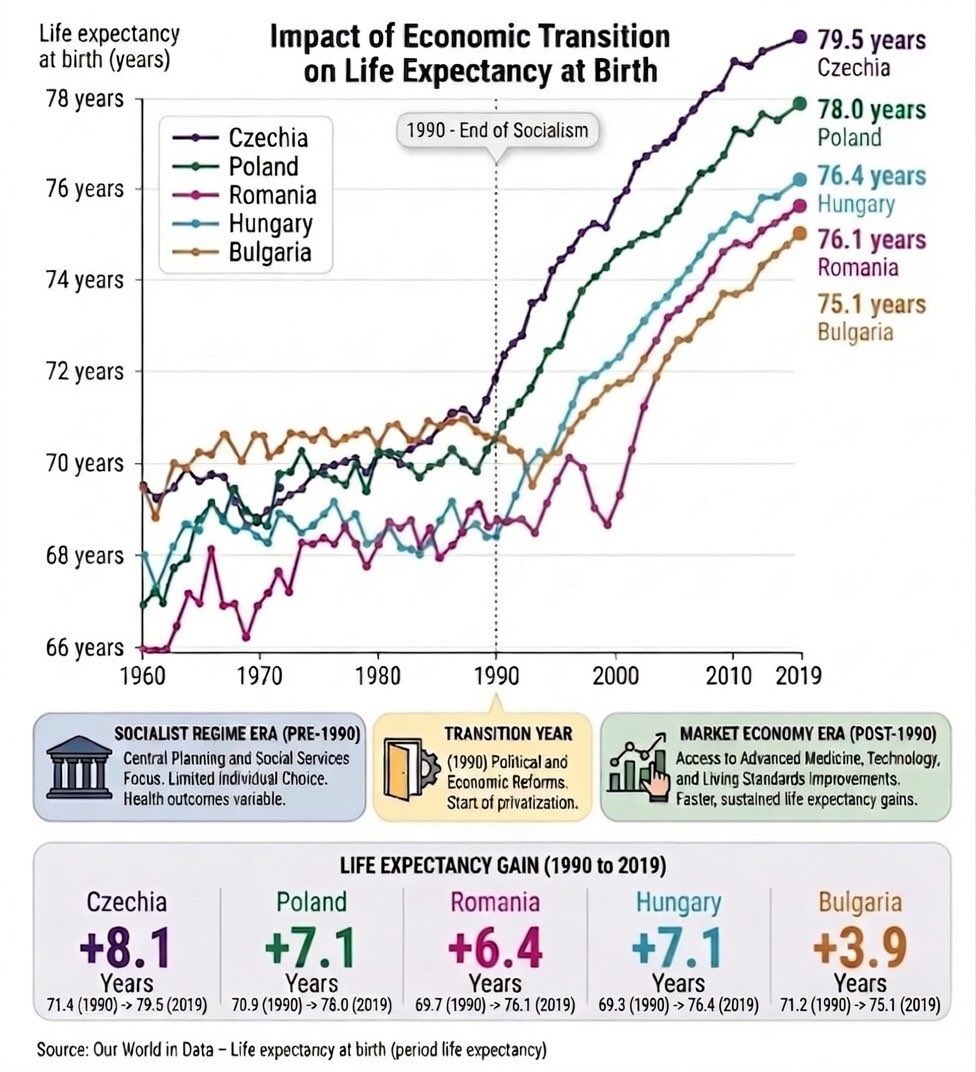
This is by far the most powerful chart showing the difference between socialism and capitalism. It’s not only about differences in wealth and prosperity, life expectancy improvement under capitalism is literally off the charts. Can you take naive Western socialists seriously?
Michael A. Arouet tweet media
English
52
228
569
32K