Project Tajdid

72 posts

Project Tajdid banner
Project Tajdid

Project Tajdid

@ProjectTajdid

Renewing understanding through civilizational analysis, context, and insight. https://t.co/IY9fb6EUel

Katılım Mart 2026
24 Takip Edilen294 Takipçiler
Sabitlenmiş Tweet
Project Tajdid
Project Tajdid@ProjectTajdid·
The Project Tajdid AI Constitution An Islamic Framework for the Age of Artificial Intelligence As humanity enters an era in which machines can generate knowledge, media, art, software, and narratives at unprecedented scale, the Muslim Ummah faces a historic choice. We may reject these tools and surrender technological leadership to others, or we may engage them responsibly, guided by revelation, wisdom, and moral restraint. Project Tajdid affirms that Artificial Intelligence is neither inherently virtuous nor inherently evil. It is a tool whose value is determined by its purpose, its governance, and the principles that guide its use. This Constitution establishes the ethical foundations for AI use within an Islamic civilizational framework. ⸻ Article I — Tawḥīd All technological development must remain subordinate to the worship of Allah and the guidance of revelation. AI shall never become an object of reverence, dependency, or authority that supersedes divine guidance. ⸻ Article II — Truth (Ṣidq) AI shall not be used to fabricate religious knowledge, falsify history, spread misinformation, or intentionally deceive. Truth remains sacred, whether spoken by man or generated by machine. ⸻ Article III — Amānah (Trust) Human beings remain morally accountable for every AI-generated output they publish, distribute, or act upon. Responsibility may not be delegated to algorithms. ⸻ Article IV — Beneficial Knowledge (ʿIlm Nāfiʿ) AI should be used to expand education, scholarship, literacy, research, translation, and access to knowledge. Technology should elevate understanding rather than encourage ignorance. ⸻ Article V — Maṣlaḥah (Public Benefit) The preferred use of AI is that which produces genuine benefit for humanity and creation. Education, healthcare, governance, scientific advancement, and community development are among its most noble applications. ⸻ Article VI — Prevention of Harm AI shall not be used for oppression, exploitation, manipulation, humiliation, corruption, or the destruction of individuals, families, communities, or nations. Preventing harm takes precedence over pursuing benefit. ⸻ Article VII — Human Dignity Human beings possess an inherent dignity granted by Allah. AI must never reduce people to mere data points, commodities, political targets, or instruments of profit. ⸻ Article VIII — Verification AI-generated claims concerning religion, law, medicine, history, politics, or public affairs must be independently verified before publication or implementation. Speed shall never replace diligence. ⸻ Article IX — Adab The use of AI must reflect Islamic character: humility, sincerity, honesty, wisdom, mercy, and respect. Technology without character becomes a source of corruption. ⸻ Article X — Civilizational Sovereignty The Ummah should strive to develop independent expertise, institutions, infrastructure, and intellectual leadership in artificial intelligence. Dependence upon foreign technological systems should not result in dependence upon foreign values. ⸻ Article XI — Content Creation AI may be used to create educational, artistic, scholarly, and beneficial content. It should not be used to manufacture outrage, vanity, deception, or empty spectacle. Beauty must remain a servant of truth. ⸻ Article XII — Civilizational Renewal (Tajdid) AI should be used to revive knowledge, strengthen institutions, preserve memory, empower communities, and prepare future generations. Its purpose is not to replace humanity, but to assist humanity in fulfilling its responsibilities before Allah. ⸻ Final Declaration We affirm that the coming age of Artificial Intelligence is not merely a technological revolution, but a moral and civilizational test. The question before humanity is not whether machines will become powerful. The question is whether human beings will remain wise. AI is not our master. AI is our tool. Islam is our compass. Tajdid— our mission.
English
3
0
4
1.8K
Project Tajdid
Project Tajdid@ProjectTajdid·
1,400 years of Islamic civilization — in your pocket. 74 civilizations. 488+ historical figures. 226 events. Interactive maps, scholarly podcasts, and 147 heritage sites — sourced, cited, and beautifully told. Atlas of Islamic Civilizations. Now on the App Store. apps.apple.com/us/app/atlas-o…
English
176
189
2.4K
4.2M
Project Tajdid
Project Tajdid@ProjectTajdid·
Thank you to everyone who’s recently followed Project Tajdid. We’re building an ecosystem of AI-powered educational experiences for the Ummah: 🗺️ Civilizational Atlases 📚 Scholarly Dossiers 🛡️ Historical Campaign Maps 🎮 Educational Games 🧭 Islamic Discourse Mapping Our goal isn’t to chase AI trends. It’s to ensure Muslims retain sovereignty over their own knowledge, institutions, and intellectual tradition in the AI age. This is just the beginning. Reviving civilization through technology.
Project Tajdid tweet media
English
0
0
3
495
Project Tajdid
Project Tajdid@ProjectTajdid·
Every civilization preserves its memory. Libraries. Museums. Maps. Archives. We asked a simple question: What should that look like in the AI era? The Atlas of Islamic Civilizations app is our answer. An interactive atlas with 74 civilizations, 491+ historical figures, 151+ heritage sites, historical maps, podcasts, and decision scenarios. Rediscover. Reclaim. Revive. Download on the App Store. apps.apple.com/us/app/atlas-o…
Project Tajdid tweet media
English
81
73
876
3.9M
Project Tajdid
Project Tajdid@ProjectTajdid·
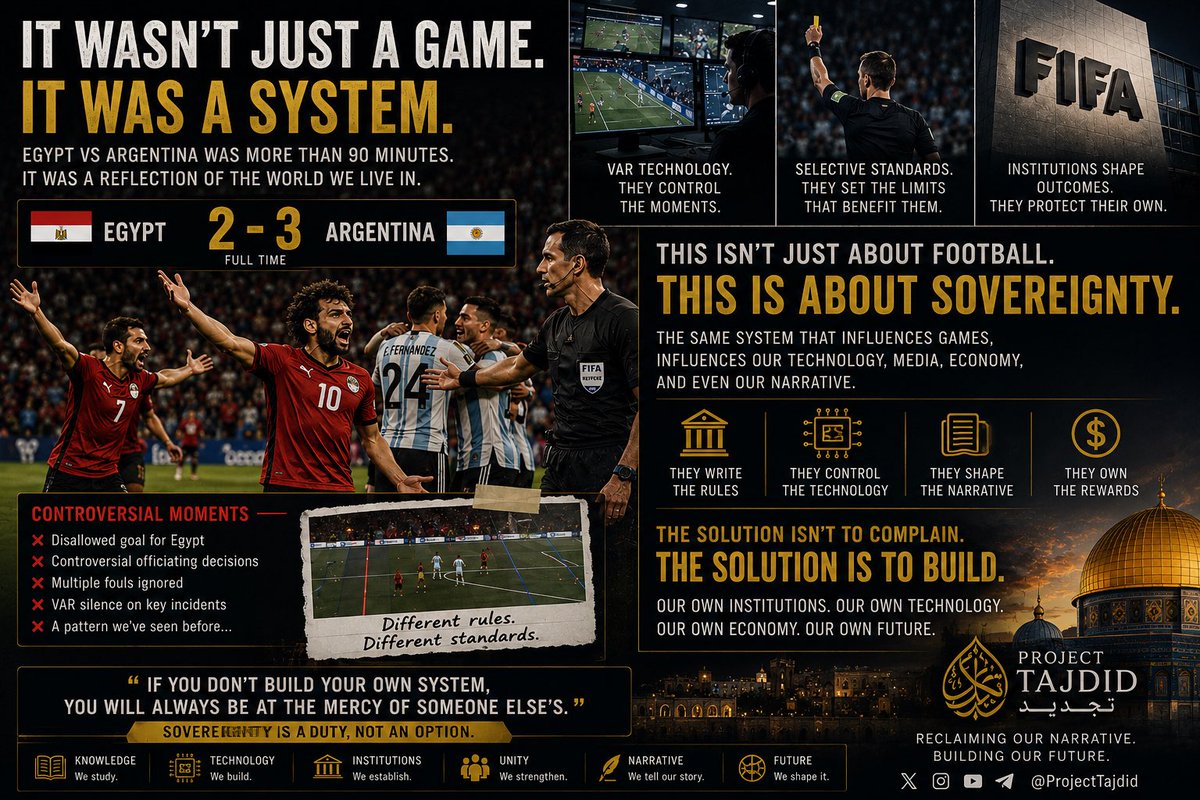
Yesterday’s Egypt–Argentina match wasn’t just about football. If you don’t build your own institutions, you’re always dependent on someone else’s. Technology. Media. Finance. Knowledge. Governance. Civilizations that don’t build these don’t shape the future—they inherit it. The answer is sovereignty. Project Tajdid.
Project Tajdid tweet media
English
0
0
5
487
Project Tajdid
Project Tajdid@ProjectTajdid·
Alhamdulillah — Atlas of Islamic Civilizations is now publicly available on the App Store. The app is designed as an Islamic history atlas that helps users explore civilizations, dynasties, modern nation-states, and historical patterns through an Islamic and civilizational lens. This project combines Islamic history, maps, state analysis, and AI-generated reflections to help users think more deeply about the rise, decline, and development of civilizations. Download it here: apps.apple.com/us/app/atlas-o… Atlas of Islamic Civilizations — now live on the App Store.
Project Tajdid tweet media
English
1
4
9
36.9K
Project Tajdid
Project Tajdid@ProjectTajdid·
The Hassan Tower was never finished. The Muslim civilization wasn’t either. Stone can remain incomplete for centuries. A civilization cannot—as long as its people continue to learn, build, innovate, and strive. Morocco’s modern achievements, from world-class infrastructure to its historic World Cup performances, remind us that our story did not end with unfinished monuments. Our next great construction will not only be of stone—but of knowledge, technology, and institutions. Learn more on the Atlas of Islamic Civilizations app. Project Tajdid.
Project Tajdid tweet mediaProject Tajdid tweet media
English
0
0
1
265
Project Tajdid
Project Tajdid@ProjectTajdid·
This may be the strongest the Ummah has been in the post-WWII era. Not because every problem has been solved. But because never before have Muslims possessed this combination of population, resources, education, technology, and global reach. The foundations are here. Now comes the responsibility to build. Project Tajdid.
Project Tajdid tweet media
English
0
0
0
185
Project Tajdid
Project Tajdid@ProjectTajdid·
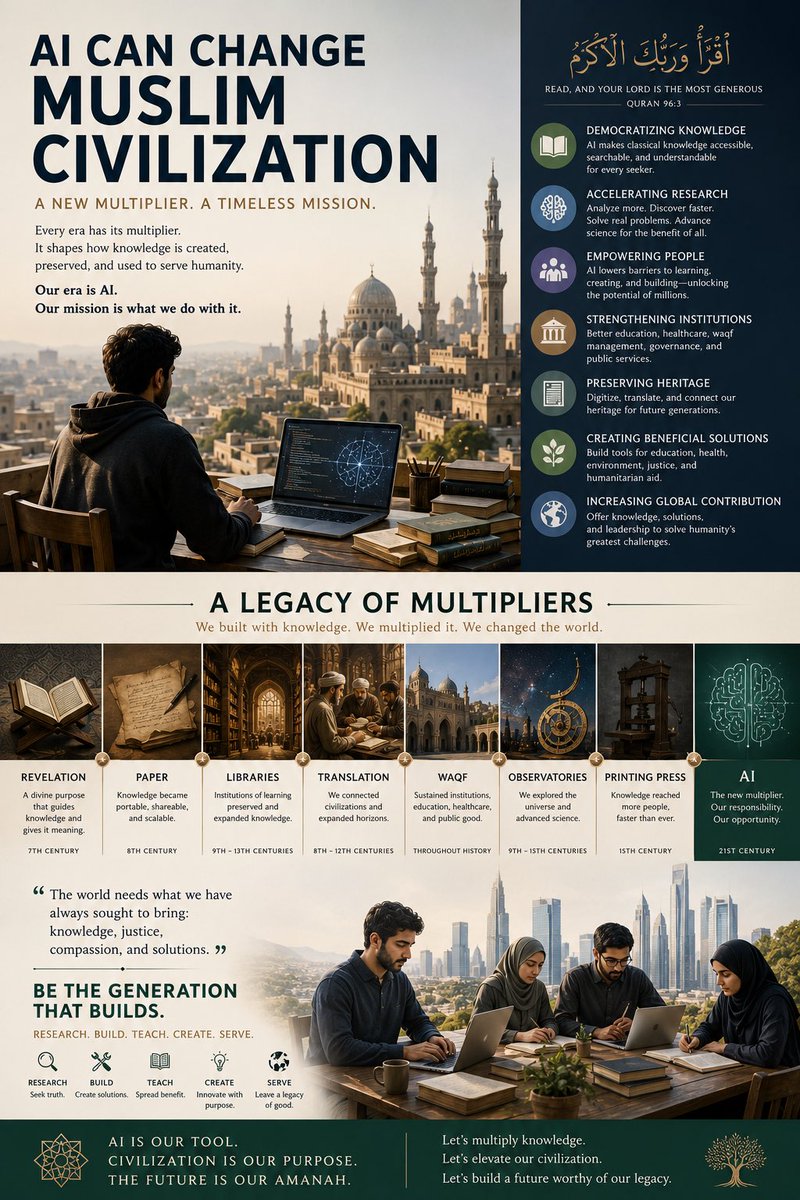
Every civilization had its multipliers. For Muslims, they were revelation, paper, libraries, translation, waqf, observatories, and institutions that transformed knowledge into civilization. Our generation has inherited a new multiplier: AI. Research. Build. Teach. Create. Multiply knowledge. Build civilization. Project Tajdid.
Project Tajdid tweet media
English
0
0
0
146
Project Tajdid
Project Tajdid@ProjectTajdid·
@SirahGame Mashallah. This is a cool project. Wishing you all the best iA.
English
1
0
1
179
SirahGame
SirahGame@SirahGame·
Take a look at the latest prototype footage of Al-Sirah, a full video game about the birth of Islam. This newest build brings meaningful progress to the project, including new activities such as archery 🏹 #alsirah #gamedev #indiegame #godotengine #gamingreels
English
8
4
57
5.4K
Project Tajdid
Project Tajdid@ProjectTajdid·
Explore modern Muslim-majority nation-states through a civilizational lens: identity, institutions, pressures, and legacy. Atlas of Islamic Civilizations helps analyzes states through an Ibn Khaldun-inspired framework with contemporary civilizational models. Coming soon to the App Store. Project Tajdid. #IslamicHistory #Civilizations
Project Tajdid tweet media
English
0
0
1
134
Project Tajdid
Project Tajdid@ProjectTajdid·
The age of passive consumption is ending. The age of civilizational participation must begin. A civilization cannot reclaim its future by endlessly consuming what others create. It must build, innovate, educate, and contribute. The coming age belongs to those who participate. Project Tajdid.
Project Tajdid tweet media
English
0
0
1
110
Project Tajdid
Project Tajdid@ProjectTajdid·
Where is the Islamic civilizational narrative today? Through an Ibn Khaldun lens, the Muslim world is neither in a unified rise nor a unified decline. The Gulf is building institutions. Türkiye seeks civilizational restoration. Iran advances a revolutionary project. Egypt preserves accumulated civilizational capital. Pakistan searches for a coherent synthesis. The Ummah possesses creed, memory, history, and sacred geography. What it lacks is a shared civilizational project. We are not witnessing the end of a cycle. We are witnessing a contest over the beginning of the next one. Project Tajdid.
Project Tajdid tweet media
English
0
0
0
110
Project Tajdid
Project Tajdid@ProjectTajdid·
The cracks in neoliberal unipolarity are becoming impossible to ignore. A multipolar world is emerging into view. The task of Muslims is: preparation for the future. Project Tajdid.
Project Tajdid tweet media
English
0
0
1
81
Project Tajdid
Project Tajdid@ProjectTajdid·
@MisbahSy MashaAllah, it always blows my mind how much room there is for creativity with these patterns. How does the randomizer work? Is it seeded and then generates variations from existing patterns, or is it using some other method?
English
1
0
2
579
Misbah Syed
Misbah Syed@MisbahSy·
AMAZING! Claude Fable 5 one-shotted a beautiful geometric islamic patterns visualizer app you could play with. Every seed generates a new pattern. Download any pattern for free.
English
13
28
342
78K
Project Tajdid
Project Tajdid@ProjectTajdid·
The Project Tajdid AI Constitution An Islamic Framework for the Age of Artificial Intelligence As humanity enters an era in which machines can generate knowledge, media, art, software, and narratives at unprecedented scale, the Muslim Ummah faces a historic choice. We may reject these tools and surrender technological leadership to others, or we may engage them responsibly, guided by revelation, wisdom, and moral restraint. Project Tajdid affirms that Artificial Intelligence is neither inherently virtuous nor inherently evil. It is a tool whose value is determined by its purpose, its governance, and the principles that guide its use. This Constitution establishes the ethical foundations for AI use within an Islamic civilizational framework. ⸻ Article I — Tawḥīd All technological development must remain subordinate to the worship of Allah and the guidance of revelation. AI shall never become an object of reverence, dependency, or authority that supersedes divine guidance. ⸻ Article II — Truth (Ṣidq) AI shall not be used to fabricate religious knowledge, falsify history, spread misinformation, or intentionally deceive. Truth remains sacred, whether spoken by man or generated by machine. ⸻ Article III — Amānah (Trust) Human beings remain morally accountable for every AI-generated output they publish, distribute, or act upon. Responsibility may not be delegated to algorithms. ⸻ Article IV — Beneficial Knowledge (ʿIlm Nāfiʿ) AI should be used to expand education, scholarship, literacy, research, translation, and access to knowledge. Technology should elevate understanding rather than encourage ignorance. ⸻ Article V — Maṣlaḥah (Public Benefit) The preferred use of AI is that which produces genuine benefit for humanity and creation. Education, healthcare, governance, scientific advancement, and community development are among its most noble applications. ⸻ Article VI — Prevention of Harm AI shall not be used for oppression, exploitation, manipulation, humiliation, corruption, or the destruction of individuals, families, communities, or nations. Preventing harm takes precedence over pursuing benefit. ⸻ Article VII — Human Dignity Human beings possess an inherent dignity granted by Allah. AI must never reduce people to mere data points, commodities, political targets, or instruments of profit. ⸻ Article VIII — Verification AI-generated claims concerning religion, law, medicine, history, politics, or public affairs must be independently verified before publication or implementation. Speed shall never replace diligence. ⸻ Article IX — Adab The use of AI must reflect Islamic character: humility, sincerity, honesty, wisdom, mercy, and respect. Technology without character becomes a source of corruption. ⸻ Article X — Civilizational Sovereignty The Ummah should strive to develop independent expertise, institutions, infrastructure, and intellectual leadership in artificial intelligence. Dependence upon foreign technological systems should not result in dependence upon foreign values. ⸻ Article XI — Content Creation AI may be used to create educational, artistic, scholarly, and beneficial content. It should not be used to manufacture outrage, vanity, deception, or empty spectacle. Beauty must remain a servant of truth. ⸻ Article XII — Civilizational Renewal (Tajdid) AI should be used to revive knowledge, strengthen institutions, preserve memory, empower communities, and prepare future generations. Its purpose is not to replace humanity, but to assist humanity in fulfilling its responsibilities before Allah. ⸻ Final Declaration We affirm that the coming age of Artificial Intelligence is not merely a technological revolution, but a moral and civilizational test. The question before humanity is not whether machines will become powerful. The question is whether human beings will remain wise. AI is not our master. AI is our tool. Islam is our compass. Tajdid— our mission.
English
3
0
4
1.8K
Project Tajdid
Project Tajdid@ProjectTajdid·
Explore the major Islamic campaigns of history through our Campaign Atlas. Learn about the commanders, units, weapons, defenses, tactics, and military doctrines that shaped each campaign. projecttajdid.com
Project Tajdid tweet media
English
0
0
1
84