

QANplatform
1.3K posts

QANplatform
@QANplatform
Quantum-resistant Layer 1 hybrid #blockchain platform. 👨💻Code smart contracts in any language. 🆕 QAN TestNet is LIVE! #QANplatform
Katılım Temmuz 2019
29 Takip Edilen47.4K Takipçiler
April Milestones: Enterprise-Ready Architecture, macOS Launch, and SDK Maturity
April marked a definitive turning point for QANplatform. Following in-depth strategic planning, we aligned our engineering roadmap with the rigorous demands of our upcoming government and enterprise partners. We celebrated full cross-platform availability with the macOS release of QAN XLINK and made significant strides in SDK maturity across Go, Python, Java, and more.
Read the full recap on our blog, link in the comments 🔗👇
English
Tiffany has priced cyber risk for eleven years. Ransomware. State-sponsored breaches. AI exploits.
She had never declined to quote. Until she tried to count the public keys.
It is a Monday morning in 2029.
Tiffany prices cyber risk for a living. Eleven years in. She is not easily surprised.
The application on her screen is from a crypto exchange. They want quantum-transition liability coverage for the eighteen months it will take them to complete their migration. She has seen six of these this month alone.
She opens their cryptographic asset inventory. Active wallets, signing infrastructure, hot wallet architecture. All migrated or in progress. Clean.
Then she scrolls to the section the exchange marked low priority.
Historical transaction records, 2017 to 2024.
She pulls the number of unique public keys ever broadcast by users during that window. A public key exposed every time someone made a withdrawal. Every time anyone signed anything on-chain. All of it permanently sitting on public ledgers the exchange does not own, cannot modify, and cannot take down.
Keys they were never authorized to rotate. Belonging to users who have since left, lost access, or simply do not know this conversation is happening.
She looks at the number.
Forty-one million.
Not forty-one million dollars of exposure. Forty-one million individual cryptographic attack surfaces. Each one a direct mathematical path to a private key. Each one permanent.
She types one line into the file.
"Decline to quote. Unquantifiable tail risk. Historical on-chain exposure falls outside any actuarial model currently available."
Then she opens the next application. A different exchange. Larger.
She already knows what she is going to find.
English
Elliptic curves for anyone to understand.
You pick a point on a curve. You multiply it by a secret number to get a new point. That new point is your public key. The secret number is your private key. Multiplying is easy. Reversing the multiplication is hard. A quantum computer makes it not hard.
English

Exciting update: QAN technology is being integrated into two government, finance and enterprise focused products, one of them already having a signed pilot.
To support this, we are restructuring onto an Ethereum-based foundation, aligning with the operational standards these sectors require. Our core values remain unchanged: QVM stays, quantum security via XLINK continues, and EVM compatibility is strengthened.
Watch the full announcement, or read through it on our blog.
Links in the comments 👇
English
Every chain that calls quantum risk "years away" is making a bet with someone else's assets.
English
Somewhere in the 1990s, a cryptographic decision was made that nobody questioned.
In 2026, 25,000 developers woke up holding the bill for it.
Nobody asked the developers.
Not when the cryptographic assumptions were baked into every protocol. Not when the standards were finalized. And not when the migration timelines started appearing in government memos.
The engineers just woke up one day holding the bill for a decision that was made in the 1990s.
Here is what that bill actually looks like.
There are roughly 20,000 to 30,000 active blockchain and Web3 developers globally. Not millions. Tens of thousands. A remarkably small group to be maintaining infrastructure that holds trillions in value. Every single one of them is writing against cryptographic primitives, ECDSA, secp256k1, SHA-256, that were designed before quantum computing was an engineering concern rather than a physics thought experiment.
They did not choose those primitives. They inherited them. And they built entire ecosystems on top.
Now here is the ask.
Migrate.
Rotate keys across millions of wallets.
Upgrade signature schemes on live networks with billions in locked value.
Coordinate hard forks across decentralized communities that agree on almost nothing.
Rewrite SDKs, auditing frameworks, tooling, documentation, and mental models across an industry that is already running at full capacity just keeping up with what it has.
Oh, and do it before a timeline nobody can pin down precisely, against a threat that is invisible until the day it is not.
This is not a product roadmap item. It's a civilizational infrastructure problem. Handed to a generation of developers who were just trying to build.
And the cruelest part is this.
The developers who are most exposed are not the ones who made the original design choices. They are the ones who arrived later, learned the tools that existed, shipped real things, and are now being told the foundation those tools sit on has an expiration date.
Post-quantum cryptography is not complicated because the math is hard, though it is. It is complicated because ML-DSA and ML-KEM, the NIST-standardized algorithms meant to replace what we have, are not drop-in replacements. Signature sizes are 30 to 40 times larger. Key generation behavior is different. The entire security proof rests on different mathematical hardness assumptions that most working developers have never had reason to study.
The tooling is immature. The libraries are young. The audit standards for post-quantum smart contract security do not fully exist yet.
So what is the actual solution?
It is not telling developers to become post-quantum cryptographers on top of everything else they are already doing.
It is building the quantum-safe layer underneath them. Into the protocol. Into the base layer. So that a developer writing a smart contract in 2026 does not have to understand lattice-based cryptography any more than a developer writing a web app today needs to understand the TLS handshake.
The best infrastructure becomes invisible. It solves the hard problem at the layer where the hard problem belongs, and hands developers a clean surface to build on.
We understand this and we are not asking developers to carry the quantum migration. We ship the solution ourselves.
English
The myth
Chains can just upgrade to post-quantum cryptography when the time comes.
The reality
Immutable smart contracts cannot be patched.
Keys cannot be rotated on behalf of users who have lost access.
Coordination across millions of independent wallets has no enforcement mechanism.
"When the time comes" assumes a clean handoff that decentralized systems have no architecture to deliver.
English
Bitcoin's security is not a lock. It is a clock.
And for the first time in history, we can hear it ticking.
Satoshi Nakamoto owns roughly 1.1 million Bitcoin.
Those coins have shown no confirmed outgoing activity. The public keys are permanently exposed on the blockchain for anyone, and eventually any machine, to see.
It is an open ledger. Go look.
Here is why that matters in a way most people have never thought about.
Early Bitcoin wallets used a format called Pay-to-Public-Key. P2PK. In that format, your actual public key, not just a hashed address, but the raw public key itself, is visible on-chain the moment you receive funds.
Modern wallets are slightly better. They hide your public key behind a hash until you spend. But the moment you send a transaction, your public key is exposed. Forever, immutably, on thousands of nodes across the planet. Plus Taproot, Bitcoin's newest address format, reintroduces a variation of this problem embedding the public key directly in the address once again.
There are an estimated 6.9 million Bitcoin sitting in addresses with permanently exposed public keys right now.
And here is the uncomfortable geometry of this.
A quantum computer running Shor's algorithm does not need your permission or your cooperation to derive your private key from your public key. It needs computation time and your public key. One of those things is improving exponentially. The other is already public.
The sleeping wallets are not the only problem. They are the most visible symptom of it.
Every chain that launched before post-quantum cryptography was a serious engineering consideration, which is essentially every major chain alive today, was designed around the assumption that public keys are safe to expose.
That assumption was reasonable in 2009. It was reasonable in 2015. It is becoming less reasonable every year, and there is no clean way to fix it retroactively on a decentralized network where nobody is in charge.
Ethereum has made post-quantum security a strategic priority, launching a dedicated research effort, development test networks, and millions in funding. Addressing the threat would likely involve large-scale coordination, potentially requiring many independent wallets to migrate to new cryptographic standards before ‘Q-Day.’ While the network can coordinate upgrades, there is no central authority that can force all users to act, and wallets whose owners have lost access, died, or are inactive may never be upgraded meaning the success of any transition depends heavily on voluntary adoption at scale, with no fixed or reliable deadline.
Coordination theory has a name for this kind of problem. It calls it nearly impossible.
The chains that will survive the quantum transition are not the ones that will scramble to patch. They are the ones that treated quantum-safe cryptography, specifically NIST-standardized algorithms like CRYSTALS-Dilithium, as a founding architectural decision, not a future upgrade.
Because you cannot retrofit a foundation.
You can only build on one.
English
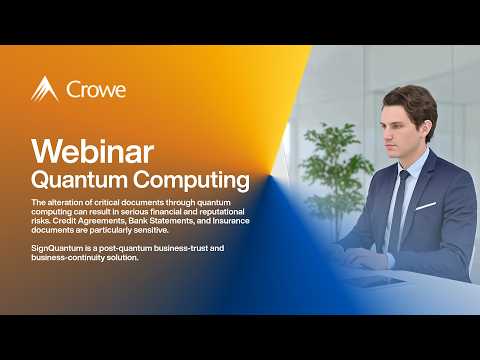
A loan agreement. One digit changed. Millions of euros at risk. No court can prove which version is authentic.
That's not a hypothetical, it's the document integrity crisis that quantum computers will make possible by breaking RSA and ECC cryptography.
SignQuantum addresses this with the help of QANplatform's post-quantum technology:
- it generates a cryptographic hash of every signed document and
- anchors it to QANplatform's quantum-resistant blockchain using ML-DSA (NIST FIPS 204) creating a mathematically provable, tamper-proof timestamp that survives the post-quantum era.
Crowe Portugal, a member of one of the world’s largest consulting and top-10 global accounting firms, hosted a 48-minute deep dive on the quantum threat, the regulatory landscape, and how to act before Q-Day arrives.
Link in the comments 👇

English
The myth
My assets are safe because the quantum computer powerful enough to break ECDSA does not exist yet.
The reality
Harvest-now-decrypt-later means the exposure already happened. The moment your public key was broadcast on-chain, the attack surface was created. The quantum computer does not need to exist at broadcast time. It only needs to exist at some point in the future.
English
Download from qanplatform.com/xlink/
Share your experience. Fill in the feedback form 👉 forms.gle/cAbgVKyjPd2Xoa…
English
Mac users, the wait is over.
The QAN XLINK desktop app is now available on macOS! Quantum-safe security, now on every major platform.
Linux ✅ Windows ✅ macOS ✅
Download it and let us know what you think.
Link in the comments 👇
English
4/🧵If you are a regular user with assets on-chain
The exposure is not immediate. But keys generated today on quantum-vulnerable chains will be recoverable by sufficiently advanced quantum hardware in the future. The wallets do not update themselves. The chains do not migrate on your behalf. This is worth knowing.
NIST publishing was not a warning shot. It was a starting gun.
English
3/🧵If you are an enterprise evaluating blockchain for serious deployment
Your security team already knows about the NIST standards. The question is whether they have connected it to your blockchain infrastructure evaluation yet. When they do, the question becomes simple, what is this chain's migration path and what does it cost us? If the answer is unclear, that is a procurement risk. And enterprise procurement people are paid to find those risks.
English
The cryptography securing every major blockchain got an expiration notice. Most missed it.
NIST published its post-quantum cryptographic standards on August 13, 2024. Most of crypto either missed it or filed it under future problem.
Here is what it actually means, cut by who you are. 🧵
English