QING DAI

149 posts

QING DAI banner
QING DAI

QING DAI

@QINGDAI444

Prof. at Shanghai Jiao Tong University, China. Focus on #nanophotonics,#2Dmaterials,#polaritons,#ultrafast electron source

Shanghai, China Katılım Eylül 2015
210 Takip Edilen187 Takipçiler
QING DAI
QING DAI@QINGDAI444·
We systematically reviewed anomalous polariton transport mechanisms in hyperbolic media, proposing "atomic manufacturing of optical states" and a physical framework across OD-3D systems. doi.org/10.1038/s41578…
English
0
0
1
35
QING DAI retweetledi
Jorge Bravo Abad
Jorge Bravo Abad@bravo_abad·
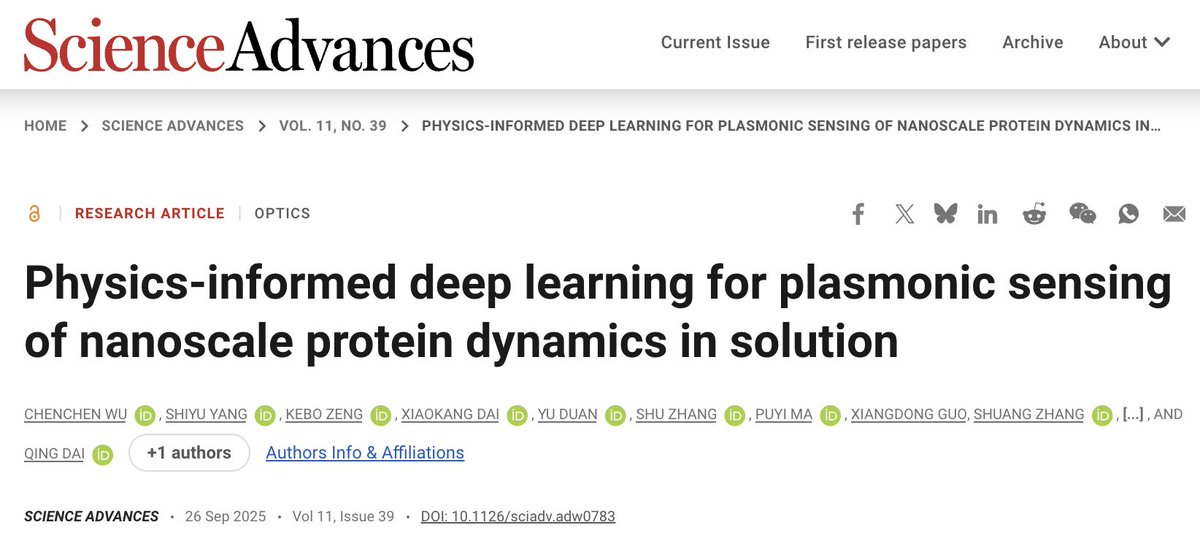
Watching proteins fold in water with plasmonics and AI Proteins rarely stay still. They twist, fold, and misfold in aqueous environments, and these subtle structural changes underlie processes from silk fiber formation to neurodegenerative disease. Yet probing them directly in water has long been a challenge: the very infrared bands that report on protein secondary structure (like the amide-I band) are drowned out by the strong absorption of H₂O. Conventional tricks—drying the sample or replacing water with heavy solvents—help, but at the cost of biological realism. Chenchen Wu and coauthors fuse nanophotonics with ML to keep everything in situ. On the hardware side, a graphene–gold metasurface creates hybrid graphene plasmons in a ~2 nm in-plane gap, squeezing mid-IR light into an ~13 nm² hotspot. That nano-focus both amplifies amide bands and physically displaces water from the field. Electrical tuning of graphene’s Fermi level then “locks” the plasmon onto the vibrational fingerprints of interest. On the learning side, they train a physics-informed CNN: pretrain on spectra simulated from the device’s electrodynamics, fine-tune on experiments, and—crucially—preprocess with synthesized complex-frequency waves (s-CFW) that virtually reduce dissipation to sharpen overlapping peaks. The payoff: mean relative error <0.10 on secondary-structure percentages (over 2× better than a vanilla CNN), resolving β-sheet / coil / turn content for sub-10-nm protein layers and tracking real-time conformational shifts during silk nanofibril assembly—directly in H₂O. Why this matters: a practical route to watch misfolding, aggregation, and receptor–ligand dynamics as they happen in physiological media. More broadly, it’s a template for physics-guided AI in spectroscopy—pairing engineered light fields with models that know the underlying physics to do more with less data. Paper: science.org/doi/full/10.11…
Jorge Bravo Abad tweet media
English
1
23
153
11.1K
QING DAI
QING DAI@QINGDAI444·
Excited to share our new work with Hailong Chen’s group, published in PRB! Using ultrafast infrared microspectroscopy, we reveal nonequilibrium intrinsic phonon relaxation in hBN, which shows near-unity polarization and a nonmonotonic decay. journals.aps.org/prb/abstract/1…
English
1
0
0
48
QING DAI
QING DAI@QINGDAI444·
Excited to share our latest collaborative work with Shuang Zhang’s team @ScienceAdvances! We combine a mid-IR plasmonic sensor with a physics-informed CNN to decode protein structures in water at the nanoscale.science.org/doi/10.1126/sc…
English
0
0
2
42
QING DAI retweetledi
Nature Materials
Nature Materials@NatureMaterials·
Metal-tip-based electron sources are constrained by a trade-off between energy spread and pulse width. Here the authors report a carbon-nanotube-based electron source with a 0.3-eV energy spread and an electron pulse width of about 13 fs. nature.com/articles/s4156…
English
1
11
30
3.6K
QING DAI
QING DAI@QINGDAI444·
Our new paper is now online @NatureMaterials. We demonstrate an ultrafast electron source based on a carbon nanotube emitter, achieving 13 fs pulse width and 0.3 eV energy spread. Thanks to all collaborators! 🔗 nature.com/articles/s4156…
English
0
0
2
48
QING DAI
QING DAI@QINGDAI444·
Glad to announce our first paper in 2025, published in Advanced Materials , which reviews Ultrafast Infrared Plasmonics and explores non-equilibrium ultrafast light-matter interactions and their cutting-edge applications! advanced.onlinelibrary.wiley.com/doi/10.1002/ad…
English
0
0
5
102
QING DAI retweetledi
Science Magazine
Science Magazine@ScienceMagazine·
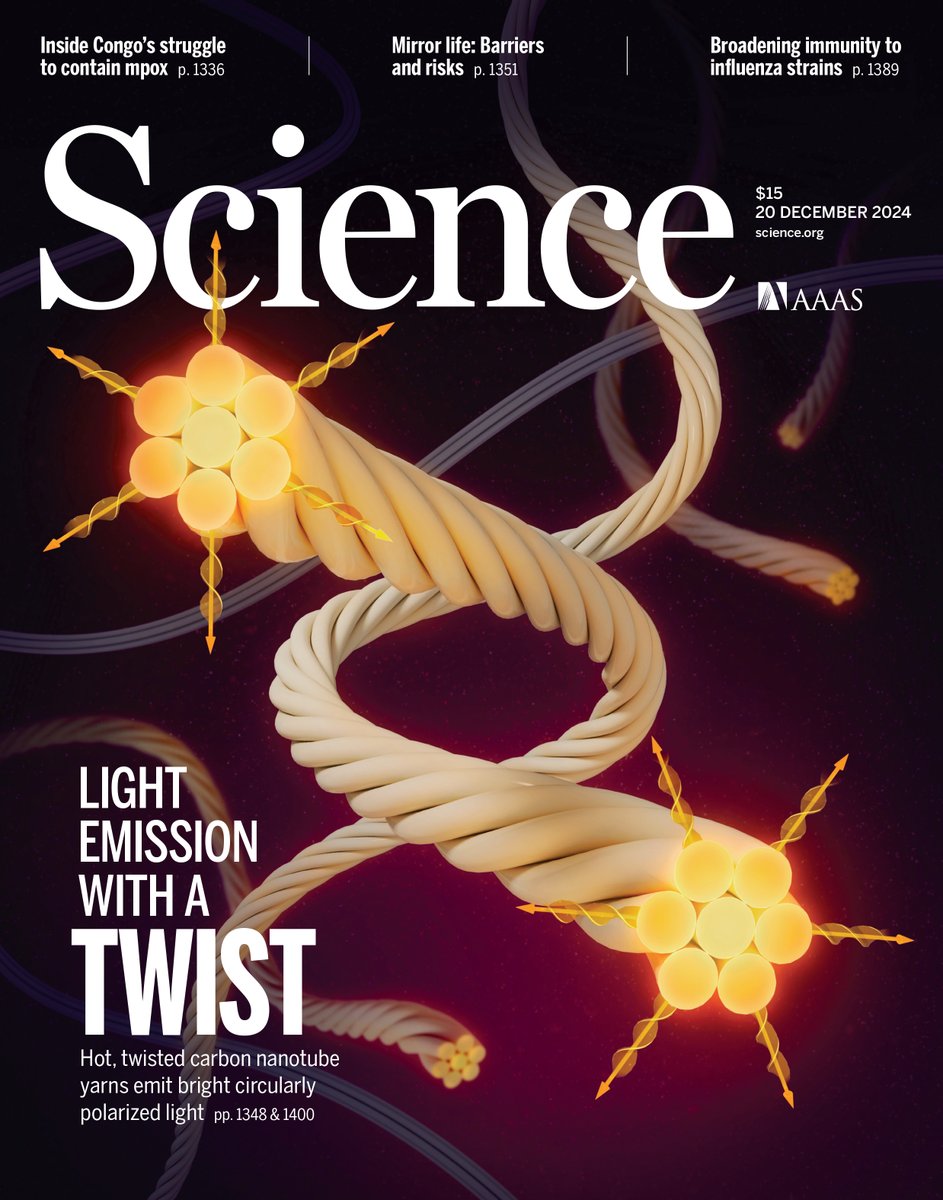
In a new Science study, researchers report that twisted carbon nanotube filaments can emit circularly polarized thermal radiation with a high brightness. These materials could be used at high temperatures that are unattainable by existing emitters. Learn more in our last issue of 2024: scim.ag/3P3aIVj
Science Magazine tweet media
English
26
75
351
281.3K
QING DAI retweetledi
Chao-Yang Lu
Chao-Yang Lu@chaoyanglu·
AI-enabled, rapid, constant-time-overhead rearrangement of defect-free atom arrays with 2024 atoms. arxiv.org/abs/2412.14647
English
2
3
22
2K
QING DAI retweetledi
nature
nature@Nature·
Generative artificial-intelligence tools have been widely adopted across academia, but users might not be aware of all their inherent risks go.nature.com/47ipOyQ
English
1
11
55
13.3K
QING DAI retweetledi
Science Magazine
Science Magazine@ScienceMagazine·
This week: Researchers have fabricated MXene films at room temperature using bacterial cellulose and liquid metal to sequentially bridge the nanosheets. The results provide a path for assembling other 2D nanosheets into high-performance materials. scim.ag/7yV
Science Magazine tweet media
English
17
47
237
355.1K
QING DAI retweetledi
eLight
eLight@eLight2021·
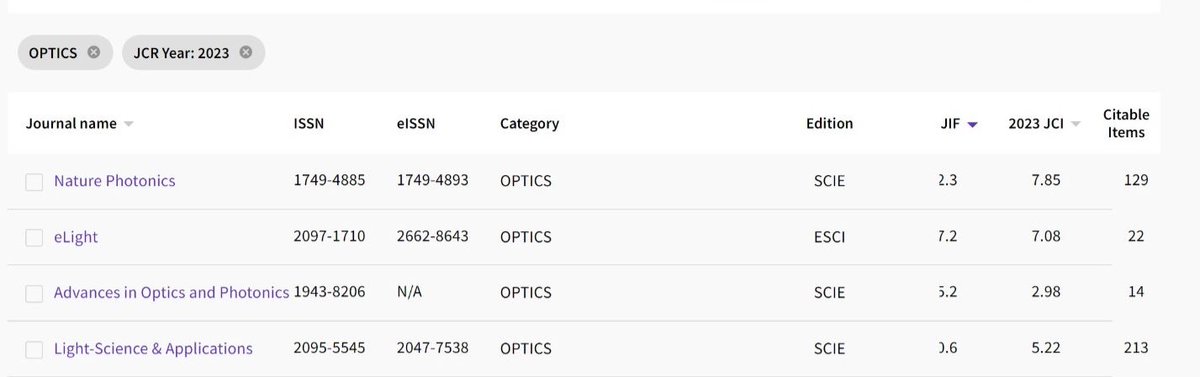
🎉🌟Exciting news! The first-ever Impact Factor (IF) for @eLight2021 has been unveiled, and it is 27.2 ! This achievement propels the eLight to the “number two ranking”among all optics journals!
eLight tweet media
English
2
4
13
2.3K
QING DAI
QING DAI@QINGDAI444·
Delighted to share our latest collabrative research @NatureComms. Here we employ a graphene plasmonic infrared sensor to probe the secondary structure of nanoscale assembly intermediates and their morphological evolution of silknanofibrils. nature.com/articles/s4146…
English
0
0
7
117