QVAC
97 posts

@qvac
Infinite intelligence. Local. Any Hardware. Peer-to-Peer Hyper Swarm. No cloud. No compromise. QVAC is the decentralized AI platform for humans and machines.


Tether AI breakthrough Tether AI team just released new version of QVAC Fabric to include the World’s First Cross-Platform BitNet LoRA Framework to Enable Billion-Parameter AI Training and Inference on Consumer GPUs and Smartphones. Background Microsoft's BitNet uses one bit architecture to dramatically compress models. Traditional LLMs operate on full-precision computation, where weights are stored as complex, high-resolution numbers. The innovation of BitNet is that it shrinks these weights into a tiny ternary range of only -1, 0, and 1. significantly reducing memory usage and computation. LoRA, is a parameter-efficient fine-tuning technique that reduces the number of trainable parameters by up to ninety-nine percent. Together they slash memory and compute requirements. Yet BitNet has mostly been limited to CPU or CUDA NVIDIA backends, and lacked the support of LoRA fine-tuning. Enters QVAC Fabric: the unlock Today, with QVAC Fabric LLM, is the first time BitNet LoRA fine-tuning and inference work cross-platform across GPU vendors and operating systems using Vulkan and Metal backends. That means support for AMD, Intel, Apple Metal and also Mobile GPUs. And for the first time ever, BitNet inference runs efficiently on smartphones using mobile GPUs. On flagship devices, GPU inference is 2 to 11 times faster than CPU while using up to 90% less memory than the full precision models. The biggest unlock: QVAC Fabric LLM support for BitNet LoRA fine-tuning on heterogeneous GPUs. Our team was able to demonstrate this by fine tuning models up to 3.8 billion parameters on all flagships phones such as Pixel 9, S25 and iPhone 16 and up to 13 billion parameter models on the iPhone 16. Github repositories: github.com/tetherto/qvac-… : general QVAC Fabric codebase github.com/tetherto/qvac-… : specific QVAC Fabric's BitNet knowledge base, architecture docs and pre-built binaries What does it mean? What used to require dedicated GPUs now runs on consumer hardware. This breakthrough is the first real-world signal of a local private AI that can truly serve the people. And this is just the beginning. In the next months and years Tether will relentlessly continue to invest significant amounts of resources and capital to continue to research and develop open-source intelligence that can scale and evolve on local devices, providing maximum utility and privacy to its users. The era of Stable Intelligence has just begun. Free as in freedom.

Tether AI breakthrough Tether AI team just released new version of QVAC Fabric to include the World’s First Cross-Platform BitNet LoRA Framework to Enable Billion-Parameter AI Training and Inference on Consumer GPUs and Smartphones. Background Microsoft's BitNet uses one bit architecture to dramatically compress models. Traditional LLMs operate on full-precision computation, where weights are stored as complex, high-resolution numbers. The innovation of BitNet is that it shrinks these weights into a tiny ternary range of only -1, 0, and 1. significantly reducing memory usage and computation. LoRA, is a parameter-efficient fine-tuning technique that reduces the number of trainable parameters by up to ninety-nine percent. Together they slash memory and compute requirements. Yet BitNet has mostly been limited to CPU or CUDA NVIDIA backends, and lacked the support of LoRA fine-tuning. Enters QVAC Fabric: the unlock Today, with QVAC Fabric LLM, is the first time BitNet LoRA fine-tuning and inference work cross-platform across GPU vendors and operating systems using Vulkan and Metal backends. That means support for AMD, Intel, Apple Metal and also Mobile GPUs. And for the first time ever, BitNet inference runs efficiently on smartphones using mobile GPUs. On flagship devices, GPU inference is 2 to 11 times faster than CPU while using up to 90% less memory than the full precision models. The biggest unlock: QVAC Fabric LLM support for BitNet LoRA fine-tuning on heterogeneous GPUs. Our team was able to demonstrate this by fine tuning models up to 3.8 billion parameters on all flagships phones such as Pixel 9, S25 and iPhone 16 and up to 13 billion parameter models on the iPhone 16. Github repositories: github.com/tetherto/qvac-… : general QVAC Fabric codebase github.com/tetherto/qvac-… : specific QVAC Fabric's BitNet knowledge base, architecture docs and pre-built binaries What does it mean? What used to require dedicated GPUs now runs on consumer hardware. This breakthrough is the first real-world signal of a local private AI that can truly serve the people. And this is just the beginning. In the next months and years Tether will relentlessly continue to invest significant amounts of resources and capital to continue to research and develop open-source intelligence that can scale and evolve on local devices, providing maximum utility and privacy to its users. The era of Stable Intelligence has just begun. Free as in freedom.

The era of Stable Intelligence is here 🤖 Tether’s QVAC Fabric just released the world’s first cross-platform 1-bit LLM LoRA fine-tuning framework. QVAC Fabric extends Microsoft's ultra-efficient BitNet architecture, allowing fine-tuning and inference of LLMs directly on your smartphone—no NVIDIA GPU/CUDA lock-in or expensive server required. The Breakthrough: - Total Sovereignty: LoRA fine-tune ultra-efficient models locally on any smartphone, including iPhones, Pixel phones, Samsung Galaxy phones and any desktop/laptop operating systems using Vulkan and Metal backends. - Extreme Efficiency: 1-bit architecture uses up to 90% less memory and runs up to 11x faster than traditional models. - Universal Access: What used to require a data center now runs on the chip in your pocket. Own your intelligence. The era of stable, local AI is here. 📱🧠 Read the full details on Hugging Face and grab the binaries to build on your own hardware. huggingface.co/blog/qvac/fabr…


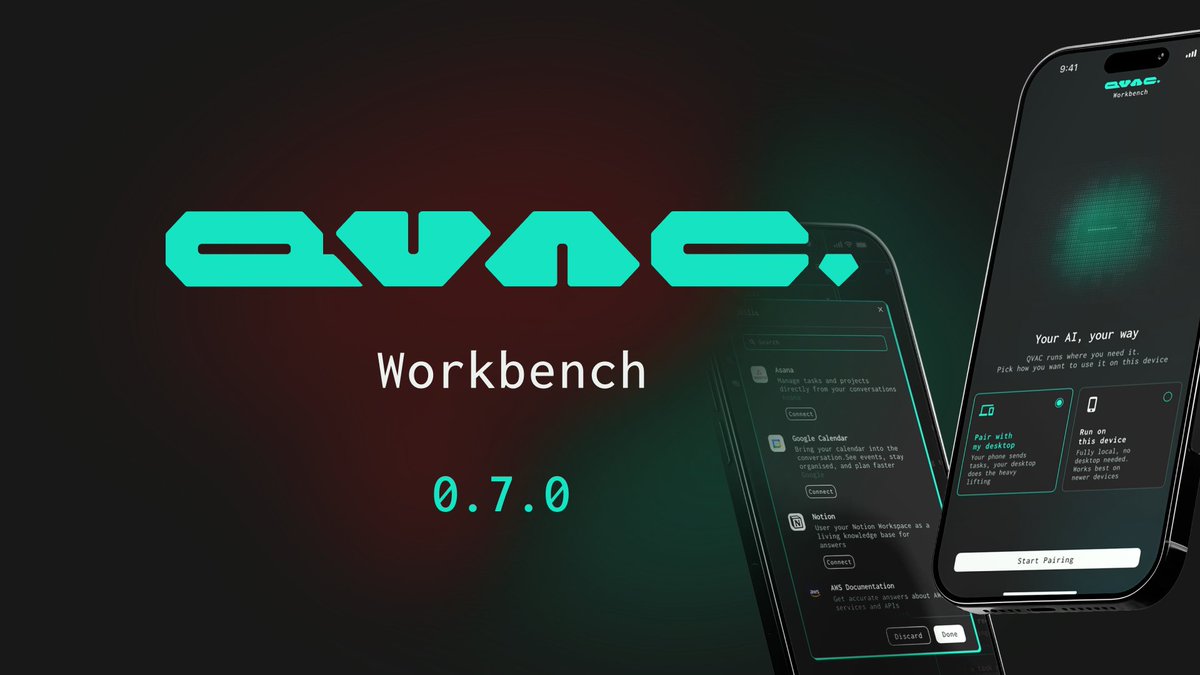
QVAC Workbench 0.4.1 is here for Desktop & Mobile! 🚀 The future of AI is local, and we’re evolving the serverless experience with our latest update: ✦ Redesigned UI: A complete overhaul focused on simplicity for all users. ✦ Delegated Inference: Clearer status indicators and improved model selection. ✦ Expanded RAG: Now supporting even more document formats for your data. ✦ Mobile Optimization: Smoother Android performance with specific fixes for Samsung and Pixel 10. ✦ Reliability: Crushed connection and authentication bugs for a seamless, always-on experience. A cleaner chat interface and enhanced navigation are packed in too. Take back control of your data and update now!


Every night, your body tells a story. 🧬💤 Tether is proud to announce our strategic investment in @eightsleep to build the future of human health intelligence. By combining their pioneering sleep fitness with our platform for Edge AI, @QVAC, we are setting a new standard for human potential. Tether x Eight Sleep. Unstoppable together.


We took the CES stage to share our vision of human-centric humanoid robotics. At #CES2026, together with @AMD, we unveiled #GENE01: the product DNA of Generative Bionics and the foundation of our Physical AI platform. Intelligence that lives in the body. Design as a source of trust, safety, and acceptability. Humanoids built to work with people, not around them. 🎥 Watch the presentation: youtu.be/epfJptqoMfA Find us at CES 2026! AMD Connect – The Venetian, Titian Rooms 2302–2305 #GENE01 #GenerativeBionics #PhysicalAI #HumanoidRobotics #HumanCentricAI #CES2026