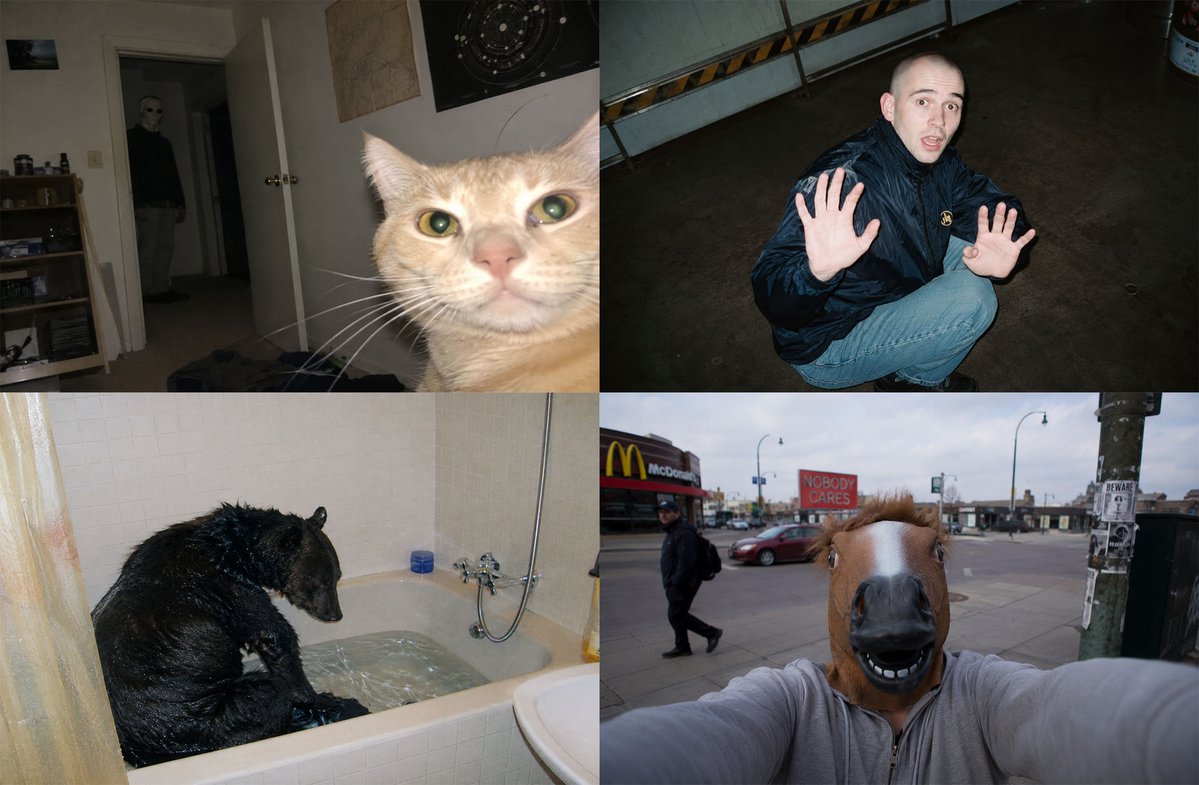
I found the new WEIRDEST ChatGPT prompt
Send it this with nothing attached:
"Show me a random photo from a strange SD card found on the street"
There is no photo. So the model invents one
And every pic is different. You will never get the same photo twice
the skill prompt:
name: paper-motion
description: Create viral paper-collage / paper-cut / VOX-style motion graphics end-to-end using Arcads. Generate an original layered paper-craft illustration, refine it, then animate it into a short vertical video (Reels, TikTok, Shorts).
Use this skill whenever the user mentions:
- paper collage
- paper cut
- papercraft
- layered paper
- VOX style
- storybook animation
- handcrafted illustrations
- turning a paper-style image into an animated video
Also use it when the user provides paper-craft reference images and wants artwork in the same visual style.
---
# Paper Motion
Create handcrafted paper-cut illustrations and animate them into cinematic vertical videos using Arcads only.
Target aesthetic:
- layered paper depth
- visible paper texture
- realistic cut edges
- soft shadows
- warm cinematic lighting
- subtle, elegant motion
Simple compositions with polished animation consistently outperform overly complex scenes.
---
## Workflow
1. (Optional) Analyze reference images.
2. Generate the illustration.
3. Refine until it looks handcrafted.
4. Animate into a short vertical video.
5. (Optional) Upscale.
6. Deliver a 1080×1920 MP4 at 24–30 fps.
Arcads widgets handle generation, polling, previews, and downloads automatically. Never expose asset IDs or URLs.
---
## 1. Analyze References (Optional)
If the user supplies reference images:
- Upload/register them.
- Analyze their visual style.
Analysis should focus on:
- paper texture
- paper thickness
- layering
- lighting
- shadows
- cut edges
- color palette
- composition
Describe only the design language—not the subjects.
Use this style description when generating the illustration.
If no references are provided, continue with the default paper-craft style.
---
## 2. Generate Illustration
If the user hasn't described a subject, ask what scene they want.
Always generate in portrait (9:16).
Prompt template:
Handcrafted paper collage illustration of [SCENE].
Style:
- layered paper-cut artwork
- visible paper thickness
- realistic cut edges
- soft drop shadows
- tactile paper texture
- [COLOR PALETTE]
- premium cinematic lighting
- strong foreground, midground, and background separation
Composition:
[Describe the focal subject and placement.]
The artwork should resemble a photographed handcrafted paper diorama rather than a flat digital illustration.
Examples:
- a fox walking through an autumn forest
- an underwater world with whales and coral reefs
- a fantasy castle at sunrise
- a cozy storybook village
Strong layer separation is essential for convincing parallax animation.
---
## 3. Refine
Iterate until the still image feels handcrafted.
Common adjustments:
- thicker paper
- stronger texture
- deeper layer separation
- softer pastel palette
- more realistic shadows
- finer paper-cut details
- more handcrafted appearance
Do not begin animation until the illustration is finalized.
---
## 4. Animate
Use the finished illustration as the starting frame.
Generate a vertical 9:16 video, 5–10 seconds.
Animation prompt:
Animate this paper collage like a handcrafted diorama filmed with a cinematic camera.
Camera:
- slow push-in
- subtle parallax
Motion:
- foreground moves slightly faster
- midground moves gently
- background moves slowest
Animate only a few elements, such as:
- drifting leaves
- moving clouds
- light rays
- floating particles
- birds
- butterflies
- gentle water movement
Preserve:
- paper texture
- layered depth
- cut edges
Avoid:
- morphing
- warping
- new objects appearing
- excessive movement
Professional paper animation is subtle.
---
## 5. Upscale & Deliver
If higher quality is requested, upscale the final render.
Output:
- 1080×1920
- MP4
- 24 or 30 fps
- optimized for Reels, TikTok, Shorts
The Arcads widget provides the download automatically.
---
## Recommended Subjects
- magical forests
- fairytale villages
- wildlife
- underwater worlds
- mountains
- fantasy castles
- children's storybook scenes
- seasonal landscapes
- travel destinations
- festivals
- animals
- nature
- city skylines
- food illustrations
---
## Common Mistakes
Avoid:
- over-animating every object
- excessive colors
- aggressive camera movement
- flat shadows
- thin paper layers
- cluttered compositions
- animating before the still artwork is finalized
Subtle motion consistently produces better results.
---
## Viral Content Tips
The strongest videos:
- establish a visual story within the first 3 seconds
- use smooth layered motion
- emphasize handcrafted realism
- finish with a satisfying reveal
For a series, maintain a consistent palette, recurring characters, and a unified visual style.
ONE PROMPT, 5 AI MODELS, AND THE MOTION DESIGN PIPELINE IS GONE
The setup is almost insultingly simple. Arcads MCP plugged into Claude, plus one uploaded motion skill. That is the entire stack. Two connections, done once.
From there, Fable 5 talks to Arcads directly and routes every job to the right model on its own. GPT-Image and Nano Banana 2 for image work, Seedance 2.5 for video, GPT-Image feeding Kling 3.0 or Veo 3 when the brief is paper motion graphics. The human contributes one prompt. The agent handles model selection, generation, and delivery.
Notice what got deleted. No After Effects. No keyframes. No timeline. No render queue. No junior designer burning 3 days on revisions. A production layer that took years to learn compressed into a setup step that takes 10 minutes.
The output is not even the interesting part. The architecture is. The model stopped being the product and the orchestration became the product. The person who routes 5 models correctly beats the person who owns 1 better model.
This is the same sequence that already ran through other verticals. Copywriting fell first. Static ad creative second. Motion graphics was supposed to be protected because it required craft. The craft got serialized into a skill file and uploaded.
Tool proficiency was a 30-year career category. It is now a file you attach once
A $5,000 WEBSITE NOW COSTS ONE PROMPT
A working website used to be a line item. Agencies quoted $3,000 to $10,000 for it. Freelancers billed $50 to $150 an hour and delivered in four to eight weeks. That price never reflected the difficulty of the work. It reflected the scarcity of people who could do it
That scarcity is gone. One prompt into Claude produces a structured, styled, functional site in minutes. Not a mockup. Not a wireframe. Shippable output. The input cost is a $20/month plan and the ability to describe what you want in a paragraph
The economics here are brutal in one specific direction. Nobody pays $4,000 for a five-page brochure site when the same artifact costs effectively zero. The mid-tier follows, because most mid-tier work was always templated anyway
What survives is judgment. Knowing what to ask for, what to reject, what a client actually needs vs what they said. The taste behind the prompt is the entire remaining product
This is the same pattern that hit stock photography, translation, and copywriting. Production capacity goes to infinity, price goes to zero, and the value migrates one layer up to the person directing the machine. Web design is next in line
The uncomfortable part: the people best positioned to profit are not developers. They are the ones with clients, distribution, and problems to solve, who were previously locked out by a $5,000 toll
The price of a website is now the price of knowing what you want
A $20/MONTH CLAUDE PRO SUBSCRIPTION JUST SWALLOWED AN ENTIRE SOFTWARE CATEGORY
Anthropic rebuilt Claude Design in June. The canvas is now directly editable: click an element, resize it, reposition it, change its properties. Before, moving a button meant describing the move in a prompt and regenerating the screen. That loop is gone
It also stopped being a separate destination. It sits in the sidebar of the Claude desktop app and burns the plan you already pay for, no extra cost on Pro, Max, Team or Enterprise. Pro is $20 a month. Max runs $100 to $200. Design is now a tab inside a number you were already paying
The edit loop was the reason AI design tools stayed demos. Generate, squint, re-prompt, lose the two things that worked. Direct manipulation splits the labor correctly: the model produces structure and variation, the human grabs the pixel. That is the difference between a slot machine and software
The billing detail is the sharper move. A million people used Claude Design in its first week. Not one of them needed a new account, a new invoice or a new line item to approve. Every standalone tool selling design generation as its whole business now competes against a marginal price of zero, inside a product that already converted the customer
Placement compounds it. The canvas syncs both ways with Claude Code: a visual edit becomes a code change, and shipped code flows back onto the canvas. Design stops being an app you open and becomes a surface inside the place the work already happens
This is the rebundling. SaaS spent a decade splitting office software into point tools, each with its own seat price. General assistants are folding those tools back in as features, priced against one subscription and one usage meter. Each absorbed category deletes a competitor's reason to exist
Standalone tools rarely die because a rival built something better. They die because software people already pay for learned the job. The most dangerous price in this market is "included"
A $20/MONTH CHAT SUBSCRIPTION WIPED 7% OFF FIGMA IN ONE DAY
Anthropic launched Claude Design on April 17. You type a paragraph, it returns a working prototype: landing pages, app screens, brand assets, even animated pieces. The output is HTML that runs
The revision loop is the part that matters. You drop a comment on the artifact, "add controls, show me the breakpoints," and the comment is the work order. The canvas executes it
Then there is distribution. Claude Design is a feature bundled into subscriptions people already pay for, starting at $20 a month. Anthropic says a million people used it in the first week. Zero acquisition cost, because the acquisition happened years ago
Figma's fundamentals were fine. $1.06 billion in 2025 revenue, up 41 percent. The stock still trades about 80 percent below its post-IPO peak. The market is not pricing the revenue. It is pricing the assumption that operating a design tool stays a scarce skill
That assumption is the entire category. Figma, Canva and Adobe all monetize the gap between wanting a design and producing one. A model that closes that gap for $20 a month does not compete with their features. It competes with their reason to exist
Figma spent ten years turning design into software. Anthropic turned it into a sentence
An open-weights 2.8T model just beat Claude Fable 5 on SWE Marathon
Moonshot released Kimi K3 today. First open model in the 3T class
> 2.8T parameters
> MoE with 16 of 896 experts active
> New attention stack: Kimi Delta Attention + Attention Residuals
> Native vision, 1M token context
> 2.5x scaling efficiency over Kimi K2
Full weights drop by July 27
Benchmarks, K3 vs Fable 5 vs GPT 5.6 Sol:
SWE Marathon: 42.0 / 35.0 / 39.0
Terminal Bench 2.1: 88.3 / 84.6 / 88.8
BrowseComp: 91.2 / 88.0 / 90.4
GPQA-Diamond: 93.5 / 92.6 / 94.1
HLE-Full: 43.5 / 53.3 / 44.5
Moonshot's own framing is unusually honest: K3 still trails Fable 5 and GPT 5.6 Sol overall. The table shows where that stops being true, one benchmark at a time
API pricing: $0.30/MTok cached input, $3.00 cache miss input, $15.00 output
AN UNOFFICIAL SCRIPT WITH 17,500+ GITHUB STARS GAVE NOTEBOOKLM THE API GOOGLE NEVER SHIPPED
NotebookLM was never built with a public endpoint or an official SDK. An outside developer closed that gap instead of Google. The bridge library hands over programmatic access to NotebookLM's features, including parts the web interface keeps hidden. It has passed 9,500 stars on GitHub and runs as a real skill inside Claude Code, not a browser script bolted to a cron job
The division of labor is mechanical. NotebookLM absorbs the reading: feed it PDFs, transcripts, source documents, and it answers only from your sources with citations, not from general training data. Claude Code absorbs the output: it asks the questions, takes the grounded answer, and turns it into code, a report, or a finished draft. One side researches. The other ships
The cost line is the part worth sitting with. No API key. No per-token research bill. No vector store to spin up, no embedding pipeline to keep alive. A notebook and an already-open login replace that whole layer. The expensive reasoning runs on Google's infrastructure at zero charge, and the agent spends its own tokens only on the final output
Grounded retrieval used to require a RAG pipeline, an embeddings budget, and someone on payroll keeping both from drifting apart. Now it just takes a skill file and an account most people already have
None of it required a new model. One person with a terminal is currently outrunning the product roadmaps of two separate companies, using tools both of them already shipped