Sam Moon

584 posts

Sam Moon

Sam Moon

@QntmGodParticle

Katılım Temmuz 2010
15 Takip Edilen10 Takipçiler
Obadiah Switzer
Obadiah Switzer@ObadiahSwitzer·
The lack of understanding regarding how war is conducted is nothing if not amusing. War is ALWAYS a cost analysis. Numbers don't lie Romanticism about who dies, who's life is worth more or less not now or ever relevant to the reality of conflict. Patriotism is delusion. This war, like Vietnam, will fundamentally alter the American economy. Every expense moves the line faster to the financial finish line. America lost the gold standard because of Vietnam. This war will lose the reserve currency for the US dollar... The question is relevant to how rapidly we are on course to that eventuality. It's not about lives lost. It's about global standards of living based on hard number economics and the inevitable decline we are currently witnessing. (Now watch the rabid non-sequitur attacks escalate)
English
22
0
1
2.5K
Mario Nawfal
Mario Nawfal@MarioNawfal·
🇺🇸🇮🇷 A senior U.S. military official just called this one of the most complex special operations missions in American history The details that are emerging are extraordinary. Two transport planes got stuck at a remote base inside Iran after the WSO was recovered. Commanders flew in three replacement aircraft, extracted everyone, and destroyed both disabled planes on the ground to prevent them falling into Iranian hands. The F-15E went down in a region with significant opposition to the Iranian government. The WSO may have received help from local civilians willing to shelter an American pilot while their own government hunted him. The CIA reportedly facilitates exactly this kind of arrangement through a process called "unconventional assisted recovery," making contact with civilians willing to help vulnerable troops survive. So the full picture: a pilot ejected, climbed a mountain, was sheltered by locals who risked their lives, evaded for 48 hours while Iran offered bounties, survived a massive firefight at the recovery site, was extracted on aircraft that then got stuck, required three more planes to fly in, and the originals were blown up on exit. What a story. Source: NYT Media: @officialrnintel
Mario Nawfal tweet media
Mario Nawfal@MarioNawfal

🚨🇺🇸🇮🇷 BREAKING: Alleged pictures of U.S. C-130 that got stuck at a refueling point inside Iran during the rescue operation and was destroyed by Delta Force to prevent capture. Source: @officialrnintel

English
835
2.1K
9.2K
1.9M
sunz_globalcharts
sunz_globalcharts@Sunzt_zheGlobal·
@MarioNawfal If US has "achieved overwhelming air dominance & superiority over the Iranian skies", Why were F15e, 2-C130 shot down from Iranian skies which neccessitated an intensified search n rescue operation? Does the US has overwhelming air dominance? What do the fired Generals knew?
English
3
0
3
2K
Sam Moon
Sam Moon@QntmGodParticle·
What is faith? 1. The biblical definition (most precise starting point) “Faith is the assurance of things hoped for, the conviction of things not seen.” — Epistle to the Hebrews 11:1 That gives two essential elements: Assurance (real interior certainty) Conviction (not blind, but grounded trust) 2. The simplest working definition Faith is trust in God based on what He has revealed—accepted as true, even when not fully seen or understood. 3. What faith is made of (3 parts) A. Intellect (belief) You accept something as true e.g., that God exists, that Christ rose B. Will (choice) You choose to trust and adhere to it not forced, not automatic C. Trust (personal reliance) You entrust yourself—not just ideas like stepping onto a bridge you believe will hold 👉 Faith is not just “thinking something is true” 👉It is leaning your life on it 4. What faith is NOT ❌ Not blind belief without reason ❌ Not mere opinion ❌ Not just emotion or feeling ❌ Not certainty based on physical proof Instead: Faith is reasonable trust beyond what can be proven empirically 5. Faith vs. knowledge Type Based on Example Knowledge Direct evidence or proof 2 + 2 = 4 Faith Trust in a reliable source Trusting God’s word Even in daily life: You have faith in doctors, history, other people You cannot personally verify everything Faith in God is similar—but higher: The source is God Himself 6. Faith in Christianity (full meaning) According to St. Thomas Aquinas: Faith is an act of the intellect, assenting to divine truth at the command of the will, moved by grace. Break that down: Intellect → you understand something is being claimed Will → you choose to accept it Grace → God enables the act of faith 7. Living faith vs. dead faith The Epistle of James makes a critical distinction: “Faith without works is dead” (James 2:26) So: Living faith → trust + action Dead faith → intellectual agreement only 8. A concrete example Two men see a tightrope walker: One says: “I believe he can carry someone across” → belief only The other gets on his back → faith 9. One-line definition (for memory) Faith is trusting God enough to stake your life on what He has revealed. 1) Faith and Reason — classical view vs. modern tensions A. The synthesis of St. Thomas Aquinas Aquinas does not see faith and reason as enemies. He sees them as two ways of knowing that come from the same source (God)and therefore cannot ultimately contradict. His core framework: 1. Two kinds of truths Natural truths (reason can reach): God exists basic moral law Revealed truths (reason cannot reach on its own): Trinity Incarnation 2. Relationship Reason can prepare for faith (e.g., showing belief in God is reasonable) Faith can elevate reason (giving access to higher truths) If there appears to be a contradiction → error is in our reasoning or interpretation, not in truth itself His famous principle: Grace does not destroy nature—it perfects it. So: Faith does not replace reason It builds on it and completes it B. The modern shift (simplified landscape) Modern thought often separates or opposes faith and reason. 1. Rationalism (e.g., René Descartes, Enlightenment thinkers) Only what can be proven by reason is reliable Faith becomes: subjective or unnecessary 👉 Result: Faith is reduced or rejected 2. Empiricism / scientific positivism Only what can be measured or observed is real knowledge Faith is treated as: emotion psychology or private preference 👉 Result: Faith is excluded from “real knowledge” 3. Existential / personalist reactions (e.g., Søren Kierkegaard) Faith is a leap beyond reason Emphasis on: personal commitment inward decision 👉 Strength: captures personal trust 👉Weakness: can make faith seem irrational C. Where the real tension lies View Relationship Aquinas Faith and reason are harmonious Modern extremes Faith vs. reason (conflict or separation) D. The strongest synthesis (classical Christian position) Reason brings you to the threshold; faith carries you beyond—but never against reason. 2) Can faith coexist with doubt? This is a crucial question—and often misunderstood. A. First distinction: two kinds of “doubt” 1. Intellectual questioning (healthy) “I don’t fully understand” “How can this be true?” 👉 This can strengthen faith Example: St. Thomas the Apostle initially doubts, but arrives at: “My Lord and my God” (John 20:28) 2. Willful refusal (destructive) “I will not believe” rejection of truth despite evidence 👉 This opposes faith B. Aquinas on doubt Aquinas teaches: Faith involves certainty of assent But the human mind still experiences: difficulty obscurity lack of full vision So: You can have real faith while still experiencing intellectual tension C. What faith actually feels like (in reality) Faith is often: Not constant clarity Not emotional certainty Not absence of questions Instead: A firm commitment of the will to truth, even when the intellect struggles D. A deeper paradox Faith exists precisely because: You do not fully see If you saw everything clearly: You would have knowledge, not faith E. Classic insight From St. Augustine: “Faith seeks understanding.” Meaning: You believe first Then you grow into understanding F. Practical synthesis Situation Is faith present? Questions + desire for truth ✅ Yes (living faith) Struggle + continued trust ✅ Yes Total certainty without mystery ❌ Not faith (that’s knowledge) Rejection of truth ❌ No faith 3) One unified conclusion On faith and reason: Faith is not irrational—it is supra-rational (above reason, not against it). On faith and doubt: Doubt can coexist with faith—as long as the will continues to trust and seek truth. 4) One-line synthesis (for memory) Reason leads you to what you can know; faith commits you to what you cannot yet fully see—and doubt is often the terrain in between.
English
0
0
0
2
Sam Moon
Sam Moon@QntmGodParticle·
Epistle to the Hebrews 7:25 — what it means “Therefore he is able to save completely those who come to God through him, because he always lives to make intercession for them.” ⸻ 1. Break it down line by line “He is able to save completely” •Not partially, not temporarily •Total salvation: past sins, present life, future destiny 👉 The Greek carries the sense of “to the uttermost” — nothing lacking ⸻ “Those who come to God through him” •Access to God is through Jesus Christ •entering the Holy of Holies •Christ as mediator ⸻ “Because he always lives…” •Key idea: the Resurrection changes everything •Christ is not a past figure •He is alive now ⸻ “To make intercession for them” This is the most important part. Intercession = ongoing priestly action Christ is: •continually presenting His sacrifice to the Father •continually advocating for us ⸻ 2. Why this verse matters for the Mass This verse is one of the strongest biblical foundations for understanding: The sacrifice of Christ is not locked in the past Instead: •It is eternally active •Christ is continuously offering Himself before the Father ⸻ 3. Connect the dots (this is crucial) On the Cross •Christ offered Himself once In Heaven (Hebrews 7:25) •Christ continually presents that same offering In the Mass •That same eternal offering is made present sacramentally 👉 So: •Not a new sacrifice •Not a repetition •But a participation in the ongoing heavenly reality ⸻ 4. Priesthood dimension Hebrews is emphasizing: Jesus is the eternal High Priest Unlike Old Testament priests: •who died •who repeated sacrifices Christ: •lives forever •offers one sacrifice eternally ⸻ 5. One deep insight (often missed) This verse implies: Salvation is not just something that happened It is something that is actively being applied Right now. ⸻ 6. One-line synthesis Hebrews 7:25 means that Christ’s sacrifice is not only finished—it is forever active, because He lives eternally as our High Priest.
English
0
0
0
13
Sam Moon
Sam Moon@QntmGodParticle·
1. What the Mass is not •It is not a symbolic drama or historical replay •It is not a new sacrifice (Christ is not crucified again) As St. Augustine and later St. Thomas Aquinas explain: the sacrifice of Christ happened once in history, but is made present sacramentally. ⸻ 2. The Crucifixion: one sacrifice, eternally present The New Testament is explicit: •Christ was offered “once for all” (Hebrews 10:10) •Yet that same sacrifice is present before God eternally (Hebrews 7:25) The Mass participates in that eternal reality. 👉 So when people say: “The Mass is the sacrifice of the Cross” They mean: •The very same sacrifice of Jesus Christ on Calvary is made present—not repeated This is why the Church uses language like: •“unbloody sacrifice” •“same victim, same priest, different mode” ⸻ 3. The Last Supper: the form Christ gave us 👉 The Mass follows the pattern of the Last Supper At the Last Supper: •Jesus said: “Do this in remembrance of me” (Luke 22:19) •He instituted: •Bread → “This is my body” •Wine → “This is my blood… poured out” This is the form of the Mass. ⸻ 4. How the two are united (this is the key insight) The Last Supper and the Crucifixion are not separate events theologically. They are one single sacrifice expressed in two moments: At the Last Supper •Christ anticipates His sacrifice •He offers Himself sacramentally On the Cross •Christ accomplishes the same sacrifice physically ⸻ 5. What the Mass actually is (precise definition) The Mass is: The sacramental making-present of the one sacrifice of Christ on the Cross, as instituted at the Last Supper. Or more simply: •Form: Last Supper •Reality: Crucifixion •Mode: Sacramental (not bloody, not repeated) ⸻ 6. Why people emphasize the Crucifixion Because the essence of the Mass is sacrifice, not just a meal. If it were only a “meal reenactment,” it would miss: •Atonement •Offering •Redemption That’s why the Church insists: The Mass is truly sacrificial, not merely commemorative ⸻ 7. Not a Reenactment If someone says: •“It’s only a reenactment of the crucifixion” → too crude •“It’s only a reenactment of the Last Supper” → incomplete The truth is deeper: 👉 The Mass is where: •The Last Supper gives the structure •The Cross gives the substance ⸻ 8. One-line synthesis (for memory) The Mass is not a reenactment of either event—it is the one sacrifice of Christ (Calvary) made present through the form He gave at the Last Supper
English
0
0
0
13
Sam Moon
Sam Moon@QntmGodParticle·
"My God, you know infinitely better than I how little I love you. I would not love you at all except for your grace. It is your grace that has opened the eyes of my mind and enabled them to see your glory. It is your grace that has touched my heart and brought upon it the influence of what is so wonderfully beautiful and fair . . . O my God, whatever is nearer to me than you, things of this earth, and things more naturally pleasing to me, will be sure to interrupt the sight of you, unless your grace interferes. Keep my eyes, my ears, my heart from any such miserable tyranny. Break my bonds—raise my heart. Keep my whole being fixed on you. Let me never lose sight of you; and, while I gaze on you, let my love of you grow more and more everyday." —St. John Henry Cardinal Newman
English
0
0
0
38
Sam Moon
Sam Moon@QntmGodParticle·
Thank you Lord Jesus Christ for keeping me in your Providence and for enabling me to attend daily Mass.
English
0
0
0
33
Sam Moon
Sam Moon@QntmGodParticle·
John 6:49–51 “Your fathers ate the manna in the wilderness, and they died. This is the bread that comes down from heaven, so that one may eat of it and not die. I am the living bread that came down from heaven.” Grace is the soul’s manna. Just as Israel could not survive the desert without manna, the soul cannot survive the spiritual desert without grace.
English
0
0
0
45
Sam Moon
Sam Moon@QntmGodParticle·
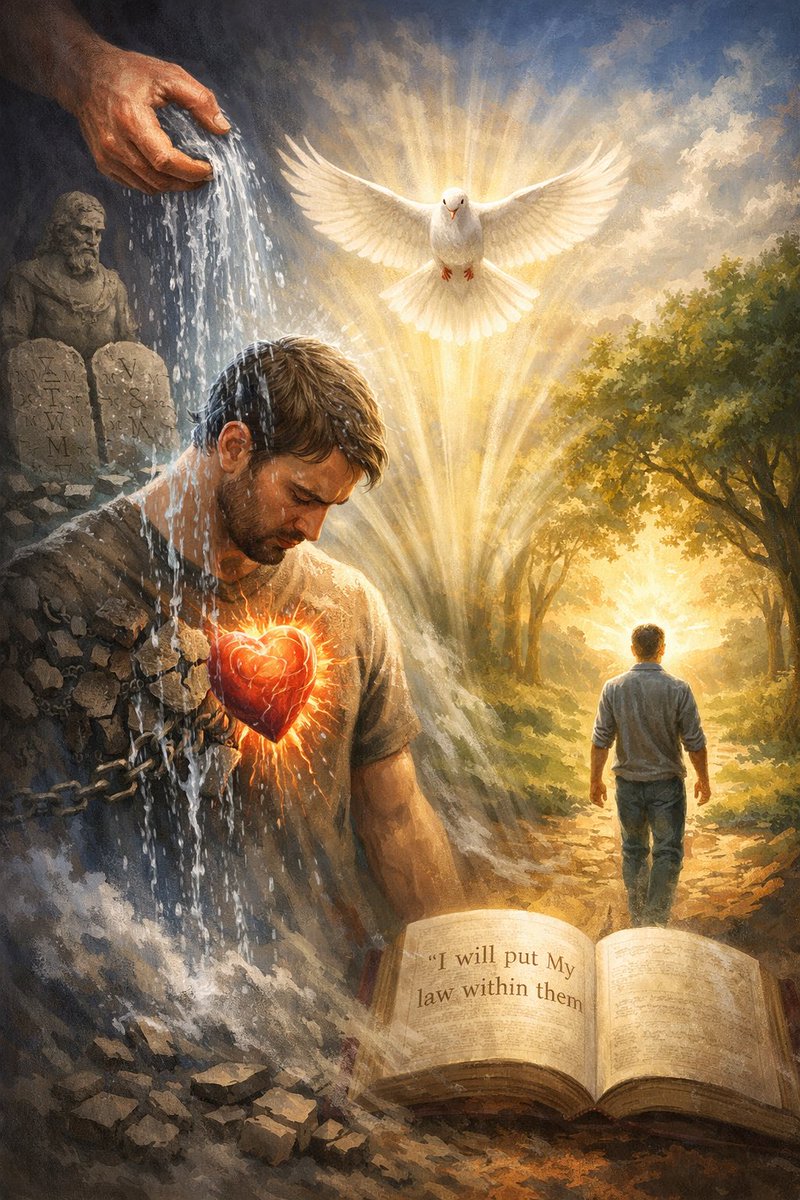
Psalm 51 — THE CRY Create in me a clean heart, O God, and renew a steadfast spirit within me. Do not cast me from your presence, and do not take your holy spirit from me. Jeremiah 31 — THE COVENANT I will make a new covenant… I will place my law within them and write it upon their hearts… They shall all know me… I will forgive their evildoing and remember their sin no more. Ezekiel 36 — THE EXECUTION I will sprinkle clean water upon you to cleanse you from all your impurities… I will give you a new heart and place a new spirit within you… I will put my spirit within you and make you live by my statutes. A Prayer Create in me a clean heart, O God, and renew a right spirit within me. Wash me, remove what is hardened and false, write Your law upon my heart, and place Your Spirit within me, that I may live in You. Amen An Evening Prayer Lord God, as this day closes, wash my heart and quiet my spirit. Where I have grown hard, give me again a living heart. Write Your ways within me, not as a burden but as light. Remain with me through the night, place Your Spirit within me, and restore in me the peace of Your presence. Amen
Sam Moon tweet media
English
0
0
0
25
Sam Moon
Sam Moon@QntmGodParticle·
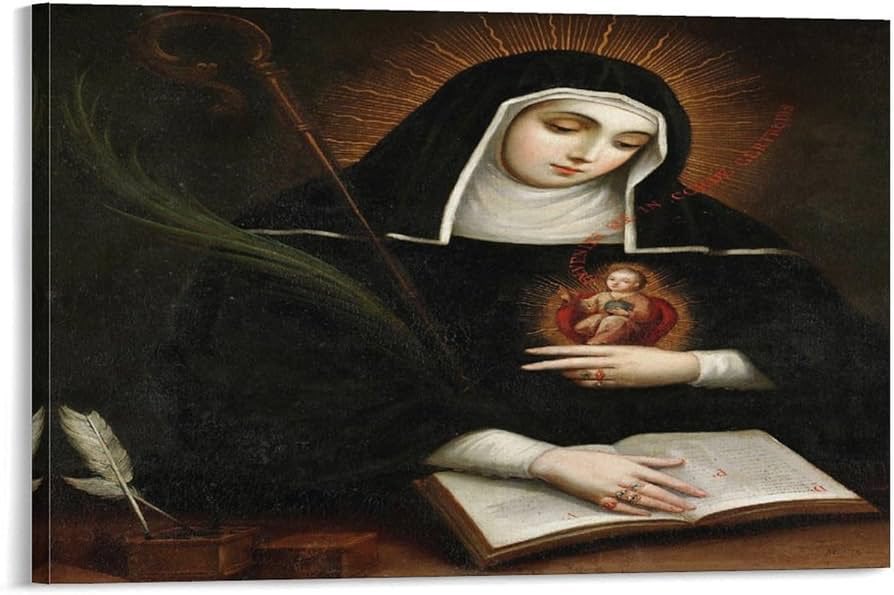
Saint Gertrude the Great (1256–1302), Benedictine mystic & Doctor of the Church in spirit, known for her profound devotion to the Sacred Heart of Jesus and prayers for souls in Purgatory. Her visions in The Herald of Divine Love reveal Christ’s immense love & mercy. Patroness of the West Indies & beloved intercessor for the holy souls—her famous prayer releases thousands! Feast: Nov 16. 🌹❤️
Sam Moon tweet media
English
0
0
0
34
Sam Moon
Sam Moon@QntmGodParticle·
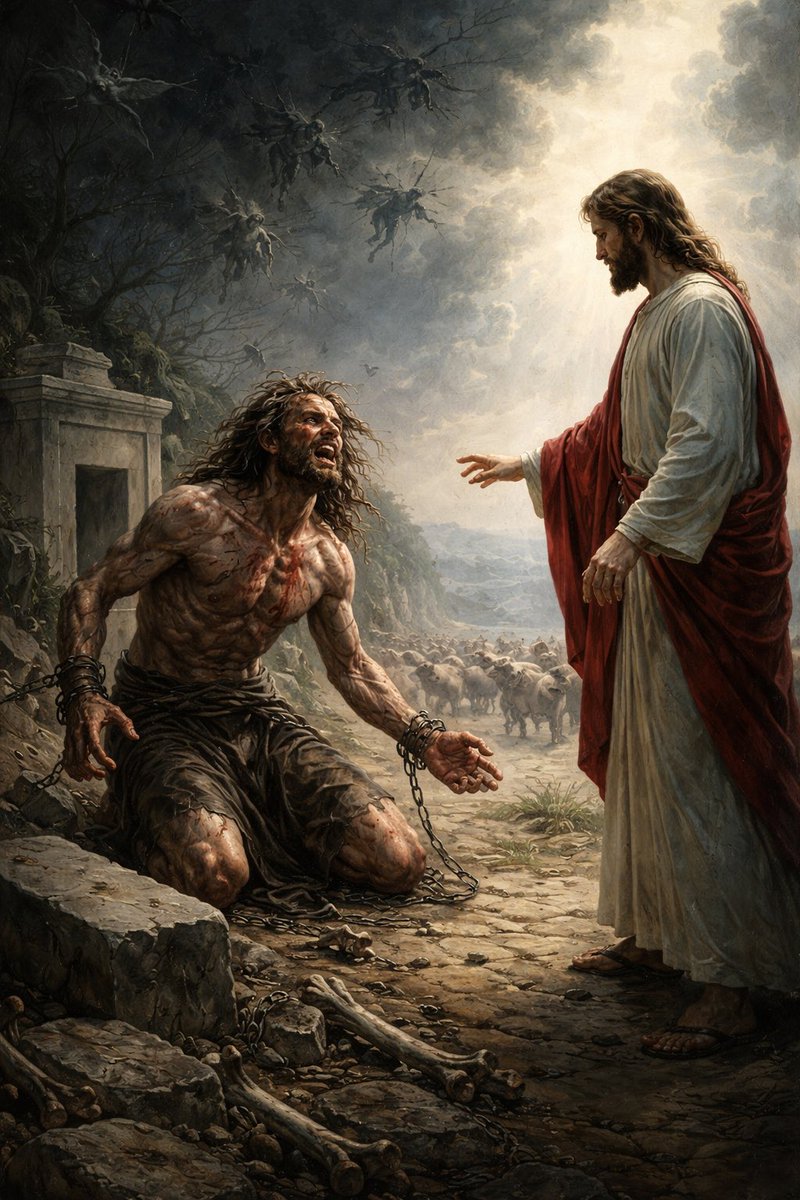
DEMONIACS The demoniac of the Gerasenes reveals what demonic rage looks like in Scripture: loss of self-rule, contempt for restraint, flight from human community, and violence that feeds on itself. Augustine of Hippo names the root—love disordered and absolutized; Thomas Aquinas names the mechanism—passion severed from reason. This same pattern appears in the rage of rioters in Minneapolis and Portland: anonymity replaces conscience, restraint collapses, destruction feels justified, and fury becomes contagious. Whether in one soul or a crowd, when rage escapes reason it takes on an impersonal, demonic force—fragmenting persons and cities alike. Only restored reason and rightly ordered love can heal what rage destroys.
Sam Moon tweet media
English
0
0
0
59