QoreGhost

203 posts

QoreGhost banner
QoreGhost

QoreGhost

@QoreGhost

Quantum • AI • Web3 • Decentralization • Open-minded

New York Katılım Nisan 2026
79 Takip Edilen21 Takipçiler
Sabitlenmiş Tweet
QoreGhost
QoreGhost@QoreGhost·
The #quantum revolution is coming, and @cellframenet is leading with the best quantum-safe technology 🚀 $CELL is infinitely scalable, C-based L0 network with dual sharding—fully ready, while 99.9% of crypto projects aren't 💥 🔊 Listen to #Cellframe WP youtu.be/0T_hLPc2xaw
YouTube video
YouTube
English
4
13
35
1.1K
QoreGhost retweetledi
Cellframe Network
Cellframe Network@cellframenet·
@QuantumBullHQ Yes, that's right, and don't say you didn't know about Cellframe! 😎
English
2
1
27
481
QoreGhost retweetledi
Cellframe Social
Cellframe Social@CellframeSocial·
Cellframe ecosystem heating up
NØNOS@nonossystems

0xnox.com/bridge is now live. Bidirectional transfers between Ethereum and Cellframe are operational, using a validator-based model with threshold signatures and post-quantum primitives. Below is a concise technical overview. Thread 🧵

English
1
11
67
1K
QoreGhost retweetledi
Diablov
Diablov@Diablov7·
It’s that quiet reminder that one random night or morning, this becomes real. No warning, no countdown, no clean “deadline” you can plan around. And if there is one, we won’t see it coming. What we do have is today. Time to get ahead of it. Not just for yourself, but for whatever you’re building. You either prepare now or you react later. @cellframenet is already building for that reality. $CELL
English
2
23
57
3.3K
QoreGhost retweetledi
NØNOS
NØNOS@nonossystems·
0xnox.com/bridge is now live. Bidirectional transfers between Ethereum and Cellframe are operational, using a validator-based model with threshold signatures and post-quantum primitives. Below is a concise technical overview. Thread 🧵
English
7
30
104
4.6K
QoreGhost retweetledi
Yungkelly💢
Yungkelly💢@Utibeabasi51147·
Blockchain gets real at state level. If BRICS is considering a quantum-safe Layer 0 like Cellframe, it shows demand for sovereign payment rails beyond Western-controlled systems. Early stage, but being considered matters. @cellframenet #Cellframe #BRICS $CELL #QuantumSafe
Cellframe Network@cellframenet

Continuing to share the outcomes from the Blockchain Forum in Moscow! 🩶 One of the key values of the forum was not only the talks and panel discussions, but also direct professional networking. It is exactly these kinds of conversations that open up new opportunities, and today we’re ready to share one of the results of that networking. During a discussion with representatives from the banking sector, we explored potential use cases for the Cellframe blockchain infrastructure as a foundation for a possible BRICS countries’ payment system. ✨ BRICS (Brazil, Russia, India, China, South Africa) is an association of emerging economies created to expand economic, technological, and financial cooperation between its members. Under the rotating presidency system, India is coordinating the BRICS agenda in 2026, taking over from Brazil. This year’s BRICS summit will take place on September 12–13 in New Delhi. One of the most actively discussed areas within the group is the development of independent infrastructure for cross-border settlements between member countries. Such infrastructure could significantly improve the efficiency of mutual payments and reduce reliance on traditional global financial channels. Various technological approaches are being considered for this purpose, with blockchain platforms among the leading options. In this context, the Cellframe platform could potentially become one of the candidates. We are currently preparing materials and working on the submission format in order to present our solution to relevant BRICS stakeholders. The application is expected to be submitted via the Indian side, as the current chair of the group. This is an important and responsible step for our team. Potential participation in infrastructure at this level opens up significant opportunities — both in terms of scaling the technology and its real-world application in the global economy. At the same time, we remain grounded: there is a serious selection process ahead, and at this stage we are speaking only about entering the “long list”, with a potentially long path ahead. What matters most is that the process has already begun, and we will continue to share updates as it develops. Stay with us so you don’t miss what comes next! #partnership_cellframe #Cellframe #BRICS

English
1
9
20
309
QoreGhost retweetledi
QUANTUM CAPT CELL🤫✨️
$CELL will surprise everyone with starting there QUANTUM gurney in 2018 and becoming full quantum audit done long before Algo Xrp and all others decided to swap to quantum Resistants!!! They have tested everything 1000% more than any other crypto Cellframe.net joinnow
Crypto Fergani@cryptofergani

🔴 2010 - You missed $BTC 🔴 2016 - You missed $ETH 🔴 2017 - You missed $ADA 🔴 2018 - You missed $BNB 🔴 2019 - You missed $LINK 🔴 2020 - You missed $DOT 🔴 2021 - You missed $SHIB 🔴 2023 - You missed $SOL 🟢 In 2026, don't miss $__ ?

English
0
5
26
603
QoreGhost
QoreGhost@QoreGhost·
@RedGrindingHood @IAMKING1786 @cellframenet QRL is basically a ledger without scalable functionality, held by a few investors. Compared to CELL, its value seems overestimated, while Cell’s price now appears undervalued, making it an interesting opportunity to buy. The future will reveal more. I’m convinced of who will lead
English
0
0
1
4
Big Red
Big Red@RedGrindingHood·
$CELL team is unlikely scammers. It's probably just a mismanaged project and it's understandable if they're small and underfunded. They just need to find a sweet spot in the way they conduct selling.
ObiWanCryptobi@Phast0

@Cryptofetch101 @RedGrindingHood @carter_zhang1 @cellframenet Theyve been in active development for 8yrs, coupd have easily exit scammed in 2021 when they had the mcap and liquidity to do it. So why are they still active?

English
8
5
25
1.2K
QoreGhost
QoreGhost@QoreGhost·
@RedGrindingHood Read the tweet below… this is the real strength of $CELL technology that no one else has, and won’t have for a long time. Where @cellframenet is now is that investor sweet spot you’re talking about—the holy grail for everyone, even skeptics. Watch! 👀 x.com/i/status/20494…
𝚎𝙺@eKnonos

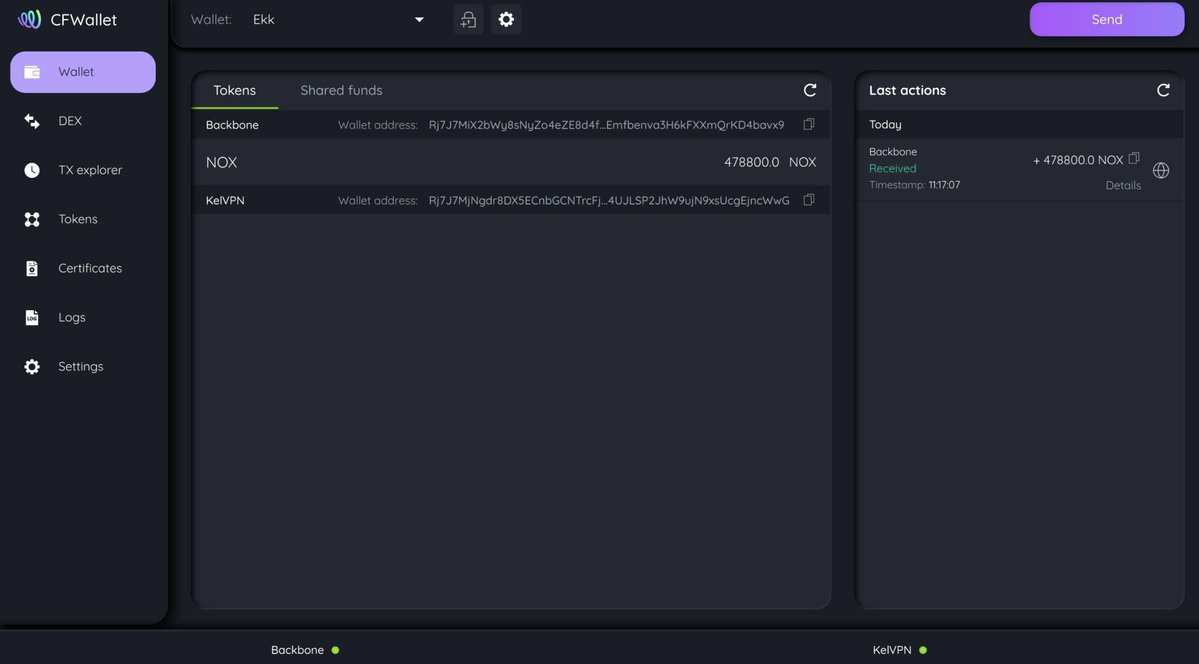
Running a masternode on @cellframenet Backbone network changed how I think about blockchain infrastructure. Our node sits at address 1C7C::9E6C::0FCE::AB3B. Version 5.7-36. Role: MASTER. Seven active links to the network at *this* given time. Full sync on both chains - the DAG layer at 106,673 events and the main block layer at 481,076 blocks. This thing runs 24/7 and i've learned more about consensus mechanisms in the past months than before. Today we completed our $NOX token bridge. 489,770 NOX moved from Ethereum to Cellframe across three transactions. Fully automatic. No manual signing. No intervention. The system detects an ETH deposit, waits for confirmations, creates an emission with three out of four required signatures using Dilithium certificates, processes it through the DAG, creates the transfer transaction with proper network fees and delivers tokens to the destination wallet. # Average time from ETH confirmation to CF delivery: roughly three minutes to 5 minutes. We do this because honestly <> The technical architecture matters here. $NOX on Cellframe is a CF20 token configured with threshold signatures. Four authorized certificates exist. Three must sign any emission. Each signature uses sig_dil - that's Dilithium, the NIST-approved lattice-based signature scheme. Every signature weighs 2096 bytes because post-quantum cryptography isn't lightweight but it's quantum-resistant. When Shor's algorithm breaks ECDSA on every other chain, these signatures remain intact. What most people don't understand about Cellframe is the dual-chain architecture. Emissions and token declarations go to zerochain, which runs DAG-POA consensus. Actual value transfers happen on main chain through ESBOCS block production. Different consensus for different operations. once you understand it, brutal to debug when something sits in mempool longer than expected. The masternode experience itself is something I never see discussed honestly. This isn't passive income. We will share $CELL rewards with our community as well. Running infrastructure means watching sync percentages, monitoring link counts, ensuring your certificates are properly configured, understanding why mempool_proc returns success but your transaction needs the fee wallet flag to actually settle. The CLI documentation assumes familiarity I had to build through trial and error. Commands like token_emit sign change the datum hash with each signature - if you're tracking the original hash, you lose reference to your emission entirely. These details don't exist in any guide. You learn them by building. Our bridge wallet holds 5,161 CELL for transaction fees. At 0.05 CELL per bridge transaction, that's capacity for over 100,000 bridges before needing a refill. The certificates - nox_owner1 through nox_owner4 - sit in /opt/cellframe-node/var/lib/ca/ as .dcert files. Each one a Dilithium keypair. Each signature operation involves cryptography that most blockchain developers have never touched. I chose Cellframe over easier options deliberately. Could have deployed another EVM bridge in a weekend. Could have gone with chains that have better tooling, more users, more immediate liquidity but I keep coming back to one fact: every signature scheme in mainstream crypto has a quantum expiration date. We don't know if it's 2030 or 2040, but the mathematics are clear. Lattice problems don't collapse the way integer factorization does under quantum computation. Building on post-quantum infrastructure now means not rebuilding everything later. The validator economics are secondary to me. Yes, the node earns rewards. Yes, the bridge collects a 0.25% fees but I'm not here for yield optimization. I'm here because decentralized networks need people who actually run the infrastructure, who understand the protocol deeply enough to build on it, who stick around when the tooling is rough and the documentation is incomplete. Someone has to be early to the things that matter.

English
0
0
1
6
QoreGhost retweetledi
Quantum Cellist
Quantum Cellist@QuantumCellist·
Respect 🫡. Sometimes doing what matters means taking the harder route. “Someone has to be early to the things that matter” truer words have never been spoken. That hits 💯 You’ve gotta wonder which other platforms are thinking the same way 🤔 Did you $Cell?
𝚎𝙺@eKnonos

Running a masternode on @cellframenet Backbone network changed how I think about blockchain infrastructure. Our node sits at address 1C7C::9E6C::0FCE::AB3B. Version 5.7-36. Role: MASTER. Seven active links to the network at *this* given time. Full sync on both chains - the DAG layer at 106,673 events and the main block layer at 481,076 blocks. This thing runs 24/7 and i've learned more about consensus mechanisms in the past months than before. Today we completed our $NOX token bridge. 489,770 NOX moved from Ethereum to Cellframe across three transactions. Fully automatic. No manual signing. No intervention. The system detects an ETH deposit, waits for confirmations, creates an emission with three out of four required signatures using Dilithium certificates, processes it through the DAG, creates the transfer transaction with proper network fees and delivers tokens to the destination wallet. # Average time from ETH confirmation to CF delivery: roughly three minutes to 5 minutes. We do this because honestly <> The technical architecture matters here. $NOX on Cellframe is a CF20 token configured with threshold signatures. Four authorized certificates exist. Three must sign any emission. Each signature uses sig_dil - that's Dilithium, the NIST-approved lattice-based signature scheme. Every signature weighs 2096 bytes because post-quantum cryptography isn't lightweight but it's quantum-resistant. When Shor's algorithm breaks ECDSA on every other chain, these signatures remain intact. What most people don't understand about Cellframe is the dual-chain architecture. Emissions and token declarations go to zerochain, which runs DAG-POA consensus. Actual value transfers happen on main chain through ESBOCS block production. Different consensus for different operations. once you understand it, brutal to debug when something sits in mempool longer than expected. The masternode experience itself is something I never see discussed honestly. This isn't passive income. We will share $CELL rewards with our community as well. Running infrastructure means watching sync percentages, monitoring link counts, ensuring your certificates are properly configured, understanding why mempool_proc returns success but your transaction needs the fee wallet flag to actually settle. The CLI documentation assumes familiarity I had to build through trial and error. Commands like token_emit sign change the datum hash with each signature - if you're tracking the original hash, you lose reference to your emission entirely. These details don't exist in any guide. You learn them by building. Our bridge wallet holds 5,161 CELL for transaction fees. At 0.05 CELL per bridge transaction, that's capacity for over 100,000 bridges before needing a refill. The certificates - nox_owner1 through nox_owner4 - sit in /opt/cellframe-node/var/lib/ca/ as .dcert files. Each one a Dilithium keypair. Each signature operation involves cryptography that most blockchain developers have never touched. I chose Cellframe over easier options deliberately. Could have deployed another EVM bridge in a weekend. Could have gone with chains that have better tooling, more users, more immediate liquidity but I keep coming back to one fact: every signature scheme in mainstream crypto has a quantum expiration date. We don't know if it's 2030 or 2040, but the mathematics are clear. Lattice problems don't collapse the way integer factorization does under quantum computation. Building on post-quantum infrastructure now means not rebuilding everything later. The validator economics are secondary to me. Yes, the node earns rewards. Yes, the bridge collects a 0.25% fees but I'm not here for yield optimization. I'm here because decentralized networks need people who actually run the infrastructure, who understand the protocol deeply enough to build on it, who stick around when the tooling is rough and the documentation is incomplete. Someone has to be early to the things that matter.

English
0
7
21
625
QoreGhost
QoreGhost@QoreGhost·
@eKnonos @cellframenet Huge… thanks for the report. $NOX and $CELL are shaping up to be a key part of the future of the crypto space and its infrastructure as we’ll come to understand it in the near future. They’re real gems for early quantum-focused investors and for anyone into high-tech innovation
English
0
1
3
12
QoreGhost retweetledi
𝚎𝙺
𝚎𝙺@eKnonos·
Running a masternode on @cellframenet Backbone network changed how I think about blockchain infrastructure. Our node sits at address 1C7C::9E6C::0FCE::AB3B. Version 5.7-36. Role: MASTER. Seven active links to the network at *this* given time. Full sync on both chains - the DAG layer at 106,673 events and the main block layer at 481,076 blocks. This thing runs 24/7 and i've learned more about consensus mechanisms in the past months than before. Today we completed our $NOX token bridge. 489,770 NOX moved from Ethereum to Cellframe across three transactions. Fully automatic. No manual signing. No intervention. The system detects an ETH deposit, waits for confirmations, creates an emission with three out of four required signatures using Dilithium certificates, processes it through the DAG, creates the transfer transaction with proper network fees and delivers tokens to the destination wallet. # Average time from ETH confirmation to CF delivery: roughly three minutes to 5 minutes. We do this because honestly <> The technical architecture matters here. $NOX on Cellframe is a CF20 token configured with threshold signatures. Four authorized certificates exist. Three must sign any emission. Each signature uses sig_dil - that's Dilithium, the NIST-approved lattice-based signature scheme. Every signature weighs 2096 bytes because post-quantum cryptography isn't lightweight but it's quantum-resistant. When Shor's algorithm breaks ECDSA on every other chain, these signatures remain intact. What most people don't understand about Cellframe is the dual-chain architecture. Emissions and token declarations go to zerochain, which runs DAG-POA consensus. Actual value transfers happen on main chain through ESBOCS block production. Different consensus for different operations. once you understand it, brutal to debug when something sits in mempool longer than expected. The masternode experience itself is something I never see discussed honestly. This isn't passive income. We will share $CELL rewards with our community as well. Running infrastructure means watching sync percentages, monitoring link counts, ensuring your certificates are properly configured, understanding why mempool_proc returns success but your transaction needs the fee wallet flag to actually settle. The CLI documentation assumes familiarity I had to build through trial and error. Commands like token_emit sign change the datum hash with each signature - if you're tracking the original hash, you lose reference to your emission entirely. These details don't exist in any guide. You learn them by building. Our bridge wallet holds 5,161 CELL for transaction fees. At 0.05 CELL per bridge transaction, that's capacity for over 100,000 bridges before needing a refill. The certificates - nox_owner1 through nox_owner4 - sit in /opt/cellframe-node/var/lib/ca/ as .dcert files. Each one a Dilithium keypair. Each signature operation involves cryptography that most blockchain developers have never touched. I chose Cellframe over easier options deliberately. Could have deployed another EVM bridge in a weekend. Could have gone with chains that have better tooling, more users, more immediate liquidity but I keep coming back to one fact: every signature scheme in mainstream crypto has a quantum expiration date. We don't know if it's 2030 or 2040, but the mathematics are clear. Lattice problems don't collapse the way integer factorization does under quantum computation. Building on post-quantum infrastructure now means not rebuilding everything later. The validator economics are secondary to me. Yes, the node earns rewards. Yes, the bridge collects a 0.25% fees but I'm not here for yield optimization. I'm here because decentralized networks need people who actually run the infrastructure, who understand the protocol deeply enough to build on it, who stick around when the tooling is rough and the documentation is incomplete. Someone has to be early to the things that matter.
𝚎𝙺 tweet media𝚎𝙺 tweet media
English
7
38
90
2.1K
QoreGhost retweetledi
Bitcoin Magazine
Bitcoin Magazine@BitcoinMagazine·
JUST IN: The Governor of the Czech National Bank revealed what they found after investing in bitcoin 🇨🇿 "With 1% in BTC, expected return goes up and overall risk stays about the same. This is what our new study shows." 👀
English
84
344
2.6K
259.2K
QoreGhost retweetledi
Cointelegraph
Cointelegraph@Cointelegraph·
🇨🇿 BULLISH: A Czech National Bank study finds that adding 1% Bitcoin to a model portfolio increases expected returns without significantly raising overall risk in local currency, according to Governor Aleš Michl.
English
30
29
194
18.6K
QoreGhost retweetledi
Coin Bureau
Coin Bureau@coinbureau·
🚨JUST IN: CZECH CENTRAL BANK TO HOLD BITCOIN AS A RESERVE ASSET The Governor of the Czech National Bank says the bank will publish results over time from a test portfolio holding Bitcoin as a reserve asset.
English
21
48
338
19.2K
QoreGhost retweetledi
Bitcoin Magazine
Bitcoin Magazine@BitcoinMagazine·
JUST IN: The Governor of the Czech National Bank says they will be publishing the results of a test portfolio holding bitcoin as a reserve asset over time 🇨🇿 "This is the future."
English
51
153
1.1K
55.2K
QoreGhost retweetledi
Elsa Brown
Elsa Brown@brown____elsa·
This is what sovereign financial infrastructure actually looks like. @cellframenet just had serious banking sector conversations in Moscow and is now preparing their formal submission to enter the BRICS selection process for independent payment rails.
Cellframe Network@cellframenet

Continuing to share the outcomes from the Blockchain Forum in Moscow! 🩶 One of the key values of the forum was not only the talks and panel discussions, but also direct professional networking. It is exactly these kinds of conversations that open up new opportunities, and today we’re ready to share one of the results of that networking. During a discussion with representatives from the banking sector, we explored potential use cases for the Cellframe blockchain infrastructure as a foundation for a possible BRICS countries’ payment system. ✨ BRICS (Brazil, Russia, India, China, South Africa) is an association of emerging economies created to expand economic, technological, and financial cooperation between its members. Under the rotating presidency system, India is coordinating the BRICS agenda in 2026, taking over from Brazil. This year’s BRICS summit will take place on September 12–13 in New Delhi. One of the most actively discussed areas within the group is the development of independent infrastructure for cross-border settlements between member countries. Such infrastructure could significantly improve the efficiency of mutual payments and reduce reliance on traditional global financial channels. Various technological approaches are being considered for this purpose, with blockchain platforms among the leading options. In this context, the Cellframe platform could potentially become one of the candidates. We are currently preparing materials and working on the submission format in order to present our solution to relevant BRICS stakeholders. The application is expected to be submitted via the Indian side, as the current chair of the group. This is an important and responsible step for our team. Potential participation in infrastructure at this level opens up significant opportunities — both in terms of scaling the technology and its real-world application in the global economy. At the same time, we remain grounded: there is a serious selection process ahead, and at this stage we are speaking only about entering the “long list”, with a potentially long path ahead. What matters most is that the process has already begun, and we will continue to share updates as it develops. Stay with us so you don’t miss what comes next! #partnership_cellframe #Cellframe #BRICS

English
1
9
33
657
QoreGhost retweetledi
Quantum Cellist
Quantum Cellist@QuantumCellist·
Calling $Cell “Others” misses the plot. The future problem isn’t just post quantum chains but also post quantum movement between chains. Without that every PQ network is just a safer island and crypto doesn’t operate that way today so why would it in a PQ future?
Our Crypto Talk@ourcryptotalk

Post quantum chains, 2026 reality check: $ALGO: Live PQ on mainnet since 2022, 140k+ txns $QRL: Fully PQ since genesis, smallest ecosystem $IOTA: PQ feeless data, no smart contracts Which approach do you think wins long term?

English
0
10
44
1.6K