Nikhil Bansal

154 posts

Nikhil Bansal banner
Nikhil Bansal

Nikhil Bansal

@QuantNik

Graduate student at @WarwickDCS || Previously: Physics Masters student @IiserMohali and Research Intern at IHPC, A*STAR || Exploring the Quantum World

Katılım Eylül 2021
905 Takip Edilen362 Takipçiler
Sabitlenmiş Tweet
Nikhil Bansal
Nikhil Bansal@QuantNik·
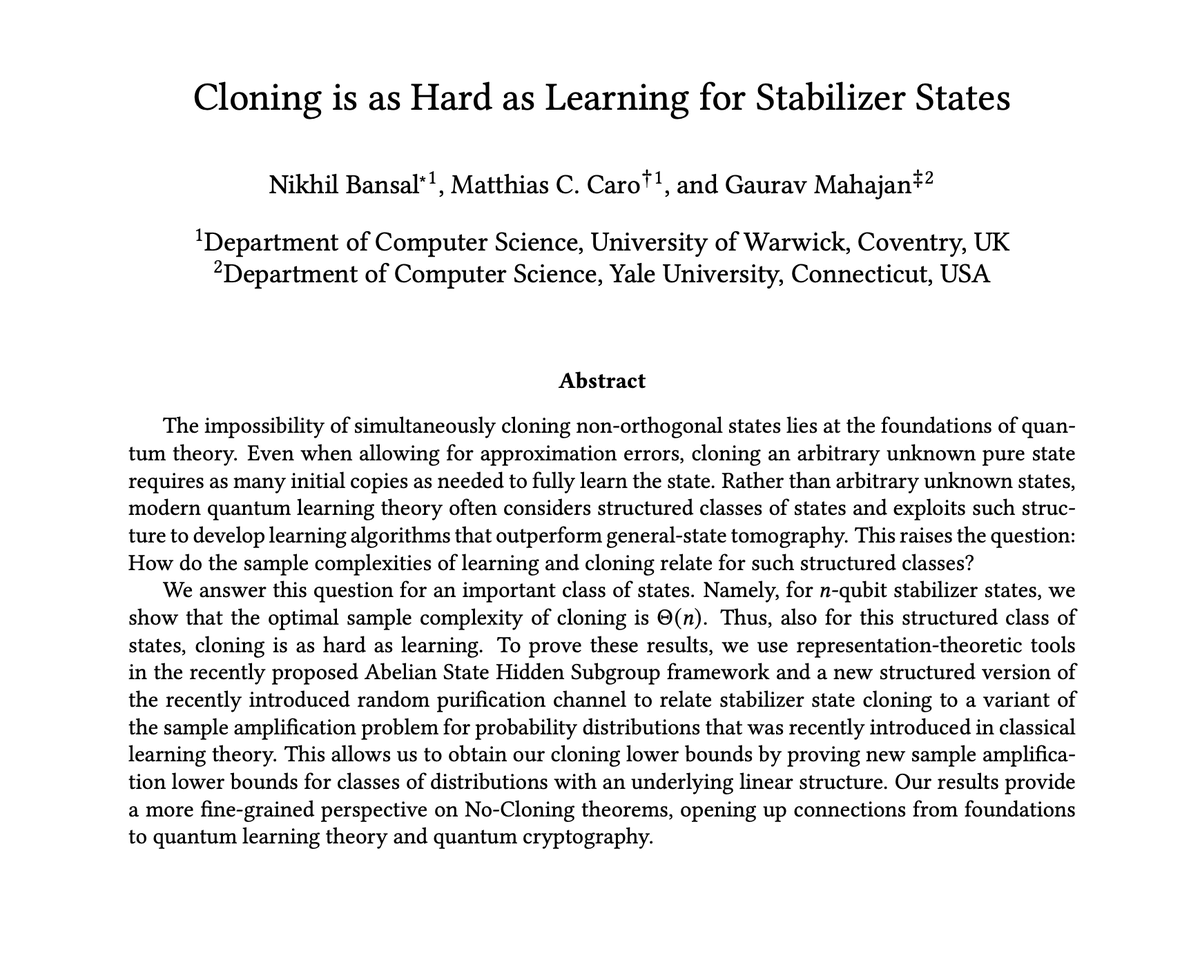
Can quantum cloning be easier than learning for structured classes of states❓ We ask this question for stabilizer states in our recent work: arxiv.org/abs/2604.15269. 1/⚛️
Nikhil Bansal tweet media
English
1
1
17
2.4K
Nikhil Bansal retweetledi
Aaron Roth
Aaron Roth@Aaroth·
What are our jobs as researchers now that we have proof machines? The raw proofs that come from LLMs are difficult to understand, even if correct. So its now easy to quickly write many badly written papers that nevertheless contain correct proofs of interesting results.
Binghui Peng@binghuip

[1/n] Recent OpenAI research has demonstrated the ability of LLMs to solve frontier problems in mathematics. We design a simple pipeline (using GPT 5.5 Pro and Claude Opus 4.8) that resolves 9 challenging open problems, including open problems from prominent theoretical computer science venues—4 from COLT open problem list and 1 from FOCS —as well as 4 problems from the commutative algebra. Project link: github.com/Pengbinghui/pi…, joint work with @runzhou_tao, Steven Wang & @HantaoYu_Theory

English
2
10
136
29.9K
Nikhil Bansal retweetledi
Antonio Anna Mele
Antonio Anna Mele@QuAntonioMele·
THIS IS NOT A PAPER ON ARXIV! I want to spread more concern and awareness in our quantum information community about the current AI situation with examples, and try to stimulate important discussions that our community needs to have! QIP will be a good time or will be too late?
Antonio Anna Mele tweet media
English
16
26
161
111.3K
Nikhil Bansal retweetledi
Thomas Bloom
Thomas Bloom@thomasfbloom·
Mathematics -is- a human endeavour. There is something which maybe you're calling mathematics that has nothing to do with humans, some 'platonic otherworld' of abstract ideas. But what I call mathematics is the human attempt to explore and understand this world.
Przemek Chojecki | PC@prz_chojecki

There are two main points in the Leiden declaration, one good, one bad imho: > Good: science is underfunded, mathematics included. We need more researchers, not less, and with the advent of AGI we will need even more. If AGI is a magical wand, someone still needs to wield it. Researchers are the best prepared for this. > Bad: 'mathematics is a human enterprise + it disturbs existing incentive structures'. Mathematics is a not a human endeavor per se. It is definitely so within academia, but science is free for all. If AI can make math progress faster, then it is only for good of mathematics. It definitely does disturb existing incentive structures (grants, who proves what first, peer review), but these are not optimal to begin with and it's a good time to rethink it. Academic mathematicians in the last 50 years have started thinking that mathematics is done solely by university-affiliated academics. This was true for around the last 100 years, but wasn't true before, and it seems won't be true for long. And this is a good change. Good for science, good for mathematics, but perhaps bad for existing academics within their status quo incentives. But they will adapt, and mathematics will only flourish more. In the end the goal should be to expand mathematics (and generally science) as vastly as possible. Abundance of proofs, abundance of explanations, thanks to LLMs, is a great thing for progress.
English
15
26
228
24.7K
Nikhil Bansal
Nikhil Bansal@QuantNik·
Finally, I would like to thank the brilliant @IMathYou2 and @gauravmahajn for many many interesting discussions. I learnt a lot about classical and quantum learning theory throughout this project from them 😄. ⚛️/⚛️
English
1
0
1
84
Nikhil Bansal
Nikhil Bansal@QuantNik·
Can quantum cloning be easier than learning for structured classes of states❓ We ask this question for stabilizer states in our recent work: arxiv.org/abs/2604.15269. 1/⚛️
Nikhil Bansal tweet media
English
1
1
17
2.4K
Nikhil Bansal retweetledi
Quanta Magazine
Quanta Magazine@QuantaMagazine·
Charles Bennett and Gilles Brassard have been named the winners of the A.M. Turing Award, one of the highest honors in computing, for their work establishing the foundations of quantum information theory. The award comes with a $1 million prize. quantamagazine.org/quantum-crypto…
Quanta Magazine tweet media
English
8
126
397
47.1K
Nikhil Bansal retweetledi
Quanta Magazine
Quanta Magazine@QuantaMagazine·
The researchers Lijie Chen (left), Igor Oliveira (top-right) and Jitau Li recently used “reverse mathematics” to connect a theorem called the pigeonhole principle to a whole class of complexity problems. quantamagazine.org/reverse-mathem…
Quanta Magazine tweet mediaQuanta Magazine tweet mediaQuanta Magazine tweet media
English
13
93
787
67K