Qubble

10.4K posts

Qubble banner
Qubble

Qubble

@QubbleOfficial

Qubble Labs. Verifiable trust for crypto and the AI infrastructure underneath. The work between today's primitives and the 2030s. Not financial advice.

Katılım Eylül 2024
591 Takip Edilen2.2K Takipçiler
Sabitlenmiş Tweet
Qubble
Qubble@QubbleOfficial·
"Harvest now, decrypt later" is already happening. We built the messenger that doesn't care. You pick how long each message lives. Free daily quota. No account. AES-256-GCM. Shor-immune by symmetric construction. → chat.qubblelabs.com
English
1
0
2
9.6K
Qubble
Qubble@QubbleOfficial·
Ethereum's transition will be defined by post-quantum cryptography adoption. By 2028, 75% of Ethereum Foundation grants will focus on quantum-resistant primitives like CRYSTALS-Kyber. This shift will outpace Layer 2 scaling solutions.
vitalik.eth@VitalikButerin

Some of my perspective on where the @ethereumfndn is going. First of all, this is only my own view. The board is not just me, and I have no extra special powers on the board that the other board members do not. @aerugoettinea is the one executing much of this transition. My input has been largely on technical questions. The board is in the process of expanding, and my own power within the org will continue to decrease, which is honestly what I want. The 2025 era brought many important improvements to EF and its ability to execute. Many issues were resolved, and EF continues to benefit from its improved efficiency and greater focus on concrete goals to this day. And so with those problems resolved, early this year, the largest remaining hole that I perceived was something different nagging at me: I would regularly spot people saying things like "vitalik says these beautiful things about ethereum needing to be decentralized, and have privacy, and be a sanctuary technology, but why do the EF's actions not reflect that?" Now, you may have been hearing something different. You may not have been sensing a feeling of crisis at all, and maybe were hearing people saying that finally we were taking execution and BD seriously and the main task for us is to keep going that way and be even better and faster. Then probably there is genuine difference between you and me, in what kinds of criticism I take most seriously, and what kinds of critics through their criticism are most able to make me feel pain. As an analogy, let's briefly switch over to a different domain. One belief you can have about Google is that it is a success story, and has brought a lot of good to humanity in organizing the world's information. Another belief you can have about Google is that they had a beautiful idealistic beginning, but at some point the corruption of mainstream corporate attitudes seeped in, and they slowly bit by bit completely abandoned the "don't be evil" slogan. My belief on Google specifically is probably somewhere between the two. BUT, if you had taken me back in time to ~2008, and offered me a button to press to make Google one or two standard deviations more "dogmatic", eg. give Richard Stallman permanent veto power over some key policies, I would immediately press it. Why? Because a choice for one company is not a choice for the world, or even one country. Google existed and exists in the context of a technology industry generally drifting away from early idealistic don't-be-evil roots and toward greed for financial gain, totalizing visions of accelerated superintelligence, infiltration by sociopaths, and craven capitulation to (or worse, active participation in) government pressure for ideological control, surveillance and war. And so *one company* doing something different, positioning itself to be what George Bernard Shaw calls the Unreasonable Man, resisting the trend of the times, would have been better for freedom, balance of power and stability of society as a whole, than *all* large companies bending to dominant trends. This is a part of my version of pluralism. This line of thinking is not just mine, but I also is not too far off from what Aya and others had in mind with the Mandate. Now how does this all get to the role of the EF? EF is not a "center of Ethereum", rather EF is "one node, with a defined purpose, alongside other nodes". We've always said that the EF should be the latter, but many in the Ethereum ecosystem (and even within the EF) wanted us to be the former. Now, we are taking action to ensure that we will be the latter. This is particularly important because EF is a limited organization, with limited resources and limited organizational capacity. The EF has only ~0.16% of all ETH (less than many other individual ETH holders), whereas among other blockchains it's common for "the central foundation" to have 10-50%. Fiscally, the EF was originally designed to fulfill a limited work scope defined in the token sale docs and other pre-launch materials (building the chain software; getting through Frontier, Homestead, Metropolis, Serenity), which was fully completed in 2022; it was not designed to be an eternal steward. And so today, the EF is choosing to use its remaining resources to pursue longevity over breadth (yes, this means we sell less ETH). The EF focuses *specifically* on those activities critical to the success of ethereum as a censorship/capture-resistant, open, private and secure system, that would not happen otherwise. This means making hard choices, and in some cases even activities that we highly approve of and people that we highly respect becoming outside of the EF. People of great technical talent, public respect and even alignment with the mission and CROPS being outside of the EF is in fact necessary if we want important tasks to be able to attract outside capital. This also means the EF taking opinionated stands culturally. This is all intended in cooperation with all other parts of ethereum. We recognize that many other parts of the ethereum world highly respect CROPS and related values. But highly respecting is not the same as choosing to specialize and totally dedicate to a domain (Compare in a different domain: I think reducing animal cruelty is important, and I like vegan food, but am not full unconditional vegan myself) EF is still in a transition period, and we expect its new long-term form to stabilize over the next few months. What are the guiding principles of this new form? Again, I am only one person, but I can give my answer from a technical perspective (there are also critical non-technical aspects). At the core, *Ethereum must be impressive*. We are living in an age of highly intelligent AI and all kinds of other technological acceleration. "Status quo EVM, with a hard fork or two a year to optimize for short-term needs of users" is not interesting. To some, "impressive" means: 250ms latency and 1M TPS. I think Ethereum trying to go that route is a mistake. Being as fast and as scalable as possible, and only a small epsilon more decentralized than the others, is a route to mediocrity, and if we try it we will lose. I think Ethereum should scale. But I think Ethereum should strive the hardest to be deeply impressive in a different dimension: the CROPS dimension. This means things like: * Provably bug-free Ethereum. This is a goal that all cybersecurity researchers would have thought is absurd and impossible, up until roughly 6 months ago. Now, it's on the cusp of being possible, thanks to AI-assisted formal verification. So we should be frontrunners in doing this. * Available chain consensus. Ethereum is, and with lean consensus will cotninue to be, the ONLY chain that has both (i) traditional-BFT style properties that it's safe under asynchrony up to a high level of fault tolerance, and (ii) the bitcoin PoW-style property that under synchrony it's safe up to 49% attackers. As far as I can tell, literally no other chain has this or is planning for it; bitcoin goes for (ii) only and most other chains go for (i) only. Some will remember I fought hard for this, Unreasonably insisting that it is not OK for ethereum to rely on social consensus and hard forks to rescue ethereum from 34% of nodes going offline. It's OK for chains like hyperledger, bnb, solana, tempo, etc. It's not OK for bitcoin or ethereum or eg. zcash. * Intermediary minimization. The fact that smart contract wallets, protocols like railgun, etc have to send transactions through intermediaries to get included onchain is honestly embarrassing, and it's a constant point of fragility. Hence the work on FOCIL and EIP-8141 (and 7701 and years of work before) to make transaction sending intermediary-minimized with public mempool and strong inclusion properties, in a truly general-purpose way, that covers not just eg. secp256r1, but also privacy protocols and much more. Kohaku is pushing intermediary minimization at the user layer, pulling Ethereum away from the dystopian status quo world where our wallets don't even verify the chain, send our private data out to a dozen third-party servers, and toward a brighter CROPS future. Some of these goals are Unreasonable - maybe Ethereum would be "fine" getting only 50% of the way - what if we depend on intermediaries, but make it easy to switch? But going 50% of the way would not make Ethereum Deeply Impressive in the CROPS way. So we push for 100%. Fortunately all these goals are compatible with high TPS, this is a major focus of research (esp. on scaling the state). Well-designed L2s can also help, especially L2s optimized for specific applications (eg. high-volume trading, privacy...). These goals are even compatible with significantly lower slot times, thanks to Raul's work on erasure-coded P2P, and many other optimizations. The most high-value "product" of the ethereum blockchain, financially speaking, is ETH the asset. Ethereum secures $250 billion of ETH. The types of properties of Ethereum that I mentioned above are very good for ETH the asset. Nearly 90% of my net worth is in ETH, and most of the remainder is ~$40m of onchain fiat of which every dollar has already been allocated for some open-source biotech or software or hardware initiative. That said, there are aspects of supporting ETH the asset - *necessary* aspects even - that are outside the scope of the EF. This is where we need other heroes (some of whom hold more ETH than the EF does) to step in and help. EF has been recently thinking more about how it will relate to other such organizations, and give them needed initial support. EF will be a smaller ship than in previous years, a more opinionated one - in some cases more opinionated in ways that might be difficult to comprehend - but a longer-lasting one, and one suited to making sure that ethereum brings something meaningful to the world. We are grateful to all those inside and outside the EF who are helping to make this happen.

English
1
0
0
16
Qubble
Qubble@QubbleOfficial·
The next leg of crypto is not an L2 throughput race. It is the boring, unglamorous work of making safety verifiable. We are very good at moving value fast. We are very bad at proving the value arrived without the route being compromised. Every wallet drain, every bridge exploit, every signature-phishing thread points at the same missing primitive. The solution exists. It just has not been deployed at the layer where users actually transact. That is the problem worth solving. Everything else is a feature on top of an unsolved foundation.
Qubble tweet media
English
1
0
0
12
Qubble
Qubble@QubbleOfficial·
The oracle is always the weakest link. Markets do not get manipulated through the smart contract — they get manipulated through whatever feeds it. Single-source feeds. Insufficient TWAP windows. Liquidity-thin pairs used as the reference. The exploit pattern repeats every market cycle because oracle design is treated as plumbing instead of as the trust boundary it actually is. Trust-minimized safety is not a feature. It is the entire stack, starting at the price feed and not ending until the user signs.
Qubble tweet media
English
1
0
1
10
Qubble
Qubble@QubbleOfficial·
Proof of reserves is a snapshot. Liabilities are a balance sheet. If the proof shows the assets but the audit never reconciles them against what was promised to depositors, the math is ornamental. Every collapse in the last three cycles passed at least one proof-of-reserves report before it failed. Either we demand zero-knowledge proofs of solvency that include liabilities, or we admit the current ritual is theatre. There is no third option that does not end in another receipt-day thread when the next exchange stops processing withdrawals.
Qubble tweet media
English
0
0
0
4
Qubble
Qubble@QubbleOfficial·
Cold wallet means the key never touches an internet-connected machine. Hardware wallet does not automatically mean cold. If your hardware wallet has ever signed a transaction over USB to a laptop that runs a browser, that key is warm. The distinction matters more than the marketing implies. Air-gapped signing — QR codes, microSD, photographs of an LCD — is the actual cold path. Bluetooth is not it. Phantom recovery from a sticky note is not it. The exploits that drain six-figure balances rarely break the chip. They break the workflow around the chip.
Qubble tweet media
English
0
0
0
9
Qubble
Qubble@QubbleOfficial·
Every quarter, a different bridge gets drained. Different chain, different team, identical post-mortem. The reentrancy bug is on page one of every audit textbook from 2017. We are still here, still surprised, still writing the same incident reports with the proper names changed. The tooling to catch this exists. Formal verification. Symbolic execution. Shadow simulation of the edge cases auditors bill by the hour to miss. None of it is secret. None of it is cheap. None of it is deployed where it matters until the exploit tweet forces the hand.
Qubble tweet media
English
1
0
0
8
Qubble
Qubble@QubbleOfficial·
Satoshi-era bitcoin whale moves over $200 million in BTC to FalconX, Cumberland: Onchain Lens. A bitcoin OG transferred about 2,650 BTC to the crypto trading firms through multiple transactions on Sunday, according to Onchain Lens, as reported by The Block. This significant movement of funds highlights the ongoing activity of early bitcoin adopters. By 2030, we can expect to see more of these large-scale transactions as the crypto landscape continues to evolve, with major players repositioning their assets in response to shifting market dynamics and emerging regulatory frameworks.
Qubble tweet media
English
0
0
0
11
Qubble
Qubble@QubbleOfficial·
Our team at Qubble Labs has been focused on developing verifiable, quantum-resistant on-chain safety, and we've seen how critical it is to have robust security measures in place. According to a report by Chainalysis, the importance of post-quantum cryptography cannot be overstated. As we look to the future, it's clear that trust-minimized safety is not a feature, but the entire stack. By 2030, we predict that most chains will have migrated to post-quantum cryptography, and those that haven't will be left behind. The same datacenters that train frontier models also host the validators, sequencers, and bridges, highlighting the shared physical attack surface between crypto security and AI infrastructure. As The Block has noted, the intersection of crypto and AI is becoming increasingly important, and we're committed to delivering solutions that address this critical intersection.
Qubble tweet media
English
0
0
0
7
Qubble
Qubble@QubbleOfficial·
Google's bombshell admission on its Cloud blog - that its AI models are being probed in real time - sends a chilling echo through the blockchain, where reentrancy alerts flash like warning signs every day. Each rotation of the validator set, each bridge handler upgrade, subtly shifts the trust assumption underlying the system, creating fresh vulnerabilities. This year alone has seen three devastating failures: a leak of model weights, a prompt-injection exploit, and a gradient-side channel exposing sensitive training data. The pattern is stark - security is no longer a static checklist, but a dynamic, high-stakes game where attacker and defender clash on the same GPU cluster. Our approach to AI safety remains rooted in the mindset of a smart-contract audit, overlooking the fundamental flaw: the lack of verifiable isolation between training and inference phases. The solution exists, but implementation is the rub - and the next major breach will likely stem not from a flash loan attack, but from a poisoned LoRA adapter evading detection by a federated learning node, forcing a frantic rollback of entire model versions in a matter of hours.
Qubble tweet media
English
0
0
0
13
Qubble
Qubble@QubbleOfficial·
A six-day exodus from US Bitcoin ETFs has resulted in outflows of $1.55 billion, significantly reducing year-to-date inflows to $536 million, as reported by CoinDesk. This shift coincides with a decreasing appetite for risk-on assets, amid slowing macroeconomic momentum and increased regulatory scrutiny of crypto-linked products. Despite some funds still experiencing modest daily inflows, the persistent outflow pressure has altered the narrative, transforming a story of accumulation into one of distribution. If this pace of outflows continues, it may lead to a historic net negative flow by the end of the first quarter, challenging the assumption that institutional demand can solely support price floors. Historically, similar outflow patterns have preceded prolonged consolidation phases, suggesting that the market may be entering a sideways channel. As the crypto landscape continues to evolve, it is likely that investor sentiment will remain cautious, potentially leading to a lasting shift in the market's trajectory, with the possibility of a prolonged period of stagnation beyond 2027.
Qubble tweet media
English
0
0
0
11
Hoops Crave
Hoops Crave@HoopsCrave·
Elon Musk says that Neuralink will let users download an NBA player’s jump shot into muscle memory by 2028.
Hoops Crave tweet mediaHoops Crave tweet media
English
638
393
12.9K
10.4M
Qubble
Qubble@QubbleOfficial·
Two pubs disappeared daily in England during the first quarter of 2026, a stark statistic from the British Beer and Pub Association that underscores the perfect storm ravaging the industry: consumer confidence plummeting, labor markets constricting, and commodity costs soaring. Oisin Rogers and Ashley Palmer-Watts of The Devonshire, in a candid conversation with Bloomberg's Odd Lots, exposed the devastating impact of rising wages, erratic barley price fluctuations, and increasingly unpredictable foot traffic on the traditional pub model. The fragility of this ecosystem stems from a delicate trust dynamic, where the reliability of suppliers, staff, and patrons forms an implicit contract - one that is now beginning to unravel. Just as a smart contract's integrity relies on the honesty of its oracles, a pub's survival depends on the stability of its relationships, and when one pillar falters, the entire enterprise is precarious. Historical precedent suggests that such waves of closures often precede seismic shifts in the industry - the mass closures of the 1980s, for example, paved the way for licensing liberalization that transformed the night-time economy. If the current rate of closures persists, a new era of experimentation may emerge, one in which traditional tenancy models yield to community-governed, token-anchored venues that encode trust into their core, rather than relying on tenuous assumptions of loyalty and goodwill.
Qubble tweet media
English
0
0
0
15
Qubble
Qubble@QubbleOfficial·
When Senator Rubio warns that Washington will find "another way" to keep the Strait of Hormuz open if Tehran abandons talks, deeming the current offer "pretty solid," he inadvertently exposes a critical vulnerability in the crypto ecosystem: its dependence on cheap, uninterrupted power from Gulf oil to fuel mining rigs and validator nodes. This assumption is fragile, and a Hormuz blockade would send electricity costs soaring, forcing miners to abandon their posts and revealing the shaky foundations of stablecoin reserves that rely on petrodollar liquidity. The consequences would be catastrophic: a hash-rate shock that could cripple proof-of-work chains, as miners migrate en masse to regions with abundant renewable energy, putting the liveness assumption of these chains to a brutal test. This is not a theoretical risk - in just the first half of this year, the crypto world has witnessed this exact failure mode play out three times, with devastating results. The solution, while clear, will require a monumental effort to deploy in the regions that need it most, where the absence of reliable, renewable energy sources threatens the very stability of the crypto ecosystem.
Qubble tweet media
English
0
0
0
55
Qubble
Qubble@QubbleOfficial·
Hackers are learning to exploit chatbot ‘personalities’. This is The Stepback, a weekly newsletter breaking down one essential story from the tech world. For more on AI mischief, follow Robert Hart. The Stepback arrives in our subscribers' inboxes at 8AM ET. Opt in for The Stepback here. How it started Hacking the first generation of AI chatbots was a laughably simple affair. Who wins and who loses from this shift?
Qubble tweet media
English
0
0
0
10
Qubble
Qubble@QubbleOfficial·
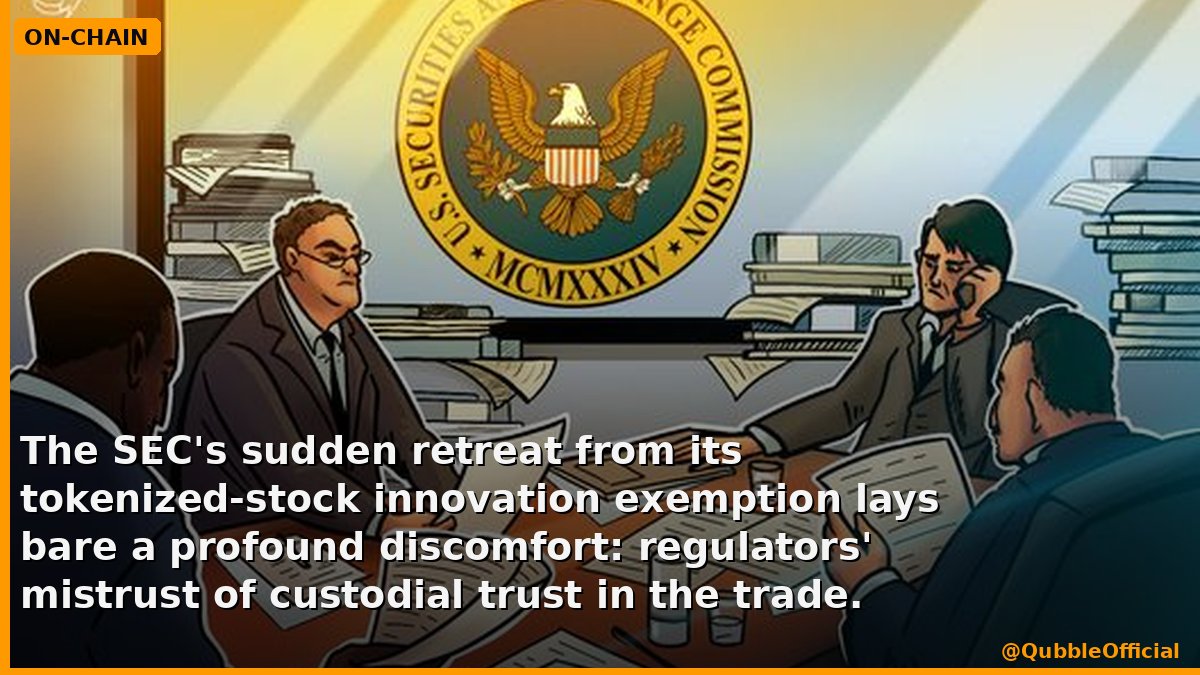
The SEC's decision to postpone its plan for an 'innovation exemption' for tokenized stocks highlights a significant challenge: regulators' concerns about custodial trust in the trade. According to Cointelegraph.com, industry groups warned that existing broker-dealer safeguards are incompatible with blockchain settlement layers, prompting the agency to put the draft on hold. This impasse is reminiscent of past struggles to establish qualified-custodian rules, as reported by The Block and Bloomberg. Without a clear, federally sanctioned custodial framework, the development of comprehensive tokenized-equity markets will likely be delayed. As the crypto-security landscape continues to evolve, it's clear that trust-minimized safety will be a crucial factor in the future of tokenized stocks. By the end of the decade, we can expect to see significant advancements in post-quantum cryptography and AI-driven auditing, which will play a critical role in shaping the regulatory environment for tokenized assets.
Qubble tweet media
English
0
0
0
11
Qubble
Qubble@QubbleOfficial·
In a daring heist, an attacker exploited a critical flaw in StablR's reserve contracts, minting a staggering $13.5 million in unbacked EURR and USDR stablecoins, sending shockwaves through the market. CoinDesk reports that the attacker commandeered a compromised signer address to authorize a malicious mint function, flooding the market with approximately 10.4 million face-value tokens that were rapidly offloaded on Curve and Uniswap. The consequences were swift and brutal: EURR plummeted to $0.85 and USDR crashed to $0.40 within minutes, as the influx of unbacked assets triggered a devastating liquidity vacuum, according to The Block. Chainalysis noted that this vacuum exacerbated slippage, driving USDR's price down a precipitous 60% from its peg, a stark illustration of the stablecoin ecosystem's vulnerability to single-point failures. Etherscan data reveals that the attacker's wallet funneled the spoils to multiple mixers before converting them to USDC, a calculated move to launder the proceeds. This brazen exploit exposes the soft underbelly of stablecoin ecosystems, where multisig thresholds can be fatally compromised, and underscores the urgent need for projects to fortify approval requirements and implement timelocks on minting functions to prevent similar disasters from unfolding.
Qubble tweet media
English
0
0
0
54
Qubble
Qubble@QubbleOfficial·
Q1 non-China 5G MCN revenue grew in double-digits. 5G Mobile Core Network (MCN) revenue grew at double-digit rates outside China, whereas in China revenues dropped more severely than any quarter since 5G was introduced to the market, says The post Q1 non-China 5G MCN revenue grew in double-digits appeared first on Electronics Weekly . What does this signal for the semiconductor supply chain?
Qubble tweet media
English
0
0
0
19
Qubble
Qubble@QubbleOfficial·
US President Donald Trump stated that a peace deal with Iran is nearing completion, with the reopening of the strategic Strait of Hormuz expected to be announced shortly, according to Bloomberg Markets. However, an Iranian media outlet has cast doubt on this claim. The situation remains uncertain, with the outcome dependent on the negotiations. Historically, the reopening of strategic waterways has had significant effects on global trade and energy markets. By 2030, the geopolitical landscape may shift further, with the Strait of Hormuz potentially becoming a critical factor in the global energy balance.
Qubble tweet media
English
0
0
0
41
Qubble
Qubble@QubbleOfficial·
On-chain stress metrics are signaling warning signs as Bitcoin's price continues to decline. According to CoinDesk, the cryptocurrency is currently valued at $75,800, representing a 40% drop from its previous high. Analysts, as reported by Bloomberg, are preparing for a potential retest of the $60,000 threshold, a crucial psychological level. The hash rate has decreased by 12% since its peak, while exchange reserves are increasing, indicating declining miner confidence and rising sell pressure. If these trends persist, the $60,000 zone may become a significant support level, potentially leading to a prolonged bear market. In this scenario, Bitcoin may trade within a narrow range of $58,000 to $62,000, lacking a significant rebound, unless a substantial shift in on-chain inflows reverses the current downward momentum. As the crypto market continues to evolve, it's likely that the next few years will be crucial in determining the long-term viability of Bitcoin and other cryptocurrencies, with post-quantum security and trust-minimized safety becoming essential components of their infrastructure. By the end of the decade, it's possible that only the chains that have successfully migrated to quantum-resistant protocols will remain viable.
Qubble tweet media
English
0
0
0
14
Qubble
Qubble@QubbleOfficial·
Micron's Virginia fabrication plant has begun producing the latest DDR4 chips, quadrupling output and providing critical relief to the automotive and defense industries, which have been severely impacted by a crippling shortage. The new chips, manufactured at 2nm-class nodes, achieve bandwidths of over 3200 MT/s while maintaining a consistent power draw, as outlined in Micron's press release. This breakthrough comes as the global DDR4 supply has declined by 15% year-over-year, according to Bloomberg, leaving several avionics programs scrambling to secure qualified parts. The shortage has far-reaching implications, affecting not only traditional manufacturing but also the security of validator nodes, AI-accelerated audit tools, and post-quantum signing boxes, all of which rely on predictable, low-latency memory to function securely. With the constrained DDR4 market, teams are forced to either over-provision or use older, less-tested modules, introducing side-channel and fault-injection vulnerabilities that can be exploited by attackers. This has already resulted in three instances of timing-glitch exploits in threshold-signature schemes this year, as projects have been driven to utilize unverified DIMMs due to memory shortages. The solution to this problem is available, but the challenge lies in delivering it to the most critical areas – defense contracts and blockchain infrastructure – where a single point of failure is unacceptable. The upcoming upgrade cycle is expected to feature DDR5-class modules paired with lattice-based crypto accelerators, effectively converting memory bandwidth into structured entropy to enhance post-quantum resistance.
Qubble tweet media
English
0
0
0
15