Sabitlenmiş Tweet
Casey A. Marx
1.2K posts

Casey A. Marx
@REALCaseyAMarx
Christian. Husband. Father. Son. Friend. Seeker. Founder of Crown Haven, Pinecone & BullBaron. Author of Inheritance: Modern Finance In Reckoning (Q3 ‘26)
Carmel, IN Katılım Ekim 2023
131 Takip Edilen1.4K Takipçiler

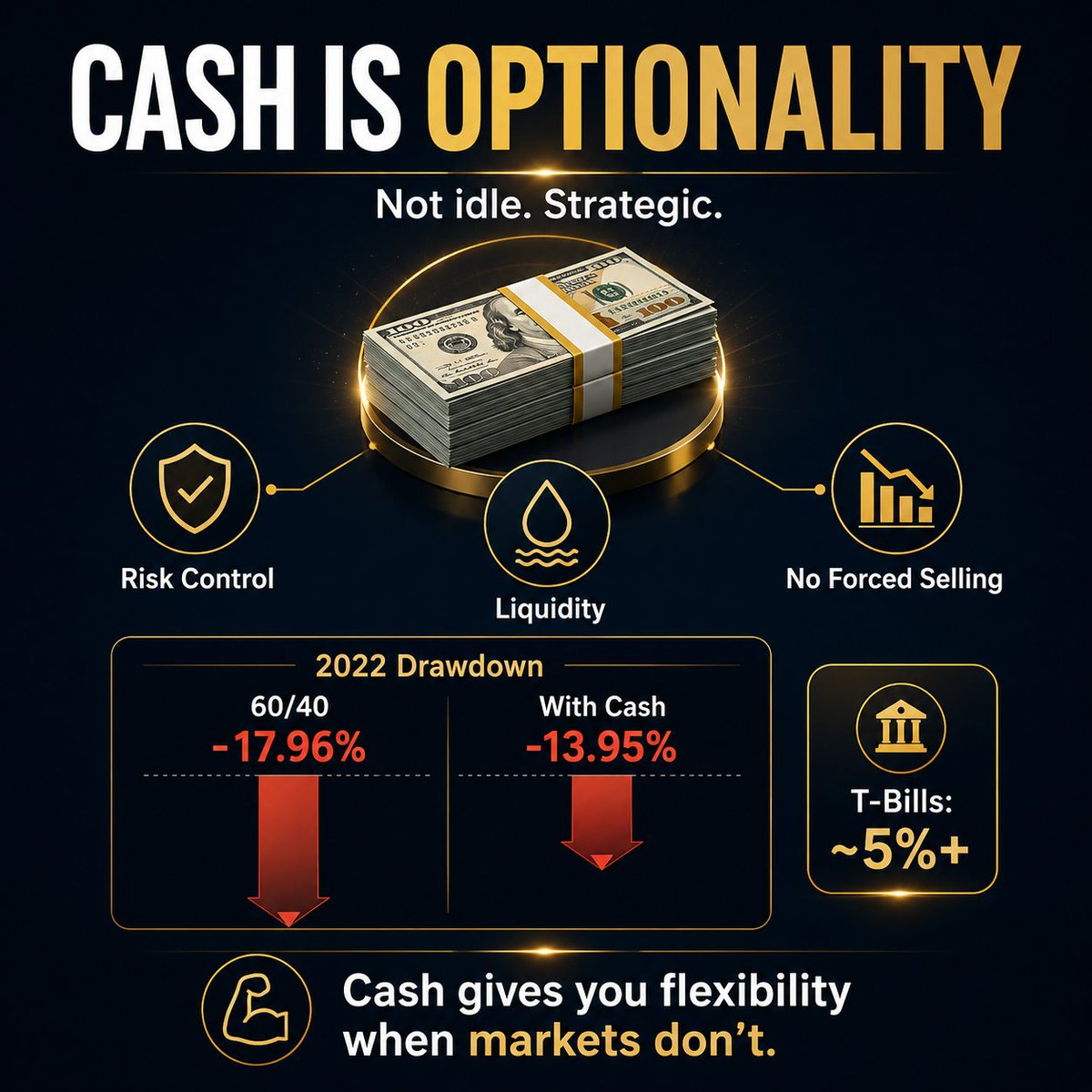
Cash is not “uninvested.” It’s one of the only assets that gives you control.
The industry frames cash as idle.
That’s incorrect.
Cash is optionality.
Damodaran data:
• T-bills yielded ~5%+ in recent years
Now look at drawdowns:
2022:
• 60/40 ≈ -17.96%
• With cash ≈ -13.95%
That difference compounds over time.
Why?
Cash:
• Has near-zero duration
• Maintains liquidity
• Prevents forced selling
This ties directly to Bengen’s sequence risk research:
Early losses matter more than long-term averages.
Cash reduces those losses.
Conclusion:
Cash is not a leftover.
It is:
→ Risk control
→ Liquidity
→ Strategic positioning
Question: Why is the one asset that gives you flexibility treated as a liability?

English

A new episode of the Inheritance Series is now out!
This one pulls back the curtain.
Not on what the brochures say.
Not on what the polished websites promise.
But on what actually gets said when clients are not in the room.
The difference between an adviser and a converter is not always obvious from the outside.
That is why families need to know the questions to ask before they trust someone with their financial future.
This episode is not about attacking good advisers.
It is about exposing the culture that rewards production over stewardship and helping families recognize the difference.
Because authority without education is control.
English

@alt_w_v_g This would all be great if one is capable of achieving a 10% return like clockwork in the S&P 500 over the coming years…not likely sir.
English

My wife mentioned a nice private school over dinner this week
She said the campus was beautiful
I asked what's the tuition
She said we should look at it as an investment in him not a cost
I made a note
She said don't make a note
I said I always make notes
She said this isn't a deal
I said everything is a deal
She closed her eyes
She said we'd discuss it Saturday
I agreed
Saturday 7:02am
She came downstairs in her Saturday robe
Coffee in hand
I had my cargo shorts on
The dining room had been cleared
The projector was on
The analyst was at the head of the table
Quarter zip on, three iced coffees, a legal pad, and two laptops
He had been there since 6:44am
I texted him at 11:14pm Friday
The text said dining room 6:45am bring the model
He sent a thumbs up
My wife stopped in the doorway
She said what is this
I said you said you wanted to discuss it
She said this is not a discussion
I did not respond
She sat down anyway
The analyst stood
He said good morning ma'am
She did not respond
He sat back down
A printed deck in front of each seat
A fourth copy in case
Slide 1 Tuition Schedule
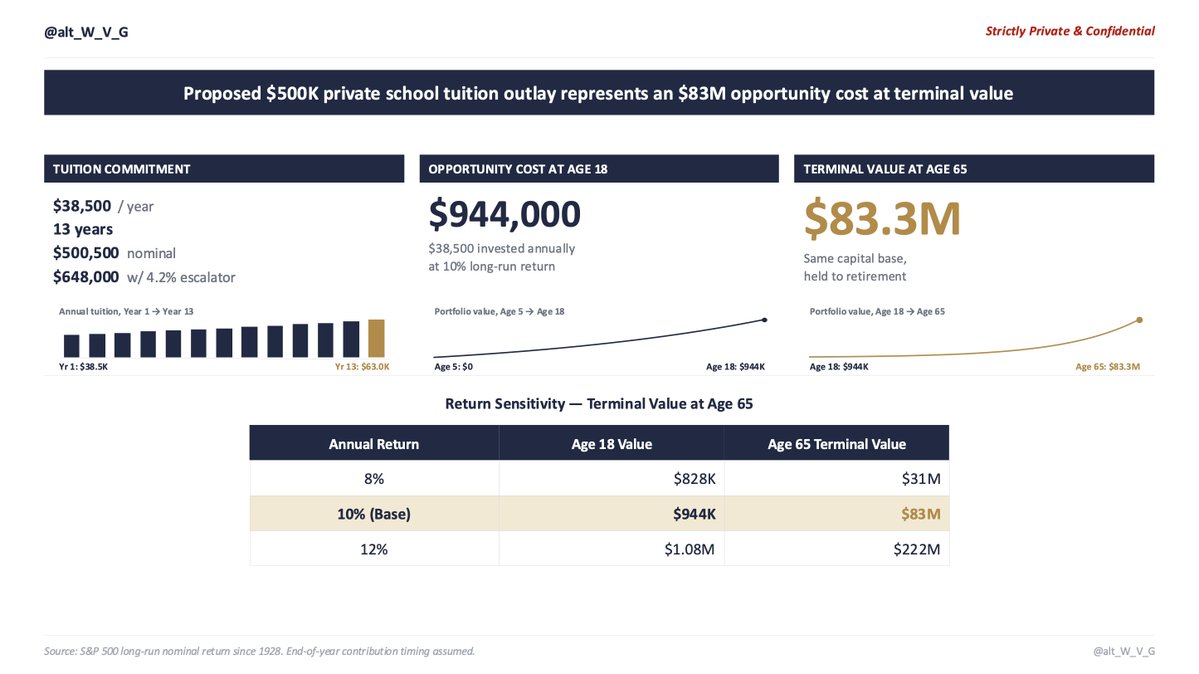
$38,500 per year
Thirteen years
$500,500 nominal
Before escalators
The school has raised tuition 4.2% per year for a decade
With escalators $648,000
My wife said okay
I said I'm not done
Slide 2 Opportunity Cost
Even before escalators
$38,500 invested annually
10% nominal return
S&P long-run average since 1928
By his eighteenth birthday $944,000
My wife said we can afford it
I said I know that's not the slide
Slide 3 Terminal Value at Age 65
$83 million
She was quiet
The analyst slid the sensitivity tables across the table
8% return $31 million
10% return $83 million
12% return $222 million
She did not look
She said this isn't about money
I said it's always about money
She said no it isn't
I said then what is it about
She did not answer
She said you can't put a dollar value on his teachers his classmates his environment
I said I can the analyst already did slide 6
He flipped to slide 6
She did not look
She said the school is the best in the city
I said best is a feeling
She said it produces the best students
I said the students were already the best before they got there
She said our son deserves it
I said our son deserves $83 million
My son walked in
He is five
Dinosaur pajamas
He looked at the projector
He looked at the open deck on the table
He looked at slide 3
He said are we modeling pre-tax or after-tax
The analyst opened a new tab
My wife looked at the ceiling
He said what's the discount rate
The analyst set down his pen
She closed her eyes
He said is this the same return assumption from the 529 conversation
The analyst stopped typing
He looked at me
I did not say anything
She stood up
Sat back down
He said dad can I help
I said yes
He pulled up a chair
The analyst handed him a printout
He started reading
My wife watched him read
She watched him for a long time
She said his name
He looked up
She said do you like school
He said the work is too easy and the kids don't ask questions
She did not respond
She looked at the ceiling
She walked out of the room
The analyst started packing up
He said should I follow up Monday sir
I said no follow up needed
He'll be fine
Sent from my iPhone

English

If you’re watching the Fed funds rate, you’re watching the wrong variable.
Markets don’t price off nominal rates.
They price off: Real yields.
Defined by the Federal Reserve (FRED):
Real yield = nominal yield – expected inflation
(DFII10 – T10YIE)
This is the actual discount rate.
Why it matters:
When real yields rise:
• Bonds fall (duration compression)
• Stocks fall (valuation compression)
2022 showed this clearly.
IMF + BIS research:
→ Inflation shocks increase real yield volatility
→ Cross-asset correlation rises
Same pattern again.
Implication:
Tracking Fed policy ≠ tracking markets.
Real yields drive pricing across asset classes.
Question: If your model doesn’t explicitly track real yields… what is it actually measuring?

English

What is QE, and why does it matter?
Most people hear “quantitative easing” and tune out.
But QE affects real families.
It can impact your savings, retirement plan, home value, purchasing power, and the cost of everyday life.
In this week’s episode, I break down why QE is not just some complicated financial policy.
It is a system that can inflate asset prices, weaken the dollar, and leave families paying for decisions they never got to make.
The key takeaway:
You may not control the Fed.
But you can build a plan that is not completely dependent on it.
Structure matters more than predictions.
Preparation beats panic.
English

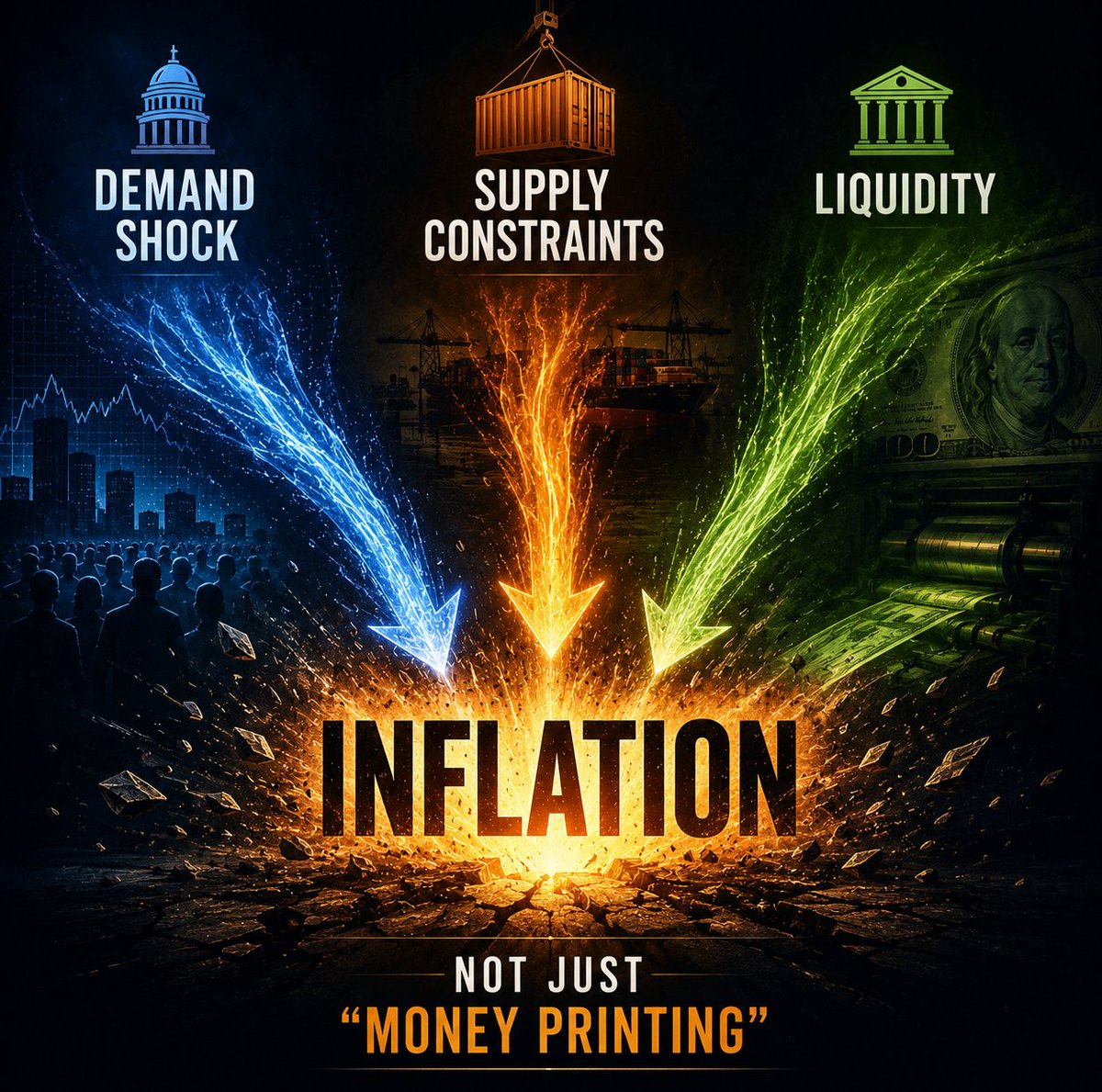
“Money printing caused inflation” is incomplete and the data doesn’t support it as a standalone explanation.
Start with fiscal policy:
• CARES Act ≈ $2.2T (~10% GDP)
• American Rescue Plan ≈ $1.9T (~6% GDP)
(Source: U.S. Treasury, CBO)
That’s direct demand injection.
NY Fed research:
→ Fiscal transfers significantly boosted goods demand
Then look at consumption:
BEA data:
• Durable goods demand rose ~20–30% above trend (2020–2021)
At the same time:
Supply was constrained.
• Manufacturing bottlenecks
• Shipping disruptions
• Labor shortages
So what do you get?
Demand spike + supply constraint = price increases.
BIS research confirms:
→ Inflation becomes synchronized and persistent under these conditions
Conclusion:
Inflation was:
→ Fiscal demand shock
→ Supply constraint
→ Monetary accommodation
Not just “money printing.”
Question: Why is the most simplified explanation the one everyone repeats?

English

Most financial disasters don’t begin with greed.
They begin with trust.
This week’s episode of the Inheritance Series, “The Cost of Blind Trust,” tells the story of a woman who survived unimaginable hardship only to be trapped by the very person who was supposed to protect her financially.
This is not just about annuities or bad advice. It’s about understanding incentives, asking better questions, and learning how to protect yourself and the people you love in a system that often rewards confusion.
The goal of this series is not fear. It’s clarity.
Because once you understand how the system works, you can build differently.
Episode is out now.
English

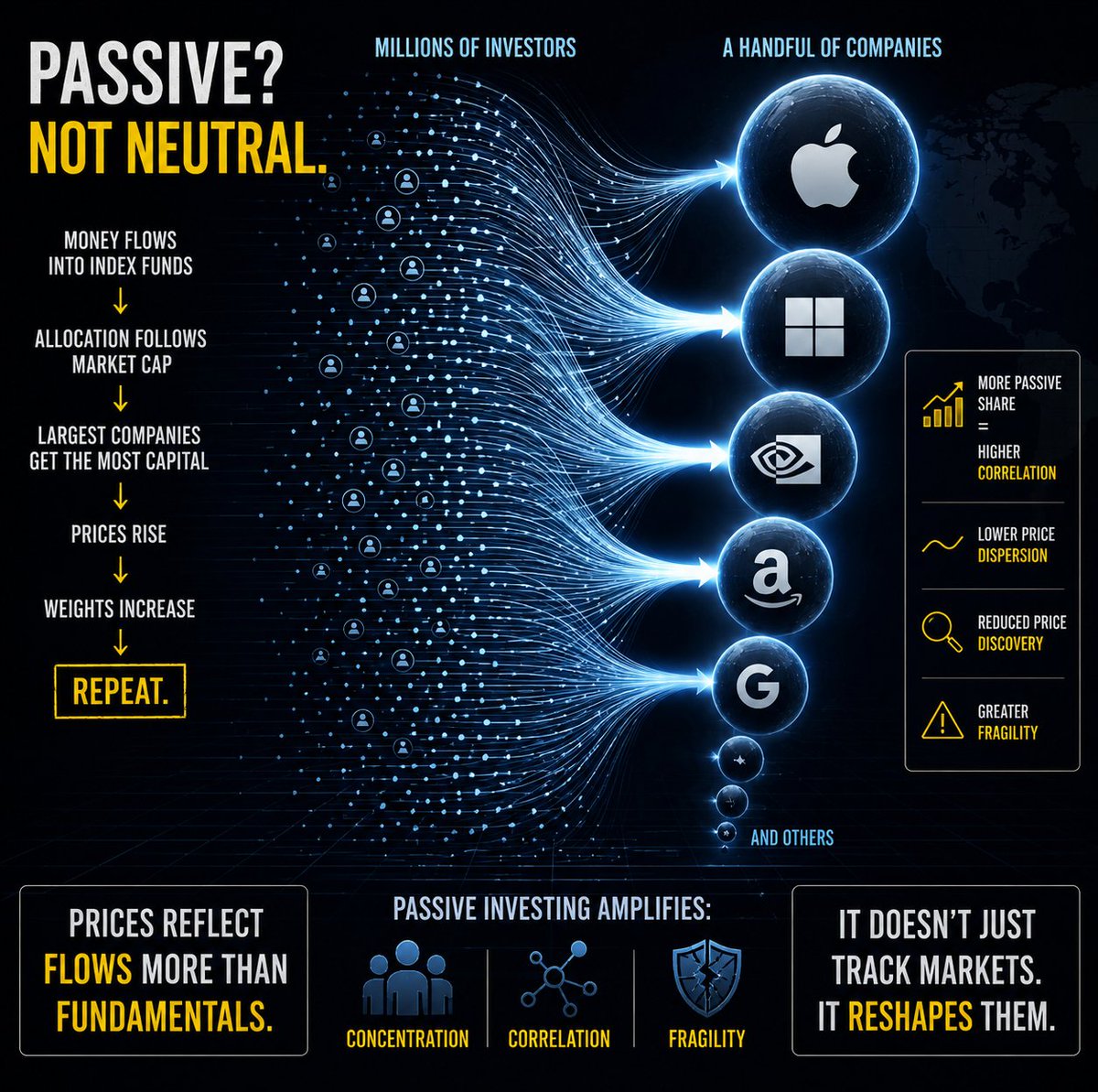
Passive investing didn’t just win. It changed the market itself.
The assumption:
Passive = neutral.
It’s not. It’s a structural force.
ICI data:
• Passive = ~51% of long-term fund assets
• Up from ~19% in 2010
That shift created a feedback loop:
→ Money flows into index funds
→ Allocation follows market cap
→ Largest companies get the most capital
→ Prices rise
→ Weights increase
Repeat.
Federal Reserve + BIS research shows:
• Higher passive share → higher correlation
• Lower price dispersion
• Reduced price discovery
Meaning:
Prices reflect flows more than fundamentals.
Second-order risk:
Passive assumes liquidity. But underlying assets don’t guarantee it under stress.
Conclusion:
Passive investing amplifies:
→ Concentration
→ Correlation
→ Fragility
It doesn’t just track markets. It reshapes them.
Question: At what point does “passive” stop being passive?

English

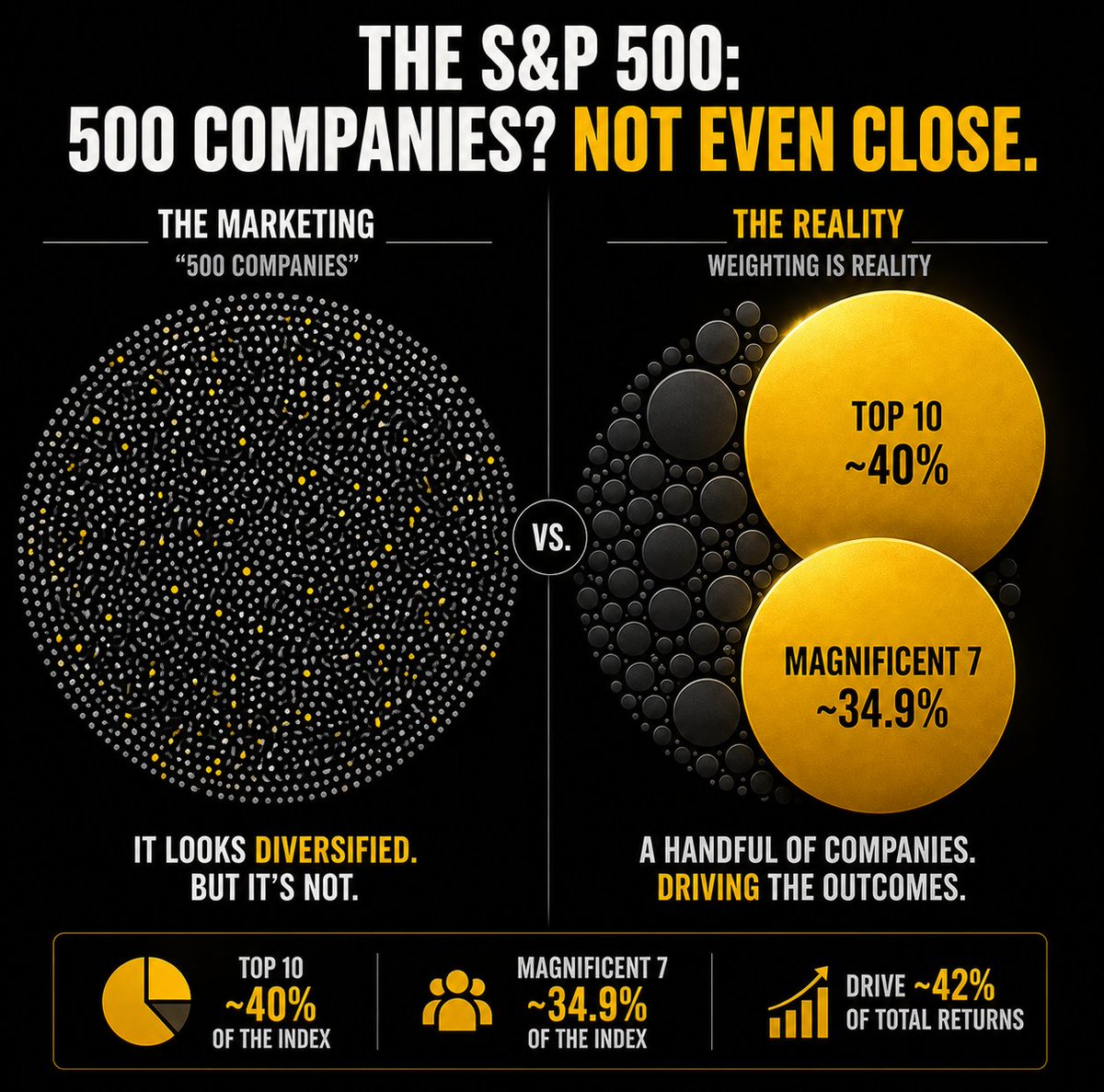
The S&P 500 is not diversified. It’s concentrated, and most investors don’t realize how extreme it is.
“500 companies” is a marketing statement.
Weighting is reality.
According to S&P Dow Jones Indices:
• Top 10 = ~40% of the index
• Magnificent 7 = ~34.9%
• ~42% of total returns
That means:
A handful of companies are driving outcomes.
Vanguard research shows this level of concentration hasn’t beeseen since the late 1960s.
So what do you actually own?
Not 500 independent businesses.
You own a concentrated exposure to:
• AI infrastructure
• Cloud monopolies
• Mega-cap growth
• Long-duration assets sensitive to real yields
And here’s the key:
These companies move together.
High correlation = low true diversification.
Translation:
The S&P 500 is a factor bet disguised as a broad market index.
Question:
If 40% of your portfolio is effectively the same trade… do you actually know your risk?

English

Love him or hate him, this is classic.
The White House@WhiteHouse
SPOTTED: PRESIDENT TRUMP TEACHING THE TRUMP DANCE ON THE SOUTH LAWN 🇺🇸
English

If your “diversified” portfolio lost money in stocks and bonds… it didn’t fail. It worked exactly as designed.
That’s the uncomfortable truth.
For 20 years, you were told stocks and bonds offset each other.
They did.
But only in one regime: Falling inflation.
Damodaran data:
• 2000–2019 stock–bond correlation ≈ -0.66
That’s not diversification. That’s a disinflation trade.
Then the regime flipped.
2020–2025:
• Correlation ≈ +0.68
2022:
• S&P 500 ≈ -18%
• 10Y Treasuries ≈ -18%
Same drawdown. Same time.
BIS and IMF research is clear:
→ Inflation regimes drive correlation convergence
→ Real rate shocks hit both equities and bonds
Mechanically:
• Bonds fall when real yields rise
• Stocks fall when discount rates rise
Same variable.
So let’s be precise:
60/40 is not diversification.
It is a duration-weighted macro bet on falling real yields. That’s it.
Question:
If your entire portfolio depends on one macro variable… is that diversification or leverage?

English

My father built his life on integrity.
He turned down opportunities that would have made him wealthy if they required compromising his values. He believed character mattered more than comfort.
Watching the system dismantle what he left behind felt like betrayal.
For a while, I thought it was random.
It wasn’t. It was predictable. And that realization gave me purpose.
I promised my father I would take care of my mother.
What I didn’t realize at the time was that promise would extend to thousands of families who walked into my office carrying similar stories, different names, same pattern.
This isn’t about anger anymore. It’s about architecture.
If you understand how the system works, you can design around it.
You can build structures that protect instead of expose.
You can choose advisors aligned by obligation, not commission.
You can rebuild.
It can’t all be for nothing.
And it doesn’t have to be your story next.

English

A new episode of the Inheritance Series is out:
Who Does the Fed Really Protect?
Most people were taught the Federal Reserve exists to protect the economy… and by extension, protect you.
That’s not how it actually works.
This episode breaks down what the Fed was really built to do, who benefits when it steps in, and why so many families feel like they’re falling behind even when they’re doing everything right.
This isn’t about blame.
It’s about understanding the system so you can make better decisions inside of it.
Because once you see how it works, things start to make a lot more sense.
English

@Steezehuman Realizing that these ‘things’ are not the answer. And subsequently becoming incredibly depressed if you have any soul whatsoever. Only when you have everything do you truly understand how little it all means.
English

One of the most expensive misunderstandings families make is assuming that “advisor” means the same thing as “fiduciary.”
It doesn’t.
An advisor can recommend a product that pays them well.
A fiduciary is legally required to put your interests ahead of their own.
That distinction would have changed my mother’s life.
You must ask how someone is paid and by whom.
You must fill out your own risk form.
You must understand that confidence is not competence and that marketing language is not protection.
The financial industry is fluent in sounding responsible while extracting value quietly over time.
Your job is not to master every detail. Your job is to understand the incentive structure.
When you understand who profits, clarity replaces confusion.

English