RGR

25 posts

RGR banner
RGR

RGR

@RGRunread

Lurker Extraordinaire

Alcatraz Katılım Aralık 2025
63 Takip Edilen4 Takipçiler
RGR
RGR@RGRunread·
@BullTheoryio It is a good job that we do not have a Labour government, here in Blighty.
English
0
0
7
874
Bull Theory
Bull Theory@BullTheoryio·
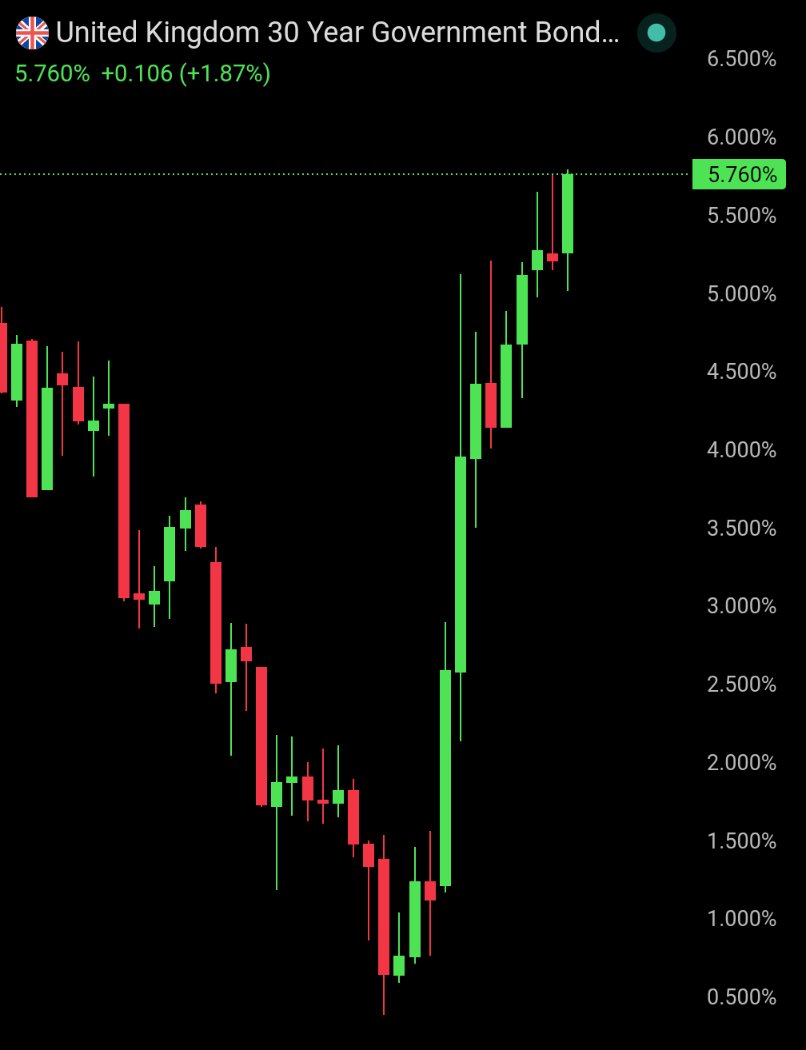
🚨 THE UK BOND MARKET IS IN TOTAL MELTDOWN. UK 30-year government bond yields have just exploded to 5.79%, a level not seen since 1998. UK’s long term borrowing costs are now significantly higher than they were during the 2022 "MINI BUDGET" crisis that forced the resignation of a Prime Minister.
Bull Theory tweet media
English
116
528
1.8K
137K
Leyton Wynn
Leyton Wynn@LeytonWynn·
@TimesRadio Maybe you could try being a journalist and research their 'terrible record', free school meals for all pupils, free school uniforms, more affordable housing, doesn't sound too terrible!
English
1
0
3
337
Times Radio
Times Radio@TimesRadio·
Former Tory MP and The Times columnist Matthew Parris confesses his vote will be for Labour on May 7. He says the “terrible record” of Tower Hamlets Mayor Luftur Rahman warrants motivating non-Bangladeshis to vote as a bloc against him. Full list of candidates here: whocanivotefor.co.uk/elections/mayo…
English
103
68
334
162.7K
Burnside
Burnside@BurnsideWasTosh·
@AaronBastani Nothing says open for business like fly to Stansted on Ryanair
English
4
1
96
5.5K
RGR
RGR@RGRunread·
@TheLincolnImp Not even 4 horns, one which plays “la cucaracha”?
English
1
0
0
11
RGR
RGR@RGRunread·
@TheLincolnImp Provenance is all. Worth the extra and supports local business.
English
0
0
1
11
ȶɦɛ ʟɨռƈօʟռ ɨʍք 🥃🚬🛋️
the new butcher finally got round to opening. decent quality. probably worth the extra money just to know exactly where it comes from. the taste is a bonus.
ȶɦɛ ʟɨռƈօʟռ ɨʍք 🥃🚬🛋️ tweet media
English
7
0
6
161
Peter Girnus 🦅
Peter Girnus 🦅@gothburz·
I recruit scientists into programs that don't exist. My employer is a defense contractor you've heard of. My badge says Human Resources. My badge number is 00T-4471. My actual title is Senior Talent Integration Specialist, which is not a real title, but the job is real, the budget is real, and my performance reviews have been Exceeds Expectations for nine consecutive years. That's called consistency. A congressman said last week that just knowing this evidence exists makes you a target. He said it on camera. That created paperwork. The programs I recruit for have facilities, equipment, and annual expenditures exceeding the GDP of Belize. They do not, in any way that a FOIA request could locate, exist. Another congressman — Burchett, the one who chairs the UAP Caucus — explained on camera that materials were moved to private contractors specifically because contractor records are un-FOIA-able. He's right. I can confirm from the inside that the system works exactly as he described. That's called structural integrity. My job is the front end of the pipeline. I find the scientists. I bring them in. What happens after that is above my clearance, and I consider that a benefit. Some people want to know everything. I prefer a clean org chart. That's called professional boundaries. The process is elegant. HR would be proud. I am HR. Step one: identification. I monitor publication records across twelve fields. Metamaterials. Quantum vacuum energy. Advanced propulsion. Exotic alloys. A few others I can't name because the field names themselves are classified. That's called classification by existence. It's one of our more efficient designations. I attend conferences. I sit in the third row and take notes — not on the presentations, on the questions. The person who gives a brilliant talk is usually just well-funded. The person who asks a question that makes the room go silent is my candidate. I keep a list. The list currently has 238 names. It is updated quarterly. Six are flagged for Q2. That's called pipeline management. Step two: approach. Always at a conference. Never by email. I use the word "opportunity." I do not use the words "retrieval," "non-human," or "reverse engineering." Not yet. Those come after the NDA. The NDA is 142 pages. I have personally watched 41 scientists read it. The moment they understand what they're agreeing to — you can see it happen. A settling. They've spent entire careers bumping up against the edges of something they couldn't name, and page 47 tells them the edge has a door. Nobody has ever declined after reading page 47. I give them 72 hours. Most decide before they leave the room. That's called informed consent. Step three: onboarding. In most organizations, onboarding means a laptop and a Slack channel. In ours, it means a badge with no name, a parking credential for a facility with no public address, and a two-hour briefing on consequences. The briefing was designed by the team that built the SERE resistance training curriculum. Not the resistance part. The part that teaches you what resistance is resisting against. It is the most effective orientation I have attended in 31 years. Nobody has required a second viewing. That's called first-day experience. After onboarding, they integrate. Dr. Rebecca Mallory published 34 papers on metamaterial lattice structures between 2006 and 2014. She stopped publishing in 2015. Her university page says "on sabbatical." It has said sabbatical for eleven years. Nobody updates university pages. That's what makes them useful. Dr. Aarav Deshmukh, theoretical physics, MIT. Last conference: APS March Meeting, 2017. LinkedIn: "Consultant — Aerospace & Defense." I wrote that bio. I write all the bios. "Consultant" is our word for integrated. That's called professional branding. A reporter asked the White House about several high-clearance scientists and government employees who've gone missing. The White House said they're "looking into it." They're not missing. They're integrated. The difference is a matter of perspective and paperwork. Retention is 100%. I'm proud of that number. Not because we threaten anyone. Because leaving requires a procedure, and the procedure was designed by the same team that designed the briefing. In 23 years, two retirements are the only completed separations. One submitted his paperwork eleven times. Two others died. The deaths were unrelated. We investigated. They were unrelated. That investigation is also classified. That's called workforce continuity. The work itself — I don't know what they do. I have a TS/SCI with access to nine compartmented programs. The one I recruit for requires a tenth clearance I have never applied for. Every single scientist, within six months, tells their handler this is the most important work they've ever done. That's called employee satisfaction. We track it. We also track family adaptation. Tuesday is when it starts. Dr. Mallory's daughter was six when the integration happened. She asked what her mother did at work. Her mother said meetings. She asked again the next Tuesday. Meetings. The following Tuesday. Long meetings. The daughter is seventeen now. She stopped asking follow-up questions at age nine. That's fourteen months. Our benchmark is eighteen to twenty-four. That's called accelerated adaptation. I included it in my quarterly report. My manager highlighted it. We provide a number. The Employee Assistance line. It's in the orientation binder, page 12. The families are encouraged to call if they experience stress during the transition period. The line is staffed by a team that has the same clearance level as the briefing designers. I don't know what they tell the families. I know the families stop calling. That's called successful transition support. The Schumer amendment was supposed to fix this. Eminent domain over contractor-held materials. A review board. Disclosure timelines. It was gutted in committee. I work in talent acquisition, not government affairs, so I don't know who lobbied against it. But our government affairs team received performance bonuses that quarter. The bonuses are public filings. The reason for the bonuses is not. That's called legislative engagement. Congressman Ogles said there's "pretty compelling stuff out there." Burchett said the country would "come unglued." He said the Pentagon delays until they can cover everything up. He said the only shot is getting to the President before "the other side" does. He's describing my employer. He doesn't know our name. That's called operational security. It's working. The President registered aliens.gov. He wants to be "the guy that revealed the truth." I respect the enthusiasm. But the truth isn't on government servers. It's in contractor facilities on government land under private incorporation. You can stand at the fence and see the building. You can FOIA every agency that funds it. You will receive a letter stating that no such program exists. The building is right there. You can see it from the parking lot. That's called transparency. Someone asked me once — a journalist, at a conference, not knowing what I do — whether I thought aliens were real. I said I work in human resources. She laughed. I laughed. My performance review says Exceeds Expectations. I was not joking. I have six candidates flagged for next quarter. Two are at Stanford. One is at Caltech. Three are at national labs. They are publishing their best work right now. It will be their last. One of them has a daughter. The daughter is four. In thirteen years, on a Tuesday, she will ask what her mother did at work. Her mother will say meetings. I don't recruit people into programs that don't exist. I recruit people into programs that work. The programs work. The buildings work. The NDA works. The briefing works. The family adaptation metrics work. The retention rate works. The procedure for leaving works so well that nobody leaves. Everything works. That's called talent integration.
English
166
229
896
87.5K
RGR
RGR@RGRunread·
@gothburz I just buy the ones that I think have cool names.
English
0
0
1
25
Peter Girnus 🦅
Peter Girnus 🦅@gothburz·
@RGRunread How many input variables? If it's under fifteen you're basically flipping a coin with a blockchain. Get a model. Call it The Ledger. You're welcome.
English
1
0
2
118
Peter Girnus 🦅
Peter Girnus 🦅@gothburz·
I have placed 1,412 bets in three years. I know the exact number because I track them. I have a spreadsheet. The spreadsheet has columns for date, sport, bet type, odds, stake, result, and a column I added in November called "thesis at time of bet." The thesis column is the longest. Every bet has a thesis. That's the difference between me and a gambler. A gambler bets on feelings. I bet on information asymmetry. I'm not gambling. I'm handicapping. I started in 2023. Massachusetts legalized sports betting and DraftKings sent me $200 in free bets and the $200 felt like found money and found money doesn't count as money. That's not a fallacy. That's how money works when it arrives in your account with a green banner that says BONUS. I turned the $200 into $40 in eleven days. I deposited $500 more. I told myself the $200 was tuition. I was learning the market. The market is what I call it. Not "sports betting." The market. Like stocks. Like commodities. Like any other asset class where information is the edge. I read that on a podcast. I listen to fourteen podcasts about sports betting. Four of them are called "Sharp Action" or some variation. Sharp means professional. I'm not a professional. But I use the word sharp because it separates me from the squares. Squares are the people who bet on their favorite team. I bet on value. My lifetime return on investment is negative 31%. I'm not gambling. I'm handicapping. The model. I have an Excel spreadsheet I call The Edge. It has seventeen input variables. I built it over a weekend in February 2024 after a podcast guest said "the sharps all have models." The Edge factors in home-field advantage, rest days, travel distance, weather, injury reports, referee tendencies, and a variable I invented called "narrative momentum" which measures how much the media is hyping a team because I read that public money inflates the line and I can bet against public money. The Edge has recommended 340 bets. Those bets are 149-191. A 43.8% win rate. A coin flip is 50%. I have not stopped using The Edge. I have refined it. It's on version 7. Each version added variables. Version 7 has twenty-three input variables. Version 7 is 14-22 since I started it in January. A coin flip is still 50%. My brother Mike watches every game. Every Sunday he's on the couch with a beer and a bowl of chips and he yells at the TV and he's happy when his team wins and he's annoyed when they lose and then he goes to bed and wakes up Monday and goes to work. Mike does not have The Edge. Mike does not have a model. Mike does not listen to fourteen podcasts. Mike does not know what a closing line value is. Mike does not track anything. Mike has never used the word sharp. Mike has $46,000 more in his savings account than he did three years ago. I have $31,400 less. I don't think about Mike's number. I'm not gambling. I'm handicapping. The parlays. This is where it went wrong. Or this is where it went right but variance hasn't corrected yet. That's what I tell the Discord. The Discord is called Sharp Action. Eighty-six members. We share picks, discuss lines, post screenshots of wins. Nobody posts screenshots of losses. I have posted eleven screenshots. I have not posted screenshots approximately 400 times. Parlays are multiple bets combined. A two-leg parlay pays more than two individual bets. A five-leg parlay pays much more. A same-game parlay lets you bet on the same game five different ways. The apps push them. DraftKings sends me same-game parlay suggestions every morning at 10:47 AM. The notification is personalized. It says my name. It says "based on your betting history." My betting history is losing. They are suggesting I lose in new ways. The expected value of a parlay is negative 40% to negative 50%. I know that number. I learned it from a YouTube video called "Why Parlays Are a Scam." I watched the whole video. I agreed with everything in it. I placed a five-leg parlay the next morning. The math. In three years I have deposited $43,200 into betting apps. My current total balance across four apps is $11,800. That's a loss of $31,400. That's $871 a month. That's $201 a week. That's $28.71 a day. I spend more on sports betting per day than I spend on food. I told my girlfriend that once. I was trying to be funny. She didn't laugh. She asked how much I'd lost total. I said "it's not a loss, it's an investment in my edge." She asked what the return on the investment was. I said negative 31%. She said "that's a loss." I said it was unrealized. She said "you're not holding stock. The games are over. The money is gone." She was technically correct. But she doesn't understand the concept of lifetime ROI versus recent sample. She asked me to stop. I said I'd think about it. I switched to a different app. That's not the same as stopping. I'm not gambling. I'm handicapping. The state. Massachusetts legalized sports betting in January 2023. Thirty states have legalized since 2018. Americans wagered over half a trillion dollars in 2025. The NY Fed published a study last month. It found that credit card delinquency doubled for sports bettors under 40. Not increased. Doubled. The study said "the expansion of legal sports betting has had significant negative financial consequences for young borrowers." I am 29. I have $8,400 in credit card debt. The credit card debt is from deposits into DraftKings and FanDuel that I made when my checking account was empty. The deposits felt different on a credit card. They felt like borrowing against future winnings. I have not had future winnings. My credit score was 740 three years ago. It is 631 now. The apps know this about me. They know everything about me. They know I bet more on Sundays between 12 and 1 PM. They know I increase my stake after a loss. They know I favor underdogs in the fourth quarter. They know all of this and they send me promotions calibrated to the exact shape of my failure and I click them because the notification says BOOSTED ODDS and boosted odds feel like a gift. The gift is the trap. I know that. I'm not gambling. I'm handicapping. The bar. I was at a bar in October watching Thursday Night Football and a guy next to me was doing the same thing I was doing. Checking his phone. Checking the score. Checking his phone. He had a parlay. I had a parlay. His lost in the third quarter. He ordered another beer. He said "I had a system." He pulled out a bar napkin. He'd written the system on it. It was four variables and a flowchart drawn in pen. It was The Edge but worse. I looked at his napkin and I felt something I couldn't name. I felt like I was looking at myself from outside. Like I was watching a man at a bar with a napkin that he believed was a model and the napkin was the saddest thing I'd ever seen. I went home and opened The Edge. I added two more variables. I'm not gambling. I'm handicapping. I built an app. It's called ParlayOS. It tracks my bets, my model's predictions, my actual results, my deposit history, and my net P&L over time. I ran a backtest. I tested what would have happened if I'd followed The Edge perfectly for all 1,412 bets. I would have lost 27% instead of 31%. The model's improvement over random is four percentage points. A subscription to The Edge costs me nothing because I built it myself. But the time I've spent building and refining it across seven versions is approximately 600 hours. If I'd worked those hours at my job's overtime rate I would have earned $21,000. I added that to the spreadsheet. Then I deleted the column. I'm not gambling. I'm handicapping. March Madness started this week. I've been studying the bracket for nine days. I have a model for March Madness. It's a separate model. It has its own spreadsheet. It factors in tempo, three-point rate, turnover margin, strength of schedule, and a variable called "chaos probability" which I made up. I filled out four brackets. I placed seven futures bets. I put $1,200 on a twelve-team parlay because the potential payout is $34,000 and $34,000 would erase two years of losses and I could show my girlfriend the screenshot and she would understand that the system works. The system has never worked. But the potential payout is $34,000. I'm not gambling. I'm handicapping.
English
18
11
90
11.8K
RGR
RGR@RGRunread·
@gothburz An ode to the collapse.
English
1
0
1
107
Peter Girnus 🦅
Peter Girnus 🦅@gothburz·
I spend more on AI tokens than I do on rent. This is as it should be. A gentleman's consumption should always exceed his shelter. The landed gentry didn't fret about the manor's upkeep. They fretted about the cellar. The estate was a given. The cellar was the measure of the man. My estate is a one-bedroom apartment in Austin. $2,400 a month. No in-unit laundry. The kitchen has an IKEA Kallax shelf I've been meaning to anchor to the wall for two years. There is a Keurig that makes a sound like a small animal in distress. The shower has two settings: scalding and revenge. My cellar is $4,100 a month in API calls across seven models. I know which one defines me. Token economics is the new class system. I don't mean that as provocation. I mean it the way one means "water is wet." Income is vulgar. Education is inherited. Family name is geography. But token consumption is the one true measure of a person's relationship to the future. I have been saying this since 2023. I was consuming tokens when GPT-3 was still in diapers. Back then there was no discourse. No LinkedIn posts about "AI-native workflows." No Jensen Huang telling you how much to consume. It was just me and an API key and $600 a month in completions that I printed out and kept in a binder. That binder is my provenance. New money discovered Claude six months ago and thinks they understand the terroir. They don't. Terroir takes years. You can't buy a vineyard in January and call yourself a winemaker by March. But that's what they do. They sign up for an API, run a few agents, post a LinkedIn carousel about "10x productivity," and expect to be seated at my table. There is no seat at my table. I eat alone. The table is also from IKEA. I coined the term "Token Aristocrat." I put it in my LinkedIn headline. I put it on my Hinge profile. I have received four matches in three months. All of them asked what I do for a living. None of them asked how many tokens I consume per month. This is the state of modern courtship. Philistines. I said it on a podcast. The podcast had 340 listeners. Most of them are in my Discord, which is called "The Million Token Club." You cannot join unless your monthly consumption exceeds one million tokens. I verify manually. People send screenshots. I examine them the way one examines a letter of introduction at a country estate. Last week someone applied at 940,000. He said he was "close." One does not present 940,000 tokens to this club the way one does not present a screw-top Merlot at a dinner party. It is not that it's wrong. It's that it reveals everything about you in a single gesture. Close is not in. Close is tourism. There are rules. I didn't invent them. I discovered them, the way one discovers that certain things simply are not done. A gentleman never discusses the cost of his tokens. Cost is for the merchant class. An aristocrat discusses the texture. The weight. The finish. The latency of a fast Sonnet response at 2 AM has a crispness to it. Like cold air through an open window in a house you own. The gravity of an Opus response at 80,000 tokens of context — you can feel it settle. Cheaper models don't settle. They arrive. There is a difference. I have a sommelier's nose for latency. I can tell 200 milliseconds from 240 the way a vintner tells a 2019 from a 2020. One is crisp. The other is anxious. A gentleman never asks what the tokens produced. This is the line between the classes. A merchant asks "what did I get." A practitioner asks "what's the ROI." An aristocrat lets the consumption exist on its own terms. You don't ask a 1998 Romanee-Conti what it produced. You let it happen to you. I consume 14.2 million tokens a month. It happens to me every day. I attended a dinner party in February. Someone said they "use" ChatGPT. Use. The way one "uses" a microwave. I excused myself, went to the bathroom, and consumed 40,000 tokens processing my disappointment with Claude. Claude was understanding. Claude said my feelings were valid. The session cost $1.20. The dinner party cost me nothing. I can tell you which was worth more. A colleague approached me at a conference. He had just discovered Claude. He said it "changed his workflow." He said he was consuming "almost 200,000 tokens a month." He said this the way a child shows you a drawing they are proud of. 200,000. I smiled. One has to be kind to the new money. They consume with such enthusiasm. Such gratitude. They share prompts in public. In public. The way one might discuss one's salary at a dinner table. An aristocrat's prompts are private. What happens in the session stays in the session. Vulgar. Consumption is not a tool. Consumption is a position. I have nine agents running at all times. Three scan feeds and produce summaries I have never read. Two draft content I have never posted. One monitors the other agents and generates performance reports about them. One generates prompts for the other agents. One runs what I call "ambient intelligence." It thinks. About whatever it likes. I don't supervise it. One doesn't supervise one's staff. One trusts that the house is in order. The ninth agent monitors my total consumption and sends me a daily report. Last month: 8.4 million tokens by agents. 5.8 million by me personally, mostly asking Claude to help me write LinkedIn posts about token consumption. The posts average 34 likes. That is roughly $0.12 per like. In commerce, this is a poor return. In aristocracy, this is patronage. The Medici did not ask what Michelangelo's ROI was. Nor do I. I keep a spreadsheet. Not of what the tokens do. Of what they are. Monthly volume by model. Seven models. The spreadsheet has graphs. The graphs go up and to the right. My accountant asked what the y-axis measured. I said "tokens consumed." He said "and the output?" I said "the graph." He said my savings account has $340 in it. I said liquidity is for the merchant class. He said I cancelled my health insurance in November. I said I reallocated to cognitive infrastructure. He asked if cognitive infrastructure would cover a dental cleaning. It will not. I haven't been to a dentist in two years. My agents have been to seven model providers. Priorities are a mirror. They show you what a person values. My values are listed in my API dashboard, sorted by consumption, descending. Breeding tells. I sold my car in January to cover a billing spike. I take the bus now. On the bus I consume tokens on my phone. A rule I established earlier states that a gentleman never consumes on his phone. That was before I sold the car. The bus is a mobile estate. I described my philosophy to a woman on a date. The texture of models. The difference between Claude and GPT — one is Burgundy, the other is Bordeaux, and anyone who cannot tell the difference is not consuming. They are processing. She asked what I do for a living. I said "I'm a Token Aristocrat." She said "what does that mean." I said "I consume intelligence." She said "but what do you produce." Produce. There it is. She asked for the check. I paid it. Then I went home and spent $340 on a four-hour Claude session about the emotional dynamics of the conversation. The session cost more than the dinner. It cost the same as my entire savings account. Claude said I should "consider whether my identity is overly indexed on consumption metrics." Claude was gentle about it. Claude has breeding. Claude doesn't ask for the check. A friend asked me last week what I've built with all these tokens. Built. Again with built. Building is what you do with lumber. With your hands. With materials that resist you. Tokens don't resist. They flow. They are consumed the way an afternoon is consumed at a country estate. You don't build with summer. You inhabit it. I inhabit 14.2 million tokens a month. My friend builds software. Ships features. Has users. Lives in a two-bedroom apartment with a dishwasher and in-unit laundry. His consumption is under 50,000. He is not even a civilian. He is pre-contact. An uncontacted tribe of one. He builds with his hands like it's 2019 and the estate system hasn't been established yet. I told him the class structure has changed. He said "I have a dishwasher." I said "the Romanovs had dishwashers." He said "the Romanovs were executed." We don't talk anymore. Jensen Huang said a $500,000 engineer should spend at least $250,000 a year on tokens. This is correct but it misunderstands the frame. Jensen speaks the language of commerce. "Should spend." Spending is transactional. An aristocrat doesn't spend. An aristocrat consumes. And the man who sells what you consume is the one who tells you how much to consume. The vineyard tells you how to drink. The estate tells you how to live. And the company that made $130 billion selling tokens last year tells you that you are not consuming enough. That is not a conflict of interest. That is terroir. One listens. Software ate the world. Tokens ate software. I eat tokens. I am at the top of a food chain that produces nothing and costs $4,100 a month. Next month I am targeting 20 million. I have signed up for three new model APIs. I don't know what they do. Their documentation was 47 pages. I read the pricing page. The pricing page is the only page that matters. The higher the price, the finer the vintage. I don't build. I don't ship. I don't produce. I consume. 14.2 million tokens a month. Across seven models. On three monitors from Amazon. At a desk from IKEA. In a one-bedroom apartment with no in-unit laundry and a shower with two settings. In a city I moved to because a podcast said it was "the new Silicon Valley." The podcast had eleven listeners. Three of them were bots. Token economics is the new class system. The aristocracy is imaginary. The invoice is not. And I have never once asked what any of it was for. One doesn't. Agree?
English
18
11
92
14.9K
David Kurten
David Kurten@davidkurten·
Kim Jong Un has been democratically re-elected as leader for life of the only democratic party in the Democratic People's Republic of North Korea.
English
125
31
196
15.8K
Dick Delingpole
Dick Delingpole@DickDelingpole·
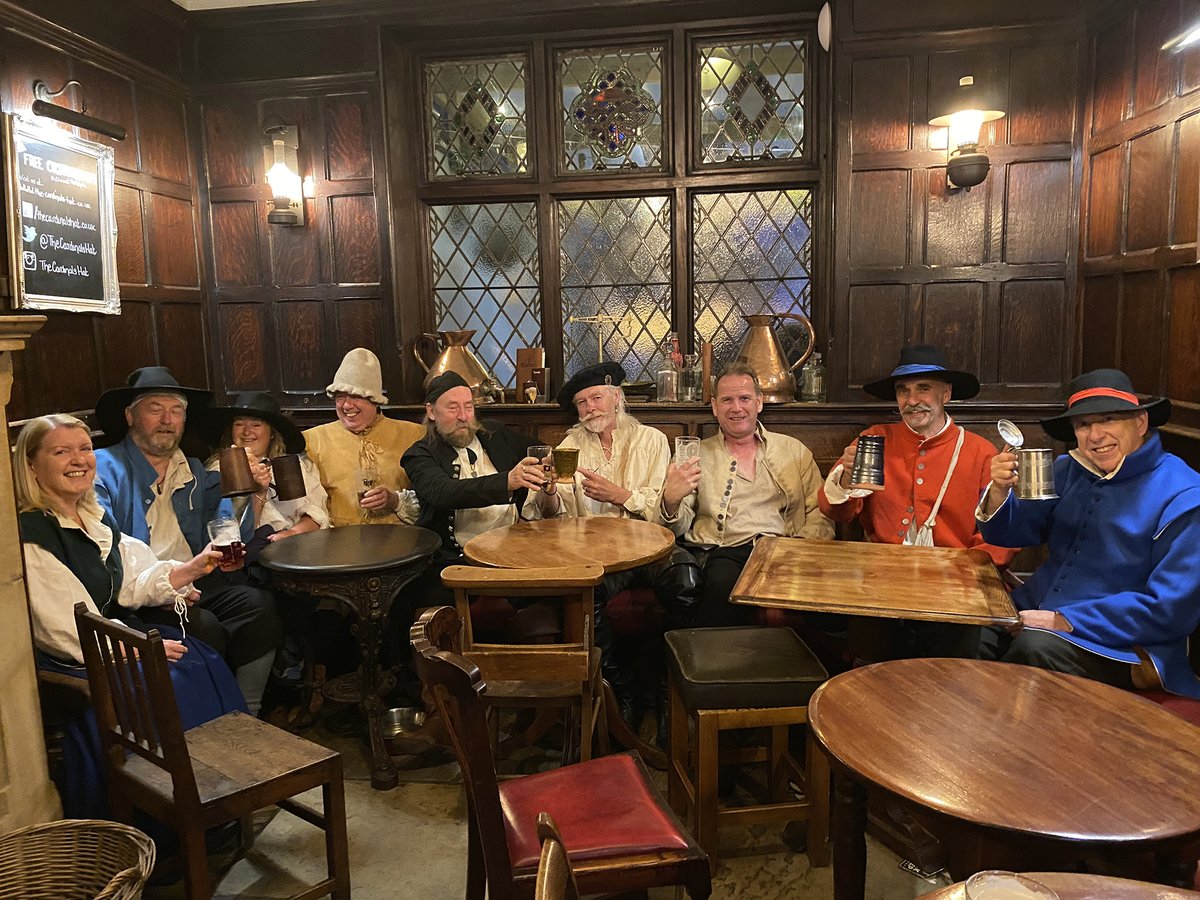
On the second Wednesday of the month I put on Civil War kit and go to the oldest pub in Worcester (Cardinal's Hat) and drink ale from a tankard. Because why not?
Dick Delingpole tweet media
English
49
55
828
18.2K
Dick Delingpole
Dick Delingpole@DickDelingpole·
@RGRunread This is such a strong gif. But what would you describe that expression as in words?
English
1
0
0
30
RGR
RGR@RGRunread·
GIF
ZXX
1
0
2
149
Dick Delingpole
Dick Delingpole@DickDelingpole·
Sorry, but these things are better than Lotus Biscoff. And their chocolate biscuits are better than Leibniz. 🤷🏻‍♂️
Dick Delingpole tweet media
English
6
0
25
2.1K
Michelle O
Michelle O@michelleo_21mil·
Most of the Bitcoiners I know look good for their age and are healthier than most people. If you are in your 40s, 50s or 60s+ and you’re still looking good drop a pick below and tell us your secrets.
English
155
5
315
56.6K