
Richa Gupta retweetledi
Richa Gupta
794 posts


Richa Gupta
@RICHADICT
Student of The Chartist @_Chartitude
Katılım Ağustos 2022
16 Takip Edilen3.2K Takipçiler


Richa Gupta retweetledi

Important note in case you missed Davinder’s post.
I love it when others do the work and I simply have to repost it. 🙂
Davinder Khurana@iDavinderK
This is how leaders will look like now. #Leaders
English
Good Insight. Risk Management.
Ankit K@prudentttrader
Risk 1% per trade. Stop loss hits. How many more trades can you take? The answer: a lot more than you think. After 10 straight losses you still have 90% of your capital. After 30 losses, 74%. You need 70 consecutive losing trades to lose half. Now do the same with 5% risk. Just 14 losses and you're at half. The math is simple but most people skip it. They blow up not because of one bad trade but because they sized too big and ran out of runway before their edge could show up. Risk management is the key. Not your chart patterns, not your indicators, not your conviction on a trade. How much you risk per trade decides whether you survive long enough to get good or whether you're done before you even start. Position sizing isn't exciting. But it's the only thing standing between you and a blown account. #riskmanagement #positionsize #trading #TradingOpportunities
English
Richa Gupta retweetledi

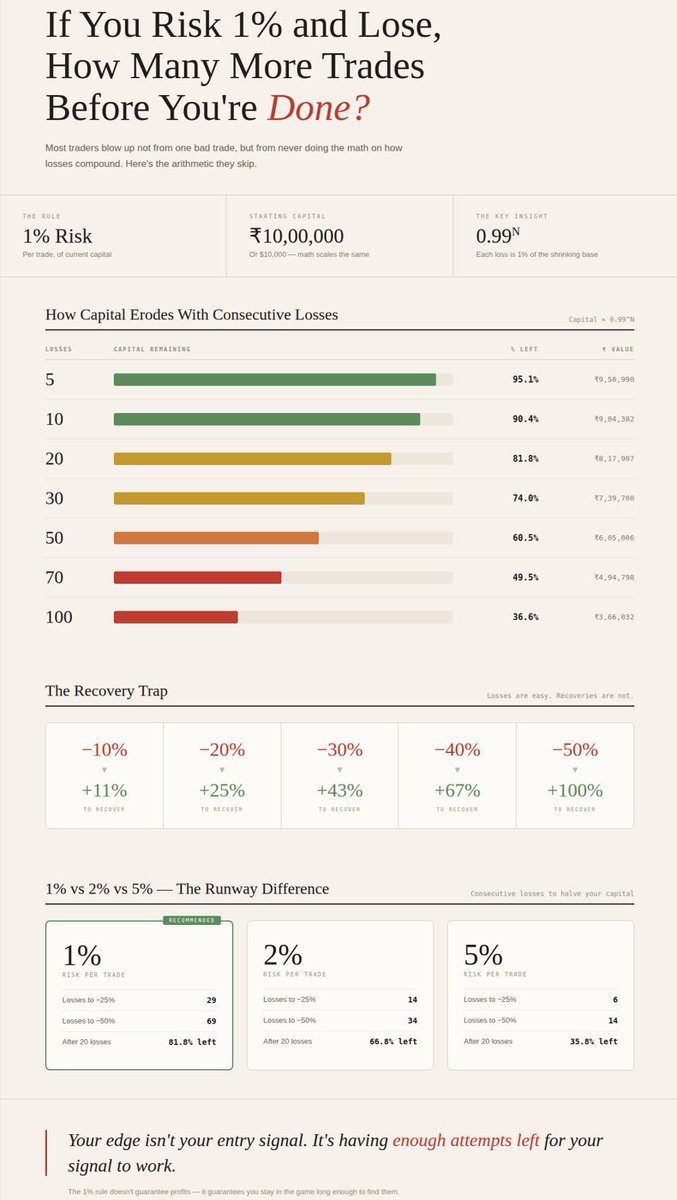
Risk 1% per trade. Stop loss hits. How many more trades can you take?
The answer: a lot more than you think.
After 10 straight losses you still have 90% of your capital. After 30 losses, 74%. You need 70 consecutive losing trades to lose half.
Now do the same with 5% risk. Just 14 losses and you're at half.
The math is simple but most people skip it. They blow up not because of one bad trade but because they sized too big and ran out of runway before their edge could show up.
Risk management is the key. Not your chart patterns, not your indicators, not your conviction on a trade.
How much you risk per trade decides whether you survive long enough to get good or whether you're done before you even start.
Position sizing isn't exciting. But it's the only thing standing between you and a blown account.
#riskmanagement #positionsize #trading #TradingOpportunities
English
Richa Gupta retweetledi

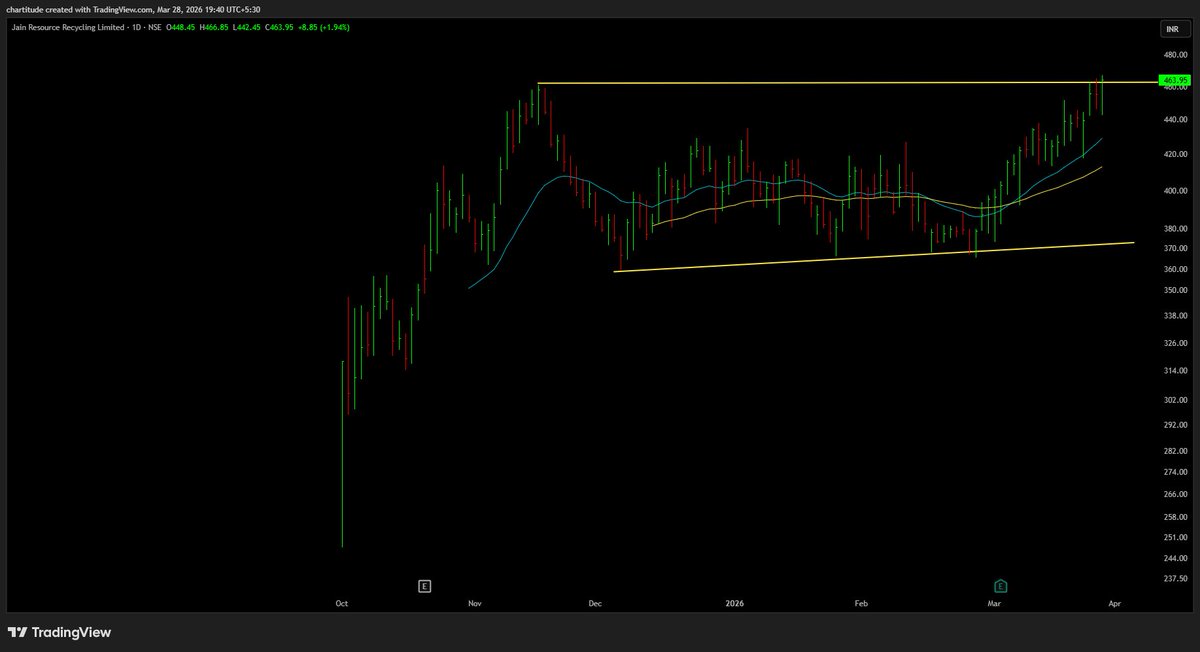
Jain REC - so far, standing strong even in this condition
Ascending triangles are bullish if the price spends a lot of time near the resistance
English
Richa Gupta retweetledi

Richa Gupta retweetledi
- Create a folder
- Run the scans
- Save the Excel file in the folder
- Tell Claude cowork to work on it and generate individual stock reports on all the tickers
- Go for your day-to-day work and come back to see all the files saved & done
Leave your PC on
The_Chartist 📈@thechartist26
A work that earlier needed a dedicated employee
English
Richa Gupta retweetledi
Markets are falling apart. Stocks, commodities, crypto. Carnage everywhere.
Most traders are either panic selling or trying to catch the bottom.
I am doing neither.
I am using this time to study charts. Not to trade them. Just to read them. Going through chart after chart, understanding how price behaves during fear.
Too many things are happening at once. War, oil, rates, currencies. It is nearly impossible to track every event and apply it to individual stocks.
No one can predict direction right now. One day it looks like the bottom is in. Next day, it falls like a house of cards.
So what can I control? My behavior.
Though I am still learning the art of trading, if there is one thing I have learned in two years, it is the ability to sit out. To not trade when conditions are hostile.
Sounds simple. Hardest thing I have done as a trader.
My aim is not to beat the market every month. I just want to earn a little more than mutual funds over time. And that is only possible if I stop giving it back during times like these.
Fewer entries. Better setups. Healthy conditions only.
For a part-time trader, this discipline is not optional. It is survival.
The market will turn. It always does.
When it does, I want to be ready with sharper eyes and a clear process. Not recovering from wounds I didn't need to take.
#TradingOpportunities #Trading #TradingMindset
English
Richa Gupta retweetledi

Unbecome
Stay alone. Get bored. Talk to yourself. Write. Discover what you really think when you are the only audience. Constant connectivity is the biggest enemy of original thought. Disconnect. Disappear.
Treat ideas like clothes. Try them. See if they fit. Discard them when they no longer serve the purpose. Separate the ideas from the person. Strip ideas to their core. Reject processed ideas. Consume them raw. Test. Observe. Unlearn. Update.
Let go of biases. Let go of attachments. Let go of the fear of being proven incorrect, being proven stupid, getting isolated. Welcome being wrong. The level of criticism you can take without defending yourself is the degree of your maturity.
Sit with uncertainty. Thinking starts at discomfort. Think. Read. Speak your heart. If you can’t say it, you don’t understand it. Teaching others is an even better way of learning.
Don’t assume conclusions. Don’t borrow convictions. Step outside the scene to understand it. Free yourself of concepts that bind you. Separate yourself from the labels that society uses to define you. Do not let your opinions become your identity.
You are not your profession. You are not your money, not your country, not your religion, not your family name. You are neither the story you keep telling yourself nor the version of you that society wants you to be.
Strip it all away. Your beliefs. Your past. Your trauma. Your achievements.
Strip it all away and ask what remains.
That. That remainder. That which quietly watches all of it come and go without becoming any of it.
That’s worth knowing.
But it’s highly unlikely that you’ll ever get there. Not because it’s hidden. But because the stripping away is uncomfortable. And society keeps handing you new things to wear.
English
Richa Gupta retweetledi

The market has been discounting higher oil prices and geopolitical uncertainty. Sentiment is finally turning more bearish, which from a contrary standpoint is a step in the right direction. However, in the short term, volatility is likely to remain elevated as bullish sentiment unwinds and bearish sentiment approaches an extreme.
As noted, this is likely a cyclical correction within a broader secular bull market. Patience and vigilance will be key to identifying the next leaders in the coming advance.
Oil will ultimately present a compelling opportunity on the short side, and equities will eventually find a bottom. That said, I don’t play guessing games or try to catch falling knives. One of the most difficult lessons for traders to internalize is that the right price is not necessarily the lowest price.
In the near term, remain defensive. Keep exposure tight and highly selective. Focus only on the highest-quality setups and demand confirmation with meaningful follow-through before committing additional capital or increasing exposure to aggressive levels. The market is offering very little margin for error—discipline and patience are essential.
minervini.com
Mark Minervini@markminervini
Oil just saw one of its biggest surges in 45+ years—driven by geopolitical shock, NOT structural change. Higher prices risk fueling inflation and weighing on GDP mildly. Not likely to fuel a SECULAR bear market in stocks, but with sentiment still elevated, a cyclical reset may be needed before the next sustainable move to the upside. It doesn't have to take months to unfold. Seasonal/cycle headwinds aren't expected until May through October.
English
Richa Gupta retweetledi
Richa Gupta retweetledi

How to Improve Your Win Rate as a Swing Trader
Your win rate matters. Not as much as your risk-reward, but it matters. A higher win rate means you stay in the game mentally. You build confidence and trust in your process.
Here's how to improve it:
1. Only enter when there is sufficient tightness on the chart
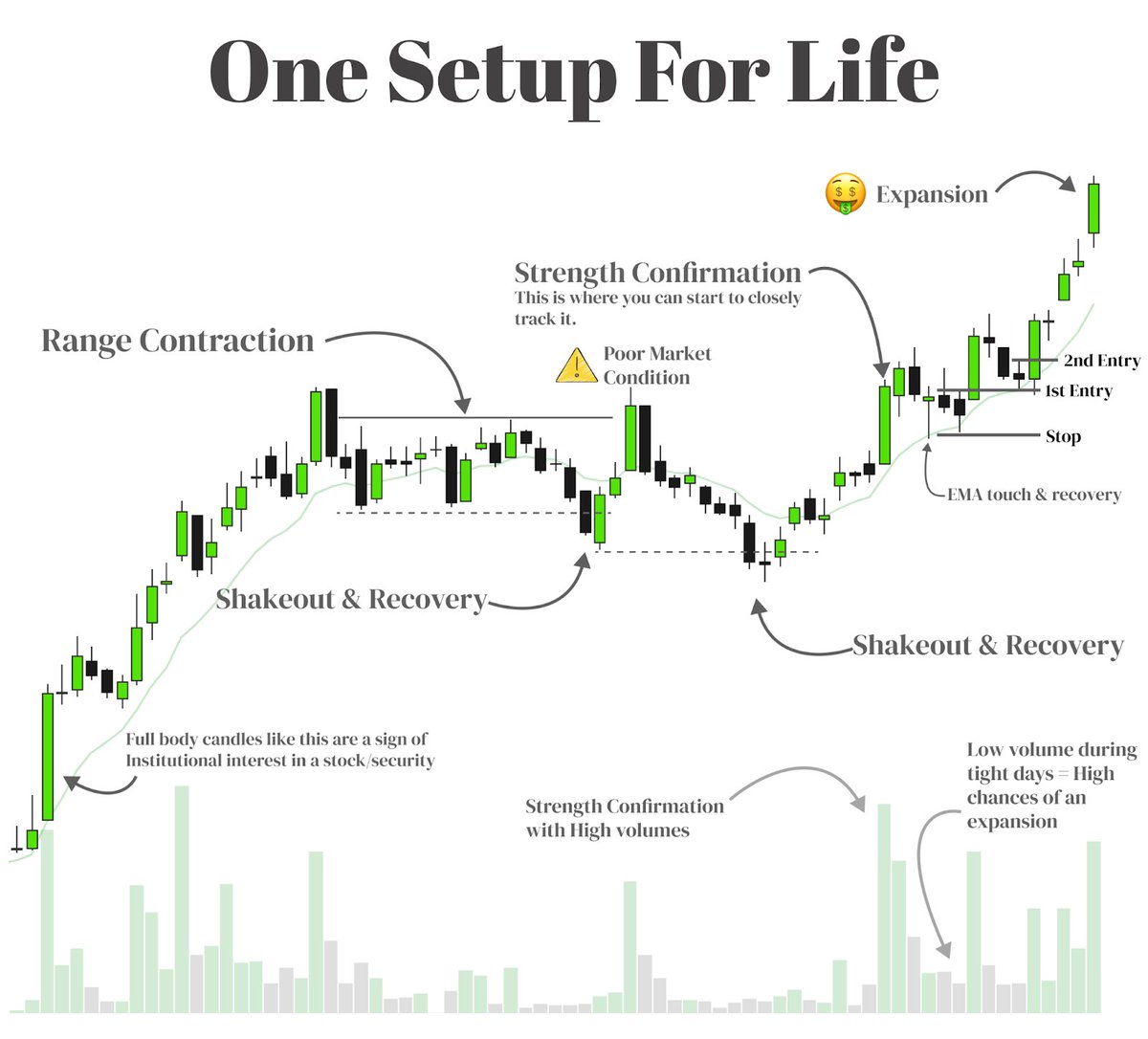
Tightness means the stock is coiling. The range is contracting. Volatility is compressing. When a stock tightens near highs, it's building energy for the next move. Loose, sloppy charts lead to loose, sloppy results.
2. Focus on stocks near their 52-week highs, not lows
Unless the entire market is recovering from bear market lows, stick to stocks making new highs. Stocks at lows are there for a reason. Stocks at highs are showing strength. Trade strength, not weakness.
3. Only trade leading stocks from leading sectors
A 3-star setup in a leading sector is better than a 5-star setup in a poorly performing sector. When the sector has momentum, even average setups work. When the sector is lagging, even great setups struggle.
4. Trail your winners aggressively
As soon as a trade moves in your favor by a certain percentage, protect your breakeven. The winning horses don't come back to the starting line. If a stock starts reversing, don't let a winner turn into a loser.
5. Stick to setups that form after a trend is established
Flags are a perfect example. They form after a strong move. You're not trying to catch the beginning of the trend. You're joining a trend that's already proven itself. This increases your odds significantly.
6. Take entries when setups form around key moving averages
Stocks respect moving averages. When a setup forms near the 10 EMA, 20 EMA, or 50 DMA, those levels often act as support. It gives your trade a higher probability of working out.
7. Be patient when your setups are forming
Don't anticipate. Don't enter early. Wait for the breakout. Trying to get in before the setup completes will cost you win rate. Let the pattern finish. Then enter.
8. Trade with the overall market
If the market is in a strong uptrend, your win rate goes up. If the market is choppy or declining, even perfect setups fail. Align your trades with the market's direction.
9. Only take 5-star setups
Not every setup is worth taking. If you're unsure, skip it. The cleaner and more obvious your setups are, the higher your win rate will be. Quality over quantity.
10. Review your losing trades
Your losses will tell you where you're going wrong. Are you entering too early? Chasing weak stocks? Trading against the market? Your losing trades are feedback. Use them.
Improving your win rate is all about being selective. Trading the right stocks, in the right sectors, at the right time, with the right market conditions.
Do that, and your win rate takes care of itself

English
Richa Gupta retweetledi
Richa Gupta retweetledi

Richa Gupta retweetledi
✍🏻Mark Minervini's VCP Pattern
Mark Minervini's Volatility Contraction Pattern (VCP) appears before nearly every major stock breakout. Here's how to spot it.
✍🏻What Is a VCP?
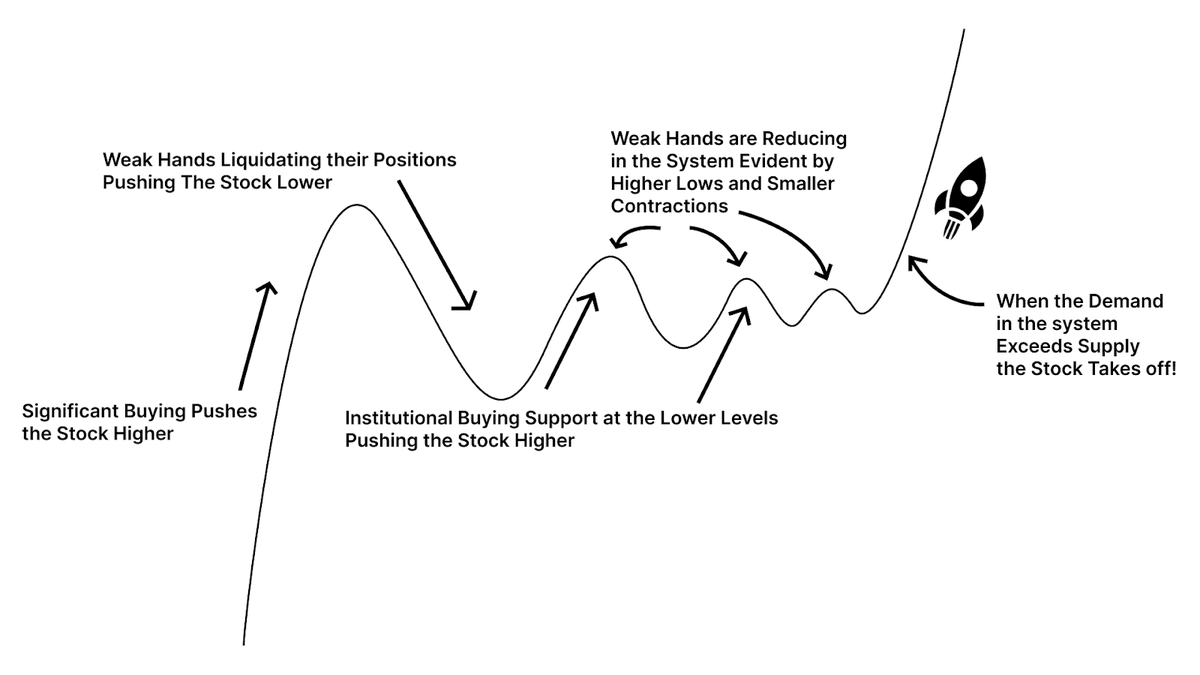
A stock goes through multiple pullbacks, but each pullback gets smaller and tighter. Like a coiled spring - the tighter the compression, the more explosive the release.
✍🏻The Four Stages
➡️Stage 1: The Initial Run
Significant buying pushes the stock higher. Institutions start accumulating.
➡️Stage 2: The Shakeout
Weak hands panic and sell. The stock drops 10-20%. This is the deepest pullback.
➡️Stage 3: The Contractions
Institutions buy the dip. The stock rallies again, but the next pullback is smaller - maybe 15%. Then it happens again with an even smaller pullback of 8-12%. Each correction is shallower than the last. Lows keep getting higher.
➡️Stage 4: The Breakout
Demand exceeds supply. No weak hands left to sell. The stock explodes higher.
✍🏻Why It Works
During those contractions, shares transfer from weak hands (emotional traders) to strong hands (institutions with conviction). Each pullback shakes out more sellers. By the final contraction, there's nobody left who wants to sell. That's when breakouts happen with force.
✍🏻The Three Must-Haves
➡️1. Higher Lows - Each pullback shallower than the previous (25% → 15% → 8%)
➡️2. Contracting Volatility - Price swings get smaller and smaller
➡️3. Volume Pattern - Light volume on pullbacks (no institutional selling), heavy volume on rallies (accumulation)
✍🏻What You're Looking For
- Strong initial move up ✓
- At least 2-3 contractions, each smaller than the last ✓
- Higher lows on each bottom ✓
- Trading tight near recent highs with low volatility ✓
- Decreasing volume on dips, increasing on rallies ✓
The longer and tighter the pattern, the more explosive the breakout.
✍🏻Avoid this mistake
Buying too early during the first or second contraction. You must wait for the pattern to complete - at least 2-3 contractions with each one smaller. Then when it breaks out on heavy volume, that's your entry.
✍🏻Why VCP works
When a stock completes a proper VCP, you're buying at the exact moment supply/demand shifts decisively to buyers. You're entering after weak hands exit and before the next institutional buying wave.
Minervini used VCPs to catch 100%, 200%, even 300%+ moves. Not prediction. Not hope. Just observation of a pattern that repeats across market history.
English
Richa Gupta retweetledi
William O'Neil was one of the greats. Founder of Investor's Business Daily, creator of the CAN SLIM methodology, and a legendary trader who studied what actually worked in the market.
I've always been a fan. I've read his book so many times that certain pages are worn out. And while he had a specific philosophy, the underlying behaviors he taught are universal. Here are the ones that stand out:
Protect what you have. Making money in the market is really about protecting the money you already have. Capital preservation comes first. If you blow up your account, you're done.
Cut losses quickly. Don't let small losses turn into big ones. The moment you realize you're wrong, get out. Your ego isn't worth the cost.
The market will tell you when it's bending. When the overall market starts declining, most stocks will eventually follow. Don't fight it. Respect what the market is showing you.
Buy in uptrends, not downtrends. Trying to catch falling knives rarely works out. Wait for the momentum to shift in your favor before entering.
Take profits when you have them. Don't get greedy waiting for the perfect exit. If you have a solid gain, there's nothing wrong with locking it in.
Never let a winning position turn into a losing one. If a trade goes your way and then reverses, don't hold it all the way back down. Protect your gains.
Follow the leaders. In strong markets, the best stocks outperform significantly. Focus on strength, not mediocrity.
Buy on strength, not weakness. Stocks that are breaking out from strong patterns tend to have momentum behind them. Don't try to bargain hunt in weakness.
Your trend is your friend. Trade with the direction of the market, not against it. Fighting the trend is a losing game.
Date the market, don't marry it. Stay flexible. What works today might not work tomorrow. Be willing to adapt.
The beauty of O'Neil's lessons isn't in the specifics of his system. It's in the behaviors: protect capital, respect trends, follow strength, cut losses, take profits, and stay disciplined.
These aren't just rules for one strategy. They're principles that work across all approaches.

English
Richa Gupta retweetledi
Most traders waste time scanning thousands of stocks with no clear criteria.
Minervini's method that helped him generate a 33,554% return over 5 years is different: a systematic 8-point filter that automatically helps you focus only the highest-probability setups.
This framework shows you exactly what to look for.

English
Richa Gupta retweetledi
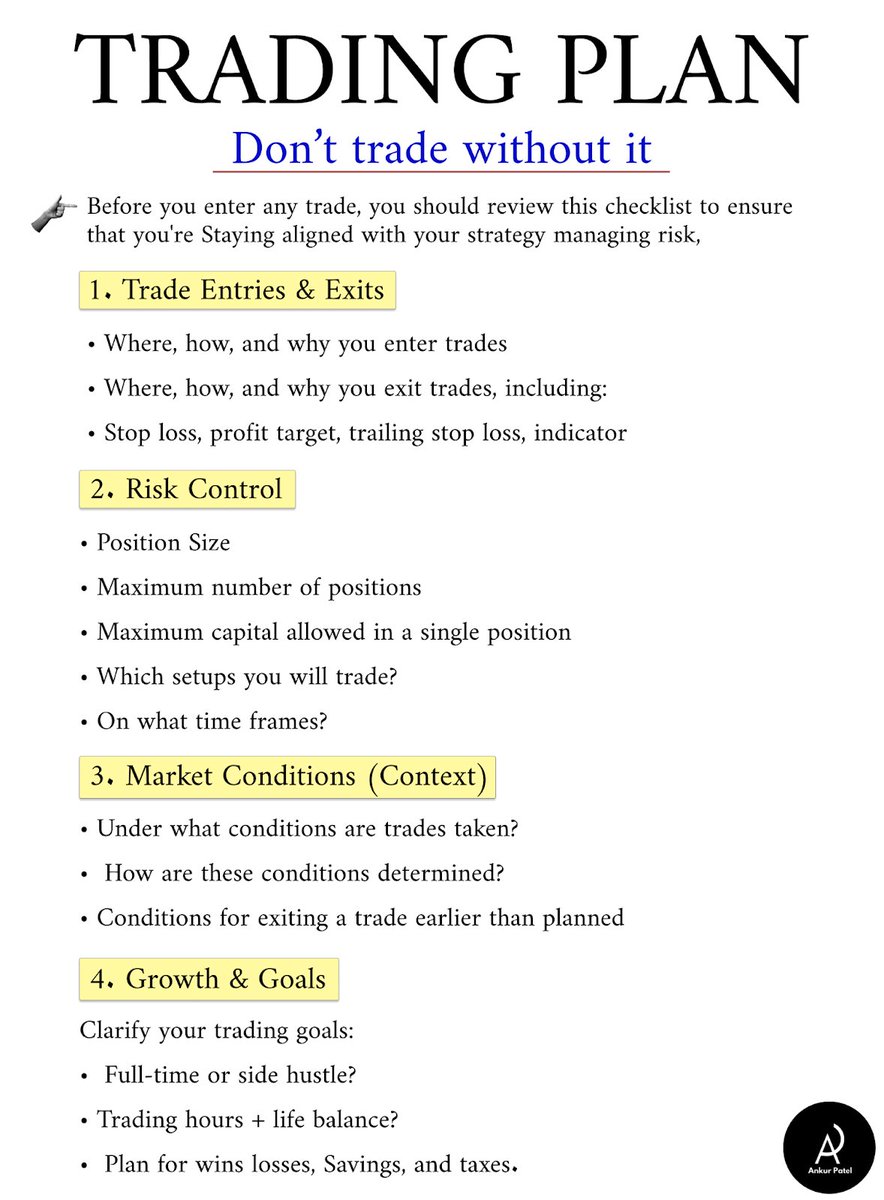
90% of traders fail because they trade without a plan.
A written trading plan isn't optional, it's the difference between disciplined execution and emotional chaos.
This one-pager gives you the complete framework:
English
Richa Gupta retweetledi
Kindly RT please
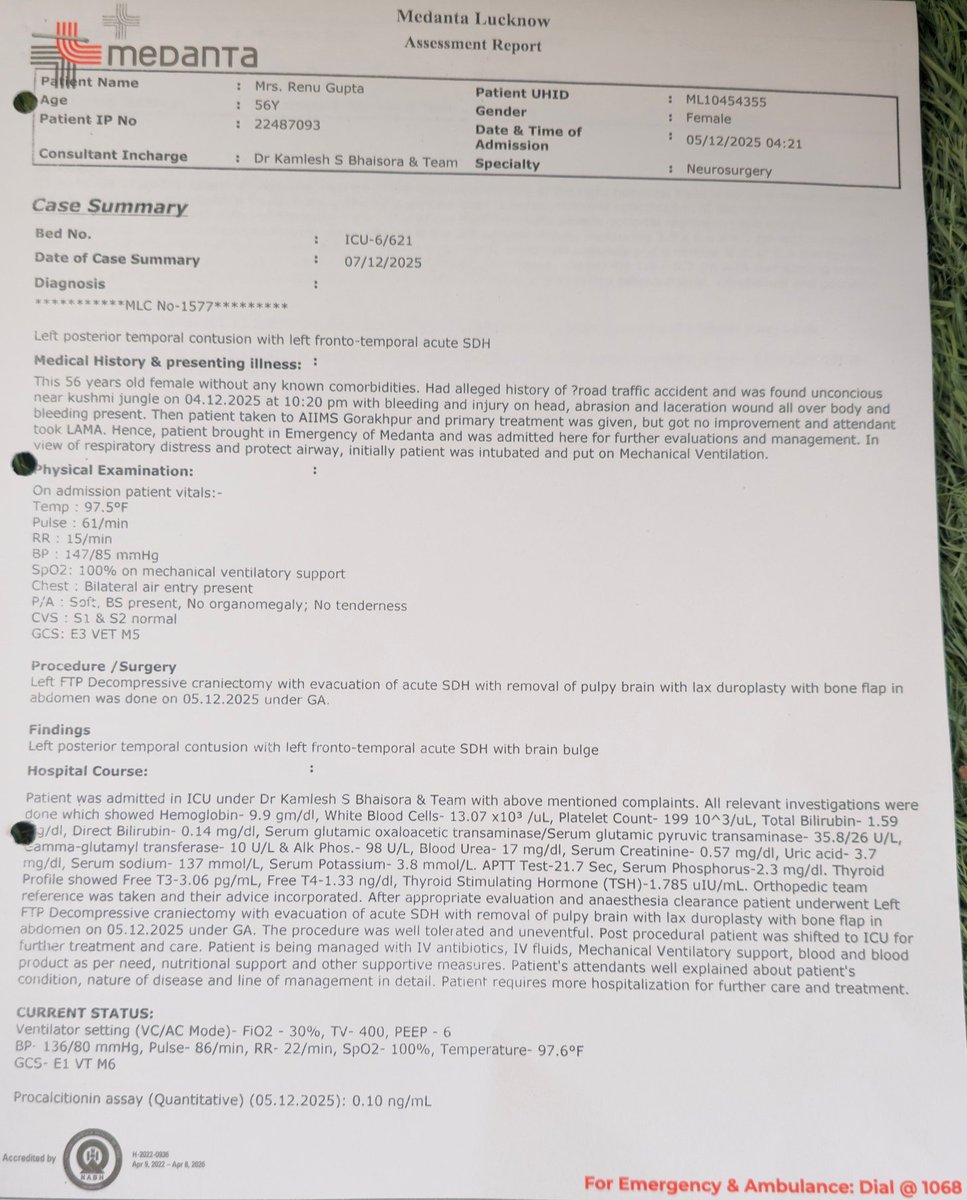
"Urgent Request for Support:
Shivam Gupta is one of my students. His parents were critically injured in an accident and are both in the ICU. The medical expenses are mounting rapidly, and he cannot manage them alone.
Any small help is greatly appreciated and can make a massive difference in covering their escalating medical costs and in supporting him during this tough time.
Name :SHIVAM GUPTA
Account Number :881036489411
MMID :9641722
Bank Name :DBS Bank
Bank IFSC :DBSS0IN0811
UPI ID: shivam71095@dbs

English
