notaguru@notaguru96
$BULL
Q1 26 Earnings Update
Why the stock is down while the fundamentals strengthened.
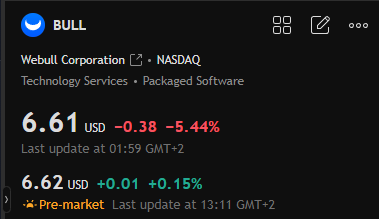
Webull is experiencing significant volatility following Q1 earnings report. The stock closed at $6.18 on Friday, down from $7.06 before earnings release.
The main reason for the fall – EPS miss and margin compression, due to high operating expenses.
However, when you dig a bit deeper, there is a whole different story.
This is the third consecutive EPS miss driven by the same mechanism — deliberate, management-chosen marketing investment — not by any deterioration in the underlying business. The pattern is now clear enough to be predictable. H.C. Wang stated directly on the call: "Operating profit margin ex marketing has remained at 40% or higher every quarter since Q3 of 2024." That single sentence tells you everything about what kind of company this is. The engine is exceptionally profitable. Management keeps choosing to reinvest the engine's output into growth rather than show it to shareholders. Whether that's the right call is debatable. That they're doing it deliberately and consistently is no longer debatable.
The Seven Things in This Earnings Call That Matter Enormously
1. B2B at 9.5% of total equity order flow — this is a genuine inflection
This is the single most important number in the entire transcript and it received almost no attention in the post-earnings selloff. Order flow from institutional business reached 9.5% of total platform equity volumes in Q1. Let that land properly. Three months ago, B2B was described as "de minimis." Today it represents nearly a tenth of the entire platform's equity order flow — in Q1, which Denier explicitly described as a very difficult market environment for trading volumes. The B2B segment is not a pipeline story anymore. It is a revenue reality that is growing faster than anyone modelled.
Denier said on the call: "We only expect that number to go up and accelerate very quickly and very aggressively." Coming from a CEO who has consistently underplayed guidance and overdelivered operationally, that language is meaningful. He also revealed that Hong Kong's broker-dealer alone is generating order flow nearly equal to all 13 other international broker-dealers combined — driven almost entirely by institutional and B2B accounts. The B2B flywheel is spinning. The market is not seeing it.
2. Nearly 200 institutional clients onboarded — the pipeline is becoming a book
Webull is approaching 200 onboarded institutional clients, with Meritz highlighted as the largest contributor in South Korea. This number deserves to sit alongside the 9.5% order flow figure. 200 institutional clients — each with onboarding timelines of months, compliance reviews, technical integrations, and contractual relationships — is not a pipeline. It is a book of business. These clients don't churn the way retail accounts do. They don't stop trading because of a bad market month. The recurring, countercyclical revenue thesis we identified as the structural re-rating catalyst is now demonstrably real, not hypothetical.
3. The self-clearing licence is the most underappreciated development in the entire call
Webull received US approval for its self-clearing licence — a significant step for the B2B business enabling in-house clearing and custody of trades, strengthening the operational backbone and creating meaningful synergies and operating leverage as the institutional business scales. Denier said this took multiple years to achieve and is "no easy feat." He's right. DTCC and OCC membership for a non-US-founded broker-dealer is an extraordinary regulatory achievement. Once operational in Q4 2026, every trade Webull clears in-house instead of paying Apex Fintech Solutions drops directly to the bottom line. At current volumes of millions of daily trades, the clearing cost savings are material — and every dollar saved on clearing can be passed to B2B clients as a pricing advantage, which deepens the competitive moat against every broker still paying external clearing fees.
4. The MCP server is the strategic move nobody is talking about
Denier opened the call with a statement that reframes the entire competitive landscape: "The interface of the future is not a screen on a smartphone. It is an API. And the brokerage platform best positioned for the future is the one with the most complete, most reliable, and most developer-friendly execution and custody infrastructure." Webull released its MCP server enabling AI agents to interact with Webull's platform natively, positioning Webull as a preferred execution and custody layer in the emerging agentic stack.
This is the hidden catalyst we identified in our previous session, and it's now confirmed as active strategy. Every AI agent — whether built by a hedge fund, a fintech startup, or an individual developer — that wants to execute trades needs a broker with an API. Webull just published the infrastructure that makes it the easiest, most developer-friendly execution layer available. If agentic AI trading becomes mainstream over the next 2-3 years, the broker with the best MCP server and API infrastructure captures that order flow by default. Denier is explicitly betting on this. The market is pricing it at zero.
5. April and May trading volumes at all-time highs
CFO Wang stated that trading volumes and market share were at all-time highs in April, with the trend continuing and actually accelerating into May. This is the Q2 forward indicator the market needed and didn't sufficiently weight. The Q1 miss was largely driven by a difficult January-March macro environment — the software sector selloff and Iran war scare. April and May are in the numbers now and they're record months. Q2 is tracking to be the best quarter in the company's history by volume metrics. The EPS miss in Q1 will almost certainly not repeat in Q2 given these volume trends, even with continued marketing investment.
6. PDT readiness on Day 1 with a specific marketing plan
Denier confirmed systems are fully updated for June 4, and revealed the specific strategy: education campaigns about what the rule change means, awareness that Webull is ready from day one, and financial incentives to consolidate accounts from competitor platforms onto Webull. He quantified his bear case for volume impact at +20% increase in transactions over time, with Q3 being the first full-quarter impact. This is more conservative than the +40% analyst estimate we referenced earlier — Denier's 20% floor is the number to anchor to for modelling purposes. Even at 20%, the revenue impact is $40-55M annualised.
7. Vega Analyst: institutional-grade research for retail traders
Vega Analyst builds upon AI capabilities to provide comprehensive, nuanced and personalised research akin to sell-side research available to institutions — subscribers can request research reports on any company at any time. Currently in beta testing with a select group of customers, rolling out across the US and globally in 2026. The active trader cohort is using Vega 16-17 times per month on average, and 20% of those interactions precede a trade. This is the data flywheel deepening in real time. The subscription layer this enables — charging for Vega Analyst access above the free Vega tier — is the path from 102,000 Premium subscribers to 500,000+ by 2028.
Why the Market Sold It Off — And Whether That's Rational
The market's reaction is understandable in a narrow context: three consecutive EPS misses, operating expenses up 64% year-over-year, and a GAAP net loss of $21.7M versus net income of $13.1M a year ago. For investors using a simple earnings scorecard, this looks like deterioration.
It is not deterioration. It is deliberate reinvestment of operating cash flow into growth at a moment when three structural tailwinds — PDT elimination, B2B scaling, international expansion — are all simultaneously live. The 40% operating margin ex-marketing, confirmed explicitly on this call, is the proof that the underlying engine hasn't weakened. Marketing spend is the variable. The engine is intact and improving.