Richard H Thaler

9.5K posts

Richard H Thaler

Richard H Thaler

@R_Thaler

Behavioral Economist. Chicago Booth. Co-author of The Winner's Curse with Alex Imas, Nudge: The Final edition with Cass Sunstein, author of Misbehaving.

Chicago Katılım Ağustos 2011
1.1K Takip Edilen200K Takipçiler
Anup Malani
Anup Malani@anup_malani·
But there's pushback. Plott & Zeiler (2005) showed the effect largely vanishes when you fix how subjects understand the experiment. List (2003) found experienced traders don't show it at all. The endowment effect may be real for novices — and irrelevant in functioning markets.
English
4
1
131
9.3K
Anup Malani
Anup Malani@anup_malani·
Give half a classroom a coffee mug. The other half gets nothing. Let them trade mug for cash. Since mugs were assigned randomly, about half the holders will value money more than the mug — so Coase predicts roughly 50% should trade. Almost nobody does.
English
36
12
838
72K
Richard H Thaler retweetledi
Alex Imas
Alex Imas@alexolegimas·
Most people know Chris Sims as a giant of macro, but he also essentially founded the modern economics literature that takes the idea that people have limited attention seriously. This work put real structure on the idea that attention is scarce, and it has shaped a huge body of research across macroeconomics, finance, and behavioral economics, including much of my own work over the past decade. The standard benchmark in economics is that people process all payoff-relevant information; they attend to all features of the information environment and make decisions based on the relevant payoffs. Behavioral economists such as Herb Simon challenged this view with the idea of bounded rationality, but without a specific account on what limited attention would look like. Chris's paper on *rational* inattention changed all that by putting real structure on the problem. It was a pretty simple idea: People can't pay attention to everything, so they pay attention to features where neglect would be more costly. It turns out this very simple assumption generates profound implications for everything from finance and monetary economics, to health and insurance decisions. Behavioral economists (myself included) have followed this work by proposing models where attention is limited but not allocated rationally, e.g., salience-driven attention. When I gave a talk at Princeton two years ago on how salience-driven attention can lead to over/underreaction to information, Chris was in the front row asking questions and making comments that helped the paper tremendously. He will be missed.
Jon Hartley@Jon_Hartley_

9/ Sims was also early to behavioral macroeconomics; see "Implications of Rational Inattention" (JME, 2003) — one of his most cited and creative contributions. Sims modeled agents as having limited information-processing capacity, not just limited information. This spawned an entire literature on how attention constraints shape macroeconomic dynamics. Basic intuition: people can't process everything happening in the economy; agents optimize how to allocate their attention & this has profound implications for price-setting, consumption, and why monetary policy works through expectations in subtle ways

English
3
87
533
61K
Richard H Thaler retweetledi
Alex Imas
Alex Imas@alexolegimas·
Schmidt Sciences RFP to fund field experiments and empirical studies on how AI impacts work. Up to $200K for early career scientists. Plus you get to join the awesome Schmidt Sciences community. If you're an ECR interested in AI + econ, apply! schmidtsciences.org/ai-at-work/
English
0
24
73
12.2K
Richard H Thaler
Richard H Thaler@R_Thaler·
There has never been an administration as ignorant about economics as Trump's. Economists rightly love congestion pricing but Trump tried to kill it. nytimes.com/2026/03/03/nyr…
English
11
12
92
8K
Luis Garicano 🇪🇺🇺🇦
It is my biggest gripe with all the industrial policy stuff. It is oh intervention is great. . as long as I am the one dictating it. But that ignores completely the political economy of intervention. I find it stunning that people who are sophisticated about power don't see that once you set up a system where the government is given all those powers you cannot know they get used for good. That is the wisdom of liberalism and limited government.
English
8
49
295
51.9K
Joshua Gans
Joshua Gans@joshgans·
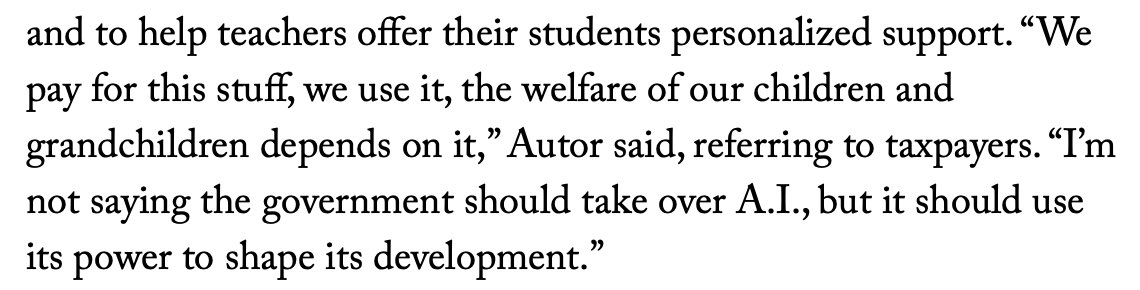
This is the kind of statement I worry about. Basically, the Pentagon apparently agrees and is doing this. But I can’t imagine this is what @DAcemogluMIT , @davidautor and Johnson mean. So what is the nuanced application of power?
Joshua Gans tweet media
English
5
6
75
29.2K
Richard H Thaler
Richard H Thaler@R_Thaler·
Very smart column by Matt using the Maine lobster industry as an insightful example. Highly recommended.
English
1
6
46
11.6K
Richard H Thaler
Richard H Thaler@R_Thaler·
Nice quote from Ken French: "Buybacks are divisive. They divide people who understand finance from those who don't." @Ritholtz
English
3
10
74
8.3K
Richard H Thaler
Richard H Thaler@R_Thaler·
Some useful background from my friend and co-author Owen Lamont. Failing to read his blog posts is an own-goal. acadian-asset.com/investment-ins…
Richard H Thaler@R_Thaler

@oren_cass Ok done here. Send me an email if you want to have a civil discussion. Firms buy back shares for lots of reasons including using them to give employees stock options. Yes they can be mis-used by top execs to meet targets, but go after that!

English
1
4
23
15.4K
Richard H Thaler
Richard H Thaler@R_Thaler·
Thanks to my friend Stephen Dubner his team at @Freakonomics for replaying the episode we did about Nudge. Nice improvements! If you listen see if you think Cass and I can be reasonably accused of thinking you can solve any problem with a nudge. Hint: no. youtube.com/watch?v=-CYMhv…
YouTube video
YouTube
English
1
8
38
7.4K
Richard H Thaler
Richard H Thaler@R_Thaler·
@oren_cass Ok done here. Send me an email if you want to have a civil discussion. Firms buy back shares for lots of reasons including using them to give employees stock options. Yes they can be mis-used by top execs to meet targets, but go after that!
English
4
0
19
16.6K
Oren Cass
Oren Cass@oren_cass·
You made an assertion that Oren believes "share repurchases are evil." I thought it was possible you really do think people only support bans for "evil" things, but clearly not. So it was just a baseless and inappropriate attempt to malign me. Fine. What is your evidence that "buybacks on average signal that the price was too low"? The empirical evidence that I'm aware of suggests the opposite, with the exception of small-cap companies with large information asymmetries (which would then bring us to the insider trading inquiry...).
English
3
0
3
1.9K
Richard H Thaler
Richard H Thaler@R_Thaler·
@oren_cass You are reading too much into "evil". Harmful? What about dividends? Share issuance à la GameStop is pretty bad but buybacks on average signal that the price was too low. Insider trading is bad. So is trading by members of Congress. Only ban bad stuff. Am I then religious?
English
3
0
15
1.2K
Oren Cass
Oren Cass@oren_cass·
I think we should prohibit via regulation a firm's management trading in its own stock because the incentives to do so are badly misaligned with the firm's and economy's long-term health. But I'm much more interested in your idea that regulatory prohibitions should be applied only to things that are "evil." Is that really your view? I mean, in securities regulation alone, it seems like that is pretty far off the mark, unless you're saying we shouldn't have securities regulation?
English
3
0
8
3.2K
Richard H Thaler
Richard H Thaler@R_Thaler·
@oren_cass I have not heard a case against them. But usually we only want to ban things that are harmful. No?
English
3
0
36
2.1K