
Race Reflections

2K posts

Race Reflections banner
Race Reflections

Race Reflections

@RaceReflections

Race Reflections is a U.K. based social enterprise tackling inequality, injustice & oppression — join us in our quest to make society fairer & safer for all.

England, United Kingdom Katılım Kasım 2020
20 Takip Edilen3.1K Takipçiler
Race Reflections
Race Reflections@RaceReflections·
Maybe, we’ll get to a point where we reach for this giftedness model, and explore this, before we reach for a deficiency model in formulating vulnerability to structural violence and thus racial traumatisation. It’s possible.
English
0
1
3
113
Race Reflections
Race Reflections@RaceReflections·
There is another major factor, which I think may mediate all four here….sensitivity to discrimination & more awareness of structural violence/inequality, which may may not only make them more vulnerable to its impact and but also more likely to activate systemic violence. This in turn increases the likelihood of all other key factors becoming activated e.g. - HOW DARE YOU THINK FOR YOURSELF? - STOP BEING OPPOSITIONAL/COMBATIVE/DIFFICULT/ARROGANT/UPPITY OR - BE LOYAL TO THE HAND THAT FEEDS… We can see how perpetuating loops can quickly come into effect, as the more you treat people violently, the more likely they are to be traumatised, the more traumatised, the more sensitive to violence, the more sensitive, the more they notice … the more they notice, the more they may challenge, the more they challenge, the more they attract violence, the more they attract violence, the more they may resist/oppose/subvert …
Race Reflections@RaceReflections

Summary.

English
2
4
11
577
Race Reflections
Race Reflections@RaceReflections·
Looking back at this formative experience given the stage of development I was in and with great compassion, I think I was thrown in at the deep end. I was holding groups *of men* with 10–15 participants *on my own*, in high security settings, trying to navigate dynamics of race, power, and associated disturbances Barely held conceptually or clinically because there was no established clinical or theoretical frameworks for formulating what I was hearing, for making sense of institutional dynamics arising and for containing highly charged histories, which were often discarded or repressed in the higher system…No accounting for vicarious traumatisation. This is highly complex & demanding work; I was completing so early on. It is only now I realise how tough this is. See why I often say, I have to learn to think on my feet and … on my own, out of necessity. I have developed this habit as a result of these experiences. I am very grateful I was given the trust by patients and clinicians, overwhelmingly, to do this work, there was no template. And it has clearly been impactful and helped me grow as an independent thinker. There was no incident, I was involved in. (And trust that accidents were very frequent on these wards) and as I reflected on elsewhere, patients eager to speak to me. So in some ways I was paradoxically protected, it would appear. Which takes us back to Afroanalytics, the function/roles we all serve within communities when it comes to archiving, memory, group welfare. Now older and wiser, I would probably not allow younger me to do this work in the configurations I did it in, today. More sensitive to risks. But…given the gains, I see the ethics as mitigated. Feel free to share what you think.
Race Reflections@RaceReflections

I want to talk about an experience I had in a research role in South London. It was about sixteen or seventeen years ago, where I was engaged in community development and community research. One piece of work involved interviewing people in psychiatric wards in South London, mainly Black men, who had accessed the mental health system through the justice system, a pathway where we know Black men are highly overrepresented. At the time I was quite junior in research, just starting my career in community engagement. I had this idea of asking questions about people’s histories, particularly around hospitalisation and offending. I was trying to understand the pathway they had taken. The research was conducted mostly in focus groups, with maybe ten to fifteen people in each, discussing journeys through the mental health system, secure units, prison services, or other provisions. Almost immediately, I realised that the conversations were not going in the direction I had intended. The participants wanted to talk about the police, unfair stop and search practices, discrimination they faced daily, the ways they were treated in the system. At the time, this was early in my work on racism and racial trauma, clinically speaking, I remember thinking that I would never be able to answer my research questions. I was trying to frame participants’ stories in a way that I thought was relevant to the study, and seriously felt being taken off course. But after maybe three or four meetings in different settings with different groups, I realised that there was a space that was desperately needed. People needed to talk about their experiences of racial violence on the way into the criminal justice system, within the mental health system, and in the community. I share this because I have been reflecting on the origins of my interest in racial trauma, and in many respects these experiences were not planned. At the time, there was little awareness of how coercive treatment or adverse pathways into the mental health system could trigger past trauma and intergenerational wounds. Even speaking about the impact of racism on people’s presentation or distress was heavily controversial. Racial trauma was not mainstream as a frame, and many of these stories had not been shared with clinical teams… The system often compounded Black service users’ experiences rather than alleviating them. On a particular ward, I was asked not to talk about racism by a few anxious Black nurses, while my own white supervisor was supportive. There is a lot to unpack here, not least the possible presence of racialised trauma, vicarious or otherwise in the Black staff. This is a note to myself and to other junior researchers. When you encounter that gap between the questions you want to answer and the stories people want to tell, it is worth pausing and asking whether you are asking the right questions. Often, the community already knows what matters most, and listening to this redirection is part of the research. This reflection also connects back to my later work in Afroanalytics in my thesis. I did not start out wanting to trace African ancestry or examine historical lineage in depth, but the data, the reflections, and the connections I made naturally took me there. These encounters forced me to pay attention to the weight of history, the intergenerational aspects of trauma and resistance embedded in communities. Last week, I presented in that same part of London on racial trauma to aspiring clinicians and students. To see that what I have been hearing and contending with already two decades ago remains a pressing issue was a little depressing. Being taken off course is not a distraction. Sometimes it is the direction you need. Allowing participants’ voices to shape the research, letting all communication shape empirical efforts should be part of any research. It can lead to insights that are deeply necessary for you and others.

English
0
2
5
729
Race Reflections
Race Reflections@RaceReflections·
I want to talk about an experience I had in a research role in South London. It was about sixteen or seventeen years ago, where I was engaged in community development and community research. One piece of work involved interviewing people in psychiatric wards in South London, mainly Black men, who had accessed the mental health system through the justice system, a pathway where we know Black men are highly overrepresented. At the time I was quite junior in research, just starting my career in community engagement. I had this idea of asking questions about people’s histories, particularly around hospitalisation and offending. I was trying to understand the pathway they had taken. The research was conducted mostly in focus groups, with maybe ten to fifteen people in each, discussing journeys through the mental health system, secure units, prison services, or other provisions. Almost immediately, I realised that the conversations were not going in the direction I had intended. The participants wanted to talk about the police, unfair stop and search practices, discrimination they faced daily, the ways they were treated in the system. At the time, this was early in my work on racism and racial trauma, clinically speaking, I remember thinking that I would never be able to answer my research questions. I was trying to frame participants’ stories in a way that I thought was relevant to the study, and seriously felt being taken off course. But after maybe three or four meetings in different settings with different groups, I realised that there was a space that was desperately needed. People needed to talk about their experiences of racial violence on the way into the criminal justice system, within the mental health system, and in the community. I share this because I have been reflecting on the origins of my interest in racial trauma, and in many respects these experiences were not planned. At the time, there was little awareness of how coercive treatment or adverse pathways into the mental health system could trigger past trauma and intergenerational wounds. Even speaking about the impact of racism on people’s presentation or distress was heavily controversial. Racial trauma was not mainstream as a frame, and many of these stories had not been shared with clinical teams… The system often compounded Black service users’ experiences rather than alleviating them. On a particular ward, I was asked not to talk about racism by a few anxious Black nurses, while my own white supervisor was supportive. There is a lot to unpack here, not least the possible presence of racialised trauma, vicarious or otherwise in the Black staff. This is a note to myself and to other junior researchers. When you encounter that gap between the questions you want to answer and the stories people want to tell, it is worth pausing and asking whether you are asking the right questions. Often, the community already knows what matters most, and listening to this redirection is part of the research. This reflection also connects back to my later work in Afroanalytics in my thesis. I did not start out wanting to trace African ancestry or examine historical lineage in depth, but the data, the reflections, and the connections I made naturally took me there. These encounters forced me to pay attention to the weight of history, the intergenerational aspects of trauma and resistance embedded in communities. Last week, I presented in that same part of London on racial trauma to aspiring clinicians and students. To see that what I have been hearing and contending with already two decades ago remains a pressing issue was a little depressing. Being taken off course is not a distraction. Sometimes it is the direction you need. Allowing participants’ voices to shape the research, letting all communication shape empirical efforts should be part of any research. It can lead to insights that are deeply necessary for you and others.
English
0
6
19
2.2K
Race Reflections
Race Reflections@RaceReflections·
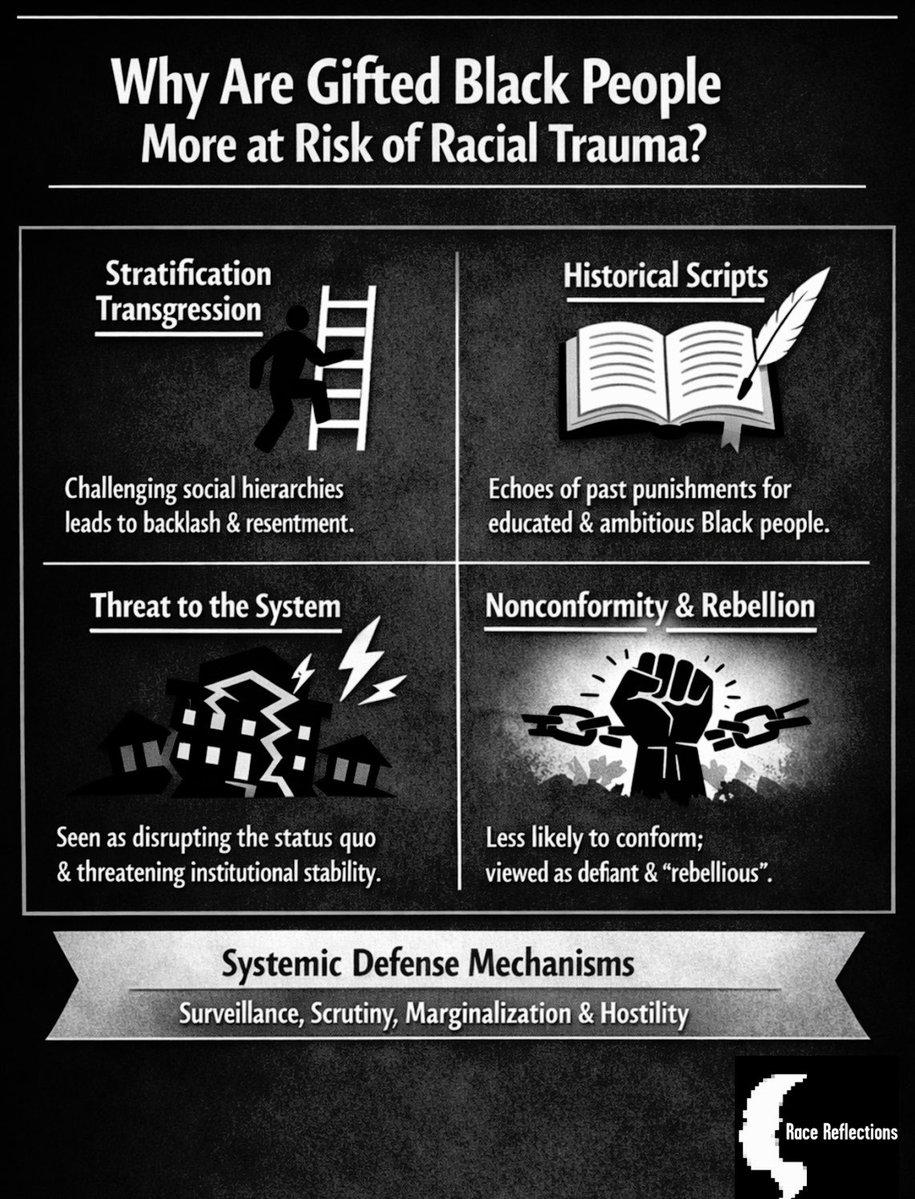
Good morning, I wanted to share some thoughts on the French mayoral result and in particular the widespread harassment of @BallyBagayoko by all corners of French society and the national press which is in many ways, prototypical. He is amongst the most intelligent, eloquent, and eligible figures within the wave of political potential uncovered by the recent election of Black mayors into power in France. That reality is precisely what makes this moment so revealing and what illuminates the racist violence he has be subjected to. Some of you may remember findings from my research on racial violence/trauma a few years ago: it was actually the most gifted Black students/people who tended to experience the most brutality within institutions, and who were therefore most at risk of racial traumatisation. I remember being so troubled by this finding at the time. It may feel counterintuitive, but it makes sense if you stop and think about: 1) stratification transgression 2) historical scripts or what used to happen to subjugated Black people who sought education or were more clever than their master 3) the disruption risks they pose to the system and 4) the reality that they are less likely to be conformists/assimilationists and more likely to be read as rebellious, which in itself is a highly racialised risk factor. This is an underexplored area, particularly empirically, because we are too busy using deficit or pathology lenses. My hypothesis has since been that there is likely a higher level of giftedness/intelligence among Black kids failed by education systems compared to white kids (though that phenomenon also exists in this group) and compared to the general Black population. That throws on its head racial discourses around the so-called achievement gap. It forces us to reframe and rethink: what if there was a widespread issue of misrecognition and systemic hostility toward Black talent, currently masked by lack/deficiency explanatory models? Once more we see echoes of this hostility and an aversion towards Black talent, within political institutions in France at the moment. I would NOT say the dynamic is unique to France at all, and yet I also know that there is something deeply culturally anchored in Frenchness as intellectual sophistication that is relevant too in terms of racialised responses to Black sophistication. When Lewis Gordon talks about a fear of Black consciousness, he posits that Black awareness, articulation, and critique of the world are destabilising forces and threatening to systems that depend on the myths of white superiority. Black consciousness as critical social and historical becomes disruptive in itself. It unsettles who gets to define reality, exposes gaps in dominant narratives, and heightens the sense of disruption. So the response is often not just exclusion, but containment, surveillance, over-scrutinising, delegitimising, diluting its potential/power. It’s not just that Black talent draws averse reactions, which it does but it triggers systemic defenses and hostile protection of prevailing social configurations. What we’re witnessing in France is not reaction to otherness, quite the opposite; it is fear of a Blackness that can express itself and behave in ways systems expect. That can use the grammar and template required by whiteness to de-centre it. When that capacity becomes visible within systems built to crash it, racist violence becomes inevitable. And this is what is happening before our very eyes publicly, and … before our very eyes, more covertly within less public facing institutions.
English
0
5
5
1.1K
Race Reflections
Race Reflections@RaceReflections·
Long and heart : what a beautiful mistake.
English
0
0
1
78
Race Reflections
Race Reflections@RaceReflections·
My good people, In anticipation of the pre-launch of Endimacy, I am sharing a small section of the book’s introduction. List members will be given access the entire introduction later today. I have thought long and heart about how best to bring this book to life, and I have decided, in community, it is where it sits. More very soon. For now if you are interested in a social, psychological and personal analysis of love, and can recognise the critical point we have reached, you may find this excerpt, from the Endimacy: The Crisis of Love in a Changing world useful. “Why Love, Why Now? I did not leave with my marriage in flames. There was no betrayal that could be easily narrated or pinned down to a specific set of acts or omissions. There was no clear responsible party to indict, though I remained resolute to end things in the absence of a crime scene. Yet, in the evenings, when my children slept and the house rested, there were moments when my body remembered the passage of love in this space and the imprint of intimacy on my body. M’s hand resting just long enough in the small of my back as our bodies brushed. The instinct to reach for him in my sleep, which lasted a second or two until it hit me that this would not be again. My body turning towards his breathing to soothe my own before my mind could try to break the habit. The stolen kisses in the kitchen, given absentmindedly while cooking dinner. The autopilot of love, we could say, now devoid of fiery passion, yet full of gentle recognition. The way my body felt it was missing a body part upon our separation. A kind of phantom love. A physical craving for familiar smells, sounds, and touches. This was the hardest language to unlearn. Not because I was stuck. Not because I regretted ending things or wanted to turn back our clock. But because the body does not move at the speed of a mind’s decision. 
It has its own timing for letting go.
 It’s own logic. It can lag, when habituated to intimacy’s rhythm. No matter how quietly the door is shut, how slowly the weight of the other is lifted from the bed, inhabiting new routines is not something that can be hurried at one’s will. At least not hurried kindly. And certainly not after decades together. This is why I am writing this book now. Because love’s most consequential movements are often silent and mundane. Because what is felt viscerally is so often missing from the story. Because we lack the grammar to narrate the ending of love. We are taught to recognise love through its excesses. Through grand gestures, intensity, sacrifice, and endurance. We are not taught how to recognise when love gradually no longer allows us to breathe freely. We are not taught to pay minute attention to what happens to our body as it exits intimacy. We are not taught how to leave without hatred or chaos, or how to say goodbye without disavowing what was good. How to relearn the world and to enter it anew with a version of ourselves that is both child-like and more mature and ever so attuned to the new ways love moves. I am not interested in exposing intimacy for spectacle. I am interested in telling the truth about the changing nature of love” Guilaine Kinouani If you’re interested in this book, look like to read the entire introduction join the list below.
English
2
5
7
592
Race Reflections
Race Reflections@RaceReflections·
Black & Brown women, we are still collecting case studies of weird experience you have ever had at work, especially as a leader. The kind of experiences that puzzled, unsettled or annoyed you, which you might indeed have kept quiet for strategic reasons or because you did not want to do the labour of unpacking them for the institution… Let us know, as we finalise this programme. A reminder … Mine, a white woman colleague who I supervised who would insist on drinking from my mug. I bought her one. I tried to separate mine from the lot. I even asked her not to, as I don’t like to share mugs. To no avail…she returned to it, over and over. Mine, always. She’d leave it used and unclean often. I laugh about this now but at the time, it was puzzling and frustrating. Drove me to distraction/destruction? The context was also that she had difficulty with my authority, common racialised experience. So I read this as passive aggression today… racereflections.co.uk/the-black-woma…
English
1
7
4
499
Race Reflections
Race Reflections@RaceReflections·
Good news folks, submitted my revised article on the safety matrix which was subject to minor revisions, form in the main, for those interested. Will share once it is up.
Race Reflections tweet media
English
0
1
3
101
Race Reflections
Race Reflections@RaceReflections·
On Endimacy We have never been more connected, yet many of us have never felt more unmet in love. What does love look like with new glasses on? From the vantage point of the end of a relationship that lasted almost a quarter century? In a world transformed by new technologies, new rules, and new expectations, what state is love in now? In this book I argue that intimacy as we know it is on the way out. This is what I call Endimacy™. Endimacy describes the gradual disappearance of genuine connection and closeness in a society reshaped by technology, shifting cultural norms, fraught dating strategies, and changing expectations of love. It captures the paradox of feeling both connected and isolated, guarded yet yearning, and the collective fear of the vulnerability needed to sustain intimacy in uncertain times. In Endimacy: The Crisis of Love in a Changing World, I explore these questions through my own lived experience as a divorced woman, alongside my professional training as a psychotherapist and psychologist. I examine not only the ending of love, but the state it is in today, how intimacy itself has shifted, and why connection so often feels elusive. More about the book pre-launch very soon.
English
0
4
3
257