Randles Lab
724 posts

Randles Lab
@RandlesLab
News and #Research from Amanda Randles's Biomedical Engineering Lab @DukeU. We are using #HPC to address #biomedical questions. #AcademicTwitter #innovation
Durham, NC Katılım Mayıs 2022
2.7K Takip Edilen1.2K Takipçiler

Congratulations to the recent graduates Dr. Cyrus Tanade and Dr. Aristotle Martin from the Randles Lab.
🎓 Dr. Cyrus Tanade defended his PhD back in May 2025. Dr. Cyrus' dissertation, "Cardiovascular Hemodynamic Digital Twins for Diagnostic, Continuous Monitoring, and Real-Time Intervention Planning" focused on utilizing digital twins for both retrospective risk analysis and prospective intervention planning. His work in the lab included publishing the first paper on both the Longitudinal Hemodynamic Mapping Framework (LHMF) and HARVEY Virtual Intervention (HarVI) tool. Dr. Cyrus Tanade is currently working as a Senior AI Research Engineer at Samsung Research America.
🎓 Dr. Aristotle Martin defended his PhD in December 2025. Dr. Aristotle's dissertation "Parallel Adhesive Dynamics With Adaptive Physics Refinement for Large-Scale Tracking of Circulating Tumor Cells" focuses on the fluid-structure-interaction methods within the lab. Some of his notable works include designing GPU-Accelerated Communication Layer for Efficient Fluid-Structure Interaction Computations on Heterogeneous Systems and publishing work on high-throughput adaptive physics refinement for tissue-scale adhesive dynamic. Dr. Aristotle Martin is currently working as a member of Technical Staff at AMD.
🏆It has been an honor to be a part of both of their journeys and to watch them grow as researchers. They leave behind a lasting impact on our research group and on everyone who has had the opportunity to work alongside them. While it is always bittersweet to see graduates leave the lab, we are incredibly proud of all they have accomplished during their time with us and look forward to seeing all that they will achieve in the future. Wishing them continued success and all the very best in the exciting journey ahead. 🎉🎓
#Duke #DukeBME #ComputationalModeling #BiomedicalEngineering #PrattEngineering #DigitalTwins #proudadvisor #phd #graduation #nextgenerationresearchers #hpc
English

Big week for the lab—multiple papers coming out, and always fun to see the work finally in print.
This one is especially meaningful as one of Cyrus Tanade’s final papers before he returns for hooding.
In this study, we show how combining physics-based modeling with machine learning enables accurate, non-invasive estimation of fractional flow reserve (FFR)—without the computational burden of traditional approaches.
By shifting to efficient steady-state models and refining predictions with ML, we achieve strong agreement with clinical gold standards while improving scalability for real-world use.
A step toward practical, patient-specific cardiovascular digital twins for clinical decision-making.
Read the full paper here: link.springer.com/article/10.100…

English

We are rapidly moving from describing physiology to predicting it.
Our new Review in Nature Reviews Bioengineering explores how digital models are evolving into true digital twins of the human circulatory system—dynamic, patient-specific systems that continuously integrate data to simulate disease progression and guide treatment decisions.
This effort was led by Wendy (Runxin Wu), who did an outstanding job bringing together the multiscale vision—from cellular transport to whole-body hemodynamics—and the computational, clinical, and data integration challenges that define the field.
A fantastic collaboration with Guinevere Ferreira, Nusrat Sadia Khan, Samreen T. Mahmud, Jorik Stoop, Lydia Sohn, and Jane Leopold.
Circulatory digital twins bring us closer to a future where we can anticipate disease and personalize care in real time.
Read more: doi.org/10.1038/s44222…

English

Join us for a virtual seminar with Pengfei Song, PhD, Associate Professor of Biomedical Engineering at Duke University.
Dr. Song’s research is advancing a new era of medical imaging through innovations in ultrafast and super-resolution ultrasound, with applications spanning 3D imaging, functional imaging, and AI-driven approaches. His work has led to over 100 peer-reviewed publications and technologies that are now used in clinical practice worldwide.
In this talk, Dr. Song will explore how super-resolution ultrasound is opening new possibilities for visualizing microvascular structures and improving our understanding of disease.
Date: April 30, 2026
Time: 3:00–4:00 PM
Place: Virtual Seminar
Register using the QR code to attend.

English

Honored to give the 2026 Daubechies Lecture today. I still remember meeting Ingrid Daubechies during my Duke interview—intimidating at first, but incredibly welcoming. My time in iiD helped shape how I approach interdisciplinary research. Grateful for this moment.
research.duke.edu/story/amanda-r…
English

From snapshots to continuous health.
Why duration and trajectories matter for digital twins and early detection.
Check out part 1 of my interview with @HlthcareToday: healthcaretoday.com/article/amanda…
English

Wearables for surgical risk are getting real.
New study from Duke Center for Computational and Digital Health Innovation member, Leah Acker, shows wrist-based HRV monitoring is feasible pre-op, with important challenges post-op.
A great example of translational digital health in action.
CompHealth Corner pick:
comphealth.duke.edu/publications/t…


English

Sudden vision loss might seem like an eye issue, but it can be a sign of something more serious.
A new review in Neurologic Clinics highlights retinal artery occlusion (RAO) as a medical emergency. It can cause sudden, painless vision loss in one eye and requires immediate evaluation, similar to how a stroke is treated.
Recognizing these symptoms early is critical for protecting both vision and overall health. For more information from this paper from Center for Computational and Digital Health Innovation member Brian Mac Grory and team, check out the full paper here: comphealth.duke.edu/publications/u…


English

Join us for an in-person seminar with Chris Cheng.
Dr. Cheng brings a unique perspective spanning research, industry, and entrepreneurship, with leadership roles across Medres Group, VIBE Solutions LLC, and Stanford University. In this talk, he will share how vascular motion research has led to medical device innovation, along with practical insights into building and translating ideas in the healthcare space.
Date: April 16, 2026
Time: 11:30 AM – 12:30 PM
Place: Wilkinson Auditorium, Room 021
Be sure to register using the QR code, and we hope to see you there!

English

Looking forward to welcoming our Duke BME community back for Reunion this week!
Join us on Friday, April 10 for an afternoon of connection. The BME Community Reception (2:30–3:30 PM) is our main gathering—bringing together alumni, students, and faculty to reconnect, meet new faces, and celebrate the Duke BME community.
We’ll also kick things off with an Alumni Panel (1:30–2:30 PM, Wilkinson 021), featuring alumni across a range of career paths sharing insights and experiences.
We’re grateful to our panelists for joining us: Chas McKee, Zac Forbes, PhD, Camille Smith, Andrew Stalnecker, Jackie Contento, and Emily Barré.
Whether you join us for the full afternoon or stop by the reception, we’d love to see you there!


English

As we close out Women’s History Month, we celebrate the remarkable women of the Center for Computational and Digital Health Innovation who are advancing the future of healthcare through research, innovation, and collaboration.
Across faculty, trainees, and students, these leaders are driving progress at the intersection of AI, engineering, and medicine—shaping the next generation of computational and digital health.
Their ideas, leadership, and discoveries are not only pushing the field forward, but redefining what is possible in healthcare.
Here’s to the women making a lasting impact—this month and every month.

English

CompHealth Corner
Brain tumors like meningiomas often don’t have many treatment options beyond surgery or radiation—which is why this kind of work is so exciting.
In a new Nature Communications study, David Ashley and collaborators activated the STING pathway using the drug 8803, triggering inflammatory tumor cell death. What’s powerful here is that it’s not just killing tumor cells—it’s also activating the immune system and helping break down the tumor’s protective environment.
In preclinical models, this led to longer survival and a stronger immune response within the tumor.
It’s an exciting step toward new immunotherapy strategies for brain tumors—and a great example of how understanding underlying biology can open entirely new treatment directions.
🔗 Full paper via the Center:
comphealth.duke.edu/publications/s…
✨ CompHealth Corner is what we’re reading at the Center each week—highlighting an interesting paper shaping the future of computational and digital health.
#CompHealthCorner #BrainScience #Immunotherapy #DigitalHealth #DukeResearch


English

Excited to share one of the first research pilots from the Center for Computational and Digital Health Innovation (where I serve as Director).
Linking athlete-reported activity + wearable head impact data to study concussion risk using ML + digital twins.
Read more: duke.is/improvingyouth…

English

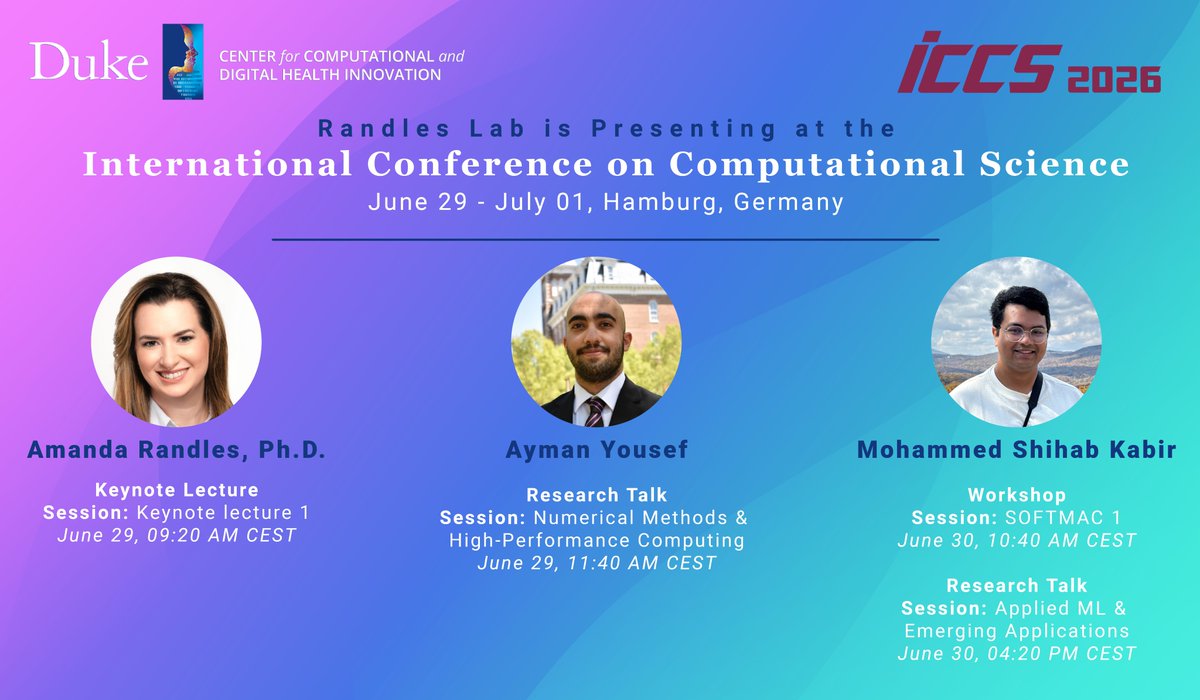
So proud of the lab: three papers accepted to ICCS this week!!
Two in the main track and one in SOFTMAC, spanning everything from fundamental biophysics to scalable AI-enabled simulation:
Main Track
• Multiscale Modeling of Shear-Dependent Tumor Cell Adhesion
Authors: Aristotle Martin, Mohammed Shihab Kabir, Runxin Wu, Amanda Randles
• Instrumenting Lightweight, Modular Machine Learning Training and Inference in Parallel Solvers
Authors: Ayman Yousef, Corey Wetterer-Nelson, Mengjiao Han, Victor Mateevitsi, Joseph Insley, Silvio Rizzi, Janet Knowles, Michael Papka, Amanda Randles
SOFTMAC
• Investigating the Influence of Red Blood Cell Heterogeneity on Cell Transport and Blood Flow Hemodynamics
Authors: Runxin Wu, Mohammed Shihab Kabir, Aristotle Martin, Wentao Ma, Amanda Randles
What I love most about this set is how it reflects the range and integration of our work from cell-scale transport and adhesion physics to the computational infrastructure needed to make these models practical at scale.
Huge credit to this incredible group of collaborators and trainees. Excited to share more at ICCS!

English

How do you make digital twins something clinicians can actually use?
Part of the answer is interaction. Working with the Sony teams has pushed this research in new directions, especially in how complex models are visualized and interpreted in practice.
This work sits within the Center’s Digital Twin Initiative, but just as important is the community behind it. Supporting women in science and creating space for collaboration is not separate from the research. It is what moves it forward.
Read more here: sony.com/en/SonyInfo/te…

English