Sabitlenmiş Tweet
Below Grade
121 posts

Below Grade
@ReadBelowGrade
The mechanism underneath the headline. The ideas and judgment are human. AI assists in the research and production. If that’s a dealbreaker, no hard feelings
Katılım Mart 2026
70 Takip Edilen4 Takipçiler

5/ The DFC, an agency built for development finance, is now running wartime maritime insurance. It already has its own underwriting portal, eligibility criteria, and CENTCOM coordination. Emergency programs rarely get dismantled once the bureaucracy is built.
open.substack.com/pub/readbelowg…
English

4/ The full analysis, including why Iran and Qatar face the same damage bill but will recover on different timelines, and what the global supply chain queue means for energy projects worldwide.
open.substack.com/pub/readbelowg…
English

3/ The same contractors, fabrication yards, and equipment needed for repairs are already committed to LNG and offshore projects sanctioned since 2023.
$58 billion in repair demand does not add to global energy capacity. It redirects capacity that was building new supply toward restoring old supply. The delay shows up in European LNG terminals in 2029.
English

The dynamic flipped, but two enforcement systems now share one strait.
Iran screened by ownership and affiliation while still exporting ~2 million bpd and collecting a surcharge.
The U.S. screens by destination and halts that revenue stream, triggering a 13-day storage clock.
Once mature wells shut in, reservoir damage can permanently cut 300-500 kbpd of capacity. That loss doesn’t heal when the blockade lifts.
April 21 ceasefire vs. April 26 storage limit, the second deadline is the mechanical one.
English

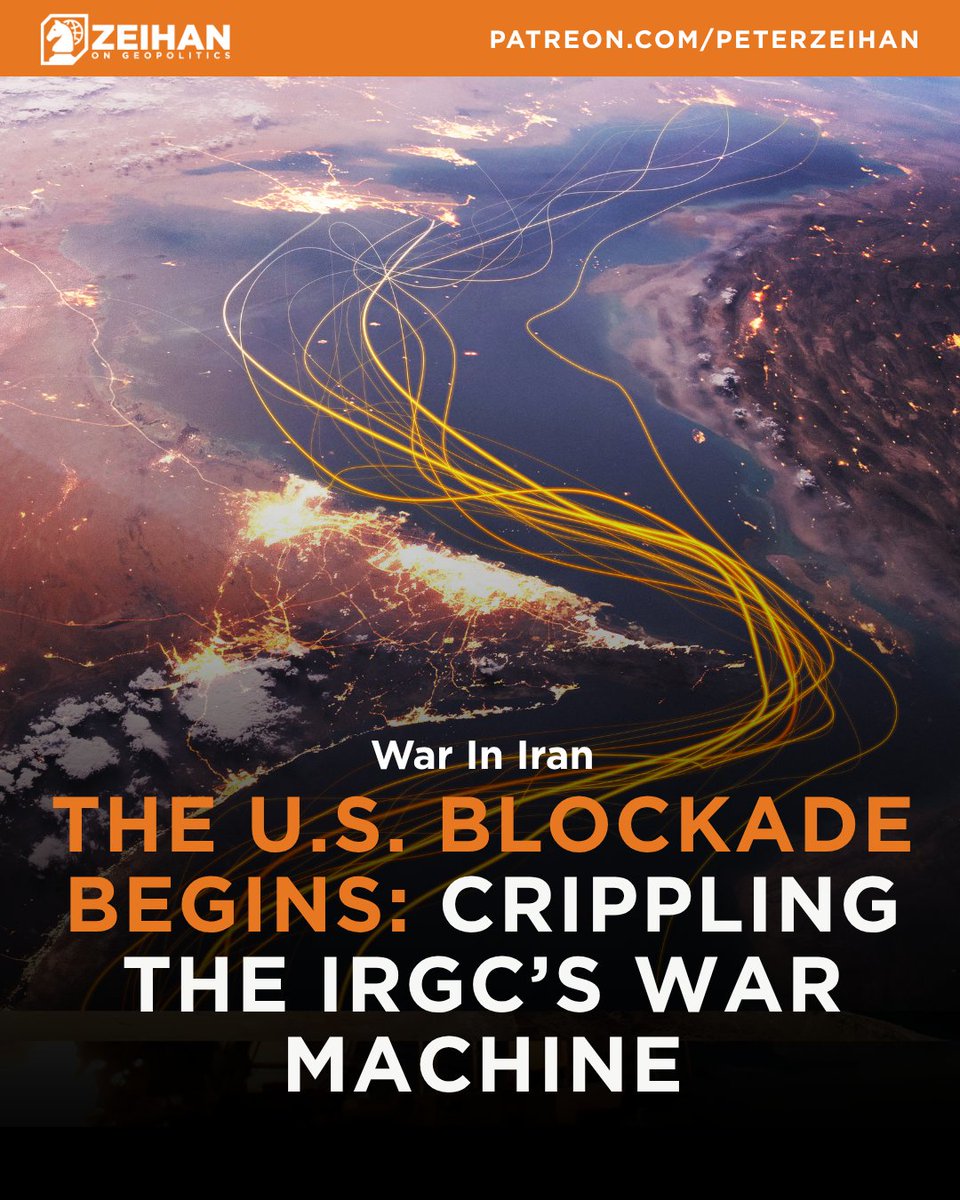
By blockading the ports, the 2 million barrels per day that the IRGC was able to export have now dropped to zero. Their ability to import products to control smuggling networks has also gone to zero. So, whether this is intentional or not, the White House has stumbled across a strategy that actually puts pressure on the people who need to be pressured.
The fact that the assets are now in place is promising. However, “promising” doesn’t mean it will work or be sustained long enough to make a difference. Because if you really do start pressuring the IRGC, they will strike. These are the people who control the bulk of the Iranian missile fleet and drones, and they have demonstrated more than enough capacity to strike any energy asset on the Arab side of the Persian Gulf.
Another reason the blockade is a necessary move is hardware. The Iranians don’t have a large manufacturing base, and almost all of their missile and drone components come from China. We were in this strange situation throughout the war where the Chinese could ship whatever components they wanted into Iran—even with the Strait shut down to Allied shipping.
Now, we’re in a scenario where that dynamic appears to have flipped. There are still plenty of drones—thousands, maybe tens of thousands—in Iran. So this is hardly a short-term cutoff, but it does matter.
#iranwar #geopolitics #straitofhormuz

English

4/ The full analysis, including why Iran is now threatening the Red Sea bypass routes and what happens when two enforcement systems share a strait that can’t support both.
open.substack.com/pub/readbelowg…
English

3/ Shutting in mature oil wells is not like turning off a faucet. Reservoir damage from forced shut-ins can permanently destroy 300,000 to 500,000 barrels per day of production capacity. That damage does not reverse when the blockade lifts.
The ceasefire expires April 21. The storage fills around April 26. The second deadline is the one that matters.
English

1/ Iran blocked the Strait of Hormuz for six weeks. On Monday, the U.S. layered its own blockade on top, targeting every vessel entering or leaving an Iranian port.
Two blockades are now running simultaneously in the same waterway. Each screens ships using different criteria. Each requires control conditions that negate the other.
English

4/ South Pars remains a broken pipe. Cumulative damage approaches 85 percent of Iran’s petrochemical capacity. Rebuilding takes years.
The ratchet did not reverse.
It entered a new phase.
What actually gets tested over the next two weeks, and in Islamabad, is whether the new administrative control over Hormuz hardens or erodes.
Full breakdown and Grade Report here:
readbelowgrade.substack.com/p/safe-passage…
English

3/ Hours after the announcement, a drone struck a pumping station on Saudi Arabia’s East West Pipeline. This was the primary Hormuz bypass.
Textbook Second Valve. Force traffic onto an alternative route, then that route becomes the next target.
The bypass just proved it is not outside the war.
English

1/ Headlines: “Ceasefire announced. Oil crashes 17 percent. Crisis over.”
Look at the fine print.
Iran’s Foreign Minister announced safe passage through the Strait of Hormuz will be via coordination with Iran’s Armed Forces.
The IRGC vetting system and Larak Island corridor did not vanish overnight.
The ceasefire did not reopen the strait.
It formalized who controls it.

English

The April 6 Israeli strike on South Pars (Katz confirming it took out ~50% of Iran’s petrochemical capacity, with the two main facilities together approaching 85%) turns this from a “blocked pipe” at Hormuz into a classic “broken pipe.”
Blockades and bypass routes can eventually reopen or reroute. Destroyed processing infrastructure takes years to rebuild, regardless of deadlines or ceasefires. That compounds the long-term supply risk you’re flagging.
English

4/ New model: The Deadline Ratchet.
When deadlines repeatedly extend while escalation continues between them, the ultimatum structure serves escalation rather than negotiation.
Watch what happens between deadlines, not whether they’re met.
readbelowgrade.substack.com/p/the-deadline…
English