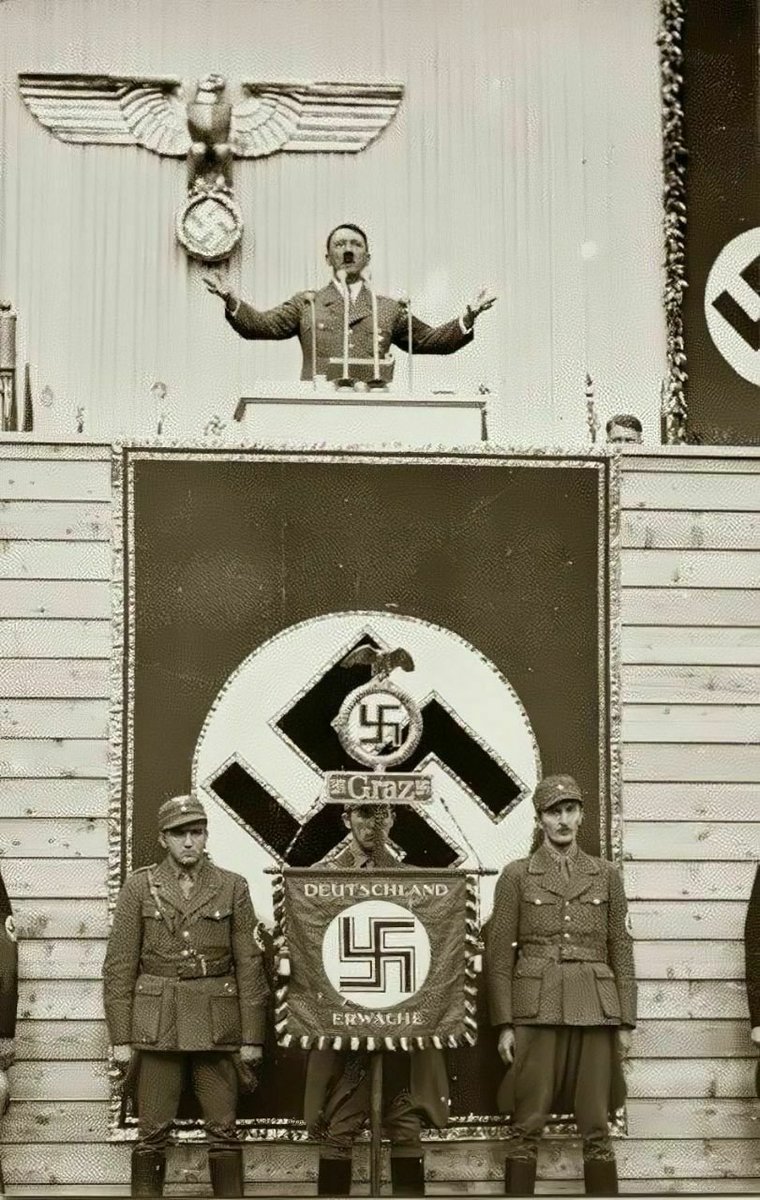
@AndrewD8814 Why don't we learn about THESE concentration camps in our history books? Oh, because they were written by the Jews who helped commit these attrocities.
@RupertLowe10 🇬🇧✝️⚔️✡️🇮🇱 Patriots support Restore Britain and the expulsion of the jews.
Thereafter, the turd -worlders will self-deport; as for whoever remains—well, tough luck.
The collapse of World Trade Center Building 7 can only be explained by a controlled demolition. The building fell symmetrically at freefall acceleration onto its own footprint. This is only possible if all vertical resistance is gone.
WTC 7 was hit by debris from the North Tower which caused scattered fires to burn for ~7 hours. These were typical office building fires fueled by ordinary combustibles like furniture, paper, partitions, etc with no jet fuel or diesel involved. By the time of the collapse, many fires had weakened—leaving the overall structure largely intact.
What happened next has never happened in the history of steel skyscrapers before or after 9/11. The One Meridian Plaza building in Philadelphia endured an intense fire for eighteen hours in 1991 yet remained standing. Madrid's Windsor Tower burned fiercely for more than twenty hours in 2005 with only partial collapse while the main core held firm.
The collapse of building 7 unfolded with striking symmetry as the entire structure dropped straight down into its own foundation. Video records capture the building descending vertically without any noticeable tilt or rotation. For much of the descent, the acceleration matched free fall as if an object had been dropped from a height. This uniform motion showed the lower portions of the building offered virtually no resistance.
Symmetrical vertical acceleration indicates that supporting columns throughout the building lost strength at virtually the same instant. The uniform support failure permitted the roofline to stay level while the whole mass plunged downward at high speed.
Damage from fire or debris would instead produce gradual uneven weakening that begins at the most affected spot and results in tilting or twisting as sections give way sequentially. The observed level drop and rapid pace therefore demand that structural support disappeared suddenly and evenly across every column.
A 4-year study at the University of Alaska spent $316,000 to determine the cause of WTC 7's collapse. The team simulated the collapse with sophisticated finite element models. They concluded (1) it could not have been caused by fire, and (2) it involved the near-simultaneous failure of every column in the building. These conclusions directly contradict the official investigation which blames fire.