Redis

14.1K posts

Redis banner
Redis

Redis

@Redisinc

See how fast feels

Katılım Ocak 2014
3K Takip Edilen44K Takipçiler
Redis
Redis@Redisinc·
We made the @Redpoint InfraRed 100, a list that recognizes the companies that are building the AI infrastructure of today and tomorrow through reliability, scalability, security, and innovation. Context orchestration at scale is the most important problem to be solved in the agentic era. We’ve built Redis to deliver the right context, with the right meaning, fast enough for agents to act on. Proud to be building alongside the other teams and companies who raised the bar. Check out the full report: redpoint.com/infrared/100/
English

0
2
3
461
Redis retweetledi
Santiago
Santiago@svpino·
Context is the bottleneck, and unfortunately, it's not something simple to solve. Here is the way I think about "the right context" (the 4 ingredients I'm always looking for): 1. Context has to be navigable: You want agents to understand and traverse relationships in the context. This is much more useful than thinking of context as "chunks of information". 2. Context has to be fast: You don't want to spend your latency budget retrieving and building your context. 3. Context has to be fresh: You need to decide when your context is stale and when to refresh it. 4. Context has to compound: The more you use the system, the better it should get. Redis released Iris, a brand new agent context and memory platform that you can use to power smart agents: fandf.co/4ueciGU First, they released the Redis Context Retriever, a semantic layer that sits over your live data. Instead of getting top-k chunks from a vector store, the Context Retriever lets the agent traverse entities and find related information. For instance, Customer → Invoice → Product. This is closer to graph traversal than regular retrieval. Second, they released the Redis Agent Memory, a managed short and long-term memory for agents. This will handle embeddings, retrieval, summarization, and durable state across sessions. Every team that's building agents is now reinventing this, and most do it badly. Third, they made Redis Data Integration generally available. This allows you to continuously sync from Postgres, MySQL, Oracle, warehouses, and document stores into Redis. This is how you can keep your context fresh. When you combine these three with Redis Search, you can handle semantic, hybrid, keyword, and structured queries with very low latency. Thanks to the team for partnering with me on this post.
English
1
8
65
9.1K
Redis retweetledi
Santiago
Santiago@svpino·
Context engineering is the single most important area you can focus on right now. We already have amazing models. Agents no longer fail because models are dumb. They fail because they don't have the right context. Here are the 4 ingredients of good context:
English
25
26
289
51.7K
Redis
Redis@Redisinc·
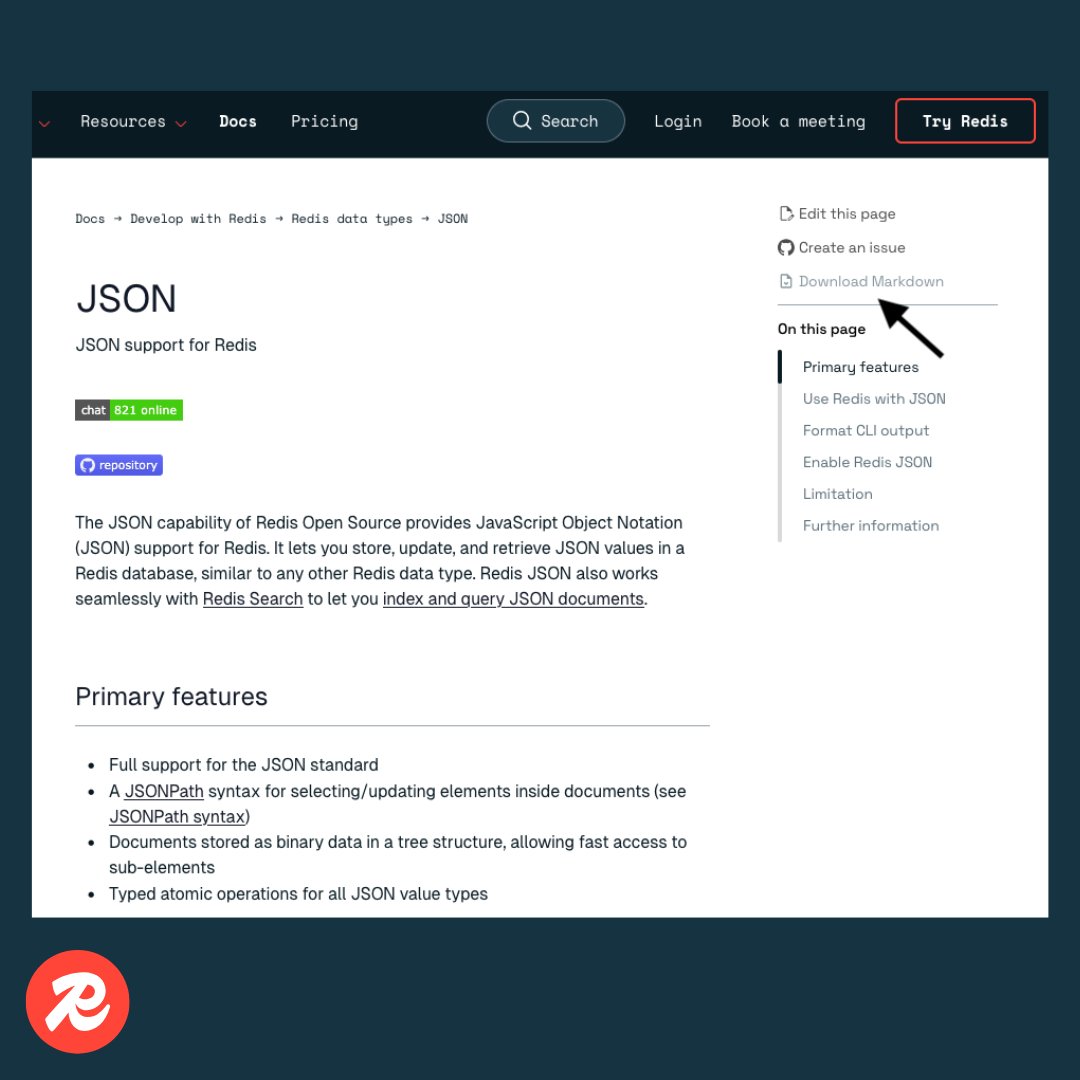
ICYMI: Redis Docs now ships with downloadable Markdown on every content page. Feed them directly into coding agents. No reformatting. No friction. Just grab the file and build. Looking for more resources for AI agent development with Redis? We got you: redis.io/docs/latest/ai…
Redis tweet media
English
1
0
2
278
Redis retweetledi
Samuel Agbede
Samuel Agbede@AgbedeSamuelD·
I was building a browser agent the other month when I noticed something. The tool (Playwright MCP) my agent called when it wanted to navigate a website didn’t return HTML. It returned an accessibility tree. This was interesting because I’d have assumed we should return HTML. It’s the source of truth for a webpage. But then I thought about what my agent actually needed to do. It didn’t need to render anything. It simply needed to read content and interact with elements. For that job, HTML is full of noise. Styling, layout, structure that only makes sense if you’re a browser. An accessibility tree strips all of that away. That made me think about data formats differently. Every format carries assumptions about who’s on the receiving end. A PDF was designed for print and human eyes. Columns, headers, layout instructions for a renderer. An API response was designed for a frontend, deeply nested, full of display metadata that a UI component needs and an agent doesn’t. In a sense, every format encodes its intended receiver. The layout assumptions in a PDF are a fingerprint of the human eye. The nesting in an API response is a fingerprint of a UI component. When we pipe these into an LLM without thinking, we’re not just sending information. We’re sending information wrapped in expectations built for someone else. I wonder how often we do this blindly. Reaching for the “default” format rather than asking whether it actually serves the agent. Going forward, the questions I now ask before wiring any data source into an agent: whose world was this format designed for and what does my agent need its format to look like?
English
1
1
5
1.2K
Redis
Redis@Redisinc·
If you're building customer support agents, AI copilots, or personalized assistants, this is the memory layer worth understanding. Full tutorial here: redis.io/tutorials/redi…
English
0
0
0
583
Redis
Redis@Redisinc·
Most AI agents forget everything the moment a session ends. Redis Agent Memory changes that by giving agents both short-term session context and durable long-term memory that persists across conversations. Lead Developer Advocate @riferrei builds a LangGraph travel agent that uses Redis Agent Memory with: → Short-term memory to keep the current conversation coherent → Long-term memory to store preferences and facts across sessions → Background extraction to decide what's worth keeping and what isn't
English
1
2
5
1.1K
Redis retweetledi
VentureBeat
VentureBeat@VentureBeat·
RAG got enterprises to production. It won't keep them there. Redis Iris launches as the context architecture era begins. venturebeat.com/ai/context-arc…
English
1
7
11
2.1K
Redis
Redis@Redisinc·
🧵One project. 10 devs. A year's worth of work. Redis shipped it with 5 people in one month. Once coding stops being the long pole, everything else needs to change too: standups, reviews, how requirements get written. Redis CEO @rowantrollope on what that actually looks like inside Redis on @tbpn
English
0
1
2
291
Redis
Redis@Redisinc·
🧵Hot take: most AI performance problems aren't model problems. They're data access problems. Benchmarks measure accuracy and task completion. They don't measure whether the agent had the right context to do the job. Stuffing everything into a context window doesn't fix it—it just creates context rot. The better path: give agents a tight set of tools and let them pull what they need. That's the architecture shift happening right now and what Redis CEO @rowantrollope explains on @tbpn
English
1
1
3
437
Redis
Redis@Redisinc·
🧵Redis started as a caching layer. Now it's the context engine for the agent era. The problem: companies will run orders of magnitude more agents than humans. Backend systems like Oracle and Snowflake weren't built for that load. Redis Iris sits in the middle, pulling live data from underlying systems, structuring it for agents via Pydantic models, and delivering exactly what's needed. Redis CEO @rowantrollope breaks it down on @tbpn
English
1
0
6
630
Redis
Redis@Redisinc·
Redis Iris gives agents a fast, governed context layer across retrieval, memory, and live operational data, so they can work with the context they need while they’re actually running. Read more here and start building today: redis.io/iris/
English
0
0
2
280
Redis
Redis@Redisinc·
For context to work in production, it has to do four things well. 1. It has to be navigable, not just retrievable. Agents need to move across entities and relationships: customers, orders, tickets, policies, accounts, workflows. Fetching chunks is useful, but production agents need a way to understand how business context fits together. 2. It has to be fast. Slow retrieval doesn’t just create a bad user experience. It increases workflow time, cost, and failure rates downstream. 3. It has to stay current. Agents operating on stale business state don’t just return bad answers. They return bad answers with confidence. 4. And it has to get better over time. Context should compound through memory, prior interactions, and a durable state instead of forcing every session to start from zero. That’s what makes context an infrastructure problem, not just a prompting problem.
English
1
0
1
314
Redis
Redis@Redisinc·
Most agent failures don’t start with the model. They start with context. The agent may be capable enough to reason through the task. The problem is that the data it needs is scattered across documents, databases, tools, memory, and operational systems. Some of it is stale. Some of it is slow. Some of it exists, but not in a form an agent can actually navigate. Redis Iris was built to solve that problem.
English
1
2
3
543
Redis retweetledi
Tyler Hutcherson
Tyler Hutcherson@tchutch94·
My current view is that legacy data infrastructure is largely NOT ready for the demand that agents will bring. That’s why we are investing in this product area for @Redisinc 🙏
English
0
1
1
611
Redis retweetledi
Tyler Hutcherson
Tyler Hutcherson@tchutch94·
❤️Redis Iris is the culmination of years of work on building memory-efficient & scalable retrieval systems for recsys, feature stores, RAG and now agents. Hats off to the entire product, RnD, marketing, DevRel, and leadership team for pulling off this release just in time!
Rowan Trollope@rowantrollope

Announcing Redis Iris. The context layer agents have been missing. Redis is already the most used database for agent data Today we’re making it easier than ever with Iris. redis.io/iris/

English
1
1
6
2K
Redis retweetledi
Dell Technologies Capital
Dell Technologies Capital@DellTechCapital·
Major launch from @Redisinc this morning: the company introduced Iris, a suite of tools to solve the challenge of bringing context to enterprise AI deployments. Catch CEO @rowantrollope talking enterprise-scale data and AI on TBPN today at 12:10 PM PT: lnkd.in/g6qtKhNX
Rowan Trollope@rowantrollope

Announcing Redis Iris. The context layer agents have been missing. Redis is already the most used database for agent data Today we’re making it easier than ever with Iris. redis.io/iris/

English
0
1
4
556