
Requestly

1.3K posts

Requestly banner
Requestly

Requestly

@RequestlyIO

Privacy-first API client with full data control • Local with Git • Loved by 300K+ devs.

San Francisco Katılım Şubat 2016
675 Takip Edilen1.6K Takipçiler
Requestly
Requestly@RequestlyIO·
Disorganized API setups don't just look messy—they double your debugging time, lead to inconsistent testing, and let critical edge cases slip through Here is how to structure your API testing workflow so it actually scales. 👇 - Keep ONE base request per endpoint: Think of this as your clean, canonical template. Never modify it directly - Use a parent-child structure: Group related scenarios under the base endpoint so your sidebar becomes a structured, navigable map - Name scenarios descriptively: Ditch "test1" or "edge case". Name them exactly after what is being tested, like "Missing token – 401" or "Payload too large – 413" - Save responses alongside requests: Don't just save the request configuration. Saving the actual response creates a living reference that saves enormous time when debugging 💡 Tip: Stop mixing environments! Use variables (like ) to switch dynamically, or create clearly labeled scenario groups for staging vs. production. Mixing them up is one of the most common sources of confusing test results 👉 Read the full blog to learn the complete scenario-based testing framework and see how Requestly's Examples feature automates this structure for you: requestly.com/blog/how-to-or…
Requestly tweet media
English
0
0
0
40
Requestly
Requestly@RequestlyIO·
Your #API request folder looking like: final_v2_ACTUAL_final_use_this_FIXED.json Yeah. We built something for that. Requestly Examples lets you save every version of a request — valid response, edge case, error state — clean, named, and ready to switch between instantly. Learn more → docs.requestly.com/api-client/exa…
GIF
English
0
0
1
32
Requestly
Requestly@RequestlyIO·
Your API returns a 200 OK. Your users trying to check out say otherwise. That’s the problem with relying purely on UI tests. 👇 Here’s a 100-second breakdown on how to catch failures before they turn into 3 a.m. pager alerts. Run your API tests locally and inside your CI pipeline before every single deploy. Try Requestly for free (no login required): requestly.com/downloads/
English
0
0
0
77
Requestly
Requestly@RequestlyIO·
Every time you test an API, you're probably editing the same request over and over — changing parameters, tweaking headers, adjusting payloads. It's repetitive, and one wrong edit breaks your original setup. With Requestly #Examples — you can save any API request + response as a snapshot, and switch between test scenarios instantly without touching the original. What you can do with Examples: ✅ Save distinct versions of a request (valid responses, edge cases, error states) under one parent request ✅ Revisit past responses without re-running anything — the response is stored too ✅ Share exact request configs with teammates so everyone's debugging the same setup ✅ Use any example as a template to spin up new requests without starting from scratch Read more here: requestly.com/blog/introduci…
Requestly tweet media
English
0
0
0
80
Requestly
Requestly@RequestlyIO·
By pairing AI-powered code generation with a structured testing environment, engineering teams can significantly reduce the time spent chasing API errors—and move faster with more confidence. Here’s a streamlined workflow using Cursor and Requestly to make API testing smarter and more efficient: ✅ AI-Assisted Generation: Use Cursor to generate endpoint URLs, query parameters, headers, and even expected response structures ✅ Execution & Validation: Plug those outputs into Requestly to run requests, inspect responses, and validate real API behavior ✅ Dynamic Request Reuse: Leverage environment or collection variables in Requestly to reuse requests across scenarios without rewriting ✅ Rapid Debugging Loop: When something breaks, feed the error back into Cursor for analysis and fixes—then instantly retest in Requestly 💡 Pro tip: Ask Cursor to generate edge-case inputs and test scenarios, and run them through Requestly to stress-test your APIs before they hit production.
English
0
0
1
97
Requestly
Requestly@RequestlyIO·
We are incredibly excited to announce that our founder, @sachinjain024 (Co-founder, @RequestlyIO and Group Product Manager, @browserstack), is taking the #BreakPoint2026 stage to officially unveil the next-generation Requestly API Client! For years, developers have relied on heavy, bloated API testing tools that force mandatory logins and cloud lock-ins. Your #APIClient shouldn't be the bottleneck slowing you down. In his session, "Ditching the Bloat," Sachin will demonstrate how our faster, privacy-friendly, open-source approach is fundamentally supercharging daily QA and development. Get ready for a highly practical breakdown as he reveals: ✅ Zero Bloat & No Lock-ins: Why modern engineering teams opting for a lightweight, lightning-fast experience. ✅ AI Test Authoring: Designed to automate complex API test generation directly within your workflow. ✅ Advanced Interception: Mastering response mocking, on-the-fly header modifications, and automated scripting. Join hundreds of thousands of developers making the switch to a truly modern API testing experience. Connect with 50,000+ peers and learn from 50+ industry leaders over 3 action-packed days. 12 days to go! 🚀 🗓️ Global: May 12-14, 2026 | ⏰ 7:30 AM PT 🗓️ APAC Exclusive: May 13-15 | ⏰ 10:00 AM IST ✅ 100% virtual & completely free 👉 Save your seat: browserstack.com/events/breakpo…
Requestly tweet media
English
0
1
4
111
Requestly
Requestly@RequestlyIO·
Teams can now manage secrets securely within their API workflows in @RequestlyIO. Securing API keys, tokens, and database credentials is a baseline requirement for any engineering team. Keeping sensitive data out of shared collections and exports is key to protecting your infrastructure. By building credential management directly into your API workflow, you can strengthen security without slowing down development. Here is how Requestly uses Vault and Pull secrets from AWS Secrets Manager: ✅ Store Secrets Locally: Store local development keys securely by accessing the Vault directly from the app footer ✅ AWS Native Integration: Connect AWS Secrets Manager to seamlessly pull centrally managed secrets directly into your local workspace ✅ Environment Configurations: Set up multiple AWS profiles to manage secrets across your different development environments ✅ Standardized Referencing: Call any credential across your workspace using a unified vault:key syntax Brief walkthrough below 👇
English
2
0
4
219
Requestly
Requestly@RequestlyIO·
Tracking success, error, and edge-case scenarios shouldn't require a cluttered workspace. 🚀 Requestly lets you save multiple request-response scenarios under a single base request to keep your testing environments clean and efficient. In our latest video, we break down how to organize and reuse API scenarios efficiently. ✅ Capture the full state: Save the exact method, URL, headers, parameters, and response data for any scenario. ✅ Standardize setups: Create and reuse saved templates as a baseline configuration to spin up new requests faster. ✅ Switch instantly: Toggle between different scenarios directly from the sidebar. 💡 Pro Tip: Use this feature to streamline the feedback loop between QA and Development. Instead of manually reproducing an edge case, you can save the exact failing response as an example in a shared workspace—giving the full context instantly.
English
0
0
0
92
Requestly
Requestly@RequestlyIO·
Engineering time often gets lost chasing frontend “bugs” that turn out to be API issues—header mismatches, silent failures, or expired tokens. If debugging still relies on guess-and-check, the workflow is the problem. In this breakdown, we go through 5 common API debugging mistakes and how to structurally fix them. ✅ Assuming payloads instead of verifying actual network traces. ✅ Treating all non-200 responses the same instead of implementing specific error handling. ✅ Relying on manual UI refreshes instead of intercepting and modifying requests mid-flight. ✅ Using hardcoded, expiring data rather than dynamic variables. ✅ Manually reproducing auth and state instead of scripting your way to a clean fix. The shift is simple but structural: move from reactive debugging to controlled, repeatable workflows. 💡 Pro Tip: Combine request interception with pre-request scripts for dynamic auth and timestamps. This allows you to isolate and test edge cases locally without relying on the UI. The goal isn’t just faster debugging. It’s fewer unknowns.
English
2
0
3
103
Requestly
Requestly@RequestlyIO·
Meet the brand new Requestly #APIClient. 🚀 We've re-architected our API testing experience from the ground up to give you the speed, privacy, and power you actually need! And we’ve made a big shift: moving the API Client out of the browser extension into a dedicated desktop app. Decoupling it from the browser lets us build a far more capable, privacy-first API client designed for real workflows. If you're tired of heavy, slow API tools, this is built for you—no forced cloud syncs and no mandatory logins. Here is what's waiting for you in the new desktop app: ✅ Lightning fast: Native handling for APIs with different supported protocols. ✅ Privacy-first & Git-native: Save locally, manage via Git, or use Team Projects. ✅ Automate Workflows: Automate your request with pre-request and post-response scripts ✅ Data-Driven Testing: Bulk execute collections using CSV & JSON files. ✅ 1-Click Imports: Seamlessly migrate Postman collections, OpenAPI specs, and cURL commands. Give the new desktop app a spin and see the difference! 👉 requestly.com/?utm_source=tw…
English
0
3
6
186
Requestly
Requestly@RequestlyIO·
An #API in 2026 is basically just a translator. It takes human language and turns it into JSON so AI agents can take action. But the real bottleneck is your AI devs waiting for backend APIs to be ready. 🤯 If you want your team to ship faster, you have to decouple them. With @RequestlyIO, your AI agents can keep testing with realistic data while the backend gets built in parallel. 🚀
English
0
0
1
118
Requestly
Requestly@RequestlyIO·
How much does sprint velocity drop just because devs have to manually recreate API endpoints in their testing clients? It usually starts with a quick Slack message asking for the latest payload structure. Then suddenly, you’re spending 20 minutes configuring headers, body params, and auth tokens just to test a single route. It’s a massive, quiet time-sink. We built a simple fix in Requestly to remove this friction. Drop your #OpenAPI spec (v2/v3, JSON or YAML) into your workspace, and it instantly builds your full API collection. ✅ Zero setup: Import all endpoints instantly ✅ Shared alignment: Same API contract across teams ✅ Instant testing: No more copy-paste setup Check out the quick walkthrough video below to see it in action. 👇 Docs: #import-/-export-openapi-spec" target="_blank" rel="nofollow noopener">docs.requestly.com/general/api-cl…
English
0
0
2
172
Zara
Zara@Zara_Ashford·
Postman used to be a no-brainer. Now it needs budget approval. That alone made me explore @RequestlyIO No login. No pricing surprises. Just a clean, local-first API workflow. Try it here requestly.com
English
75
61
136
8.4K
Requestly
Requestly@RequestlyIO·
We’ve rolled out native #SOAP support in @RequestlyIO ! 🚀 A huge part of the world’s infrastructure—financial systems, healthcare, telecom—still runs on SOAP APIs. But testing them often means switching to clunky legacy tools or wrestling with XML in modern clients. We wanted to remove that friction. Now you can handle SOAP workflows right alongside #REST and #GraphQl—without leaving Requestly. Here’s how it works: ✅ Import WSDL: Add a URL or file to auto-generate structured requests ✅ Tweak & Send: Edit XML parameters and fire requests instantly ✅ Analyze: View responses in the same clean interface you already use Whether you're maintaining legacy systems or migrating away from them, everything now lives in one place! 👉 Docs: docs.requestly.com/general/api-cl…
English
0
0
1
117
Requestly
Requestly@RequestlyIO·
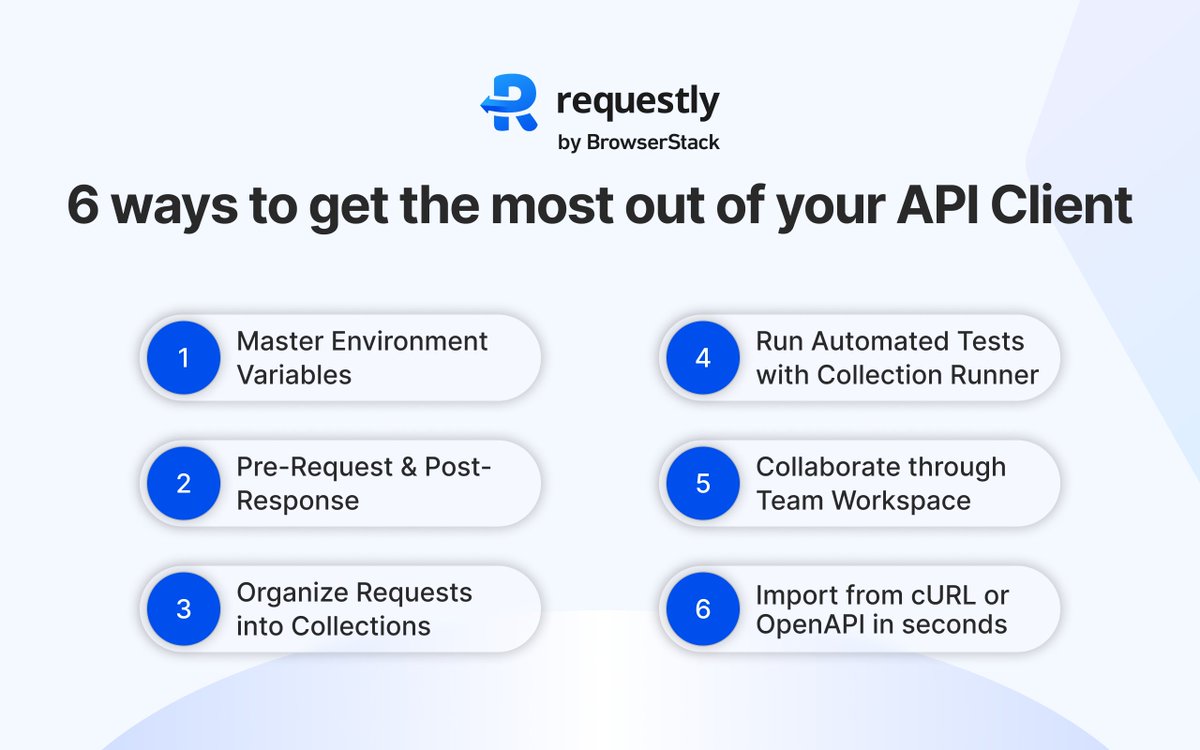
Most developers use only 20% of their #APIClient. If you're only using your #API client to fire off GET requests and check status codes — you're leaving a lot of value on the table. Here are 6 ways to get the most out of Requestly API Client: 1️⃣ Master Environment Variables: Stop hardcoding base URLs. Create Dev, Staging, and Production environments in Requestly and switch between them in one click — no manual edits across requests. 2️⃣ Use Pre-Request & Post-Response Scripts: Requestly lets you write JavaScript pre-request scripts to set dynamic headers or tokens, and post-response scripts to transform or validate data — automatically, every time. 3️⃣ Organize Requests into Collections: Group related API calls into Collections and sub-folders. Your projects stay clean, shareable, and navigable — especially as your API surface grows. 4️⃣ Run Automated Tests with the Collection Runner: Don't just test one request manually. Use Requestly's Collection Runner to execute multiple requests sequentially — with data file support for running tests across multiple inputs at once. 5️⃣ Collaborate Through Team Workspaces: Share Collections, Environments, and requests directly with teammates through Requestly Workspaces. Everyone works from the same source of truth, no emailing JSON files around. 6️⃣ Import from cURL or OpenAPI in Seconds: Got a cURL command from your browser's Network tab? Paste it straight into Requestly and it converts into a full request. You can also import OpenAPI/Swagger specs or even existing collections.
Requestly tweet media
English
0
0
3
111
Requestly
Requestly@RequestlyIO·
Introducing “Examples” in Requestly! 🎉 Most #API workspaces end up as the same few requests cloned over and over. But cloning requests just to track different responses creates a mess. Debugging slows down, and sharing context becomes painful—you open a workspace and see a graveyard of duplicates. We wanted to fix this in Requestly, so we built “Examples.” Instead of duplicating a request multiple times, you can save multiple request/response snapshots under a single endpoint. - Got a 200? Save it as “Success.” - Hit a 400? Save it as “Invalid Input.” - Testing edge cases? Save “404 Not Found.” Now your workspace stays clean. Open one API call, toggle between scenarios, and reuse them instantly. Give it a look 👇 Docs: #save-a-request-&-responses-as-an-example" target="_blank" rel="nofollow noopener">docs.requestly.com/general/api-cl…
English
0
1
1
103
Requestly
Requestly@RequestlyIO·
Finding an #APIclient that isn't bulky, slow, or cloud-mandatory… really isn’t that hard. 😉 👇 Watch our full breakdown of the top tools
English
0
0
5
131
Requestly
Requestly@RequestlyIO·
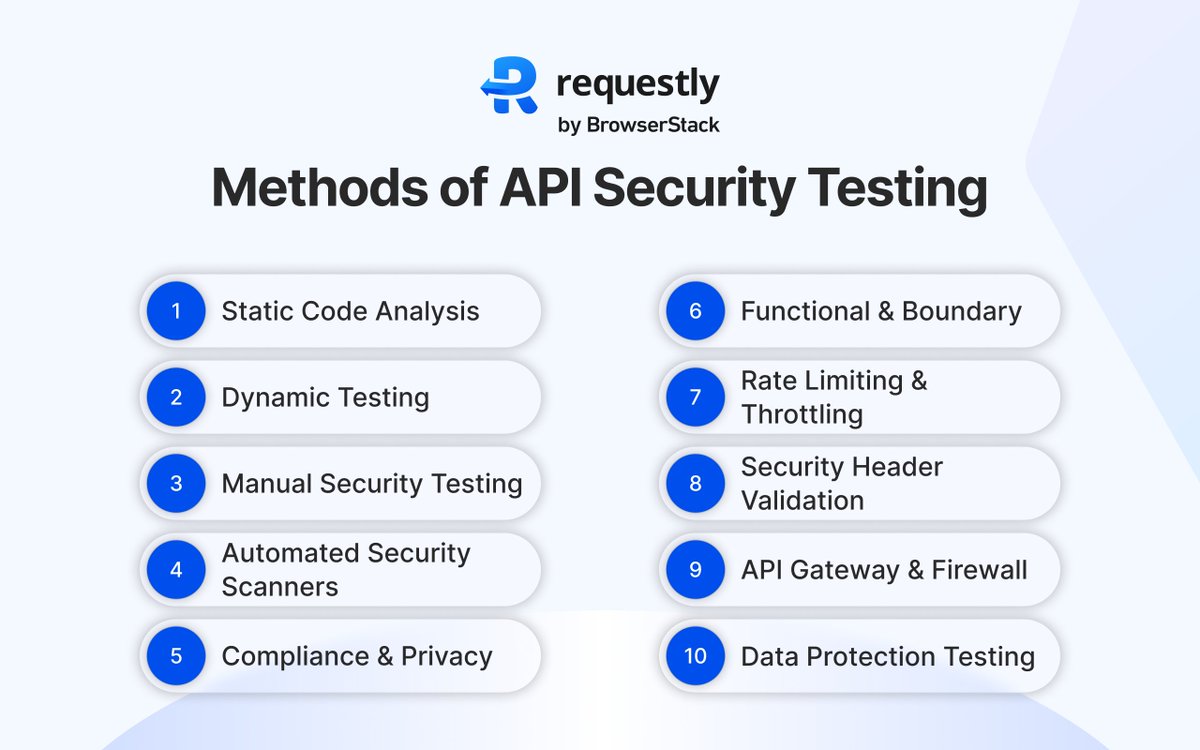
Securing APIs requires a multi-layered approach. Relying on a single testing method leaves your endpoints vulnerable to attacks. Here are 10 essential methods for comprehensive API Security Testing: 1️⃣ Static Code Analysis (SAST): Scanning source code for vulnerabilities before the application is running. 2️⃣ Dynamic Testing (DAST): Simulating real-world attacks on the running API to find runtime flaws. 3️⃣ Manual Security Testing: Uncovering complex business-logic flaws that automated tools miss. 4️⃣ Automated Security Scanners: Catching low-hanging fruit (like OWASP Top 10) in your CI/CD pipeline. 5️⃣ Compliance & Privacy Testing: Ensuring PII is handled securely and complies with GDPR/HIPAA. 6️⃣ Functional & Boundary Testing: Pushing APIs to the limit with massive payloads or unexpected data. 7️⃣ Rate Limiting & Throttling: Testing how the system behaves under heavy traffic or DDoS attempts. 8️⃣ Security Header Validation: Verifying proper HTTP headers (CORS, CSP, HSTS) are in place. 9️⃣ API Gateway & Firewall Testing: Ensuring your WAF properly blocks malicious traffic. 🔟 Data Protection Testing: Checking encryption (in transit and at rest) and authorization (OAuth/JWT). 💡 Requestly API Client helps you take full control of your endpoints. You can easily craft custom requests, push edge-case payloads, and validate your token/auth flows—all from one streamlined workspace! #API #Security
Requestly tweet media
English
0
1
3
126
Requestly
Requestly@RequestlyIO·
AI isn’t just a buzzword anymore—it’s actively changing how we build, debug, and test software. Whether you are an engineer integrating LLMs into your app or a QA figuring out how to test unpredictable AI API responses, upskilling is no longer optional. But with so much noise out there, where should developers actually start? There are 5 incredible resources available at no cost: 1. Microsoft’s "Generative AI for Beginners" : A hands-on curriculum teaching you how to build GenAI applications using Python and TypeScript. 🔗 github.com/microsoft/gene… 2. DeepLearning.AI : Short practical tutorials focused entirely on interacting with and testing LLMs via API calls. 🔗 deeplearning.ai/short-courses/ 3. DAIR.AI Prompt Engineering Guide: A comprehensive framework for crafting precise prompts and evaluating AI outputs for consistent, testable results. 🔗 promptingguide.ai 4. Anthropic's Educational Courses: GitHub tutorials on constraining models, reducing hallucinations, and forcing strict JSON API responses. 🔗 github.com/anthropics/cou… 5. Hugging Face: A introduction to practically implementing open-source AI models without relying solely on paid APIs. 🔗 huggingface.co/learn As you start building and testing new AI features, you will be making a massive amount of API calls. And debugging those requests is exactly where Requestly comes in to save you time. 💙
English
1
0
2
125
Requestly
Requestly@RequestlyIO·
Did you know teams using a strict design-first #API approach ship features noticeably faster than those writing code first? Yet half the industry is still writing API docs manually. 🫠 Let's clear up the oldest debate in the API world: Swagger is the tooling, OpenAPI is the specification. Think of OpenAPI as the blueprint for your house—it tells everyone exactly where the plumbing goes so you don't accidentally flood the basement. Stop writing manual docs and let the spec do the heavy lifting. 💡 Pro tip: If you aren't using your #OpenAPI specs to automatically generate collections and client SDKs in your CI/CD pipeline, you're leaking engineering velocity. Design-first > Code-first. 🚀
English
0
0
1
105