SOIC Research

429 posts

SOIC Research banner
SOIC Research

SOIC Research

@ResearchSOIC

SOIC Intelligent Research LLP | SEBI Registered Research Analyst (Reg. No: INH000012582) | BSE Enlistment No. - 5808 | Not Investment Advice |

India Katılım Eylül 2025
35 Takip Edilen12.3K Takipçiler
Sabitlenmiş Tweet
SOIC Research
SOIC Research@ResearchSOIC·
We have been running a series called 20 Unique Businesses on this page. The filter is simple :- → High barriers to entry → Cannot be replicated just via blank cheque → Good return ratios → Limited competitors → Doing something cutting edge or structurally different Not stocks to buy. Not targets to chase. Just businesses worth understanding, the kind where the moat is not a number on a screener but something you feel once you study the value chain. If you missed any of them, this thread is your single window. Every business we have covered so far, in one place -
English
5
64
404
47.6K
SOIC Research
SOIC Research@ResearchSOIC·
An elevator pitch on how the industrial gases industry works! You separate air into gases, or you buy rare gases and repackage them. You sell either from a plant you own (merchant) or from a plant you build inside a customer's factory (on-site). On-site is a 15-20 year annuity at thin margins. A merchant is a spot market where the same molecule earns very different money depending on the gas, the distance, and who else is selling nearby. The whole game is capital, location, and the ability to squeeze extra high-margin gas (argon, liquid) out of a plant you've already built. But let’s get into interesting details about that - What does the industry actually sell? Strip away the chemistry and this is an air-separation business. A cryogenic plant is an Air Separation Unit, or ASU that chills atmospheric air until its components liquefy at their different boiling points, and pipes off oxygen, nitrogen and argon at high purity. Everyone in the industry runs broadly the same technology, so purity differences are marginal (roughly plus-or-minus 5%). The molecule is a commodity. Almost everything interesting happens around the molecule in how it's contracted, delivered, and priced. The demand base has historically been the heavy stuff: steel and metals, autos, pharma, healthcare, and a thin slice of chemicals and F&B. What's changing the growth story is the sunrise demand from solar and semiconductors, which pull large volumes of nitrogen and, in semis, demand purity that cheaper suppliers struggle to hit. That single shift is why every player in the country is pouring capital into new capacity at the same time. The top four global MNCs Linde, INOX Air Products, Air Water India and Air Liquide India control roughly 80% of the market. Below them sit regional, owner-driven players (Ellenbarrie, Vayu, Shree Ram Oxygas and similar) who have been around 10–15 years and whose space widened after COVID, when oxygen subsidies pulled local capital in. Now let’s understand the 2 engines in this industry separately > on-site vs merchant Everything downstream flows from one fork in the road: do you build the plant inside the customer's factory, or near a cluster of customers and truck the gas out? These are two genuinely different businesses with different economics, different customers, and different personalities. > On-site - An anchor customer, usually a large steel plant, issues an RFQ saying, in effect, we need ~1,100–1,800 tonnes of gas a day flowing into our furnace. A supplier builds and operates an ASU on their premises under a Build-Own-Operate (BOO) contract running 15–20 years. The revenue is fixed and stable, so it's underwritten on a modest return — players will accept an operating margin of roughly 10–12%, sometimes pricing the whole thing to a ~10–15% IRR. It is deliberately boring money. Why fight so hard for boring money? Because it's stable, long-dated and defensive with a 15–20 year foothold that also keeps a rival out of that customer. Contracts signed before roughly 2016–18 carried fatter margins and some still run (a few end around 2035), but the new-build market is now openly competitive on price. > Merchant business - Here you own the plant, liquefy the output, and sell it as liquid, bulk or cylinders to whoever's within reach. Margins are structurally better but volatile: liquid/bulk runs a ~20–25% bottom line, while cylinder and specialty can reach ~40%. The catch is geography. Oxygen and nitrogen are cheap and heavy, so you can't economically truck them much beyond ~200–300 km before distribution cost (typically 10–12% of revenue) eats you alive. You plant an ASU, draw a 200–300 km radius, and fight for that circle. The reason branded MNCs earn ~40–45% at the top while a strong regional player earns ~35% isn't a secret formula rather it's scale and mix. A Linde or INOX moves 4,000–5,000 TPD daily; a regional player moves 250–300 TPD. At a small scale, tender-driven medical demand keeps margins decent. But to scale from 300 TPD to 3,000–4,000 TPD you must chase the lower-margin sectors that make up the bulk of the market and that's exactly where pricing and margin pressure begin. The value chain, end to end Follow a molecule of oxygen from the atmosphere to the customer and you can see where value is captured and where it leaks. Stage 1 - Build the plant (the capital gate) This is a capital-intensive, power-intensive industry, and the entry cost is the first moat. A modest 200–250 TPD on-site plant needs at least INR 300–400 crore of initial capex. Core components are compressors, cold boxes that have to be imported; India makes none of them. Only fabrication and storage tanks (INOX, Cryolor, VRV) are domestic. Build time runs 16–24 months per ASU Stage 2 - Choose your engineering partner (the quiet moat) Who actually builds the plant is becoming the real differentiator. The MNCs carry in-house EPC muscle - Linde has Linde Engineering, INOX leans on Air Products' US technology which lets them build large, reliable ASUs and win the technically demanding jobs. Regional players without that engineering wing increasingly tie up with Chinese OEMs on a sale-of-equipment basis: the Chinese firm builds and exits, and the local player does the O&M. It's cheaper (a 200 TPD plant runs ~INR 100–120 crore via a Chinese vendor vs ~INR 150–200 crore via an MNC), but blue-chip steelmakers (Tata, JSW, SAIL, AM/NS) often won't allow a Chinese machine where they're underwriting 15–20 years of reliability, power efficiency and capital backup, and they pay up for it. The cost-vs-capability gap > MNC plant, 200 TPD: ~INR 150–200 crore — technology, reliability, blue-chip acceptance. > Chinese plant, 200 TPD: ~INR 100–120 crore — cost-optimised, favoured by smaller / secondary steel and rolling mills. > No Indian regulation restricts Chinese ASUs, so the split is driven purely by which customer is buying. Stage 3 - Extract the by-products (where margin hides) A basic ASU makes oxygen and nitrogen. To pull argon you must bolt on a separate argon-recovery column and here's the quirk: that column costs roughly the same whether the plant is small or large, but a small 200 TPD ASU yields only ~5–6 TPD of argon while a big ASU yields 50–60 TPD. The capital-to-recovery maths favours scale heavily, yet argon's economics are so attractive that even smaller players are now installing the column anyway. Stage 4 - Distribute (the tyranny of distance) Oxygen and nitrogen are regional products which are heavy, cheap, and uneconomic beyond ~300 km. Argon is a national product valuable enough to ship across the country, though distribution then runs ~17–18% of revenue rather than 10–12%. This distinction quietly shapes the entire competitive map: oxygen/nitrogen competition is local and radius-bound, while argon competition is national and cyclical. How to judge any player in this industry? Pulling the mechanics together, a handful of questions separate a structurally strong operator from a fragile one regardless of the name on the door. > Capacity trajectory: Can they actually double liquid capacity? You can't sell a molecule if you can't make expansion of 200 TPD takes 1.5 - 2 years, not six months. > Mix quality: How much on-site annuity vs volatile merchant? How much argon and by-product upside are they extracting per plant? > Engineering independence: In-house EPC, or dependent on Chinese OEMs who build and exit? This gates which customers they can win. > Geographic competition: Are their plants in pockets with few rivals inside the 300 km radius, or in contested western/central India? > Blue-chip acceptance: Can they clear the reliability/purity bar for Tata, JSW, AM/NS, and semiconductors or are they confined to secondary, cost-driven demand? > Cycle timing: Are they adding capacity into the current glut, and can their balance sheet and geography absorb 2–3 years of merchant price erosion before demand catches up? Dislaimer - not a recommendation to buy/sell
SOIC Research tweet media
English
1
14
99
8.4K
SOIC Research
SOIC Research@ResearchSOIC·
Disclaimer - Not a recommendation to buy/sell
English
0
0
4
2K
SOIC Research
SOIC Research@ResearchSOIC·
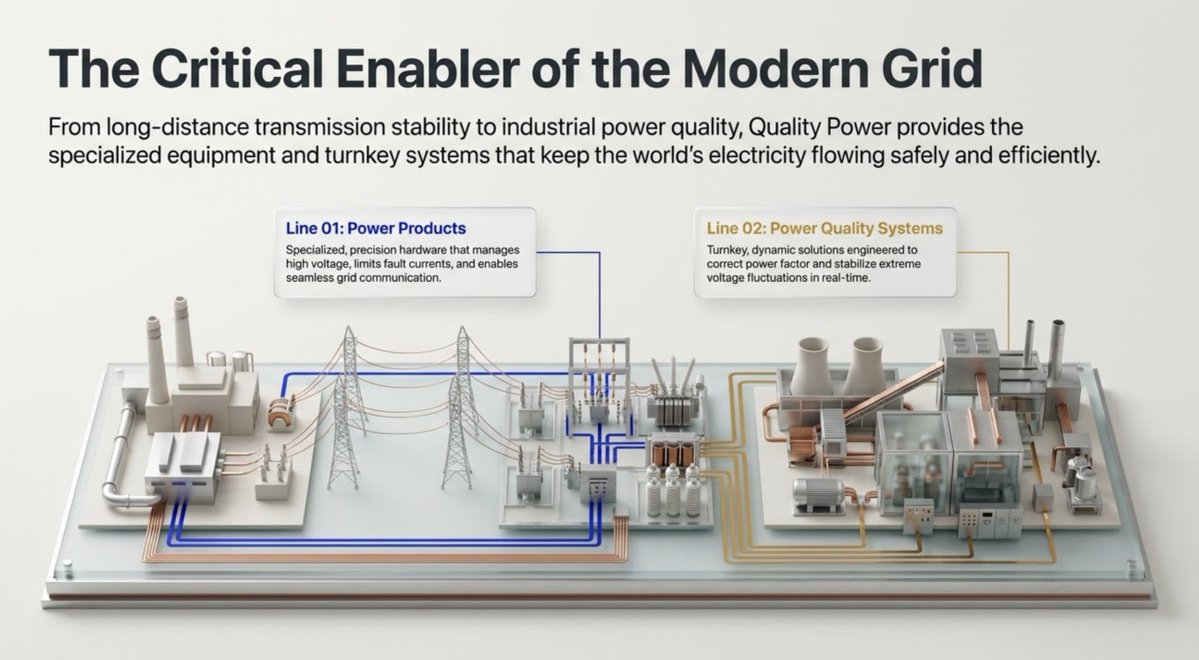
Essentially, if you picture electricity moving from a power plant, across long transmission lines, through substations, and down to factories or cities  Quality Power makes the supporting equipment at nearly every step: components that limit fault currents, filter harmonics, stabilize voltage, enable HVDC long-distance transfer, and let utilities monitor/communicate over the grid.
English
1
0
16
2.6K
SOIC Research
SOIC Research@ResearchSOIC·
Qpower is the critical component supplier in the modern grid. It doesn't make the generators or the big power transformers themselves at massive scale (like a BHEL or Siemens Energy)  it specializes in these grid-support and power-quality niches, which is why it's often described as a critical enabling equipment supplier rather than a bulk equipment maker and rather act as an equipment provider to the end HVDC providers such as Siemens energy , Ge Vernova .
SOIC Research tweet media
English
1
24
225
16.3K
SOIC Research
SOIC Research@ResearchSOIC·
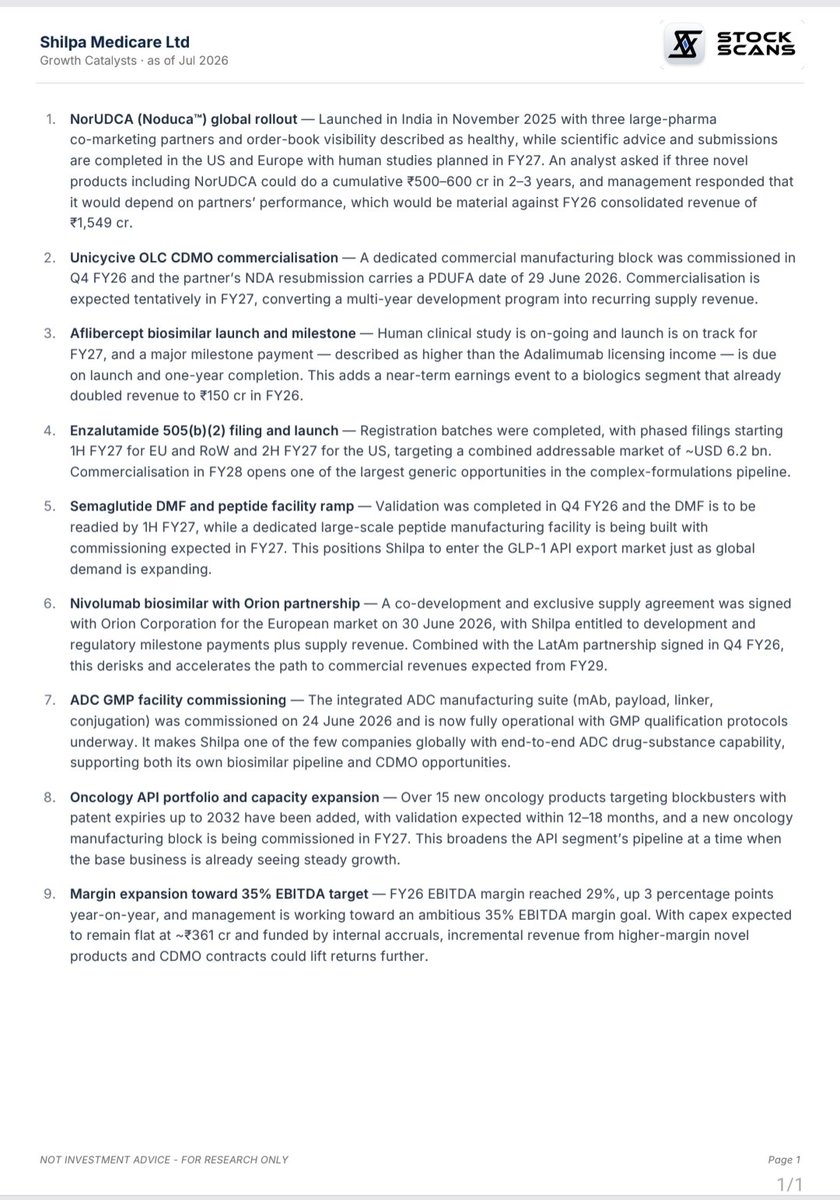
Here is the summarised version of the growth catalysts for the company @stockscansin
SOIC Research tweet media
English
0
4
19
2.7K
SOIC Research
SOIC Research@ResearchSOIC·
Here's a detailed deep dive on Shilpa Medicare, which we covered for our subscribers under SOIC Research a while back. Every Sunday, we discuss one business like this from our watchlist both Indian and global. Here is the link: drive.google.com/file/d/1xMXMZC… Disclaimer - Nothing is a buy or sell recommendation and this is only for educational purposes
English
6
33
221
22K
SOIC Research retweetledi
Investing Accelerator Summit 🚀
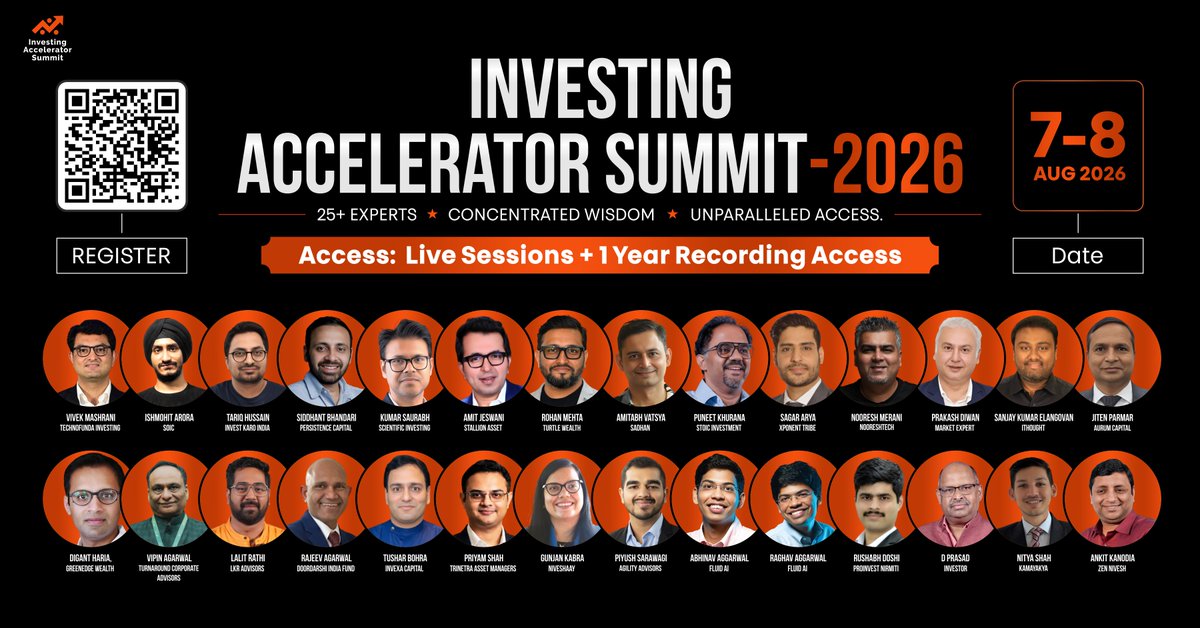
30 investors. 20 stock ideas, 10 powerful investing frameworks, and 5 sessions with listed-company management. Investing Accelerator Summit 2026 — live, Aug 7 & 8. investingacceleratorsummit.com Full lineup 👇 Vivek Mashrani · TechnoFunda Investing Ishmohit Arora · SOIC Tariq Hussain · The Wrap Siddhant Bhandari · Persistence Capital Kumar Saurabh · Scientific Investing Amit Jeswani · Stallion Asset Rohan Mehta · Turtle Wealth Amitabh Vatsya · Sadhan Puneet Khurana · Stoic Investment Sagar Arya · Xponent Tribe Nooresh Merani · NooreshTech Digant Haria · GreenEdge Wealth Prakash Diwan · Investor Sanjay Kumar Elangovan · ithought PMS Jiten Parmar · Aurum Capital Vipin Agarwal · Turnaround Corporate Advisors Lalit Rathi · LKR Advisors Rajeev Agarwal · DoorDarshi Advisors Ankit Kanodia · Zen Nivesh Tushar Bohra · Invexa Capital Priyam Shah · Trinetra Asset Managers Gunjan Kabra · Niveshaay Navy Ramavat · Indira Securities Piyush Sarawagi · Agility Advisors Abhinav Aggarwal · Fluid AI Raghav Aggarwal · Fluid AI Rushabh Doshi · Proinvest Nirmiti D Prasad · Investor Nitya Shah · Kamaya Kya Join us live → investingacceleratorsummit.com
Investing Accelerator Summit 🚀 tweet media
English
12
31
205
290.4K
SOIC Research
SOIC Research@ResearchSOIC·
Rategain Travel Technologies x.com/ResearchSOIC/s…
SOIC Research@ResearchSOIC

Today, let's talk about a SaaS business that most people would dismiss at first glance. An IT company. A software business. In 2025-26, the automatic reaction is, "AI will eat these guys alive." And honestly? For most SaaS companies, that fear is valid. But this one is different. This isn't a generic software vendor selling dashboards or CRM tools. This business has quietly built itself into the invisible infrastructure of a $1.5 trillion global travel industry. Every time you book a hotel on Booking. com, every time an airline adjusts its fare, every time a hotel decides how much to spend on Google ads there's a high chance this company's technology is running in the background, making that decision happen. And here's the contrarian thesis that we'll break down in this thread: AI doesn't disrupt this business. AI makes its moat deeper. While the market debates whether SaaS companies will survive the AI wave, this one is already deploying AI agents that deliver 300% revenue lifts for customers, has built the world's largest travel intent data platform with 1.5 billion data points, and is in active conversations with OpenAI and Google to become the advertising infrastructure layer for AI-powered travel. So in this thread, we're going to break it all down for you in simple terms: → What the business actually does (and why it can't be replicated) → Why financial metrics of this company are among the best in Indian SaaS → What's going to drive the next phase of growth → The real risks that you should watch → And the big question, is AI a threat or the biggest tailwind this business has ever had?

English
1
3
21
6.5K
SOIC Research
SOIC Research@ResearchSOIC·
We have been running a series called 20 Unique Businesses on this page. The filter is simple :- → High barriers to entry → Cannot be replicated just via blank cheque → Good return ratios → Limited competitors → Doing something cutting edge or structurally different Not stocks to buy. Not targets to chase. Just businesses worth understanding, the kind where the moat is not a number on a screener but something you feel once you study the value chain. If you missed any of them, this thread is your single window. Every business we have covered so far, in one place -
English
5
64
404
47.6K
SOIC Research
SOIC Research@ResearchSOIC·
Today we are going to discuss a very unique 2W OEM that has been able to built a product that is built to last in 10+ years. For context - They had no legacy nothing and have built the business ground up from nothing (product first distribution later) Ather invested in the things that compound and are hard to copy i.e. design IP, software, brand, charging network and rented the things that don't (cell manufacturing). That is why it spends less than Ola yet has better unit economics, and why the moat is earned rather than bought. And this is the fruits of investing in building technology and a superior product for years before just thinking about scaling distribution. At the end of the day we can see the result that the product won that did not catch fire :) But here today we will get into details of how they created this MOAT and how it is now able to win a superior market share and show such a strong growth at the same time when competition did not decrease in fact it has gone up!
SOIC Research tweet media
English
6
21
152
22.5K
SOIC Research
SOIC Research@ResearchSOIC·
Ather Energy is best understood not as another EV volume-chaser but as a vertically design-integrated, product-and-software-led franchise that has spent thirteen years building the things capital can't buy quickly in-house powertrain, BMS and software IP, India's largest fast-charging network, and a premium brand with ~90% software attach rates while deliberately renting the things that don't compound (battery-cell manufacturing). That choice is why it has clawed durable market share back from a far better-funded Ola while burning less cash, and why its unit economics already rival ICE majors at the gross-profit line. The investable question is therefore no longer whether the model works but whether it scales into its fixed-cost base on schedule: management is steering toward EBITDA breakeven by FY28 (net profit ~FY29) on operating leverage from the new AURIC capacity, the cost-cutting EL platform, the LFP transition and a growing high-margin software mix All underpinned by a freshly recapitalized, net-cash, negative-working-capital balance sheet and a rare double tailwind of scooterisation and electrification, with the EL and Zenith platforms set to multiply its addressable market. The risks, though, are real and mostly about pace and price rather than viability: the valuation underwrites an as-yet-unproven profitability inflection that is highly sensitive to volume execution; disciplined incumbents (TVS, Bajaj) and a capable re-entrant like Honda may cap further share gains; a China-centric battery and rare-earth supply chain remains a genuine structural dependence; demand leans on EV-friendly subsidy and GST policy Net-net, Ather looks like the most durable franchise in Indian E2W built to last rather than merely to scale but it remains a "right business, unproven profitability, full price" situation, where the reward hinges on execution over the FY27–28 window doing exactly what management has guided.
SOIC Research tweet media
English
3
0
10
1.8K
SOIC Research
SOIC Research@ResearchSOIC·
Ather has explicitly framed its corporate journey in three phases (1) product development, (2) ecosystem creation (Ather Grid, AtherStack, service), and now (3) a high-growth + path-to-profitability phase. The whole forward story is the company executing phase 3 on the foundation built in phases 1–2. Management's stated aim is simple to reach profitability while sustaining above-industry growth. Gross margin keeps expanding (LFP + EL + BOM re-engineering), EBITDA breakeven ≈ FY28E (+1.5%) driven by operating leverage as AURIC volumes absorb fixed cost, PBT/PAT positive ≈ FY29 lags EBITDA because of higher depreciation (Factory 3.0) and lower other income. This is how the path to profitability should be for the company while the new facility kicks in and drives strong volume growth for the company (north of 40%) with realisations remaining largely flat for the company. One has to keep a close track on few of the simple things - 1) Monthly VAHAN registrations / market share - Good: share holding ~17–19%+ and tracking toward ~531k units FY28E. 2) Non-South share gains (North + West) - Good: West share rising past ~14%, North traction post-EL. 3) Rizta sustainment - it's ~60% of volume; watch it doesn't fade as EL arrives And the 2 product milestones i.e EL platform launch by FY27 Festive season (track timing, pricing (must stay >Rs100k), and reception) and Zenith motorcycle timeline (longer-dated; any concrete launch date/spec is upside optionality) These are the few simple variables that one should keep tracking to get a better understanding of the future trajectory of the company.
English
1
0
9
1.7K