Rage
12.7K posts


A cryptographer found a hidden fingerprint in Bitcoin’s earliest blocks that proves ONE person mined 1.1 MILLION BTC and never spent a single coin
That stash is worth over $115 BILLION today
In 2013 a researcher named Sergio Demian Lerner was studying the very first blocks ever mined on Bitcoin. He noticed something nobody else had spotted in 4 years
Every Bitcoin block contains a small data field called the ExtraNonce. It’s a number that gets incremented every time a miner generates a block. Different miners produce different ExtraNonce sequences
Lerner mapped the ExtraNonce values from the first 50,000 blocks and discovered something incredible
When you plot them on a graph they form slopes. Each slope represents a single miner
There were dozens of slopes. But ONE dominated everything
A single slope appeared across approximately 22,000 of the first 36,000 blocks ever mined. Perfectly consistent timing, identical software behavior, no overlap with itself, and a self imposed limit
Lerner named this miner “Patoshi”
The math became obvious. Patoshi mined approximately 1.1 MILLION Bitcoin during 2009 and the first half of 2010
That’s 5.7% of every Bitcoin that will ever exist. Mined by one person before almost anyone else knew what Bitcoin was
Satoshi’s mining code incremented the ExtraNonce field differently than any other miner’s which was an unintentional fingerprint built into the original Bitcoin client itself
Through cross referencing with known transactions between Satoshi and early developers like Hal Finney, the cryptography community concluded the Patoshi miner was almost certainly Satoshi Nakamoto
The wildest part is what Patoshi DIDN’T do
He could have mined far more. The Bitcoin network in 2009 had so few participants that Satoshi’s hardware was effectively the entire network. He could have captured close to 100% of all blocks for months
Instead the pattern shows Patoshi deliberately throttled his hash rate to roughly 50% of his actual capability. He was leaving room for other miners to win blocks
Patoshi also stopped mining at the same time every day. The on/off pattern looks more like one person running a computer in their study than an industrial operation
Around April 2010 the Patoshi pattern stops appearing entirely. Satoshi never mined another block
Over a year later in April 2011 he sent his last public message and disappeared forever
The 1.1 MILLION BTC is still sitting in approximately 20,000 separate addresses across the chain
It has not moved in 16 YEARS
The single largest dormant fortune in human history measured by current value. Worth more than the GDP of most countries and owned by an identity nobody has ever confirmed
The Patoshi pattern is the closest thing we have to evidence that Bitcoin was created by an individual rather than a state actor or organization
The mining patterns show one person, one timezone, one consistent personality taking breaks like a normal human
If they ever sell, the entire crypto market would have to absorb the largest single liquidation in financial history
If they never sell, those 1.1 MILLION BTC are effectively burned forever making Bitcoin’s true circulating supply much smaller than people think
Both outcomes are world changing. The decision rests with one person who hasn’t been seen since 2011
The person it points to is gone

English
Submission: Ultra-low latency SOL balance computation
Approach:
Parallel multi-pivot probing across slot ranges, adaptive splitting of dense windows, and early termination for sparse regions. Computes SOL balance directly from pre/post balances.
Optimized for busy, sparse, and periodic wallets.
Rust implementation:
gist.github.com/revengerrr/edc…
English

announcing a mini solana dev weekend competition, $1,500 prize and bragging rights
challenge: lowest latency algorithm for computing SOL PnL at runtime with no indexing and only RPC
context: with existing solana RPC methods, you have getSignaturesForAddress and getTransaction
the problem is gSFA only lets you traverse from recent -> old in one direction, so you are inherently capped on choice of algorithm
with the new getTransactionsForAddress method however, you can start from start, end, middle, or any range you want and parallelize these calls to get 10x lower latencies
the core challenge becomes "how do you search the set of transactions for an address the most efficiently given you do not know how sparse they are for a given wallet?"
leave your submission as a DM or reply to this tweet as a gist or code sample and at the end of 2 days, I will run all the algorithms against each other for a set of addresses ranging from busy, sparse, and periodic. winner will be based on lowest avg latency
English
Adaptive Signatures-First Range Search (ASFRS)
Key idea: signatures mode returns 1000 tx/call vs full mode's 100. So use signatures to plan, full to extract.
- Sparse wallet (≤100 tx): 2 RPC calls, 2 roundtrips. Done.
- ≤1000 tx: 1 sig probe gets ALL sigs, then parallel full fetches using sig timestamps as bucket boundaries
- Busy (>1000 tx): sig probe + speculative full fetches fire simultaneously. Density estimation from known range sizes remaining chunks.
The trick is minimizing sequential roundtrip depth, not call count. Parallel calls are free for latency.
Most algos waste their first roundtrip on density probing. This one makes the first call productive - if the wallet is sparse, that single sig probe already contains everything needed.
gist.github.com/revengerrr/fb6…
English

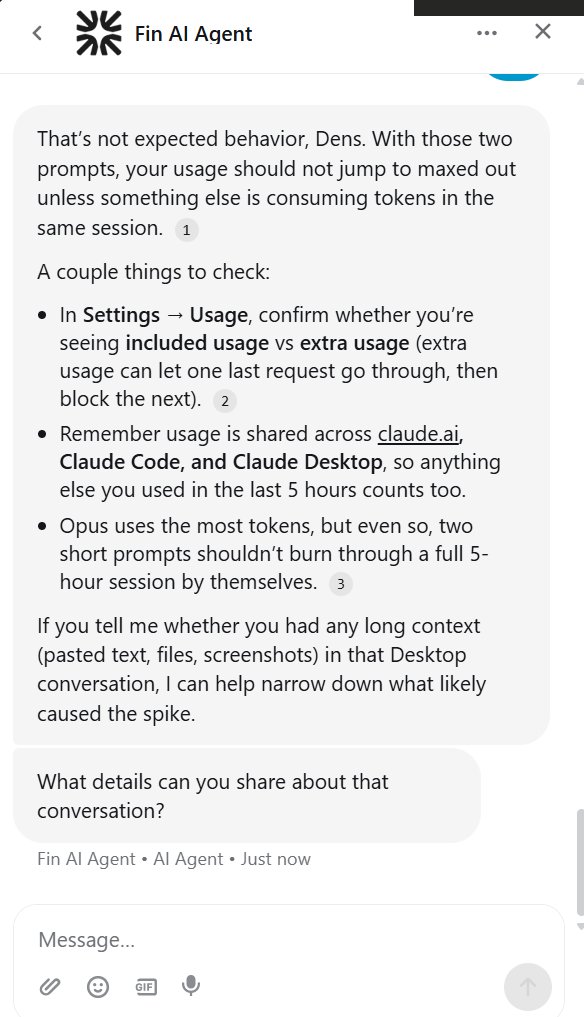
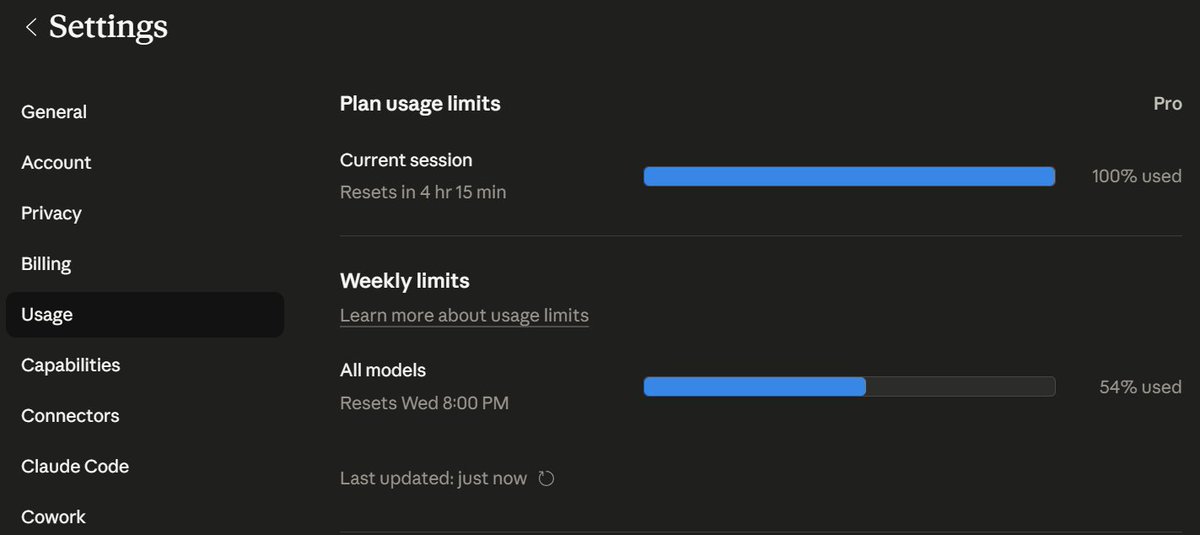
Is Claude having errors again?
I was just waiting for the 5-hour session reset on Claude, and when it reset, literally two minutes and two prompts later, my 5-hour limit was maxed out again. My weekly usage also jumped from 40% to 54% from just those two prompts.
I’m using Opus 4.6 at the moment.
can you please help thariq @trq212 noah @noahzweben
English



If you’ve ever wondered what Elon Musk sees when talking about satellites, this live map shows it all:
platform.leolabs.space/visualization
English
@JadenOnChain Jaden I have a dream but no sol
FbCQ6hwcXWKA79KYpcKLsGheNkgkawxcAkwiZQYVgLAx
Indonesia