
Rich Tatum »∵«

41.5K posts

Rich Tatum »∵« banner
Rich Tatum »∵«

Rich Tatum »∵«

@RichTatum

🔺 Freelance 🔺 Contract 🔺 FT SEO ▫ Agentic Workflows ▫ Prompt Engineer ▫ Elevating Teams for 30 Years ▫ Factotum 📸 Photog • Noticer of Details • Dad 🧠 AuDHD

Norton Shores, Michigan Katılım Mayıs 2007
2.5K Takip Edilen2.6K Takipçiler
Sabitlenmiş Tweet
Rich Tatum »∵«
Rich Tatum »∵«@RichTatum·
My #SEO job search update: 👋🏼 I've been lucky to have gotten several fantastic interviews with some great companies so far. The market is super competitive right now (especially with Forbes/CNN SEOs likely joining the hunt soon 🔥!) But I remain optimistic! (Tiny🧵)
English
6
5
33
6.2K
Rich Tatum »∵«
Rich Tatum »∵«@RichTatum·
@wilreynolds Your work doing this means a lot to me. My son is residing at a shelter rn and my eyes have been opened and heart broken over the struggles that don’t get reported in the usual PR materials.
English
0
0
2
26
Wil Reynolds
Wil Reynolds@wilreynolds·
Give me 3 minutes of your time to reflect on this question... what was Thanksgiving like for the young people at the covenant house and how might that have been different than yours?? That was a reflection I had as I wrote my thank you messages. I tried to thank each and every one of you who helped me raise money for the sleepout, but my fingers and voice can't keep up with the sheer volume, so here is my thank you and my reflection and that stepping up / showing up has been insane. Thank you so much guys! You can still donate. sleepout.org/participant/62…
English
3
0
9
744
Rich Tatum »∵«
Rich Tatum »∵«@RichTatum·
This is interesting. Google’s Speech-to-Retrieval (S2R) model could become the watershed innovation that eventually makes voice search as good as text search. (If deployed at scale.) Old school voice search transcribes speech, baking in transcription errors and treating long, “rare” spoken queries as novel text strings. This has caused two problems: 1) Mistranscribed queries reduce search result accuracy, this caused some of the friction preventing the infamous “50% voice search by 2020” predictions. (To be fair, SERP accuracy wasn’t the only adoption barrier.) 2) Google Search Console already hides rare or personal queries for privacy reasons – and spoken queries tend to be both rare and long-tail. For problem one, S2R doesn’t lean on realtime, error-prone transcription. Instead, it maps voice queries directly into a shared semantic space with text and images – effectively skipping transcription. This has the potential to close the quality gap between spoken and typed queries (and possibly reduce that friction, leading to wider voice search adoption). As for Google Search Console: If Google deploys S2R into Universal Search, reporting will likely get messier and more aggregated. Search results derived from vector embeddings don’t translate neatly into text strings or “keywords.” (I believe S2R is targeting assistant models first, not main search.) (Big caveats here though: A Google Research demo ≠ imminent deployment. It could be years before it’s built into core Web search. Also, utility and search accuracy are not even the main barriers to wider voice search adoption.) Speech-to-Retrieval (S2R): A new approach to voice search research.google/blog/speech-to…
English
0
1
5
156
Rich Tatum »∵« retweetledi
Yossi Matias
Yossi Matias@ymatias·
Our new Speech-to-Retrieval (S2R) model improves how search engines process spoken queries. The approach moves beyond an intermediate text transcript (ASR). S2R directly encodes the spoken query's intent into an audio embedding for document retrieval. Evaluation shows this method improves retrieval quality, approaching the performance of flawless transcription. We have open-sourced the Simple Voice Questions dataset to support further work in this area. More in the blog by Ehsan Variani and Michael Riley: research.google/blog/speech-to…
English
2
1
13
3K
Rich Tatum »∵«
Rich Tatum »∵«@RichTatum·
@dejanseo I love it when companies that think getting rid of the human in the loop is a great idea get caught publishing crap content. <sigh />
English
0
0
0
62
DEJAN
DEJAN@dejanseo·
If you do this. Check your site. Check search results. Take action. A common artifact reveals thousands of websites which use AI content derived from other content sources through search and tools: dejan.ai/blog/ai-reveal/
DEJAN tweet media
English
1
5
37
3.4K
Rich Tatum »∵«
Rich Tatum »∵«@RichTatum·
@lilyraynyc You’re simultaneously ruggedly handsome, winsome, and adorable? I’d take the win
English
0
0
2
390
Lily Ray 😏
Lily Ray 😏@lilyraynyc·
Not sure if I’m supposed to be offended by this one or what
Lily Ray 😏 tweet media
English
31
1
85
8.3K
Rich Tatum »∵«
Rich Tatum »∵«@RichTatum·
One year since my layoff, and I feel sharper now – especially in seeing where search is headed. In a second-stage interview this week, I walked agency founders through simple but important questions: where is your link equity flowing, what hubs define your authority, and who owns the category your prospects are Googling? Capturing leads today isn’t just about “keyword research” and “better ranking” anymore. For a prospect doing due diligence, the difference between a signed contract and a missed shot may be whether you or your agency is defined in AI – not merely cited, and certainly not just appearing on page one. Most agencies are earning citations accidentally: because they ranked, or used to rank. Few are deliberately writing and structuring content to *own* the answers for “generative engine optimization”/GEO and related LLM questions. The fundamentals haven’t changed (architecture, schema, link flow, clarity, utility, remarkability…). But the stakes have. Definitional content is now the moat. GEO is already an entity. Your future clients are searching for solutions to their problems using these terms right now. So, I’m curious: if you’re not positioned to answer GEO-related queries, how will you show up as the solution?
English
0
1
4
265
Rich Tatum »∵«
Rich Tatum »∵«@RichTatum·
@timsoulo A solid evergreen guide is still useful for demonstrating domain expertise and authority when a csuite exec needs to know you’re not full of 💩, IMO.
English
0
1
9
1.6K
Rich Tatum »∵«
Rich Tatum »∵«@RichTatum·
BYW, a huge shoutout to @Dixon_Jones, his cool new tool, Waikay.io, really helped me prepare for my test pitch this week. The free account alone is well worth taking for a spin and will amaze you with the insights! waikay.io/free/
English
0
1
2
50
Rich Tatum »∵«
Rich Tatum »∵«@RichTatum·
My #SEO job search update: 👋🏼 I've been lucky to have gotten several fantastic interviews with some great companies so far. The market is super competitive right now (especially with Forbes/CNN SEOs likely joining the hunt soon 🔥!) But I remain optimistic! (Tiny🧵)
English

6
5
33
6.2K
Rich Tatum »∵«
Rich Tatum »∵«@RichTatum·
One year post-layoff today. Still going strong. Still landing interviews. Still hopeful, but a wee bit tired. lol Had an interview this week, a couple thoughts here:
Rich Tatum »∵«@RichTatum

One year since my layoff, and I feel sharper now – especially in seeing where search is headed. In a second-stage interview this week, I walked agency founders through simple but important questions: where is your link equity flowing, what hubs define your authority, and who owns the category your prospects are Googling? Capturing leads today isn’t just about “keyword research” and “better ranking” anymore. For a prospect doing due diligence, the difference between a signed contract and a missed shot may be whether you or your agency is defined in AI – not merely cited, and certainly not just appearing on page one. Most agencies are earning citations accidentally: because they ranked, or used to rank. Few are deliberately writing and structuring content to *own* the answers for “generative engine optimization”/GEO and related LLM questions. The fundamentals haven’t changed (architecture, schema, link flow, clarity, utility, remarkability…). But the stakes have. Definitional content is now the moat. GEO is already an entity. Your future clients are searching for solutions to their problems using these terms right now. So, I’m curious: if you’re not positioned to answer GEO-related queries, how will you show up as the solution?

English
0
0
0
62
Rich Tatum »∵«
Rich Tatum »∵«@RichTatum·
Rank is not a leading indicator of content success. It’s just one of many attributes. Also, this is a great example of how the mere act of tracking and measuring actually changes the values you’re trying to track. There’s no way to eliminate the tracking tool’s effects on average position. Users rarely, very rarely, go past the first page. But when tools grab the first 100 results, the metrics and average positions are necessarily skewed. This means, of course, it’ll be harder to track progress from page 10 authority and low ranks to finally breaking into coveted page one positions. But it also means your page two queries will seem to have improved their rank positions mysteriously. And all this at a time when queries are becoming increasingly long tail (rare) and “conversational” (singularly rare!) due to AI interactions. Have fun explaining this to the suits!
Brodie Clark@brodieseo

SEO Update: Final update on the &num=100 situation. We have now received a statement from Google related to the &num=100 parameter being disabled, with the response being somewhat unsurprising. While @rustybrick was seeking feedback on both the rank tracking implications and the changes to Google Search Console, the response was quite general and didn't answer many of the concerns from the community: "The use of this URL parameter is not something that we formally support." – Google Spokesperson The intentionally brief response doesn't shed light on the primary concern: why are our GSC impressions and average position data so out of whack!? I suspect we won't receive a clear answer on this point (covered in more detail in my article). With this in mind, it is now time to annotate your GSC reports for September 10th, 2025, and move forward with the knowledge that impressions data can be heavily inflated by rank trackers. To such an extent that I've seen situations where impressions declined by a whopping 47%. There is likely more to this story that makes an explanation difficult to communicate transparently from Google's end, with there being plenty of unusual anomalies within the declining dataset and leading up to the more forceful change that don't make complete sense. The impact on rank trackers will be one to watch closely. Most tools have said that a top 20 ranking set should be enough for most customers. Personally, I'd ideally like to have the top 100 still, considering how movement beyond position 20 can often be quite helpful to diagnose issues within the work I do. And with rank trackers ramping up once again, I expect that artificial impressions will also now gradually increase over time. But interestingly, I expect that average position on desktop in GSC in particular will remain higher, considering &num=100 has been disabled. As a somewhat unexpected outcome, there is now the potential to give more credibility to 'average position' in GSC, which has ironically come at a time when 3rd party rank trackers have had to reevaluate their business models. Again, we don't know the full story behind these changes from Google, but a simple change like disabling &num=100 sure has had far-reaching implications. And for those who still think that Google will reverse the &num=100 change, there's nothing to suggest that this will happen, unfortunately, with @Jammer_Volts highlighting that Google posted a job ad recently for an "anti-scraper" role within the Search team. This, combined with the statement from Google, gives us pretty much everything we need to know. More details on the statement from Google and the link to my original article within the comments that gives the full breakdown of the situation, if you need a reference to pass on to your clients.

English
0
0
0
59
Tim Soulo 🇺🇦
Tim Soulo 🇺🇦@timsoulo·
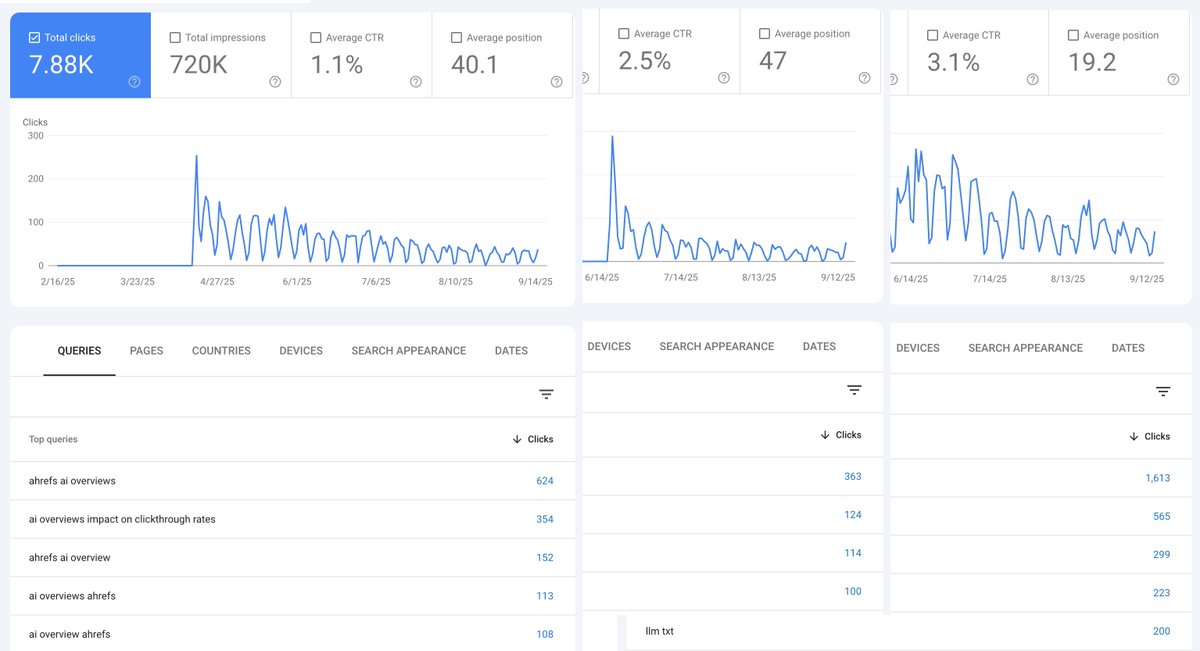
The era of "evergreen SEO content" is over. We're entering the era of "fast SEO." There’s little point in writing yet another "Ultimate Guide To ___." Most evergreen topics have already been covered to death and turned into common knowledge. Google is therefore happy to give an AI answer, and searchers are fine with that. Instead, the real opportunity lies in spotting and covering new trends — or even setting them yourself. Below is a GSC trend for three recent Ahrefs Blog articles. 👇 It’s only a matter of time before these topics turn into "common knowledge." But while they’re fresh, Google doesn’t seem confident enough to hand them over to AI. Or maybe users just prefer to hear it straight from the source. And I like this shift. Content teams should be more like newsrooms, less like libraries. Because let’s be honest — rewriting the same article for the fifth time in two years, trying to squeeze in some originality just to appeal to Google's algo, is exhausting. It’s far more exciting to chase new ideas and explore new ground.
Tim Soulo 🇺🇦 tweet media
English
49
47
347
44.8K
Rich Tatum »∵« retweetledi
Tim Soulo 🇺🇦
Tim Soulo 🇺🇦@timsoulo·
Do you need keyword ranking data below Top20? Because it's likely going away... You might've heard the news - Google is dropping the "&num=100" parameter, which allowed SEO rank tracking tools to pull the top 100 search results in a single page load. Ramping up the data pulls by 10x is just not feasible, given the scale at which all SEO tools operate. So the question is: "Do you need keyword data below Top20?" Because most likely it's going to come at a pretty steep premium going forward. ... Personally, I see it this way: ▪️ Top10 - is where all the traffic is at. Definitely a musthave. ▪️ Top20 - this is where "opportunity" is at, both for your and your competitors. Also musthave. ▪️ Top21-100 - IMO this is merely an indication that a page is "indexed" by Google. I can't recall any truly actionable use cases for this data. ... Please share your thoughts in comments. 👀
Tim Soulo 🇺🇦 tweet media
English
41
22
139
28.7K
Rich Tatum »∵« retweetledi
Joe Youngblood - SEO, Futurology, AI, Marketing
My son will be born sometime in the next 3-weeks. I am watching and reading everything I can to ensure I am the best father possible across all subject matters and situations he might encounter in his life. My dad was there for me, literally saved my life at one point when I almost drowned. He's been there for relationship advice (most of it honestly not good), work ethics, and questions about cars. Any suggestions or recommendation from fathers out there are highly welcome.
English
32
1
45
4.3K