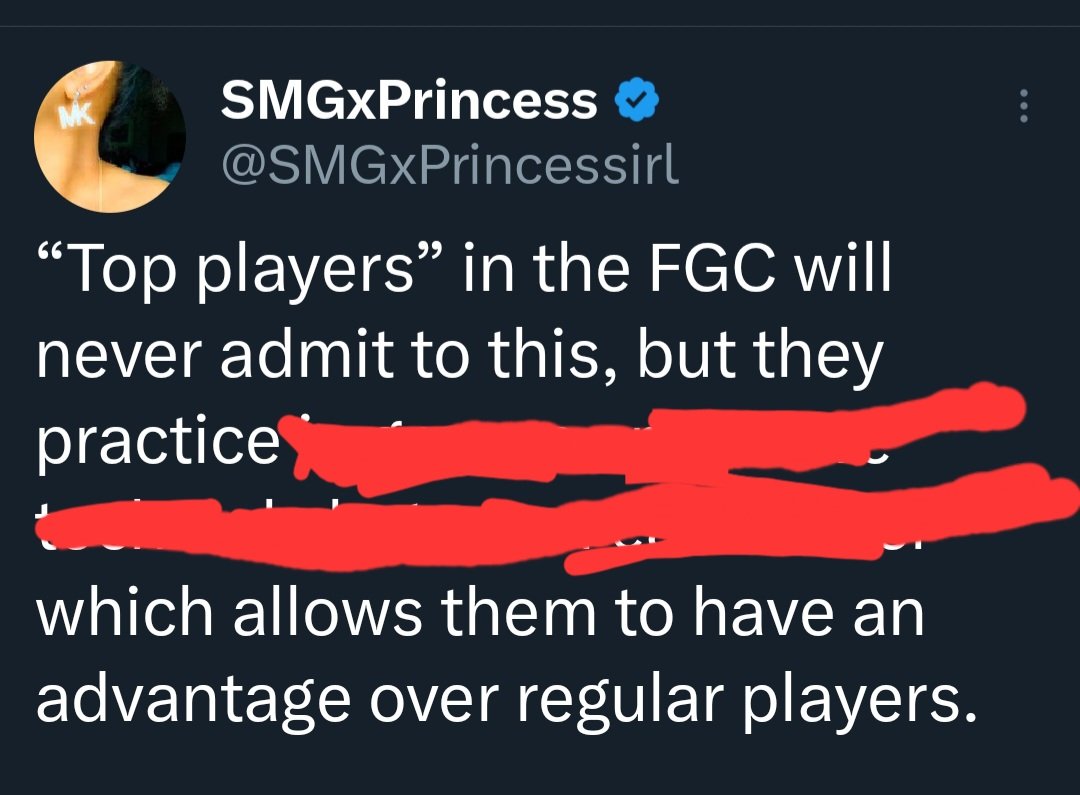
@Whodat_TBFN@twicea_day@End3rJ their opponent's habits to influence their decisions in a match. That process is effective, but not a single part of it requires someone to be able to elaborate on what they did in any given moment. With enough experience, a lot of it becomes habit and intuition, despite (2/3)
I hate to be the one to tell you this, but Soul Calibur is not the deep game that you claim. It's the easiest barrier for entry. To top it off, 99.9% of the players are mediocre at best.
Ok, I will only ask once about this request.
Why do some communities send me requests for "Waffle House"?
Please be sure to explain the basis for the request, including the original story, history and background.
I look forward to an explanation from someone who knows more.
During the development of TEKKEN3 (Arcade release was in 1997, but development took less than two years, 1996-1997), we tried many animation captures, and Minoru Suzuki was one of them. He gave us ideas for all kinds of throws and throw combos, as well as capturing the King's stance.
Also, the Arm Lock Suplex wrestling move that Michele and Julia perform was originally invented by Minoru Suzuki in the real world and taught to female wrestlers.
Incidentally, at that time, the technology was called magnetic capture, not optical capture, and Minori Suzuki was performing the King's moves with a large number of spaghetti-like cables attached all over her body.
By the way, this is a side note, but the weakness of magnetic capturing is that it not only restricts the actor's movements and is not very accurate, but it is literally heavily influenced by magnetism, so it did not work at all just because a train was passing by. It was even affected by all kinds of large vehicles and radio waves, which made it very difficult to record the data properly.
He never complained about any of the difficulties, but solemnly and professionally carried out his work. He was a very gentlemanly fighter.
At that time, Minoru Suzuki taught us, TEKKEN PROJECT, a lot about the physical and mental aspects of being a fighter.
and One day, I asked him,
"Ground techniques have become popular in recent years, and I often see fighters losing consciousness due to choke holds in fights. How is it possible for a fighter with such a thick neck to fall so easily?" I asked.
(At that time, MMA was still in its infancy, and the structure of jiu-jitsu techniques was not widely known to the public.)
Minoru Suzuki told me that the best way to learn is to experience it, so I decided to experience his techniques at namco's animation capture studio.
His choke easily knocked me out as I watched the second hand on my watch. I thought I had fallen asleep for 20~30 minutes, when in fact the clock had ticked forward only 8~10 seconds. It was an amazing experience.
(*By the way, it is not a good idea for you to imitate this, because I had a fair amount of experience in martial arts such as judo, karate, and taekwondo, and above all, Minoru Suzuki was a professional instructor).
Every time I have had the opportunity to conduct an animated capture of a professional martial artist, I have attempted to experience their techniques in action.
What I learned from those experiences. Yes, while I am honing my headshot skills every night on video games, they are working on their skills and physical modifications to knock people out every day. You all already understand what that means.....