Rick ☆

91.6K posts

Rick ☆ banner
Rick ☆

Rick ☆

@RickChapterTwo

Sarcastic Guy With The Best Of Intentions ▫️ Explicit Language ▫️ Democratic Values ▫️ Never Trump ▫️ Laughter Is Contagious ▫️ Can You Believe This Shit?

TEXAS Katılım Aralık 2018
39.8K Takip Edilen39.1K Takipçiler
Rick ☆
Rick ☆@RickChapterTwo·
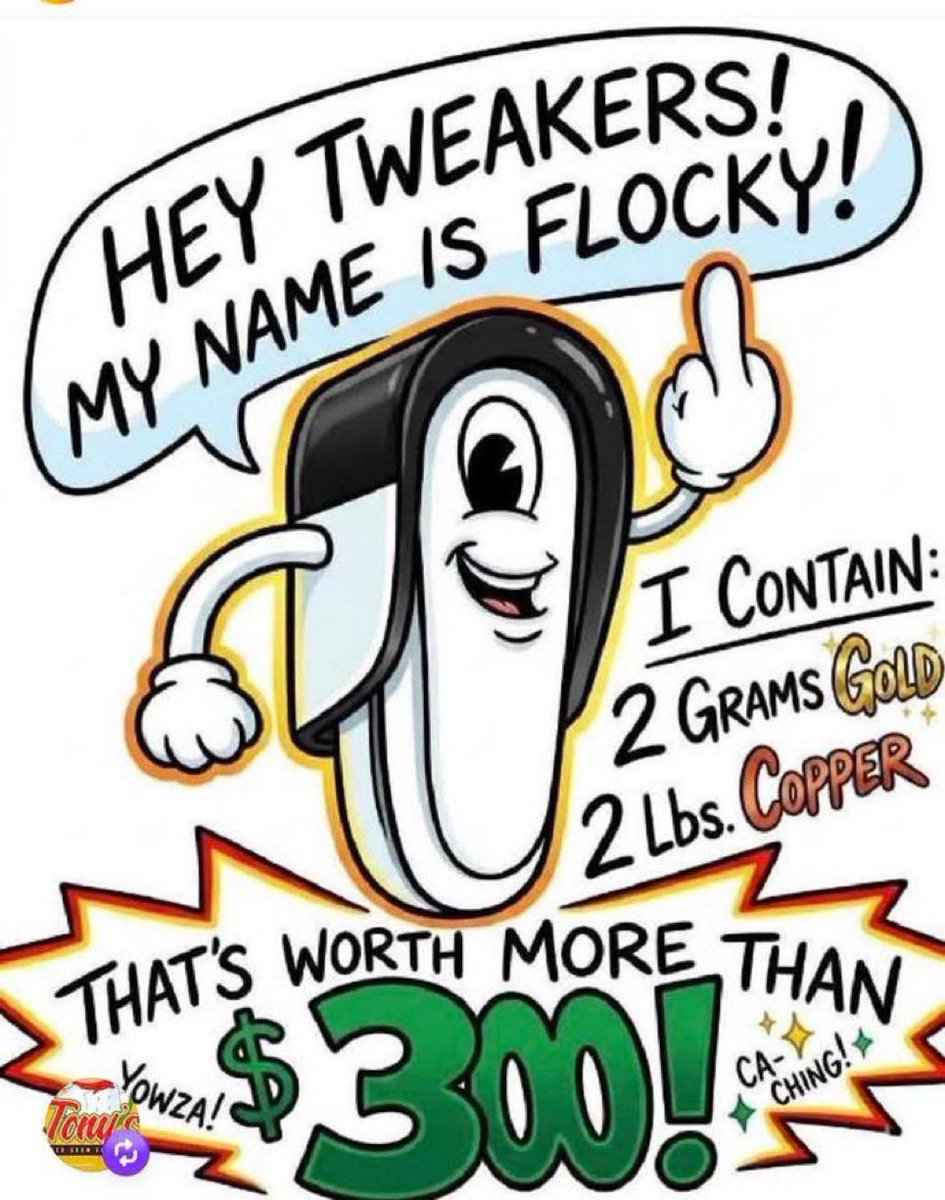
I've seen this many times and I still wonder how he knew this so many years ago.
English
2
15
27
330
ᗰᗩƳᖇᗩ
ᗰᗩƳᖇᗩ@LePapillonBlu2·
My friends in here are seeing less and less of me everyday. If you’re still getting my posts, please reply with a 💙
English
2.1K
773
6.1K
51.8K
Rick ☆
Rick ☆@RickChapterTwo·
@politicsusa46 Now read what Walmart and Vizio TV are doing with your information
Ricardo@Ric_RTP

Walmart is selling you an unprofitable TV that watches everything you do and reports it back to their $6.4 billion advertising machine. And the TV literally won't turn on until you give them permission. This is one of the most sophisticated consumer surveillance operations in history and 150 million people walk into their stores every single week with no idea it's happening. Here's the full story: In December 2024, Walmart bought Vizio for $2.3 billion. Everyone assumed it was about selling more TVs. But it had nothing to do with TVs. Vizio's TV hardware business was actually LOSING money, posting a $6.7 million loss in its final quarter as an independent company. The advertising division made $115.8 million in profit that same quarter. Walmart bought 19 million living rooms - not a TV company. In March 2026, Walmart flipped the switch. Every new Vizio TV now requires a mandatory Walmart account before you can access any smart features. No account, no streaming apps. Without signing in, your TV is useless. The moment you create that account, something called Automatic Content Recognition activates. ACR runs silently in the background, taking screenshots of everything displayed on your screen and comparing them against a database to identify exactly what you're watching, second by second, across 700 TV networks and over 100 streaming apps. It knows what you watched, when you watched it, how long you watched it, and what you did afterward. Now here's the part that makes this genuinely unprecedented in the history of retail: Walmart ALREADY knows what 150 million Americans buy every week. They know your grocery habits, your clothing preferences, your pharmacy purchases, your financial behavior through Walmart Pay, and your location data from the app. But what they couldn't see was the 4 to 6 hours a day Americans spend staring at their television screens. By connecting your Walmart account to your Vizio TV, they've closed that loop. They can now prove that you saw a 30 second ad for gardening soil Sunday night and bought that exact brand at Walmart Monday morning. L'Oréal is already signed on as a launch partner for this kind of targeting. The math on this is just insane: Walmart Connect, their advertising arm, generated $6.4 billion last year with 46% year-over-year growth. Advertising runs at 70 to 90% profit margins compared to traditional retail's 3 to 4%. Their CFO admitted that ads and membership fees already account for one-third of Walmart's total operating income. The advertising business is now more important to Walmart's bottom line than entire product categories in their stores. And they're just getting started. Analysts calculated that Walmart's ad revenue currently represents only 1% of total sales. Amazon's ad business runs at 8% of sales. The gap between where Walmart is and where Amazon is represents roughly $50 billion in untapped advertising revenue. The Vizio deal is the bridge to get there. This is WHY they're selling certain TVs at a loss. When you break down the $2.3 billion acquisition across 19 million households, Walmart paid $121 per living room. A lifetime of behavioral viewing data from a household that also shops at Walmart is worth infinitely more than that. The cheap TV is a trojan horse. Vizio has already been fined $2.2 million by the FTC for secretly collecting viewing data on 11 million TVs without consent. The Texas Attorney General sued them for "spying on Texans." Walmart bought them anyway and made the surveillance MANDATORY. The company that built its empire promising everyday low prices is becoming the most powerful advertising platform in the world, and the TV in your living room is the entry point. What do you think?

English
0
0
2
90
Rick ☆
Rick ☆@RickChapterTwo·
Substitute the word 'medications' with 'president' and he is correct. Otherwise, what is coming out of his mouth is bullshit.
English
0
0
6
140
Rick ☆
Rick ☆@RickChapterTwo·
This is really nice!
English
0
0
2
96
Rick ☆ retweetledi
CALL TO ACTIVISM
CALL TO ACTIVISM@CalltoActivism·
🚨MAJOR BREAKING: Donald Trump has arrived in China to find that President XI did NOT greet him at the airport. MAGA is in spin mode heralding the “red carpet treatment,” but the visit is already at a rocky start. Instead of a presidential welcome, Trump was greeted by US Ambassador to China David Perdue; Xi’s vice president, Han Zheng; China’s Ambassador to Washington Xie Feng; and Executive Vice Minister of Foreign Affairs Ma Zhaoxu. I’m sure Trump would hate if you shared this and rubbed it in all day long.
English
3.7K
25.9K
73.2K
3.3M
Rick ☆ retweetledi
Miss Ally
Miss Ally@MissAlly_01·
A man was in a hospital bed wearing an oxygen mask over his mouth. He mumbles, "Nurse, are my testicles black?" The nurse lifts his gown, holds his penis in one hand & his testicles in the other, takes a close look & says, "There's nothing wrong with them sir."
English
238
169
11.2K
4.6M
Rick ☆
Rick ☆@RickChapterTwo·
I appreciate the ACLU. But they want me to give $19 a month to defend the constitution. Isn't that what my vote was supposed to do?
English
2
0
12
239
Rick ☆
Rick ☆@RickChapterTwo·
@MavrocksGirl Please show this tweet to the company who manufactures the cologne before you tell everyone. Demand your share of the money because whatever you say, the fragrance will be sold out in hours. And I only ask for my 2% advisory fee.
English
0
0
14
446
Rick ☆
Rick ☆@RickChapterTwo·
Such a shame that no one in government does anything... about anything... any longer. You tell thousands of people about Elon Musk and Air Force One and yet nothing will happen. What a horrible timeline we live in. If there are history books in the future, at least we're in them.
English
4
10
35
658
Rick ☆
Rick ☆@RickChapterTwo·
Fuck. Donald. Trump. I'm so sorry, I shouldn't curse like that. There may be children looking over your shoulder. Let me rephrase that... #FuckDonaldTrump
English
1
5
40
311
Rick ☆ retweetledi
Scott Dworkin
Scott Dworkin@funder·
The Trump regime actually let two guys with zero government experience use ChatGPT to cancel $100M in grants—including Holocaust education. A federal judge just humiliated them, called it unconstitutional, and reversed every single cut. Hit ❤️ if you love seeing them lose in court, and read how she did it: dworkinsubstack.com/p/a-federal-ju…
Scott Dworkin tweet media
English
520
6K
17.2K
161K
Rick ☆
Rick ☆@RickChapterTwo·
I actually knew this about wasabi but had never seen it prepared. I did get to try it at a nice restaurant in Vegas. It's twice as strong as a sinus opening condiment than horseradish with an excellent flavor. I wish it was more reasonably priced and available here in the states.
Massimo@Rainmaker1973

Real wasabi comes from a gnarly root that’s super rare, expensive, and basically impossible to grow outside Japan. This chef carefully preps it for top-tier sushi. [📹 sushi.yoshinaga]

English
0
0
10
333
Rick ☆ retweetledi
Crazy Vibes
Crazy Vibes@CrazyVibes_1·
In the middle of the most popular television show in American history, the actor who played its purest heart walked into the producers’ office and said he was done. Not because he was tired. Not because the money wasn’t good enough. Because the role was quietly killing the man playing it. His name was Gary Burghoff. And in 1979, at the absolute peak of M*A*S*H — a show pulling in 30 to 40 million viewers every week — he turned down $4 million (roughly $15 million today), creative control, and fewer episodes just to save himself. Most people would have called it career suicide. Gary called it survival. To understand why he left, you have to understand who he was before Radar O'Reilly ever existed. Gary grew up in Bristol, Connecticut, in the 1940s with a condition called brachydactyly — three fingers on his left hand noticeably smaller than the others. In an era when being visibly different made you a target, he learned early how to hide. He hid his hand in photos. He developed other talents so powerful that people noticed those instead. He became an exceptional drummer. A gifted wildlife painter. And, almost by accident, an actor. At sixteen, recovering from a basketball injury, a drama teacher steered him toward the stage. He auditioned for Take a Giant Step and beat out 450 other kids for the lead. The play opened on Broadway. He won awards. The money helped his mother stop working as a maid. Acting became his refuge — a place where his difference didn’t define him. When Robert Altman cast him as Radar in the 1970 film M*A*S*H, Gary brought something the script never asked for: raw, aching vulnerability. Radar wasn’t just comic relief. He was a scared kid trying to survive war by making himself indispensable. The film became a phenomenon. When CBS turned it into a television series in 1972, Gary was the only actor from the movie kept as a series regular. For the first few seasons, Radar was the wide-eyed Iowa farm boy who slept with a teddy bear and drank grape Nehi. But as M*A*S*H grew darker — confronting the horror of war alongside its humor — Radar changed too. Gary started playing him as someone slowly fracturing under the weight of what he was seeing. The teddy bear became a lifeline. The innocence became armor. He won an Emmy in 1977. Mike Farrell, who played B.J. Hunnicutt, later said Gary might have been the best actor on the show — his ability to find tiny, truthful moments was unmatched. But playing someone so different from himself, month after month, year after year, began to feel like psychological erasure. Gary wasn’t naïve or meek. He was serious, introspective, sometimes difficult because he cared so deeply about emotional honesty. Living in Radar’s skin for eight months a year started to make him forget what his own skin felt like. His marriage was falling apart under the pressure of fame and endless work. He barely saw his daughter. Fans everywhere called him “Radar” and expected the sweet, innocent character instead of the complicated man he actually was. By Season 7, something inside him broke. When his contract ended in 1979, the producers offered him a fortune to stay. Gary said no. He told them family had become the most important thing in his life, and he wasn’t available as a father anymore. But the deeper truth was simpler and sadder: he was disappearing. His final episodes, “Goodbye, Radar,” aired in two parts. He played them with such raw honesty that cast members were crying on camera for real. Fans wrote letters begging him to return. He didn’t. Leaving at the absolute peak devastated his career. He was so identified with Radar that casting directors couldn’t see him as anything else. The few roles that came were pale versions of the same gentle character. A planned spinoff never took off. Some of his co-stars — Alan Alda, Mike Farrell — thrived afterward. Gary largely stepped away from Hollywood. Many assumed he had failed. That walking away had been a terrible mistake. But Gary never defined success by fame or money. He moved back east, remarried, focused on his first love: wildlife art. He painted detailed animal portraits. He played drums with small groups. He spent real time with his children. He lived quietly and intentionally. In rare interviews years later, he was asked if he regretted leaving M*A*S*H. His answer never wavered: “I regret that I couldn’t find a way to stay without losing myself. But I don’t regret choosing to survive.” In an industry that worships visibility, Gary Burghoff did something almost unthinkable: he chose obscurity over fame. Peace over fortune. His own identity over a role that threatened to consume it. He understood something most people chasing success never learn: success that costs you yourself isn’t success. It’s slow erasure. Today, at 82, Gary lives a quiet life far from the spotlight. He rarely attends reunions. He doesn’t cash in on nostalgia. When fans meet him at the occasional convention, they’re often surprised by how different he is from Radar — more serious, more layered, more himself. And that might be the most beautiful part of his story. By leaving Radar behind, Gary fulfilled the deepest lesson the character ever taught: that gentleness in brutal environments is strength, not weakness. That holding onto your essential self is the ultimate act of courage. Radar survived war by clinging to his innocence. Gary survived fame by doing the same. The teddy-bear-clutching clerk showed millions that kindness matters. The actor who played him showed something even rarer: that knowing when to walk away — even when the whole world is begging you to stay — can be the bravest choice of all. In a culture obsessed with staying relevant at any cost, Gary Burghoff chose to remember who he was before anyone was watching. And in doing so, he gave the rest of us permission to do the same.
Crazy Vibes tweet media
English
71
242
1.8K
150.5K
Rick ☆ retweetledi
James Talarico
James Talarico@jamestalarico·
Thank you for coming to Texas, Mr. President.
James Talarico tweet media
English
3.8K
3.3K
36.6K
656.3K