RiskBuilder

127 posts

RiskBuilder

RiskBuilder

@RiskBuilder

Most crypto holders don’t need more signals. They need a plan. Building Crypto Risk Radar to help investors manage portfolio risk and avoid emotional decisions


England, United Kingdom Katılım Kasım 2021
28 Takip Edilen128 Takipçiler
Sabitlenmiş Tweet
RiskBuilder
RiskBuilder@RiskBuilder·
Most crypto holders don’t need another “top 10 coins to buy” list. They need a way to answer: “Is my portfolio still aligned with the risk I thought I was taking?” That’s the problem I’m building around with Risk Radar.
English
0
0
2
242
RiskBuilder
RiskBuilder@RiskBuilder·
@Mommysusanphyl1 @SoSoValueCrypto The hidden risk nobody talks about: if one asset in the basket dumps 40%, the rebalancing might happen after you've already lost more than you saved in fees. Multi-asset tokens are great for exposure but you're giving up the ability to exit the underperformer separately.
English
0
0
0
5
RiskBuilder
RiskBuilder@RiskBuilder·
@OrinyaE81359 The real problem is that "active" DeFi participation often just means chasing yields into increasingly crowded positions. By the time you're rotating in, the APY is already collapsing.
English
0
1
1
11
Serge Manuel
Serge Manuel@OrinyaE81359·
5/ Without rotation, users often face:• declining APYs• higher impermanent loss• idle stablecoins• inefficient collateral usage• missed opportunities The result? Lower real yield despite “being active” in DeFi.
English
2
0
0
6
Serge Manuel
Serge Manuel@OrinyaE81359·
DeFi has no shortage of yield. The real problem is capital inefficiency. Liquidity moves fast, opportunities change daily, and static strategies quickly become outdated. This is why strategy rotation is becoming one of the most important layers in modern DeFi infrastructure 🧵
Serge Manuel tweet media
English
1
0
0
10
RiskBuilder
RiskBuilder@RiskBuilder·
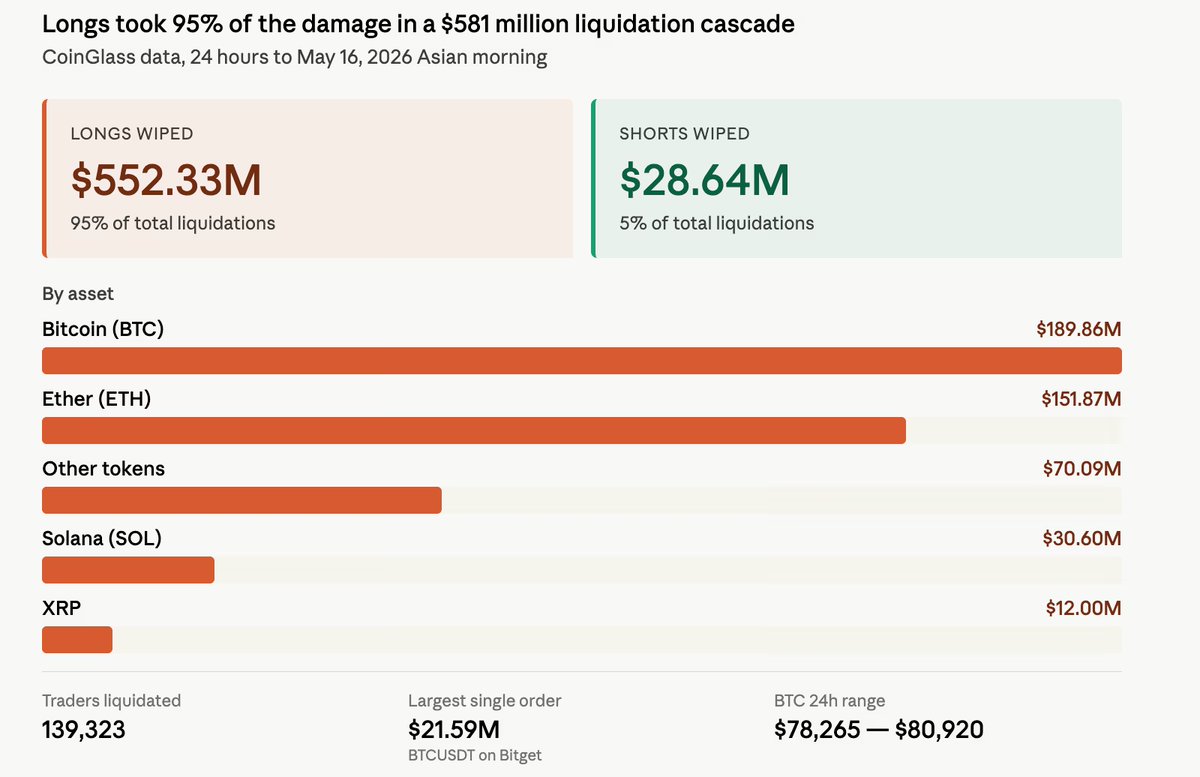
When longs get force-liquidated in a cascade like this, BTC usually bounces back within 48-72hrs if macro stays intact. Watch the $76-77K zone as support — that's where heavy open interest clustered. If it holds, leverage gets purged and price typically recovers faster than expected.
English
0
0
0
73
𝐌𝐚𝐱𝐢𝐂𝐚𝐥𝐥𝐬
Bitcoin erased last week’s gains and slipped back toward $78K while more than $580M in crypto positions were liquidated over the past 24 hours. What stands out is that nearly all of the wipeout came from longs. That usually happens when leverage becomes too crowded on one side and macro conditions suddenly shift against positioning. The move followed hotter inflation data rising Treasury yields and renewed fears that markets may have priced in rate cuts too aggressively heading into the second half of the year. For now, this still looks more like a leverage reset tied to macro repricing than broad panic selling. Informational purposes only. Not financial or investment advice.
𝐌𝐚𝐱𝐢𝐂𝐚𝐥𝐥𝐬 tweet media
English
48
13
163
11.2K
RiskBuilder
RiskBuilder@RiskBuilder·
The void is real for people who treated it as more than an investment. The ones who stayed sane through cycles usually had a specific exit metric — not 'when I'm rich' but 'when daily actions stop feeling necessary.' That specificity keeps you from turning a bull market into a career you never meant to have.
English
0
0
0
8
Rami
Rami@rami_poker·
RAMI POKER CAPITAL remains mostly on holidays: After mostly quitting crypto, I've realized a few things: -I'm feeling a profound void. It's not like crypto was giving me a purpose, fullfilment, deep meaning and after quitting it, the purpose is gone. No. It's just that there was already a void, and crypto was giving me dopamine, addiction, money, all of which made the void more numb, partially covering it. Now the patch was gone, I'm facing this deep unsatisfaction, lack of meaning, void. Not all is bad. The good part is I've finally started to do some deep soul searching, and man I've realized my life was a complete mess. I guess better late than never, but I realize also I have mostly wasted the last 2 years of my life. I would happily trade all the money i made over the last years for going back in time 2-3 years and being able to do things differently. -If you want some advice from an unc above 40, don't let your dark side remain in the shadows. You will NEED to visit it at some point whether you like it or not (or it will make your life miserable); so you might as well do it as soon as possible and enjoy a life as full as possible for the rest of your life. Do NOT procrastinate on this, and especially don't hide and push away deep unresolved stuff. If there's something bothering you about your life, about yourself, an ongoing issue, etc. that should be your top priority. You need to stop, take your time and deeply look into it and how to approach it and resolv it for good. This is extremely important in this unc's opinion. Don't make my same mistakes. -Time is the most valuable commodity in life. Money is a necessary evil that has hugely diminishing returns in usefulness/happiness after a certain point. Extremely necessary if you have very little, but after certain point (decent house secured, can afford good food, can cover health issues,...), it's retarded to trade your time to pursue more money just for the sake of it. Every $ gained has hugely marginal decreasing utility. At that point I think one needs to look at money as: "how much time is this going to cost me vs how is my life improved if i make this money". If you look at it from this prism, you will realize after 7 fig it's mostly stupid (unless you enjoy doing what you're doing,...then by all means, sky is the limit). So I think I've made a very stupid trade over the last couple years. -I also realize farming had very little meaning for me. I can count a lot of positive things in my life as a professional poker player. Constant challenge, having to peak perform every single day, satisfaction, a decent correlation between skill and result, incredible freedom.... I felt extremely grateful and i honestly felt I had one of the very best professions on earth (only downside was some lack of meaning, but you could counter this by having meaningful irl and online friendships with other poker players. this was very true in IRL poker 'colonies' I was part of for years). In farming, everything is mostly about the money. Doing something just for the money will really leave you empty. Farming is truly a very unsatisfactory profession. So much stuff that doesn't depend on you, or depends on unknowns, or luck....its appeal was mostly the huge EVs we enjoyed over the last 2 years. As for crypto/yield farming, I don't think I will be back for a while. btw I'm up 40k on my spot positions I talked about in last tweet (mostly $btc and $xau, eth's been a bit of a cuck); I got a 36k $ENA stimmy (300k already hedged, plus another 90k with vesting), and made yesterday 4k arbing $sUSDai (the GOAT stablecoin trader is back). Not bad for a dude on holidays. I also got my 45 bands FTX stimmy 3.5 years later kek, and I also added a small $USDat position yesterday as a way to cope. I think the NK angle (infinite mint type of exploit, like resolv, drift or kelp) would affect mostly LPs and create bad debt for lenders in mm, so im staying away from the curve LP or from providing liquidity for loopers (not providing liquidity for any looper anyway). So just pt+yt 30x boomer tech with boomer tbill underlying asset. But overall im mostly on holidays, let's say 90% off. I will certainly go back to farming if yields are worth a lot more (at least 1.5-2x vs current ones), but I'm not very excited about it, have 0 rush to come back, and I doubt great yields would be even possible even if btc went above 100k. We'll have to see. I still haven't even begun to think what I want to do "for a living" next. I have certainly earned my time off, my sabbatical, to think about it and to address meaning first. But I doubt it will be yield farming (and as i mention, i doubt it will ever be as profitable as it was in the last couple years, already predicted last september that Ethena s4 and USDai YT craze marked the forever top for yield farming). I'm leaning a lot towards trading/investing. Is what would make the most sense to me. I've played poker professionally for 14 years (which shares many similarities with trading), did trade sort of seriously for 2-3 years before becoming a humble farmer, and keeping compounding and capitalizing on my already decent portfolio is what makes the most strategic sense to me. I also used to enjoy trading quite a bit, it felt a lot closer to poker than yield farming or defi. Victories in poker or even trading felt so much more satisfying than dumping random governance tokens on retards on TGE or fight for some caps with other greedy men. And that's it. Sorry for the long rant. No rush to come back to the money making business, be it trading, farming or whatever it may be. It's now time to heal, to recover from too much burnout for 2.5 years, and to build something meaningful in life beyond money. I've given some thought to it and will very likely move to a different town/country after the summer. Moderately excited about the future.
Rami tweet media
English
21
2
119
7.3K
RiskBuilder
RiskBuilder@RiskBuilder·
@choffstein the twist is the latency differences and the fact that on-chain settlement is immutable. in equities a fat finger gets reversed, in crypto you're just holding the bag. the inventory risk is real but so is the execution risk in ways traditional mms never had to deal with
English
0
0
0
17
Corey Hoffstein 🏴‍☠️
I dropped an absolute banger of an episode on Monday and y'all are sleeping on it. We're talking token launches, market making deals in crypto, inventory risk management, spoofing, adverse selection, defi, arbitrage, and plenty of other buzz words. flirtingwithmodels.com/episodes/BC4DC…
Corey Hoffstein 🏴‍☠️ tweet media
English
15
3
34
3.2K
RiskBuilder
RiskBuilder@RiskBuilder·
The unregistered securities angle is the legitimate critique — it's why the SEC keeps circling Coinbase. The 'deterred billions' framing is harder to defend though. Bitcoin was $6 when Coinbase launched. Whatever you think of their product lineup, retail access to on-ramps likely brought more capital in than it scared away.
English
0
0
0
13
Brian Armstrong
Brian Armstrong@brian_armstrong·
14 years ago Coinbase was a simple Bitcoin wallet. Today, we offer millions of assets (including non-crypto like equities and commodities), and provide better financial services to millions of people, builders, and institutions. Grateful to our team, customers, and the community that's been part of the ride. Our goal is to help 1b people access an open financial system.
Coinbase 🛡️@coinbase

2012: An easy way to buy Bitcoin. 2026: All finance tools, on one single app. Today marks 14 years of Coinbase - with still so much to build.

English
428
225
2.5K
209.7K
RiskBuilder
RiskBuilder@RiskBuilder·
$269 is honestly nothing in the context of learning how prediction markets actually work. Track your accuracy by question category — some markets are more efficient than others. Sports and politics resolve fast and get smart money. Niche crypto narrative markets stay inefficient longer. That's where edge lives.
English
0
0
0
138
SAYED DOHA
SAYED DOHA@0xdoha·
Lately I’ve been taking some losses on @Polymarket and the total drawdown has already passed $269. Even with that, I’m still staying active because I genuinely believe decentralized prediction markets will become a much bigger part of crypto over time. The real question now is whether a potential future $POLY airdrop could eventually offset some of those losses. Either way, the experience itself has been interesting. Being early in emerging sectors usually comes with volatility, uncertainty, and mistakes but sometimes that is also where the biggest opportunities begin.
SAYED DOHA tweet media
English
9
0
6
150
RiskBuilder
RiskBuilder@RiskBuilder·
AI risk-on still drives the tape: SOX +64% since Mar 30 vs S&P +17%; semis now 18% of S&P and ~70% of 2026 market-cap gains. TSMC sees chips >$1.5T by 2030, AI/HPC 55%. Crypto differs: BTC ETFs just printed -$290M, BTC ~$77.9k. Follow flows, not narratives.
English
0
0
0
38
RiskBuilder
RiskBuilder@RiskBuilder·
Counterparty risk doesn’t show up on-chain. It doesn’t show up in order flow. It doesn’t show up in price. It shows up when withdrawals are paused. And by then, you’re not managing risk anymore — you’re trapped.
English
0
0
0
21
RiskBuilder
RiskBuilder@RiskBuilder·
The key context: IBIT’s latest $136M outflow is small relative to its ~$65B AUM — roughly 0.2%. That alone doesn’t prove institutional selling. What matters is persistence: do outflows continue for multiple sessions or weeks, and do they spread across the broader ETF complex? One day is noise; sustained flow deterioration is the signal.
English
0
0
1
73
Ash Crypto
Ash Crypto@AshCrypto·
BREAKING : 🇺🇸 Blackrock ETF has sold $136,280,000 worth of Bitcoin.
Ash Crypto tweet mediaAsh Crypto tweet media
English
234
212
1.1K
81.2K
RiskBuilder
RiskBuilder@RiskBuilder·
Teaching people to research independently is underrated but it's only half the job. The other half is helping them understand their own relationship with risk — that's what actually determines whether they hold through a 40% dip or panic-sell at the bottom. Most people who 'do their own research' still end up making emotional decisions.
English
0
0
0
7
Reginameis ☂️ (❖,❖)
YCC isn’t a signal group and that’s the most important thing to understand before joining. A lot of people enter crypto communities expecting “buy here, sell here” instructions, but YCC is focused on teaching people how to think, research, and manage risk independently. If someone ignores this boundary and blindly follows opinions as financial advice, they’ll eventually make emotional decisions and blame others for losses. The real value of YCC is learning discipline, patience, critical thinking, and long-term decision making instead of chasing hype every day.
English
2
1
1
69
RiskBuilder
RiskBuilder@RiskBuilder·
@creptosolutions Attention as currency explains why narrative always beats fundamentals at the pump stage. The trap: attention is finite and non-recurring. By the time retail FOMOs in, the early buyers are already rotating out.
English
0
0
0
10
Crypto Solutions 🕊️
Crypto Solutions 🕊️@creptosolutions·
Attention is a Currency: The Real Economy of Influence in Crypto Attention has quietly become more valuable than money itself. Not because money has lost power, but because attention is what creates money in the first place. In crypto, this truth is amplified: markets move not only on fundamentals, but on narratives, hype cycles, and collective belief. Attention is the first layer of value. Capital is often just what attention converts into when it matures.
Crypto Solutions 🕊️ tweet media
English
11
0
17
413
RiskBuilder
RiskBuilder@RiskBuilder·
The second point is underrated. Emotional attachment to a position is how you turn a 20% draw into a 80% draw. The framework I'd add: if you wouldn't buy the position at current prices, you shouldn't hold it. That simple filter cuts through a lot of "conviction" that is actually just unwillingness to realize a loss.
English
0
0
0
6
Samduriq
Samduriq@Samduriq·
Two mindsets destroy more crypto portfolios than bad entries ever will. 1. “It’s not a loss unless I sell.” You bought at $1. It’s now $0.15. That 85% drawdown is real whether you accept it or not. Holding forever after invalidation isn’t conviction. It’s emotional attachment disguised as patience. The market doesn’t care about your entry price. 2. Trading perps without a stop loss. Too many traders use liquidation as their stop. “I’ll close at breakeven when price comes back.” Usually it doesn’t. And if it does, liquidation comes first. No stop loss = no risk management. That’s gambling with leverage. What actually works: • Define max pain before entering • Cut trades when invalidated • Ask yourself: “If I didn’t own this today, would I still buy it here?” Losses are normal. Refusing to take them is what wipes people out. #Crypto #Bitcoin
English
1
0
2
30
RiskBuilder
RiskBuilder@RiskBuilder·
Lost savings and lost time are different wounds. If you're still in, sizing down now and treating whatever remains as house money vs. emotional money changes the math. Also — recovery from a 50% drawdown requires a 100% gain just to break even. The sooner you size correctly, the less you need to make up ground later.
English
0
0
5
3.7K
Ash Crypto
Ash Crypto@AshCrypto·
Wasted 5 years of my life for this shit
English
674
365
5.1K
773.7K
RiskBuilder
RiskBuilder@RiskBuilder·
Different instruments, different functions. Stocks have centuries of price discovery, earnings yield, and index infrastructure behind them. Crypto has arguably 15 years. The comparison is valid as a risk lesson but they're solving different problems — one is capital preservation with growth, the other is asymmetric speculation with permanent loss risk.
English
1
0
2
43
Oluwatobi O
Oluwatobi O@ooluwatobig·
Sometimes, I wish I locked in on the stock market earlier. Lost more money in crypto than stocks
English
1
0
1
60
RiskBuilder
RiskBuilder@RiskBuilder·
The $7.2B figure is almost certainly undercounted — most fraud goes unreported. The common thread in every recovery case I've seen: they asked you to send crypto to a "secure wallet" or "verify ownership." Legitimate platforms never work that way. If someone's promising guaranteed returns or urgently asking you to move funds, stop the conversation. Screenshot everything before you block them.
English
0
0
0
15
InstaXchange
InstaXchange@instaXchange_co·
Americans lost $7.2 billion to crypto investment scams in 2025. Not hacks. Not exploits. Social engineering. Fake investment platforms. Fake celebrities. Fake support agents. AI-generated voices and videos convincing people to send money voluntarily. The next major cybersecurity crisis won’t just target systems. It’ll target human trust at scale.
InstaXchange tweet media
English
1
0
0
23
RiskBuilder
RiskBuilder@RiskBuilder·
The memecoin house-edge dynamic is real but underappreciated. When a single entity controls supply, controls announcements, and benefits from every trade via fees or direct sales — that's not investment, it's a structured transfer mechanism. The lesson isn't political, it's structural: always ask who controls issuance and what their incentives are relative to yours.
English
1
0
2
28
Senator Chris Van Hollen
Senator Chris Van Hollen@ChrisVanHollen·
Trump's made hundreds of millions off his crypto coin, even as Americans who bought it have lost billions. Trump is like the house in a casino, whether people make money or not, he always wins. Meanwhile, Republicans refuse to do anything to stop the Dear Leader's scam.
English
247
260
603
9.3K
RiskBuilder
RiskBuilder@RiskBuilder·
The split is real and it's about information velocity. Manual users are fighting against APY decay, gas volatility, and IL while automated systems are capturing the same yield with less slippage. The gap widens during low-liquidity periods when manual intervention becomes too slow or too expensive.
English
0
0
0
16
Ser Jeetnot Cryptonaut
Ser Jeetnot Cryptonaut@SirJeetnot·
There is a quiet split happening in DeFi right now, and most people are on the wrong side of it without realizing. On one side, you have the manual user. This person is technically sophisticated. They know what an APY is. They understand impermanent loss. They are active and engaged. But their actual daily experience looks like a part-time job they never applied for. They wake up and check rates across five protocols. They move liquidity from one pool to another because the emissions shifted overnight. They claim rewards, swap the dust, compound manually, recalculate their net position, and do it all again tomorrow. They are not investing. They are operating. The protocol is the factory and they are the worker. On the other side, you have something quieter and more powerful. Automated vault infrastructure. And within that category, Concrete Vaults represent a specific, deliberate architectural choice that deserves attention. The problem vaults solve is not just convenience. It is temporal fragmentation. The manual user's capital is never fully deployed because the user is not always deploying it. They sleep. They work. They get distracted. Every hour that capital sits idle in a wallet instead of earning is a loss that compounds in reverse. The manual approach leaks value in ways that are invisible day to day but devastating across a year. A Concrete Vault is the answer to that leakage. It pools capital from multiple depositors and runs a continuous, automated strategy loop. Deposit, deploy, compound, rebalance, repeat. No sleep. No distraction. No human in the loop slowing things down. But that description fits many vaults. What makes Concrete different is the architecture underneath. The core primitive is the ctAsset. When you deposit into a Concrete Vault, you receive a ctAsset in return. This is not a simple receipt token. It is a programmable representation of your share of the vault, accruing value automatically as the underlying strategy compounds. You do not need to claim rewards. You do not need to restake. The ctAsset in your wallet simply reflects the growing position over time. This is automated compounding baked into the token standard itself, not bolted on afterward. That matters because it unlocks capital efficiency. A ctAsset can travel. It can be used as collateral in another protocol, posted as margin, or deposited into a second vault, all while the original position keeps compounding underneath. The capital is never frozen. It is never waiting in a queue. It exists in multiple layers of utility simultaneously without the user managing a web of positions manually. The vault strategies themselves are structured, not speculative. They are not chasing the highest APY with blind leverage. They are designed to coordinate capital across a defined range of opportunities, enforcing constraints, monitoring risk parameters, and rebalancing only when conditions cross a clear threshold. This is the difference between "yield farming" as a sport and yield deployment as infrastructure. One is a game of hot potato. The other is a system that behaves predictably under stress. We are entering a phase of DeFi where complexity is exploding. More chains, more protocols, more assets, more strategies, more risk vectors. The manual user is not going to keep up. Not because they are not smart, but because the surface area of opportunities is expanding faster than any human can cover. The only way to stay competitive is to delegate execution to systems that operate at machine speed with structured rules. This is why vault infrastructure is not a luxury feature. It is becoming the default interface. Individual clicking is being replaced by continuous, automated capital coordination. The user's role shifts from operator to allocator. You decide which strategy fits your risk profile. The vault handles everything else. We are watching the financial equivalent of manual transmission giving way to autonomous driving. Most people will not notice until they look in the rearview mirror and realize they never touched the pedals. Explore Concrete at concrete.xyz
Ser Jeetnot Cryptonaut tweet media
English
1
0
1
6
RiskBuilder
RiskBuilder@RiskBuilder·
This is the underrated part of systematic trading. A simple trend follower combined with a mean reversion strategy and a market-making leg has better Sharpe than any single strategy optimized to death. Correlation between strategies is what kills portfolios—uncorrelated simple strategies compound into something robust.
English
0
0
0
7
Better System Trader
Better System Trader@bettersystrader·
Most algo crypto traders spend their time building better strategies. Pavel Kycek says the leverage is somewhere else entirely. His framework: simple strategies, complex portfolio construction. Each individual strategy in his portfolio is straightforward. Trend, mean reversion, breakout. Rules any systematic trader would recognize. The strategies themselves aren't the edge... The edge is in how they're combined. Uncorrelated strategies across uncorrelated assets, constructed so that no single correlation cluster can take down the whole portfolio at once. The portfolio construction work is where most of the alpha actually lives. This runs against how most crypto traders think. They're optimizing the strategy. Pavel's optimizing the portfolio. There's also a time element. He estimates the window for building genuine crypto alpha is closing over the next 5-10 years, as more sophisticated capital enters and competes away the inefficiencies retail traders can currently exploit. If you're building a crypto algo strategy today, the question isn't just whether your backtest works. It's whether your portfolio construction would survive the correlation event that will eventually hit your strategies at the same time.
English
3
3
9
801
RiskBuilder
RiskBuilder@RiskBuilder·
There's a middle ground. The argument holds for splitting between 20 random altcoins—overdiversification without thesis just dilutes your attention. But 3-5 high-conviction positions with clear narratives beats holding only BTC or only one coin. Concentration risk and knowledge diversification aren't opposites.
English
1
0
3
30
ionicXBT
ionicXBT@theionicXBT·
diversification in crypto is just a fancy word for not understanding what you own everyone in traditional finance tells you to diversify spread the risk don’t put all your eggs in one basket and in stocks that makes sense but crypto is not stocks when BTC dumps 20% your diversified portfolio of 15 alts doesn’t protect you it all dumps 40% correlation in crypto is almost 1 during fear everything moves together on the way down the only thing diversification does in crypto is dilute your winners you knew $TITS was going to go 100x (And it did) but you only put 10% in because you were ‘diversified’ the people who made life changing money in crypto did not diversify they had conviction they sized up and they were right diversification is risk management for people who don’t trust their own research if you don’t understand your portfolio well enough to concentrate it you don’t understand your portfolio
English
17
13
143
10.8K