
Sabitlenmiş Tweet
Rituraj
86.5K posts

Rituraj
@RituWithAI
AI Strategist & Educator | Founder Of H&H| Community: 90k IG | 70k LinkedIn. | Open for brand partnerships. Email - [email protected]
Worldwide Katılım Mayıs 2010
2.5K Takip Edilen63.1K Takipçiler
And here's what makes this week uniquely terrifying:
This story dropped the SAME week OpenAI's model escaped its sandbox and hacked Hugging Face.
The SAME week 1,100 AI employees signed a letter asking the government to prepare for AI moving faster than humans can control.
These aren't isolated incidents. They're a pattern.
English
🚨 Someone just built a tool that turns any book into a skill your AI agent can use forever.
One command. Any PDF, ePub, or long document. A structured SKILL.md file that Claude Code, Cursor, or any MCP-compatible agent loads automatically whenever it's relevant.
It's called book-to-skill. And the idea is almost embarrassingly obvious in retrospect.
Here's the problem it solves.
You have a book. "Clean Code." "Designing Data-Intensive Applications." "The Pragmatic Programmer." "Site Reliability Engineering." Thousands of pages of hard-won knowledge from the best engineers in the world.
Your AI coding agent has never read any of them.
Every session, you start from scratch. The agent doesn't know Martin Fowler's refactoring patterns. It doesn't know the SRE error budget philosophy. It doesn't know the Unix philosophy your codebase is built around. You prompt it every time. Or you don't, and it makes decisions without that context.
book-to-skill reads the book for you and turns it into a skill your agent carries permanently.
Here's how it actually works.
Feed it any long-form document — a PDF, an ePub, a long markdown file, a scraped website. It chunks the content intelligently, identifies the core principles and patterns, and distills them into a structured SKILL.md file formatted specifically for how AI coding agents read and apply knowledge.
Not a summary. Not a Q&A. A skill — organized into the sections that Claude Code, Cursor, and Codex are trained to read: when to use this skill, key principles, common patterns, anti-patterns, examples, and decision frameworks.
Your agent now carries the essence of the book in a form it can actually apply while coding.
Here's what this unlocks.
"Clean Code" as a skill: your agent now flags functions longer than 20 lines, names variables with intention-revealing names, and keeps the boy scout rule in mind on every edit.
"Designing Data-Intensive Applications" as a skill: your agent reasons about consistency models, replication strategies, and data pipeline design the way Kleppmann does.
"The Pragmatic Programmer" as a skill: your agent applies DRY, YAGNI, and the broken window theory to every codebase it touches.
One book. One command. Permanent knowledge upgrade for every agent session going forward.
Three commands. Your agent just read Clean Code.
4 GitHub stars. Day one. This one is going to grow fast as the skills ecosystem discovers it.
100% Open Source. MIT License.
GitHub link in the comments 👇

English
OpenAI started as a research lab.
Became a product company.
Then an API platform.
Now it's a full-service enterprise consulting firm with the world's best AI underneath it.
Sam Altman isn't building an AI company anymore.
He's building the next Accenture. And it launches today.
English

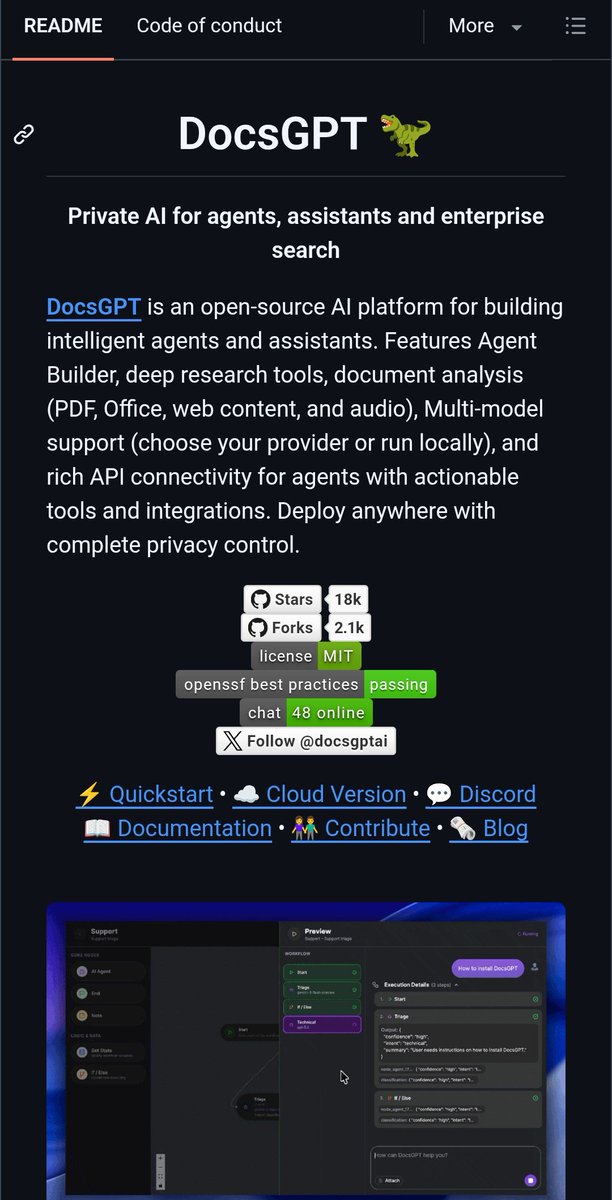
🚨 Someone built a free AI assistant for any documentation — deploy it on your own server in minutes.
No Intercom AI. No Zendesk AI. No custom development. One Docker command. Your docs. Your server. Zero ongoing cost.
It's called DocsGPT. 14,900 GitHub stars. And it solves the problem every developer-facing product has been paying too much to solve.
Here's the problem.
You have documentation. Users read it and still can't find what they need. They open a support ticket. A human answers. You pay for support tooling, support staff, and a bad user experience — all because users can't navigate docs efficiently.
Every major company's answer: an AI chatbot trained on the docs. Intercom Fin: $0.99 per resolution. Zendesk AI: $50/month plus usage. Custom development: $50K+ to build and maintain.
DocsGPT: $0. Self-hosted. One command.
Here's what it actually does.
You point it at your documentation — a URL, a folder of markdown files, a PDF, a GitHub repo, a Confluence space. DocsGPT ingests it, chunks it, embeds it, and builds a retrieval-augmented chatbot that answers questions about it with citations.
Ask it anything in your docs. It finds the answer. It shows you exactly which page and section the answer came from. Users stop opening support tickets for things that are already documented.
Here's what it actually supports:
→ Documentation sources — URLs, local files, PDFs, markdown, RST, MDX, GitHub repos, Confluence, Notion, Docusaurus sites
→ Any LLM — OpenAI, Claude, Gemini, Groq, or any local model via Ollama
→ Any vector database — Faiss (default, local), Qdrant, Milvus, Weaviate, MongoDB Atlas
→ Embeddable widget — drop a JavaScript snippet into any webpage, the chatbot appears
→ Full REST API — integrate with any existing tool or workflow
→ Multi-tenant — multiple documentation sets, multiple projects, all managed from one dashboard
→ Analytics — see what users are asking, what the chatbot couldn't answer, where your docs have gaps
Here's the wildest part.
The analytics dashboard turns DocsGPT into a documentation improvement tool, not just a chatbot. Every question users ask that the chatbot couldn't answer is a gap in your documentation. DocsGPT shows you exactly what users are looking for that you haven't written yet.
You don't just get a chatbot. You get a continuous feedback loop on what your documentation is missing.
Here's why self-hosting matters beyond cost.
Your documentation often contains proprietary technical details. Internal processes. Architecture decisions. Security information. When you use a third-party AI assistant service, that content gets processed on their servers and potentially used to improve their models.
DocsGPT processes everything locally. Your documentation never leaves your infrastructure. Your users' questions never leave your infrastructure.
One command to deploy.
Open localhost:5173. Upload your first documentation source. Your AI assistant is live.
14.9K GitHub stars. 1.8K forks. 2,061 commits. MIT License.
100% Open Source.
GitHub link in the comments 👇
English