

Robert Suits
3.8K posts
Robert Suits
@Robert_Suits
Asst Prof/Lecturer in environmental history at University College London. (Somewhat more active on other social media platforms!)
Katılım Nisan 2016
998 Takip Edilen910 Takipçiler

Some personal news:
I'm delighted to share that starting this fall, I will be joining the department of history at University College London as Lecturer in Environmental History!
(*Lecturer ~= Assistant Professor in the US!)
English
(Please feel free to reach out if you are part of the London academic community -- or if you are ever visiting/doing research there!)
English
@arielronid OWID thinks the US/Argentina/Australia track each other quite closely and that they were about on par in 1960; since then the US has just slightly ticked ahead of the other two:
ourworldindata.org/grapher/meat-s…
English
@arielronid I would suspect that Canada, Australia, Argentina are all much closer to the US than they are to the EU though.
English

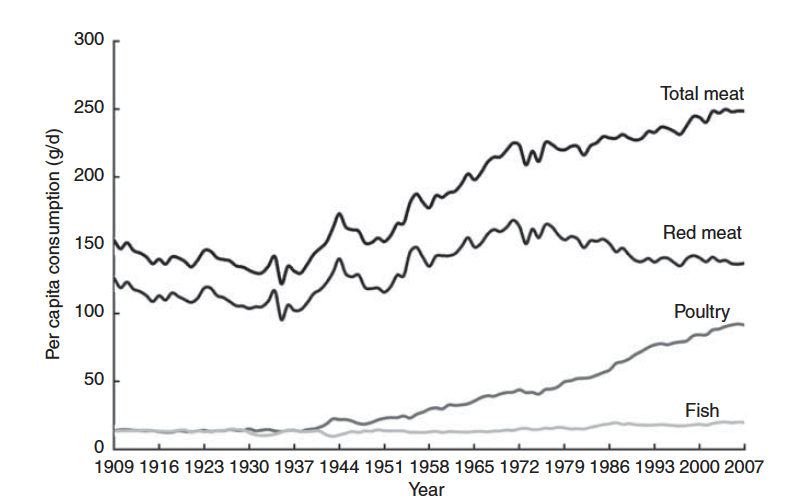
My theory is that the replacement of horses w/tractors & autos on American farms c. 1920s-40s contributed significantly to rising meat consumption. In essence, land once reserved for equine energy generation was converted to meat production.
doi:10.1017/S1368980010002077
English
@Robert_Suits lmk when then the article appears, I'll want to read
English
@Robert_Suits I don't think it's just chickens although that might be the most extreme form of breeding and nutrition to raise the share of saleable meat per animal
English
@arielronid ((So there are fewer chickens at any one time relative to their importance in the diet.))
English
@arielronid (Chickens live very briefly given their end weight, especially compared to red meat.)
English
@arielronid (Of course, the kind of meat shifts over time -- broadly from pork to beef to chicken.) (But the centrality of carnivorousness to American diet is baked in from a very early date, I'd argue, as part of a larger story about the settler colonial bundling of energy and prosperity.)
English
@arielronid Arable land area stays more or less constant from, what, 1890 on? The trick was we somehow fed people a similarly meat-heavy diet on the same land even though the population quintupled.
English
Robert Suits retweetledi

In our latest book review @Robert_Suits looks at Natural Allies: Environment, Energy, and the History of US-Canada Relations by @danny__mac__ (@McGillQueensUP 2023).
niche-canada.org/2024/07/02/rev…
#envhist #bookreview #books
English
Robert Suits retweetledi

Philosophy of Medicine is still a young discipline, so maybe you are the only one in the subfield at your institution.
Come hang out for an hour-ish every two weeks this fall to build community, discuss recent lit & plan where the field should go next.
forms.gle/tzyjfd46x5AffX…
Sarah Wieten @sarahwieten.bsky.social@SarahWieten
Call for participation in new International History and Philosophy of Medicine online reading group, fall 2024. 10 meetings from Sept-Dec 2024, on zoom. Looking to grow the international iHPM community. Please sign up here: forms.gle/tzyjfd46x5AffX…
English

@Robert_Suits I’d love to be a reader for you, when you’re at that stage. It would be great fun.
English
A fascinating account of labour ebbs and flows of early US western plains wheat harvests. It argues that the instability of climate variability (good harvests vs drought) were transferred from farmers to itinerant workers, aided by gov’t and cops, opposed by labour unions.
Robert Suits@Robert_Suits
I am THRILLED to share that my article "Hoboes, Wheat, and Climate Precarity, 1870-1922" won the 2024 Alice Hamilton Prize for best article from the American Society for Environmental History. Read it here! read.dukeupress.edu/agricultural-h…
English