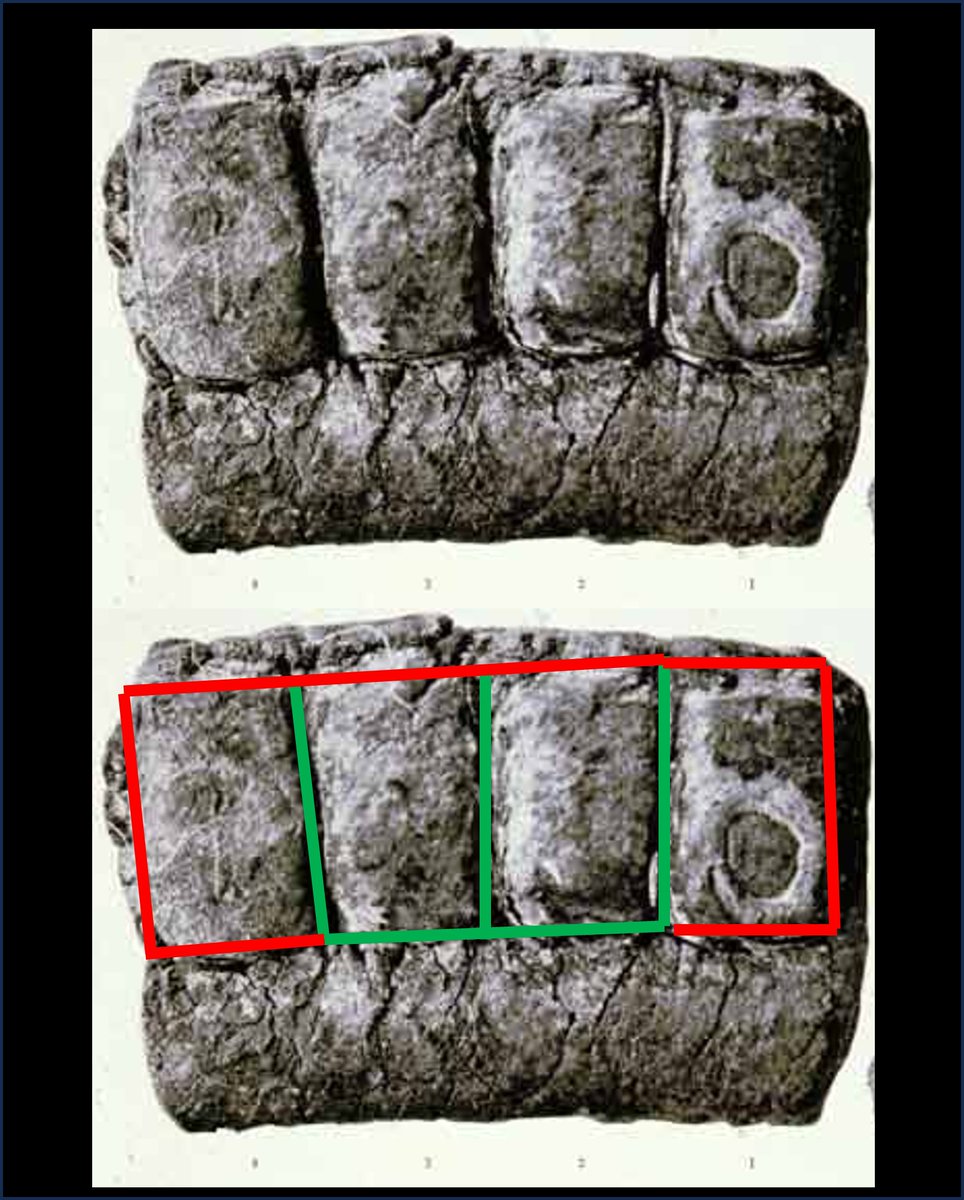
@AdlerYonatan@20nine7teen However the Rishonim/Geonim may have explained these creases to be what the Gemara was referring to if the original intent was something else.
@AdlerYonatan@20nine7teen The problem I have is that we don't have a reason to believe that in the times of the Talmud they had tall tefillin. So then the leather would stretch and they wouldn't have these creases.
Am I wrong?
Yigael Yadin thought that this was the “Shin” in ancient tefillin.
I don’t see it.
First some background:
The Bavli attributes the following saying to Abaye (late third to early fourth century, Babylonia):
"שין של תפִלין הלכה למשה מסיני; וצריך שיגיע חריץ למקום התפר"
(“Shin of tefillin is a halakhah given to Moses at Sinai; and the groove must reach to the place of the stitch”). (Menaḥ 35a; cf. b. Šabb. 28b; 62a).
Upon this R. Dimi of Nehardea (fourth century, Babylonia) is said to have remarked:
"כיון דמינכר לא צריך"
(“Since [or: as long as] it is clearly visible, this is unnecessary”).
The fact that “the place of the stitch” is mentioned here suggests that the Shin in question is associated somehow with the tefillin case rather than with the inscription on the tefillin slips (as the slips presumably have no stitches). Aside from this observation, however, it is very difficult to know what is meant by “Shin of tefillin.”
A post-Talmudic tradition which came to dominate the halakhic tradition in the Middle Ages understood that the form of the letter Shin is to be impressed into the leather on two sides of the tefillin case.
A lesser-known medieval explanation (attributed to R. Eliakim b. Joseph of Mainz) was that the four compartments of the tefillin case are to be compressed at their bases, causing them to fan out at their tops—thereby creating the form of the letter Shin.
Neither of these practices appears to have been followed among the Judean Desert tefillin cases.
Yadin and others have suggested that the four protrusions of the compartments form three grooves (not counting the ends) which, together with the perpendicular seam of the strap-passage form the letter Shin when viewed from above (see the supposed “Shin” formed from the green lines in the photo here).
The hypothesis appears to be a case of pareidolia—the tendency to perceive a meaningful image in a random pattern. It seems to me that Yadin’s suggestion is flawed because:
(1) it arbitrarily selects grooves and one particular line of stitching to form the Shin (the green lines in the photo), while ignoring three other lines of stitching on the remaining sides (the red lines in the photo);
(2) the contemporary Shin (Hasmonean and Herodian forms) did not have a flat base with three perpendicular arms. It looked more like this: ש
What do you think?
@AdlerYonatan@20nine7teen I've heard from friends who've made their own tefillin that such creases anyway accur. As far as I remember I heard the hypothesis from one them.
@RoniBrookman46@20nine7teen Fun idea!
Only that random creases could take on all kinds of shapes. But OK.
Is this your own idea, or did you see it published somewhere?
@AdlerYonatan@20nine7teen If that's what abaye was referring to, the creases often naturally occur when making taller tefillin. They may have seen these folds resemble the letter shin similar to your example of pareidolia. When making a cube out of a thin sheet there will be diagonal creases on the sides.
@loyodatt בני אדם הם לא שעשוע אם התכוונת ברצינות ליצור בן אדם כדי להנות ממנו זה מאוד אנוכי שבן אדם יחיה חיים שלמים בשביל הנאה דמיון של הורים (מחקרים מראים כי הורים לא יותר מאושרים מאנשים שלא הולידו). השאלה האמיתית אם הבן אדם יהנה מהעולם ויהיה יותר סיכוי שיהיה טוב לו. (סליחה על הסאחיות)
החזקתי היום בעבודה תינוקת בזמן שאמא שלה הלכה לשירותים והיא הייתה הדבר הכי רך קטיפתי ומתוק בעולם ובכל פעם שליטפתי אותה בלחי היא חייכה והיא החזיקה לי את האצבע חזק והיו לה את הכפות רגליים הכי רכות ושמנמנות ורציתי לאכול אותה ורציתי להיכנס להריון ורציתי להחזיק אותה לנצח קוראים לה תמרה
ידעתם שהמחיר של האוברול המנומר של עדן בן זקן באודישן באקס פקטור זה רפרנס לסכום שיהודה איש קריות קיבל מהרומאים תמורת ההלשנה על ישו על פי הבשורה על פי מתי????? אנשים לא קולטים את זה רק כי עדן בן זקן נראית להם סתומה כי היא מזרחית ומקריית שמונה
@20nine7teen@AdlerYonatan Regarding the shin according to the traditional explanation it is refering to creases (early commenters refer to creases-קמטים) on the sides which weren't purposely made rather naturally occur when the leather is folded and stretched which were given significance.
@20nine7teen@AdlerYonatan There's only one manuscript that has dalet without yud. The dalet may just be a way of describing the shape of the knot but without actual significance as a letter.
@KolHaolam "רבוש"ע האט נישט קיין אנדערע זאך נישט נאר אידן"
Jews: ~18 million
People: ~8 billion
So God only cares for 0.2% of the people in the world! How lovely
Harav Reb Yaakov Meir Schechter Shlita of Breslov in Miron tonight. He is there for the first time in 17 years. It follows a historic Shabbos in Tevarya with around 60 negidim from the USA.
Opinion: If Judaism indeed has a "central tenet," it's obeying God's commandments.
*All* of them.*
* Or at least as many as one can within one's ability.
@AdlerYonatan@20nine7teen It is missing from some of the Rishonim's¹ version of 62a. Some manuscripts² only have shin and dalet.
¹Rif and Or Zerua. Tosafos questions it.
²Munich 95 (adds dalet in the margin) and Oxford 366.
A problem with the suggestion that "Shin" means teeth is that in b. Šabb. 62a, Abaye adds two more LETTERS:
“Dalet of tefillin is a halakhah given to Moses at Sinai".
“Yod of tefillin is a halakhah given to Moses at Sinai".
It would be a stretch, I think, to argue that "Dalet" means "door" and "Yod" means hand.
It may be significant that only "Shin" (not Dalet or Yod) appears in b. Šabb. 28b and Menaḥ 35a). But I am not sure if this is enough to think that Shin is the more authentic saying of Abaye and the others were added later (after misunderstanding Abaye's teeth for the letter).
@20nine7teen@AdlerYonatan It would need to fit with tefilin from the amoraic period. (Which may not have looked too different) Additionally it should be in plural שיני תפילין not שין של. It would also need to come to exclude a different option for it to have relevance as a law. (Yadin's excludes a grid).
The most expensive home in the Middle East!!! ❤️🇮🇱❤️🇮🇱 When the richest hedgefunders are driven from their cities throughout the world, the richest Jews in the world will come home to Israel!