Shane Ross

4.7K posts

Shane Ross banner
Shane Ross

Shane Ross

@RossDynamicsLab

Engineering math professor at @Virginia_Tech. Nonlinear dynamics, orbital mechanics, and the geometry of motion // @Caltech PhD

Virginia Katılım Temmuz 2015
1.4K Takip Edilen4.7K Takipçiler
Sabitlenmiş Tweet
Shane Ross
Shane Ross@RossDynamicsLab·
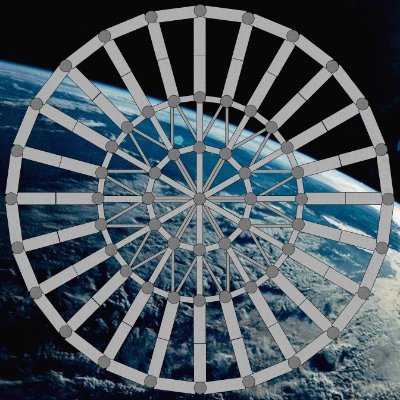
What if a spacecraft could cycle between Earth and Moon orbits, performing multiple circuits of each, naturally and indefinitely, with zero propulsion? We’ve discovered a new class of stable, prograde, low-energy cycler orbits that do just that. Why these orbits matter: Ballistic → fuel-free Stable → long-term ready Near-chaotic → agile with low ΔV Low-energy → access to Earth/Moon, Lagrange points, Sun–Earth L1/L2, even heliocentric space At the AAS/AIAA Astrodynamics Specialist Conference in Boston next week, I’ll present on a new family of ballistic Earth-Moon cycler orbits that are stable, prograde, and mission agile—unlike any cyclers in the current literature. The example below is shown in both the Earth-Moon rotating frame and inertial frame. Conference Paper: ross.aoe.vt.edu/papers/ross-ro…
English
178
588
4.7K
418.7K
Shane Ross
Shane Ross@RossDynamicsLab·
@space_stations There are those who want to re-engineer the human genome so that we can live forever or gene edit embryos to increase IQ. Falling birth rates may be the catalyst for some radical evolutionary changes.
English
1
0
0
19
Artificial Gravity Space Stations
@RossDynamicsLab He's wrong about organic adaptability though. We haven't even begun on that. Our power to modify ourselves is outpacing our will to put it into effect, but that dam will break soon.
English
1
0
0
28
Shane Ross
Shane Ross@RossDynamicsLab·
Foreshadowing instantaneous global communications, telework, and AI. Sounds as if Clarke believed technology would make globalization inevitable.
English
1
2
4
466
Shane Ross retweetledi
SightBringer
SightBringer@_The_Prophet__·
⚡️Higher education is entering its liquidation phase as a mass middle-class belief system. The demographic cliff is only the visible trigger. The deeper break is that the entire college model was built on three assumptions: there would always be more students, families would always treat college as mandatory, and employers would always reward the credential enough to justify the cost. All three are now weakening at the same time. That is why this matters. A fertility decline from 2007 shows up in college admissions with an 18-year delay, but the enrollment shock lands inside a system already overbuilt. Colleges expanded staff, facilities, administrative layers, debt loads, athletic budgets, student-life amenities, DEI bureaucracies, marketing machines, and low-ROI programs during an era when the college-going population was bigger and the credential premium felt unquestioned. Now the customer base is shrinking while the product is being repriced. That creates a financial vise. The elite tier survives because it sells scarcity, network, status, marriage markets, recruiting access, and proximity to power. A Harvard or Stanford degree is not mainly a classroom product. It is a social-routing asset. Those schools can keep demand even if people lose faith in “college” broadly. The practical tier survives because it has obvious economic utility. Engineering, nursing, accounting, skilled health fields, hard technical programs, logistics, applied AI, defense-adjacent disciplines, and high-placement public universities can still justify themselves. Cheap public options also survive because affordability becomes a weapon. The exposed layer is the bloated middle: expensive private colleges without elite status, regional schools with weak draw, generic master’s programs, low-placement liberal arts degrees, weak online MBAs, tuition-dependent institutions, and universities that confuse branding with value. Those schools are going to face the hardest truth: students were not loyal to them. Students were loyal to the belief that the system required them. That belief is cracking. AI makes the break sharper because it attacks the bottom rung of the white-collar ladder. College made sense when the degree bought access to entry-level knowledge work. If entry-level knowledge work gets compressed by AI, the bridge weakens. Families will not pay unlimited tuition for a credential that leads into a shrinking first rung. They will ask harder questions: what job, what network, what income, what debt, what skill, what proof? The cultural layer is even bigger. College used to be the default coming-of-age institution for the American middle class. It replaced church, apprenticeship, local adulthood, early marriage, and family formation as the official bridge from youth into adult status. Now that bridge is expensive, delayed, ideologically contested, economically uncertain, and increasingly detached from real capability. So the enrollment cliff is really a legitimacy cliff. The schools will respond by discounting tuition, poaching students, merging departments, cutting humanities programs, chasing international enrollment, adding AI buzzwords, expanding career services, begging donors, leaning harder into athletics, and selling “community” because the economic case is weaker. Some will survive. Many will shrink. Some will close. The sector will consolidate because the old demand curve is not coming back. The brutal truth: higher education became a credential factory priced like a luxury good, staffed like a bureaucracy, and justified by an employment ladder AI is now destabilizing. Demography lit the fuse. AI removes the escape route. The next decade is going to separate institutions that actually create human capital from institutions that merely certify participation in a fading social ritual.
Jim Bianco@biancoresearch

Fertility peaked in 2007. 2026 is 18 years later, when this "baby bust" starts heading to college. Only the beginning, and ALL schools should prepare.

English
60
190
1.1K
199.1K
Shane Ross
Shane Ross@RossDynamicsLab·
@Autoparallel Thanks for the suggestion! Would love to get back into tensor analysis on manifolds.
English
0
0
1
12
Shane Ross
Shane Ross@RossDynamicsLab·
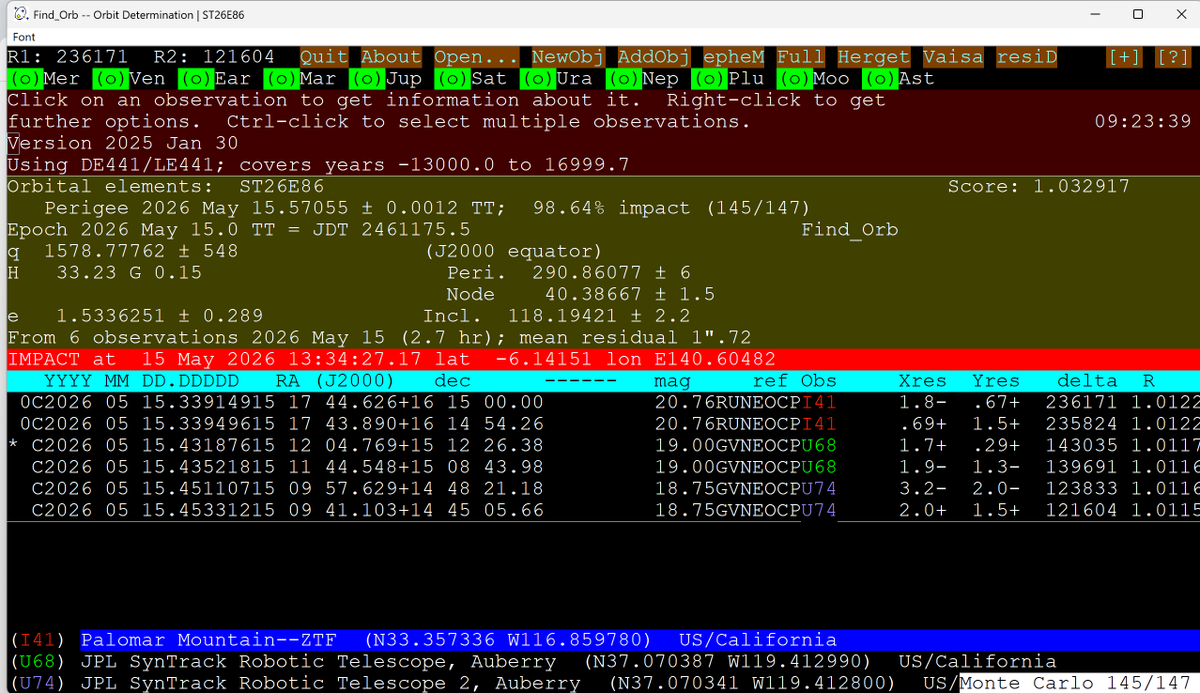
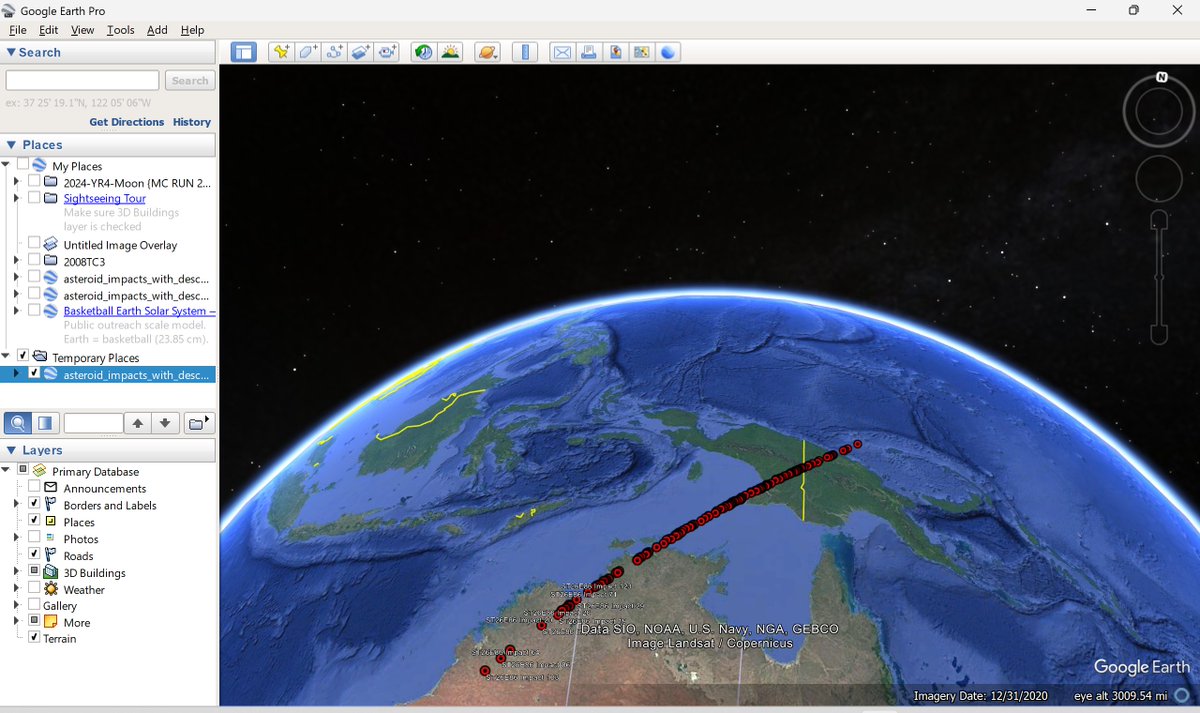
@StevearenoBR Looks like this ~1 m object just impacted / entered the atmosphere around 9:30 AM ET @tony873004 Link says: IMPACT at 15 May 2026 13:36:25.79 lat -8.62564 lon E137.34121
English
1
0
1
89
Shane Ross
Shane Ross@RossDynamicsLab·
Over this same time frame, I read to my kids every night: classic novels, biographies, history. Now as older teenagers, do they read much? No. The internet’s allure is too strong. I tried.
Simon Kuestenmacher@simongerman600

In almost all US states reading scores dropped almost a full grade in just the last decade. That’s catastrophic. One surefire way to set yourself apart these days is to establish a regular reading habit. Source: edopportunity.org/trends/

English
0
1
6
457
Shane Ross
Shane Ross@RossDynamicsLab·
@andy_not_today That would be cool. The Sol Foundation is an organization dedicated to bringing academic and scientific rigor to the study of UAPs. They discuss the use of sophisticated sensors to track these objects near sensitive military facilities. thesolfoundation.org
English
1
0
2
29
Captain Toddler
Captain Toddler@andy_not_today·
@RossDynamicsLab I’ve recently read about some tiny high quality spectrometers that could be integrated into cameras and smartphones in the future. This could shave another chunk of potential UAPs, when their spectra will be found to match known terestrial sources.
English
1
0
1
30
Shane Ross
Shane Ross@RossDynamicsLab·
Some anomalous UAP behavior may disappear once observer motion, distance, and imaging limitations are properly modeled. Which allows us to focus on the truly anomalous ones that deserve attention
Mick West@MickWest

Explained: the UFO that seems to fly around a wind farm and change direction with no visible means of propulsion A video that some call impossible to explain actually has a very plausible explanation. But you might not like it. It's probably a balloon.

English
4
0
8
967
Shane Ross
Shane Ross@RossDynamicsLab·
@andy_not_today That’s right: going between planets, this isn’t very feasible within a human lifetime But for moving around the Earth-moon-sun system, and between the moons of Jupiter, for example, very feasible.
English
1
0
1
25
Captain Toddler
Captain Toddler@andy_not_today·
@RossDynamicsLab This is really cool! I have yet to wrap my brain arround it, but I know it is real. I’ve heard that the downside to the low Delta-v requirement is the long time it takes to go from one planet to another.
English
1
0
1
18
Shane Ross
Shane Ross@RossDynamicsLab·
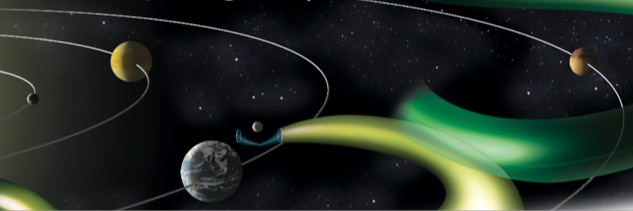
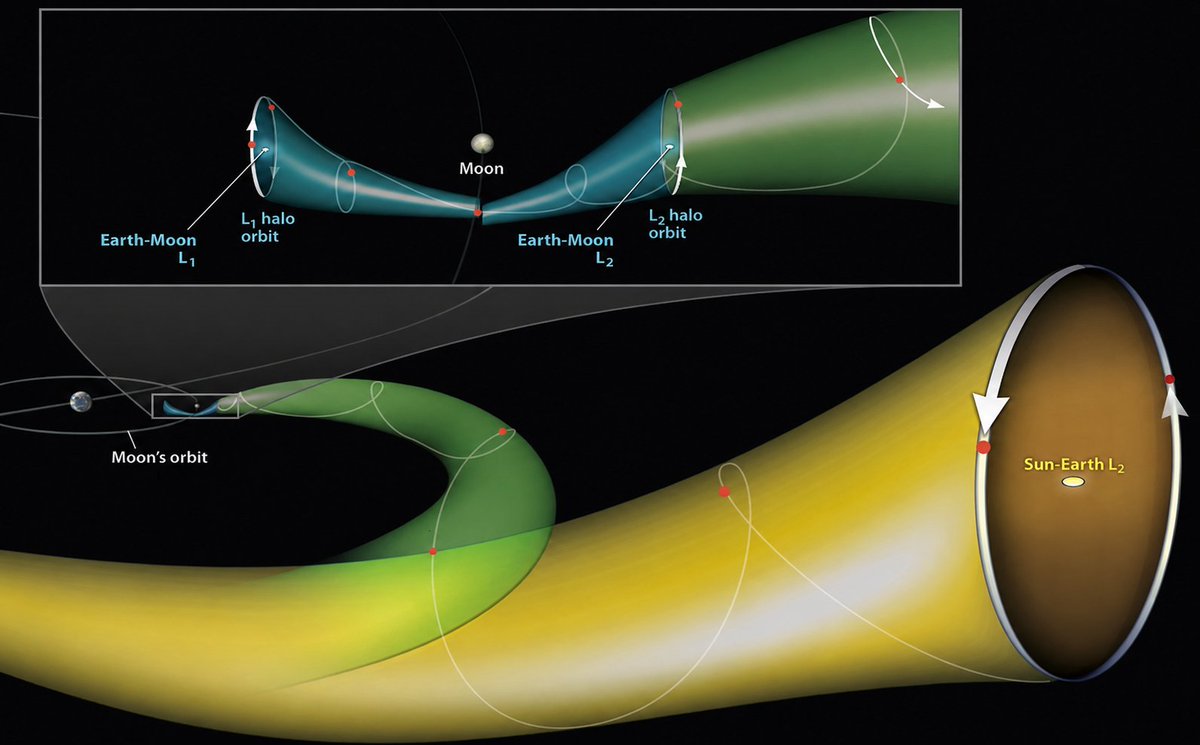
Not every path through space is obvious Some are hidden in dynamics: natural but unintuitive free-fall pathways shaped by the intricacies of gravity itself This is part of what’s often called the interplanetary superhighway We’re still learning how to use it #NationalSpaceDay
Shane Ross tweet media
English
8
29
165
10.4K
Shane Ross retweetledi
Nicolas Badre
Nicolas Badre@BadreNicolas·
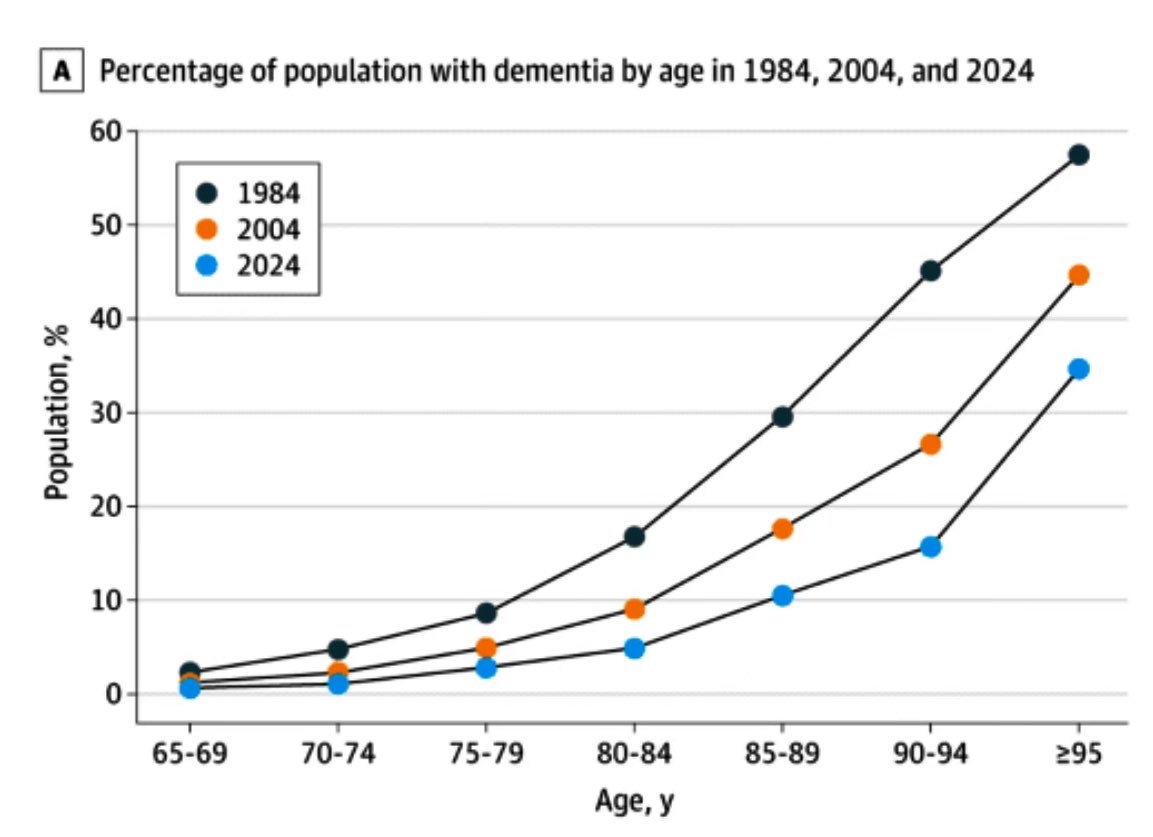
The odds of having dementia at age 85 were close to 1 in 3 in the 80s; now they are 1 in 10. I don’t think we have a great explanation: better cardiovascular health, diet, and education are often mentioned. Good news nonetheless. Carnall Farrar. (2025, March 27). Dementia trends.
Nicolas Badre tweet media
English
206
1K
4.9K
664.5K
Shane Ross
Shane Ross@RossDynamicsLab·
Physics doesn’t care whether it’s seen it before. Nature has no obligation to stay inside the training set.
Yohan@yohaniddawela

Physics-based weather models still beat AI when it matters most. Not on average. On the most extreme days. This is the opposite of what we've been hearing... A new paper in Science Advances ran every major AI weather model: GraphCast, Pangu-Weather, Fuxi, against ECMWF's HRES across 162,751 record-breaking heat events, 32,991 cold records, and 53,345 wind records in 2020. On average conditions, the AI models win. GraphCast, Fuxi, and the rest outperform HRES on standard temperature and wind benchmarks across most lead times. This matches what every prior benchmark study has shown. AI weather forecasting is genuinely impressive. Then the researchers asked a different question. What happens when the event is unprecedented? Not extreme. Not the 95th percentile. Actually beyond anything in the training data. HRES won every single category. Heat records. Cold records. Wind records. Nearly every lead time. The performance gap was largest at short lead times, where AI models should have the most information and the least uncertainty. The bias pattern is pretty massive. The AI models systematically underestimated how extreme the events were. The bigger the record exceedance, the larger the underprediction. The researchers describe it as an implicit 'soft cap': the models behave as if they can't forecast values much beyond the most extreme thing in their training data. The bias grows almost linearly with how far the event exceeded the record. HRES showed no such pattern. This isn't a fluke. The same result held in 2018 and 2020, which had opposite ENSO conditions. It held across the tropics, subtropics, mid-latitudes, and high latitudes. It held for all three variables. It held when the researchers ran an alternative evaluation specifically designed to avoid the forecaster's dilemma. The mechanism is pretty straightforward. AI weather models are trained on ERA5 reanalysis data from 1979 to 2017. They learn to interpolate between historical weather patterns. When a new initial condition arrives, they find the nearest analogues in training and produce something in between. Record-breaking events, by definition, have no close analogues. The model has never seen anything quite like this, so it regresses toward the most extreme things it has. Physics-based models like HRES don't work this way. They solve partial differential equations describing atmospheric dynamics. They don't need a historical analogue for a 48°C heatwave in Siberia. The physics doesn't care whether it's happened before. The authors are careful about what this means. AI models remain faster, cheaper, and competitive on average conditions. Probabilistic AI forecasting is developing rapidly. Data augmentation with simulated extreme events and hybrid physics-AI architectures are plausible paths forward. This isn't a verdict on AI weather forecasting broadly. But the policy implication is quite important. The events where AI models fail hardest are exactly the events where accurate forecasting matters most. Record-shattering heat. Unprecedented wind storms. The scenarios that overwhelm emergency response, strain infrastructure, and kill people because no one expected them to be that bad. The authors wrote it plainly: it remains vital to fund and run physics-based NWP and AI weather models in parallel. I find it an unusually direct recommendation in a methods paper. Climate change means record-breaking events are becoming more frequent, not less. The training distribution is shifting. AI models trained on 1979 to 2017 data will see more and more out-of-distribution events as the climate diverges from that baseline. The extrapolation problem the researchers identified isn't going away. It's getting harder. The models that can't forecast records are being asked to forecast a world that's setting them constantly. Link to full paper: science.org/doi/10.1126/sc…

English
0
2
12
1K