Roy Atkinson

87.6K posts

Roy Atkinson banner
Roy Atkinson

Roy Atkinson

@RoyAtkinson

Business Advisor | Industry Analyst | Writer | CEO #CX #tech #ITSM Podcast: Reach Your Do Point® https://t.co/1s3CrrfhcV

South Carolina, USA Katılım Mayıs 2009
9.9K Takip Edilen16.3K Takipçiler
Roy Atkinson retweetledi
Jeff Thomas
Jeff Thomas@JeffT_Growth·
The companies winning with AI picked one workflow, or maybe HubSpot's AI Customer Agent, implemented it properly, trained their team, and didn't move until it was running. Breadth of AI adoption is easy to fake. Depth is where the results live.
English
0
1
1
69
Roy Atkinson
Roy Atkinson@RoyAtkinson·
The advent of AI, whether strategically adopted into workflows by an organization, embedded in the software we use or the “Shadow AI” individuals are using ... ushers in a transformation of work (My latest post on @SymphonySummit ) symphonyai.com/resources/blog…
English
0
0
0
25
Evan Kirstel #B2B #TechFluencer
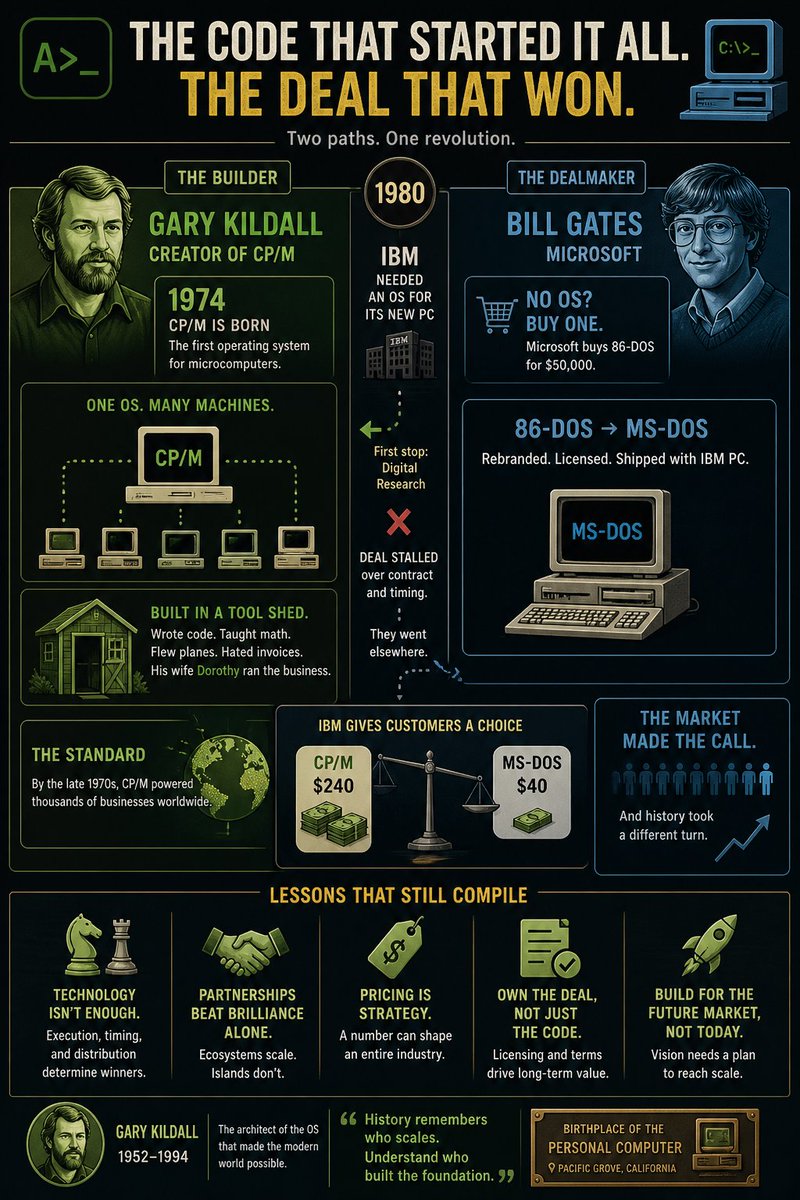
On a sidewalk in Pacific Grove, California, a small bronze plaque marks the spot where the personal computer revolution began. The name on it isn't Bill Gates. It's Gary Kildall. In 1974, Kildall built CP/M, the first widely adopted operating system for microcomputers. Until then, every machine lived in its own walled garden, and software had to be rewritten for each one, which made scale nearly impossible. Kildall introduced a layer between hardware and software so that a program written once could run across many machines. Developers stopped duplicating effort, and computing began to behave like a platform instead of a pile of incompatible boxes. Intel saw an early demo and passed. By the late 1970s, CP/M had become the standard, powering business computing across banks, offices, and early startups. Kildall didn't fit the mold of a future tech titan. He was a computer scientist with a PhD from Washington who taught at the Naval Postgraduate School, and he preferred flying his Piper to negotiating contracts. He wrote early versions of CP/M in a workshop behind his house, sometimes accepted hardware in lieu of cash because invoicing bored him, and in his spare time co-hosted Computer Chronicles on PBS. His wife Dorothy McEwen ran the business while he focused on the code. In 1980, IBM came looking for an operating system for its new personal computer. The meeting at Digital Research stalled over a one-sided non-disclosure agreement, and IBM left without a deal. They went back to Bill Gates, who didn't yet have an operating system to offer. Microsoft acquired 86-DOS from Seattle Computer Products, a system whose structure and commands closely mirrored CP/M, rebranded it MS-DOS, and licensed it to IBM. When the IBM PC shipped in August 1981, PC DOS was the only operating system available. CP/M-86 arrived six months later at $240, while PC DOS sold for $40. One survey found 96 percent of buyers chose the cheaper option. When Kildall later examined PC DOS, he was incensed by the similarities, but his lawyer told him software copyright law was too unsettled to litigate. He settled for having CP/M-86 listed as a pricier option, partly because he didn't believe the IBM PC would amount to much. The system that had defined the category was sidelined almost overnight. The philosophical gap had been visible all along. On a panel together, Kildall argued the operating system market was huge and could support many companies. Gates cut in: "No. There will always be one company." Kildall built the technical foundation. Microsoft built the business model that scaled. The outcome wasn't about who wrote better code. It was about distribution, licensing, and pricing discipline. The company that controlled how software reached customers ended up controlling the market. The personal computer revolution wasn't just built on code. It was built on how that code reached the desk. CP/M made personal computing viable, and MS-DOS made it ubiquitous.
Evan Kirstel #B2B #TechFluencer tweet media
English
2
7
17
1.2K
Roy Atkinson retweetledi
Mario Andretti
Mario Andretti@MarioAndretti·
In the game of life, Alex Zanardi left nothing in the tank. I remember when he asked me to write the foreword for his book. I asked him anything you want me to say? He said: Well, I need to order new legs- how tall do you think I should be?
English
0
879
8.4K
136.3K
Roy Atkinson
Roy Atkinson@RoyAtkinson·
RIP great racer Bob Tullius. (My photo from a visit to Jaguar-Daimler Heritage Trust)
Roy Atkinson tweet media
English
0
0
0
21
Roy Atkinson
Roy Atkinson@RoyAtkinson·
We find ourselves facing a version of Heisenberg’s Principle as new ways to use AI are surfacing every day; we might be able to see where we are, but we can’t see where we are going, or how fast. (Thanks for publishing my thoughts, @SymphonySummit .) symphonyai.com/resources/blog…
English
0
0
0
31
Roy Atkinson
Roy Atkinson@RoyAtkinson·
The Power of Mentorship: On the latest episode of Reach Your Do Point®, Luke Keultjes and I discuss the types of mentorship and what it can do for mentor and mentee. Full video: youtu.be/8_TlMC6wPYU?si…
YouTube video
YouTube
English
0
0
1
47
Roy Atkinson retweetledi
Evan Kirstel #B2B #TechFluencer
On April 15, 1912, the RMS Titanic was going down, and the most important room on the ship wasn't the bridge. It was the wireless room. Jack Phillips and Harold Bride were still at their posts, headsets on, hands flying over the key, sending distress signals into the night. Not one message. Dozens. They repeated coordinates as the urgency climbed with every transmission. At one point they switched between CQD and the newer SOS signal, not caring about protocol, just trying to be heard. The power was fading. The ship was tilting. They kept transmitting anyway. Miles away, the RMS Carpathia picked up the signal. Captain Arthur Rostron made the call that would define the night and ordered full speed through ice fields toward the wreck. That decision, triggered by a signal pulled out of the Atlantic air, saved more than 700 lives. That was the moment connectivity stopped being a novelty and became infrastructure. Fast forward more than a century and the principle hasn't changed, but the system around it has. Today's emergency response runs on real-time, always-on networks powered by technologies like 5G. First responders don't just hear a call. They see the scene, share data instantly, and coordinate across agencies as events unfold. Carriers are now building dedicated lanes for that traffic. @TMobileBusiness T-Priority service, for example, gives first responders prioritized 5G access during emergencies, so the network holds up exactly when everyone else is trying to use it too. What's changed even more is where that capability lives. It's no longer confined to ships, towers, or control rooms. It's in your pocket and on your wrist. Devices like the Apple Watch can now send emergency signals via satellite when there's no cellular coverage. You can be off-grid, deep in the mountains or on a remote stretch of road, and still reach help. That's a long way from Morse code in a dark radio room. What comes next is already taking shape. Satellite-to-device becomes standard. Drones spin up temporary networks over disaster zones. AI helps triage incidents and route resources faster than any manual system could. The goal is simple and ambitious at the same time. No dead zones. No missed signals. No delay between distress and response. On that night in 1912, two operators kept sending a signal as long as they could. More than a century later, we're still building systems to make sure that signal always gets through.
Evan Kirstel #B2B #TechFluencer tweet media
English
0
9
7
1K