

ryan staley
3K posts
ryan staley
@Ryan_Staley1
Founder & CEO, Whale Boss | 2x Your Team's Output Without Hiring | Trusted by PE-backed SaaS | Transform your team in 60 days
Katılım Eylül 2015
1K Takip Edilen289 Takipçiler

My companies close $20M/year on 30-minute Zoom calls.
I had an ex-McKinsey consultant reverse-engineer exactly how:
– Sales call recordings
– Sales scripts
– Lead gen systems
Reply with “GA” and I'll DM you the copy. Free.
English

@thejustinwelsh Just use google stitch or genspark. Both have free plans to start and can build this out in minutes for you for free to $20 per month
English

Does anyone have a good designer who specializes in elegant, editorial-style branding?
Think Monocle, The Atlantic, The New Yorker, etc.
Looking for a complete brand kit for a project.
English

@tannerlinsley let me know if you want in on the beta for the new CC Desktop UI/UX
English

Ghostty was fun, but time for something else.
I still love opencode, too but with CC plans dead on it… I’m feeling lost.
Full GUI?
T3 Code?
Opencode GUI?
Warp?
Back to cursor?
Try CC again?
Raw Codex?
My 🧠 hurts and I just need to keep shipping.
English

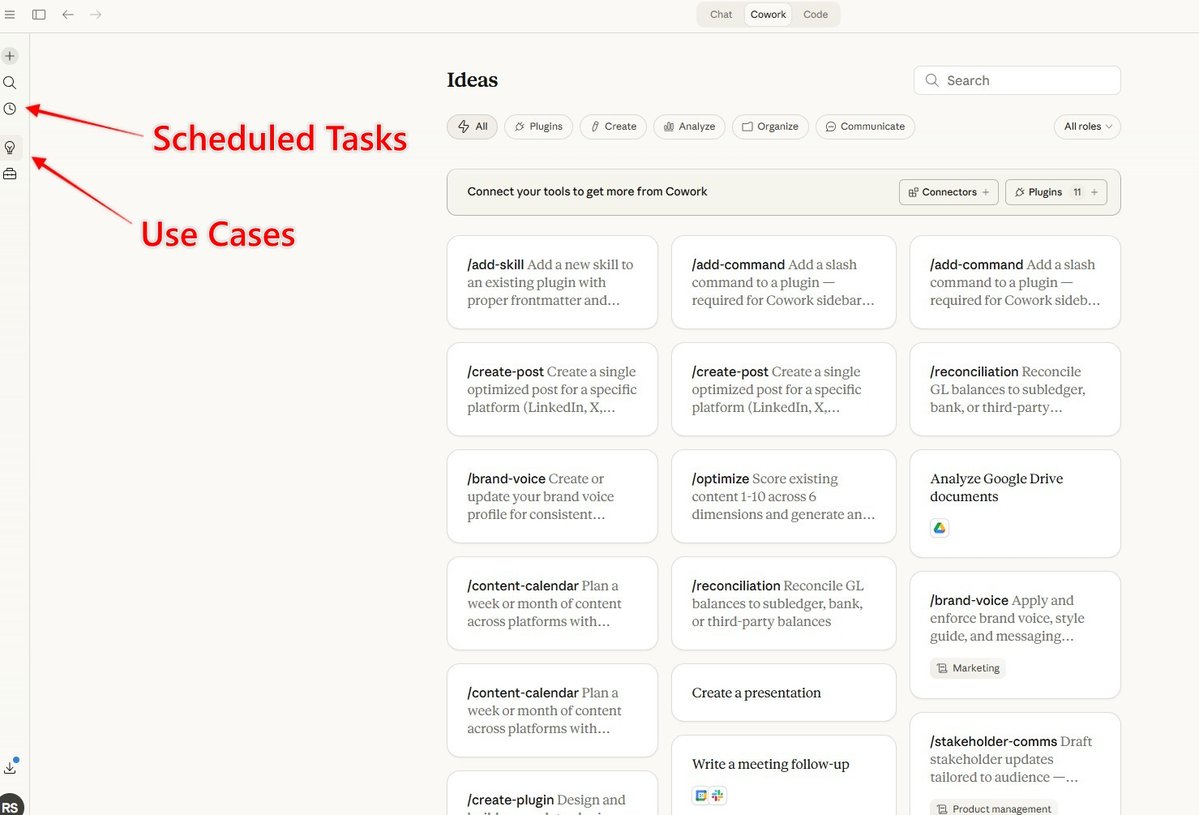
Cowork dropped a Schedule Task feature — and the use cases Anthropic built into it are WILD.
Here's why this matters more than 90% of what gets posted about AI this week.
There's been a massive gap in the market between two worlds.
World 1: A chatbot. Easy to use. Limited. Reactive. You ask, it answers. Nothing changes when you close the tab.
World 2: A sophisticated coding agent. Insanely powerful. Almost zero adoption because the average executive has no idea how to deploy it.
NOBODY has solved that gap.
Until now.
Cowork with Schedule Task sits DIRECTLY in the middle. It's the bridge non-technical executives have been waiting for.
Here's what you can actually do today:
Click Schedule Task → Use Cases → pick a workflow that runs for you automatically.
That's it. No code. No engineers. No 6-month implementation.
You're now operating with agentic automation that most companies spend $200K trying to build.
NOTE: The executives who find these features first and build habits around them are the ones who will look like AI geniuses in 12 months.
The window to be early is still open — but it's closing fast.
What's the number one task on your team that should already be running automatically?
English
This week, multiple enterprise clients - independently - asked me to build the same thing.
An agent operating system.
Not an AI tool. Not a chatbot. Not a "copilot."
An operating system with Claude Code where AI agents handle core business functions: pipeline management, content generation, candidate evaluation, client deliverables, and reporting.
All connected. All learning. All orchestrated from one environment.
Here's my prediction:
Within 18 months, every company above $50M in revenue will need one of these.
Not want one. NEED one.
Here's why:
Right now, most companies use AI like it's 1995 internet. One tool at a time. Disconnected. Manual.
"Use ChatGPT for this."
"Use Copilot for that."
"Here's a prompt template for the other thing."
That's not a strategy. That's a collection of experiments.
An Agent Operating System is different:
**It connects.** Your CRM data flows into your pipeline agent, which informs your content agent, which feeds your outreach agent. Information moves across the business automatically.
**It learns.** Every interaction teaches the system how your team operates. What you prioritize. What you skip. Where you need help. It gets smarter every week.
**It orchestrates.** Instead of 10 employees using 10 separate AI tools in 10 separate ways, one system coordinates agents that work together like a team.
**It compounds.** The system you build in Month 1 makes Month 2 better. Month 2 makes Month 6 dramatically better. By Month 12, you're operating at a level that's structurally unreachable for companies that started late.
When I showed my own Agent OS to executives this week, I saw the same reaction every time:
Not "that's cool."
"We need this. Now."
They saw what their company could look like when AI isn't a collection of tools but an actual operating layer.
The companies that build their Agent OS in 2026 will have a 12-18 month compounding advantage over those who start in 2027.
And in AI, 18 months of compounding is a lifetime.
The race isn't to adopt AI.
The race is to architect it.
Are you building an operating system? Or are you still buying tools?

English
I rebuilt core features of an AI operating system from my phone.
While watching TV.
Not a prototype. Not a mockup. Actual working features — memory systems, skill frameworks, and communication channels — all built from my cell phone on the couch.
A year ago this would have required:
→ A development environment
→ A software engineer
→ 2-3 months of sprints
→ $40K-$80K budget
I did it between Olympic events on the commercial break.
Here's what this means:
The barrier to building AI is gone.
Not "lowered." Gone.
The excuse era is over.
You don't need a technical background.
You don't need a big screen.
You don't need a dev team.
You don't need a budget.
You need clarity on what to build and the willingness to describe it in plain language.
I've never formally coded anything.
I built 15+ AI agents, 3 operating systems, and now I'm shipping features from my phone.
Every week I hear leaders say: "We need to hire engineers before we can start our AI strategy."
No. You don't.
You need someone who understands your business deeply enough to describe what AI should do — and then let AI build it.
That person might already be on your team.
It might be you.
The question isn't whether you have the technical skills.
It's whether you have the clarity and the courage to start.

English
@garrytan That is amazing, fyi when I used got 3.5 and was testing it for startup planning I had it act like Gary Tan to eval the startup planning.
The results were good even back then so I am sure this is amazing. Also great to see you giving back by sharing
English

Google just changed the game for every executive using Workspace.
And most people won't notice for 6 months.
Here's what happened:
Gemini just got upgraded ACROSS the entire Google Workspace suite. Slides. Sheets. Drive. All of it.
I have early access. I've been testing it.
And I'm genuinely impressed with what Google is doing here.
Here's what matters:
1. Gemini in Slides now creates professional layouts and fully editable diagrams from scratch. You describe your story. It handles the design. Minutes instead of hours.
2. Gemini in Sheets is now a full spreadsheet BUILDER. Describe what you need. It creates, organizes, and edits entire sheets from basic tasks to complex data analysis.
3. Ask Gemini in Drive lets you search in natural language and get an AI Overview at the top of your results. It pulls insights across your documents, emails, calendar AND the web.
This isn't a feature update.
This is Google turning Workspace into an AI operating system.
NOTE: The companies that retrain their teams on these capabilities in the next 60 days will operate at a completely different speed than those who wait.
The gap between AI-first and AI-last companies just got wider.
Which of these 3 updates would save YOUR team the most time?

English
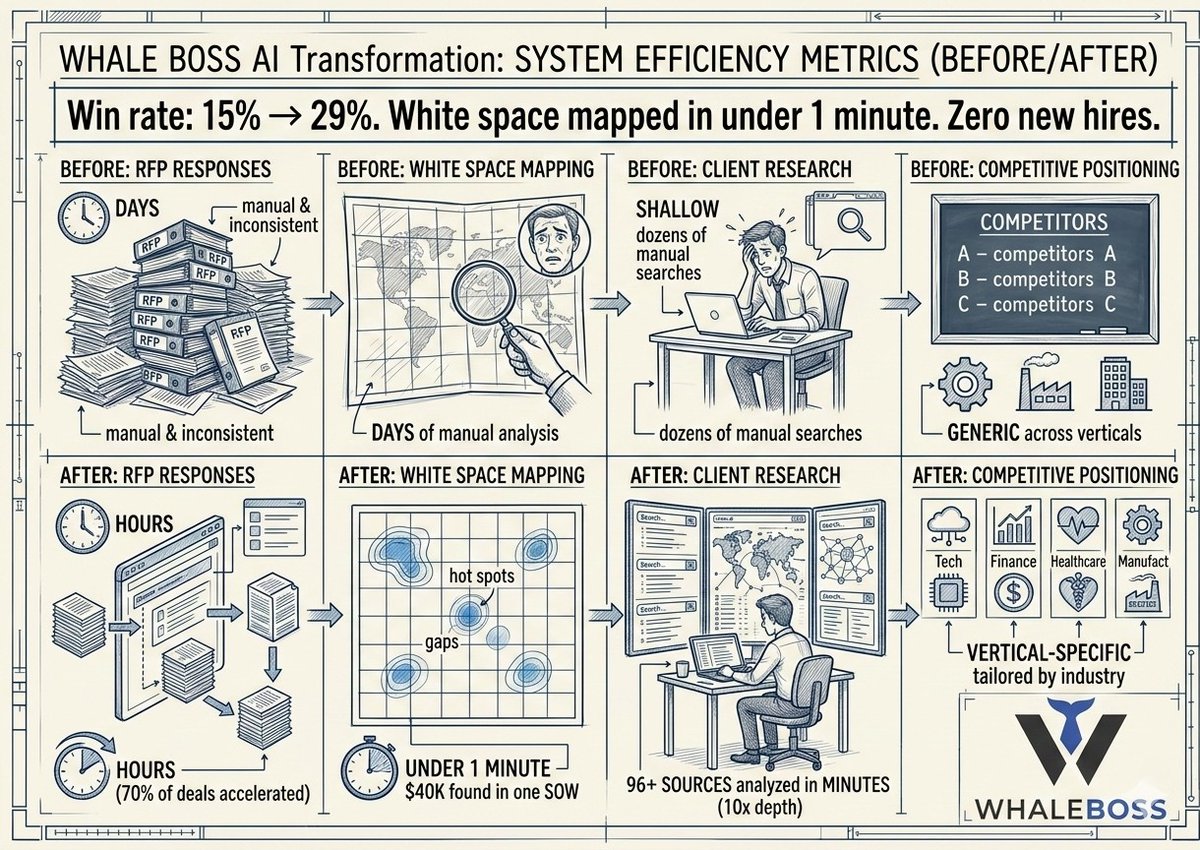
I recently wrapped a 60-day AI Transformation with a $3B services company with over 600 enterprise clients.
Their CRO told me in our kickoff: "Our win rate is in the mid-teens. We're managing 250 deals a quarter across 5+ lines of business. Our people can't research fast enough, can't respond to RFPs fast enough, and can't expand into accounts they're already sitting in."
We didn't add headcount.
We attacked 4 constraints across their sales, account management, and BDR teams:
📊RFP responses were the bottleneck killing their pipeline. 70% of their deals come through RFPs, and the proposal process was manual, slow, and inconsistent. We built a system that ingests previous responses, compliance requirements, and solution details — then generates targeted RFP responses. Their proposal team said it "blew their minds." What used to take days now takes hours.
📈White space mapping across existing accounts was manual and reactive. With 8 lines of business and 600 clients, account managers couldn't see what else they could sell into accounts they already owned. We built a system that instantly maps client challenges to their full solution portfolio. One account manager used it to identify $40K in new opportunities from a single SOW analysis. White space mapping went from days to less than a minute.
📊Client research for meetings was shallow and slow. Reps were manually searching dozens of websites, pulling financials, and trying to find hidden initiatives. We built a deep research system that analyzes public data, financials, and industry trends in minutes. One rep used it to uncover a secret project name at a Fortune 500 client that gave him an unfair advantage walking into the meeting.
📈Competitive positioning was inconsistent across verticals. With major global competitors, reps needed to speak different languages for healthcare, financial services, and telco — but the messaging was generic. We built AI systems that generate vertical-specific competitive comparisons, joint value propositions, and tailored outreach by industry.
The result?
White space mapping: days to under 1 minute.
Massive new opportunities from AI-surfaced SOW gaps.
Research depth: 10x, with reps analyzing 96+ data sources in minutes.
Zero new hires.
Their CRO said it: "This is the most relevant investment we can make for immediate impact."
NOTE: We didn't try to "transform the whole org." We found the TOP 4 constraints on their revenue team and attacked each one with a specific AI system. That's the difference between AI strategy and AI transformation.
Strategy is a deck.
Transformation is pipeline.
What would nearly doubling your win rate do for your revenue team?
DM me to see if you're a fit for us to help you.
English
@clarashih @karpathy Thanks for sharing. It looks like this was taken down. I checked his repo and can’t locate it?
Where is the exact link vs his bio page link?
English

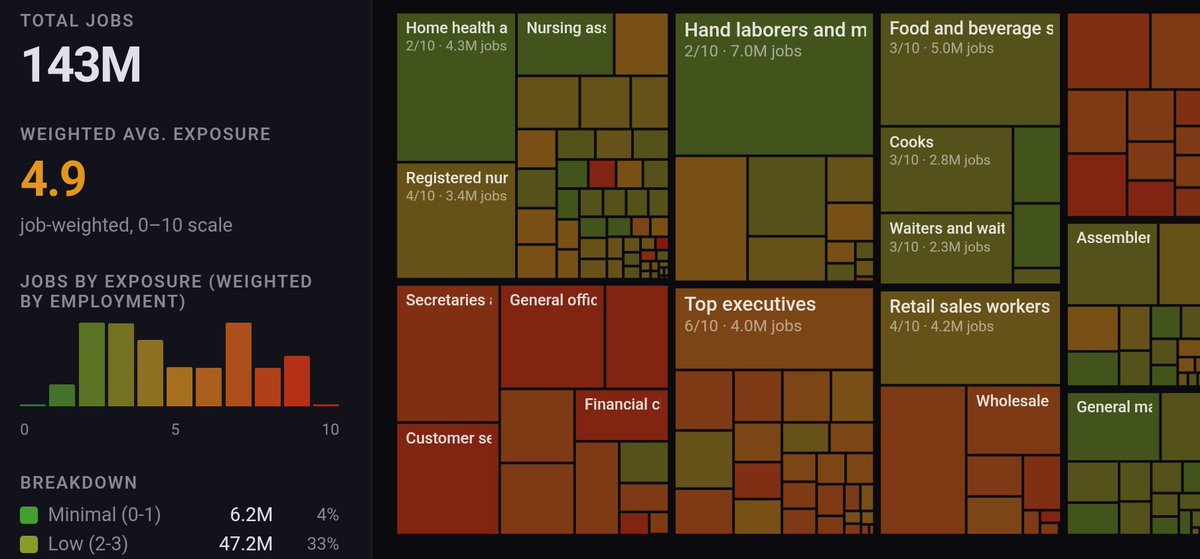
AI isn't just coming for junior software engineers in Big Tech.
@karpathy just used Gemini to score AI exposure (0-10) across 143M US jobs in 342 BLS categories:
• High/very high exposure (~60M jobs, $4T+ in wages): billing specialists, secretaries, many desk-based roles
• Low/minimal exposure (~53M jobs): home health aides, carpenters, hands-on trades
• Jobs paying <$35K are least exposed. Those >$100K are most exposed
In a reversal from a decades-long trend, it is cognitive work rather than manual labor that is in the crosshairs.
Data + viz 📈: karpathy.ai/jobs
Andrej Karpathy@karpathy
It is hard to communicate how much programming has changed due to AI in the last 2 months: not gradually and over time in the "progress as usual" way, but specifically this last December. There are a number of asterisks but imo coding agents basically didn’t work before December and basically work since - the models have significantly higher quality, long-term coherence and tenacity and they can power through large and long tasks, well past enough that it is extremely disruptive to the default programming workflow. Just to give an example, over the weekend I was building a local video analysis dashboard for the cameras of my home so I wrote: “Here is the local IP and username/password of my DGX Spark. Log in, set up ssh keys, set up vLLM, download and bench Qwen3-VL, set up a server endpoint to inference videos, a basic web ui dashboard, test everything, set it up with systemd, record memory notes for yourself and write up a markdown report for me”. The agent went off for ~30 minutes, ran into multiple issues, researched solutions online, resolved them one by one, wrote the code, tested it, debugged it, set up the services, and came back with the report and it was just done. I didn’t touch anything. All of this could easily have been a weekend project just 3 months ago but today it’s something you kick off and forget about for 30 minutes. As a result, programming is becoming unrecognizable. You’re not typing computer code into an editor like the way things were since computers were invented, that era is over. You're spinning up AI agents, giving them tasks *in English* and managing and reviewing their work in parallel. The biggest prize is in figuring out how you can keep ascending the layers of abstraction to set up long-running orchestrator Claws with all of the right tools, memory and instructions that productively manage multiple parallel Code instances for you. The leverage achievable via top tier "agentic engineering" feels very high right now. It’s not perfect, it needs high-level direction, judgement, taste, oversight, iteration and hints and ideas. It works a lot better in some scenarios than others (e.g. especially for tasks that are well-specified and where you can verify/test functionality). The key is to build intuition to decompose the task just right to hand off the parts that work and help out around the edges. But imo, this is nowhere near "business as usual" time in software.
English
ryan staley retweetledi

Automation consultants charge $15K for what Claude Code now does in 2 hours.
I know because we're the ones who used to charge it.
Here's the exact process:
Step 1: Discovery (20 min)
→ Paste your org chart, tool stack, and top 3 bottlenecks
→ Claude interviews you with clarifying questions
→ Outputs a full process inventory ranked by time cost
Step 2: Workflow Mapping (15 min)
→ Describe any department's daily operations in plain English
→ Claude builds a complete process map
→ Every manual handoff, redundant step, and automation trigger flagged
Step 3: Opportunity Audit (10 min)
→ Feed it the workflow map output
→ Returns your top 10 automation opportunities
→ Ranked by ROI, complexity, and build time
Step 4: Architecture Design (20 min)
→ Claude designs the full system architecture
→ Which tools connect where, what the data flow looks like
→ Agents for complex logic, linear flows for the repetitive stuff
Step 5: Build (ongoing)
→ Claude writes the actual workflow JSON
→ Self-documents everything as it builds
Step 6: The output.
A live dashboard your whole team can work from.
→ Clickable process maps for every department
→ Automation opportunities ranked by ROI
→ Implementation progress by phase
→ KPIs updated in real time
→ One link you share with clients, freelancers, or your team to execute
This is what we hand every client at the end of discovery.
The .md file is what makes all of it possible.
Without it, Claude guesses.
With it, Claude builds like a $15K consultant.
Like this post, RT and comment "BLUEPRINT" and I'll send you the full prompt stack and the .md file we use internally. (Must be following so I can DM you)
🎁 Bonus: The first 100 people get a real Precision AI Blueprint — an actual sample audit doc from a client engagement so you can see exactly what the output looks like.

English
English

@Ryan_Staley1 @aiclubchicago @GoogleDeepMind We just hit capacity this morning but if anything changes we’ll make announcements
English
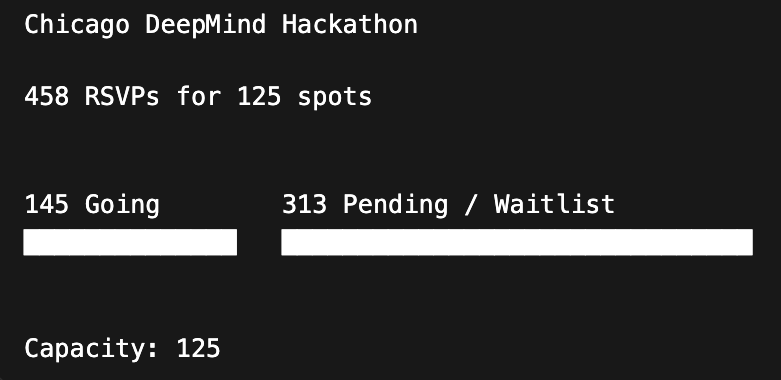
We're hosting a hackathon with @GoogleDeepMind this Saturday in Chicago
During St. Patrick’s Day weekend 🍀
Sign ups are off the charts
458 total RSVPs 🚀
313 pending / waitlist ‼️
125 capacity 😳
Love to see it @aiclubchicago
English
There are three core areas that you need to look at for that implementation and this is based on over 3000 people that I’ve worked with on AI transformation from Fortune 1000 to start ups.
1. Identify the target – the KPI constraint that you want to solve or case.
2. Make it roll specific which means have used cases that are directly at lined for the workflow or jobs to be done to support that KPI or solve that constraint. But only on the prompts and ai use cases that’ll solve those problems.
3. Start really simple and work up the Claude ladder from chat to coworker to Claude code. Everyone who wants to jump straight the code and for users that are not very tactical by nature. This is gonna be a massive frustration point.
Let me know if you have any other questions that I’d be happy to answer them. This has been my life working with corporate teams on scaling ai for roi for the past 3 years
English

How is everyone getting team adoption for Claude?
I spent a lot of time on Twitter, as do you. We see all this AI stuff popping up. We're on top of it, or at least sorta. I know what's going on and are testing all these fringe ideas.
But how are all you people getting your team to actually use it effectively without spending all their time on Twitter and learning, which we know they won't and probably shouldn't be?
English
I was running a C-Suite AI workshop this week.
$300m+ company. Frameworks. Use cases. Hands-on practice.
Then I made a decision that wasn't in the agenda.
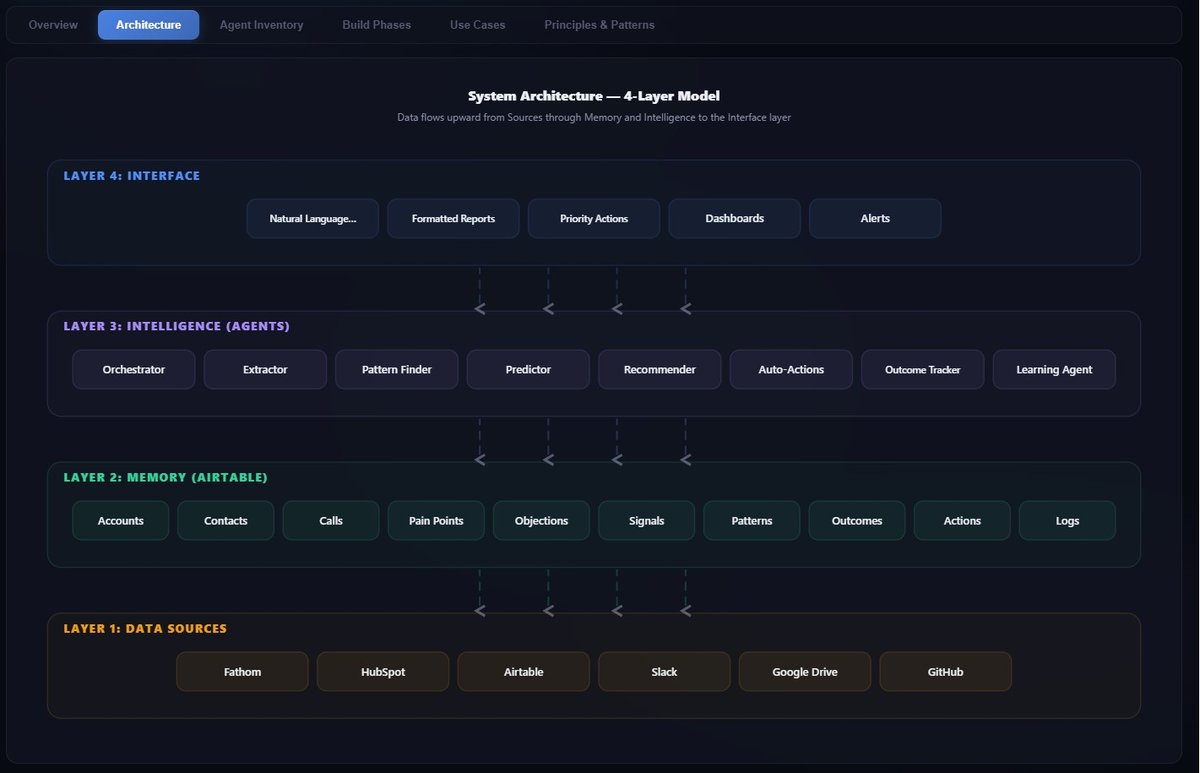
I showed them the agent operating system I built for my own business.
Not a slide deck about it. Not a concept diagram.
The actual system. Running. Live. In real time.
I walked them through how AI agents handle my:
-pipeline reviews
-score candidates
-generate content from my daily notes
-build client deliverables
ALL orchestrated from one environment.
The energy in the room shifted instantly.
One executive said: "We need this for our team."
Another asked: "What would it take to have you build something like this for us?"
Later that same day, two other clients in completely different industries told me the same thing: "Build this for us."
Three companies. One week. Same request.
Here's what I realized:
The gap in the market isn't AI tools. Everyone has access to tools.
The gap is AI SYSTEMS - purpose-built, connected, learning from your actual data and workflows.
Tools answer questions.
Systems run operations.
When those executives saw a live system that manages a real business, they didn't see a cool demo.
They saw the 30 hours a week they're currently burning on work that an agent could handle.
They saw decisions being made faster because context was already synthesized.
They saw what their company could look like in 6 months.
And they wanted it immediately.
The companies that figure this out first won't just be more efficient.
They'll be operating from a completely different architecture.
They will be playing 3d Chess when everyone else is playing checkers.
And the gap between "we use AI tools" and "we run on AI systems" is about to become uncloseable.
English
@ericDesignsNow Thanks so much! 😊 It's always great to connect with folks who get it. Appreciate the shoutout! 🙌 How's everything going on your end?
English

I fired a $150K prospect a few weeks ago.
Not because the deal fell apart.
Because the person on the other side couldn't move at the speed needed — or delegate to the people trying to help him.
Here's what happened:
I'd been bending over backwards to accommodate a complex enterprise deal. Custom scope. Revised SOW. Extra calls.
My contact's team was supportive and wanted to move forward. But the decision-maker?
He was a great person however, he was struggling with how fast everything in AI is moving.
This caused indecision.
That led to paralyzed decision making.
Which led to no progress in 5 months.
I hung up the phone and realized something:
I was chasing a deal I didn't even want.
So I processed it and sent a note.
Took the high road.
And walked away from $150K.
Here's what I've learned building a bootstrapped company from zero to product market fit:
The clients you say NO to define your business more than the ones you say yes to.
Bad-fit clients drain your energy.
They erode your team's confidence.
They take 3x the time for half the result.
And they never refer anyone worth working with.
English
@ericDesignsNow Thanks for reaching out! 😊 I'll check out the DM soon. Appreciate you taking the time to connect! 🚀
English
@Ryan_Staley1 Yeah, Ryan, welcome.
Also, if you are free, you can check your Dm requests. I sent you a message.
Not sure if you will find it useful.
English