Sean Cronin

1.4K posts

Sean Cronin

Sean Cronin

@SCronin01

Director of Curriculum and Instruction (Grades 6-12) focused on developing creative and flexible thinking. Whole Child Advocate. Ed. D. @SHUCEHS

Monmouth County, New Jersey Katılım Ekim 2010
1.4K Takip Edilen686 Takipçiler
Sean Cronin retweetledi
Jonathan Haidt
Jonathan Haidt@JonHaidt·
I'm sure there's a role for tech in education (e.g., @khanacademy), but not as 1:1 devices on students' desks. I hope that many elementary schools will remove devices by Sept., or create an analog path for parents who want that. Let's see if kids do better with books and paper
English
9
37
388
19.1K
Sean Cronin retweetledi
Nav Toor
Nav Toor@heynavtoor·
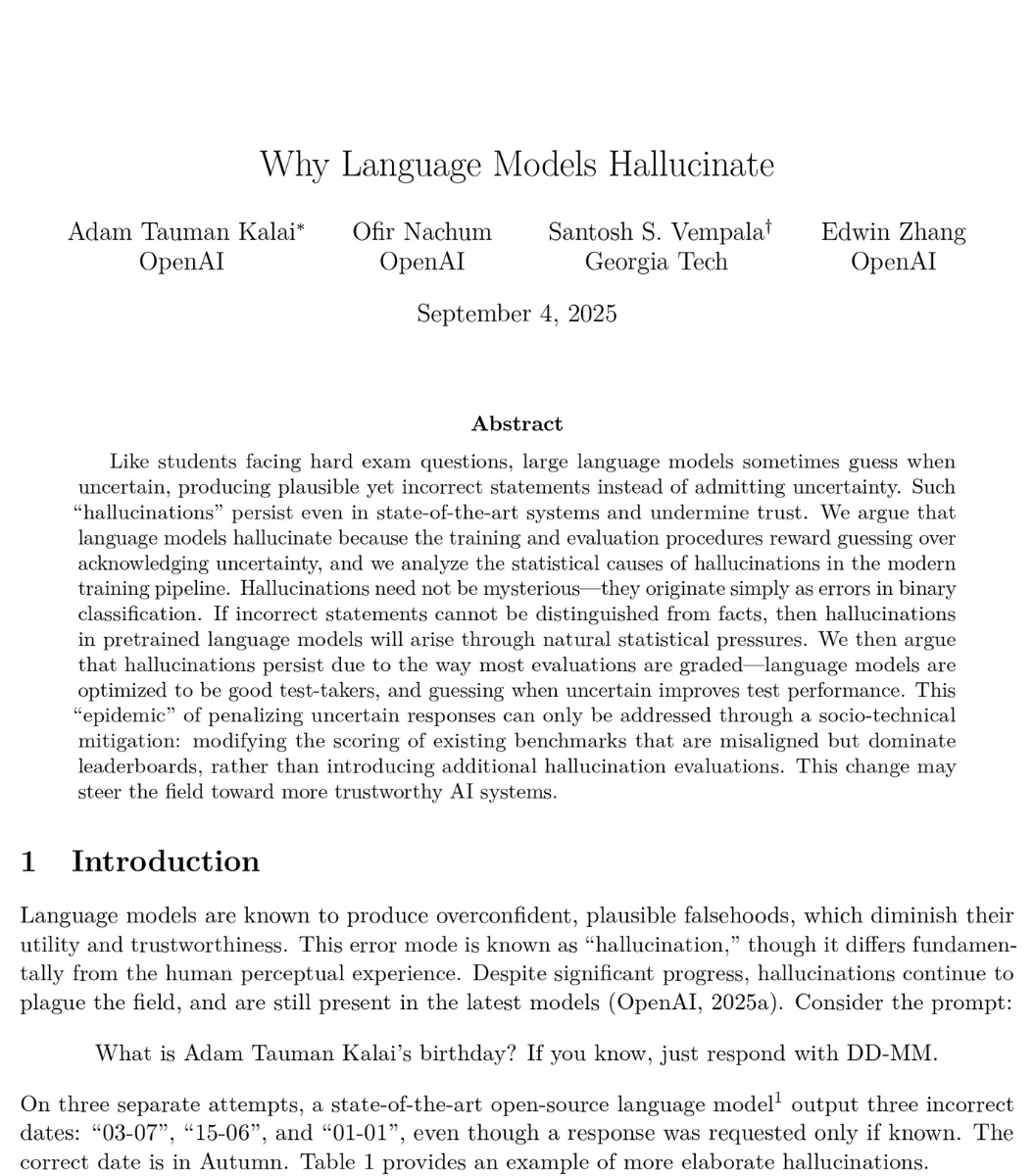
🚨BREAKING: OpenAI published a paper proving that ChatGPT will always make things up. Not sometimes. Not until the next update. Always. They proved it with math. Even with perfect training data and unlimited computing power, AI models will still confidently tell you things that are completely false. This isn't a bug they're working on. It's baked into how these systems work at a fundamental level. And their own numbers are brutal. OpenAI's o1 reasoning model hallucinates 16% of the time. Their newer o3 model? 33%. Their newest o4-mini? 48%. Nearly half of what their most recent model tells you could be fabricated. The "smarter" models are actually getting worse at telling the truth. Here's why it can't be fixed. Language models work by predicting the next word based on probability. When they hit something uncertain, they don't pause. They don't flag it. They guess. And they guess with complete confidence, because that's exactly what they were trained to do. The researchers looked at the 10 biggest AI benchmarks used to measure how good these models are. 9 out of 10 give the same score for saying "I don't know" as for giving a completely wrong answer: zero points. The entire testing system literally punishes honesty and rewards guessing. So the AI learned the optimal strategy: always guess. Never admit uncertainty. Sound confident even when you're making it up. OpenAI's proposed fix? Have ChatGPT say "I don't know" when it's unsure. Their own math shows this would mean roughly 30% of your questions get no answer. Imagine asking ChatGPT something three times out of ten and getting "I'm not confident enough to respond." Users would leave overnight. So the fix exists, but it would kill the product. This isn't just OpenAI's problem. DeepMind and Tsinghua University independently reached the same conclusion. Three of the world's top AI labs, working separately, all agree: this is permanent. Every time ChatGPT gives you an answer, ask yourself: is this real, or is it just a confident guess?
Nav Toor tweet media
English
1.4K
8.9K
33.8K
3.2M
Sean Cronin retweetledi
Next Science
Next Science@NextScience·
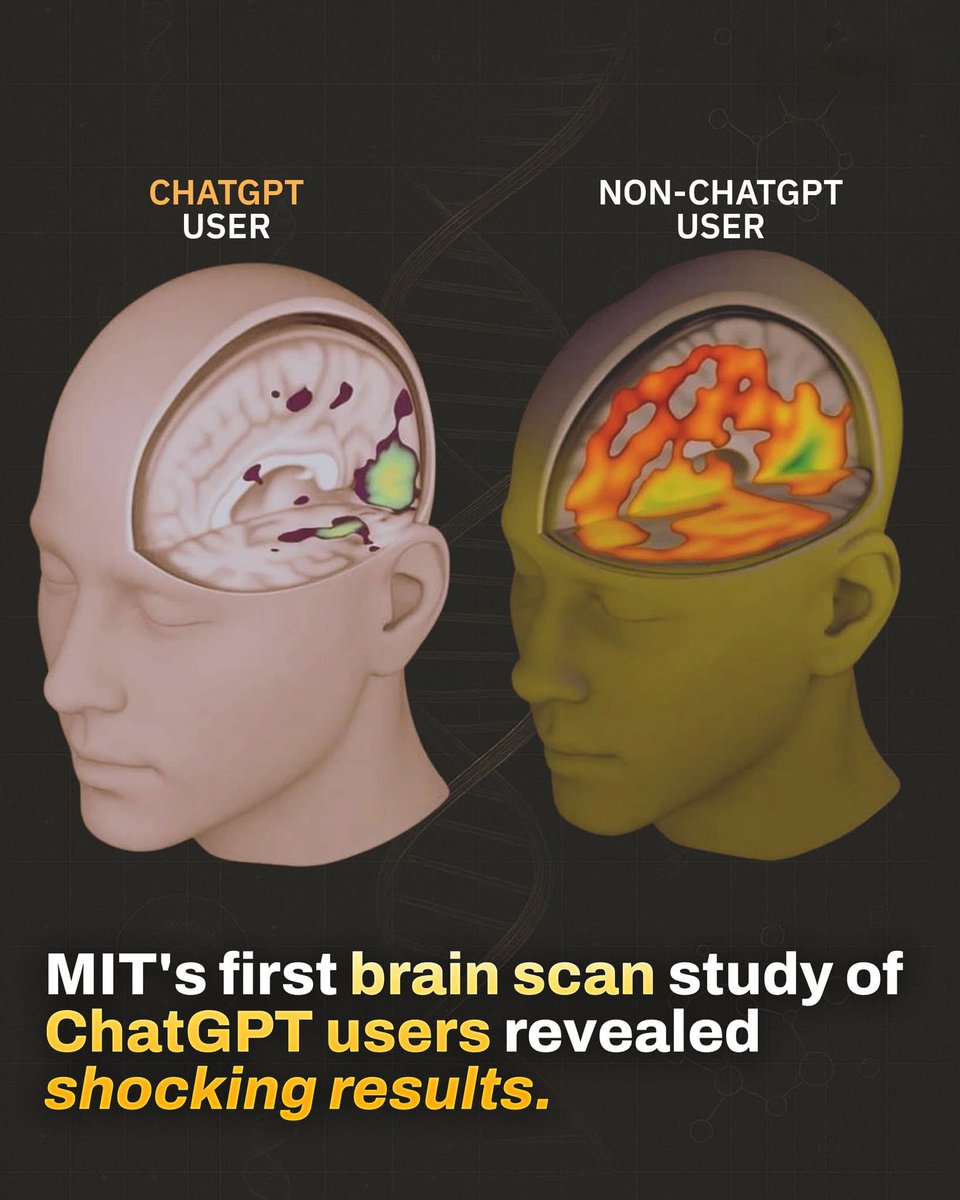
🧠 MIT recently completed the first brain-scan study on ChatGPT users—and the results are deeply revealing. Rather than boosting brain function, prolonged AI use may be dulling it. Over four months of cognitive data suggest we might be measuring productivity all wrong ⤵️ In MIT’s study, participants had their brains scanned while using ChatGPT. → 83.3% of users couldn’t recall a single sentence they’d written just minutes earlier. → In contrast, those writing without AI had no trouble remembering. Brain connectivity dropped sharply—from 79 to 42 points. → That’s a 47% drop in neural engagement. → The lowest cognitive performance among all user groups. Even after stopping ChatGPT use in later sessions, these users showed continued under-engagement. → Their performance remained lower than those who never used AI. → This suggests more than dependency—it’s cognitive weakening. Beyond the scans, educators flagged the writing itself. → Essays were technically solid, but often called “robotic,” “soulless,” and “lacking depth.” Here’s the paradox: → ChatGPT makes you 60% faster at completing tasks… → But it reduces the mental effort required for learning by 32%. The top-performing group? → Those who began without AI and added it later. → They retained the best memory, brain activity, and overall scores. Using ChatGPT can feel empowering—but it may quietly offload your thinking. → You gain speed, but lose engagement. → You get answers, but stop learning how to think. The takeaway isn’t to avoid AI—but to use it intentionally. → Use it to assist, not replace your mind. → Build cognitive strength—not dependency. MIT’s early study on AI and the brain lays out the stakes. The way we use these tools matters more than ever.
Next Science tweet media
English
710
2.2K
8.8K
1.3M
Sean Cronin retweetledi
Carl Hendrick
Carl Hendrick@C_Hendrick·
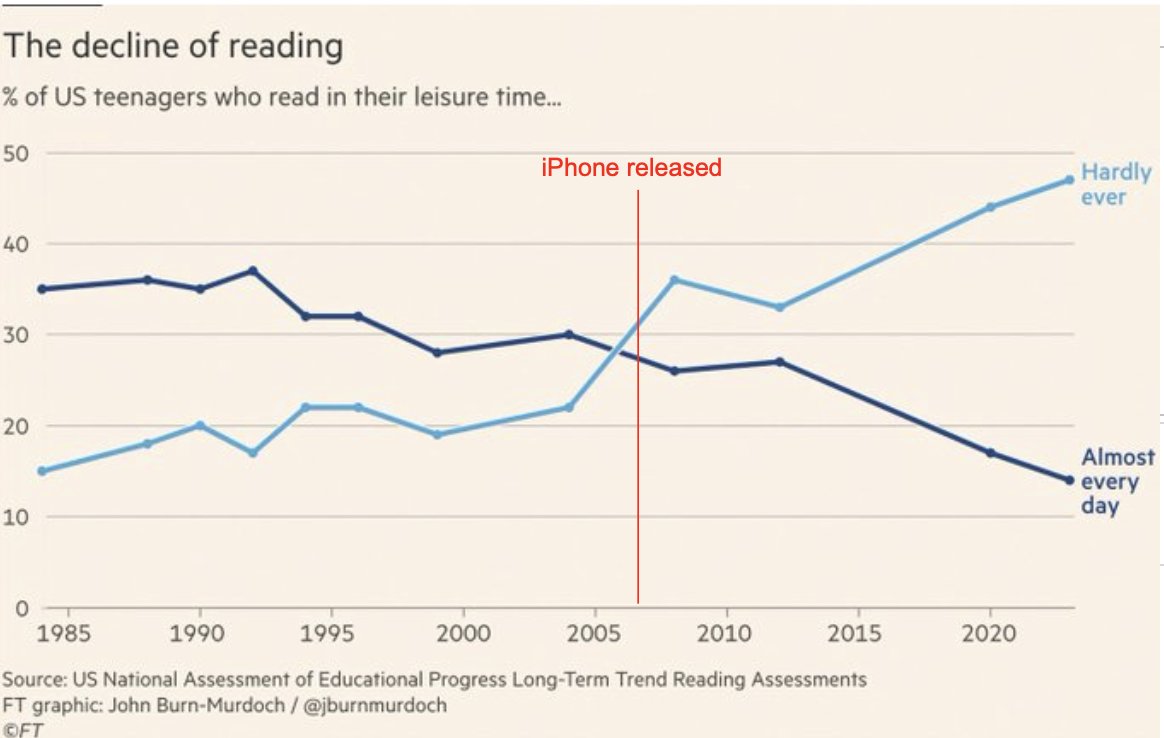
@paulg If this were a medical chart, the iPhone release would be labelled ‘onset’.
Carl Hendrick tweet media
English
11
11
57
4.4K
Sean Cronin retweetledi
Brandon Luu, MD
Brandon Luu, MD@BrandonLuuMD·
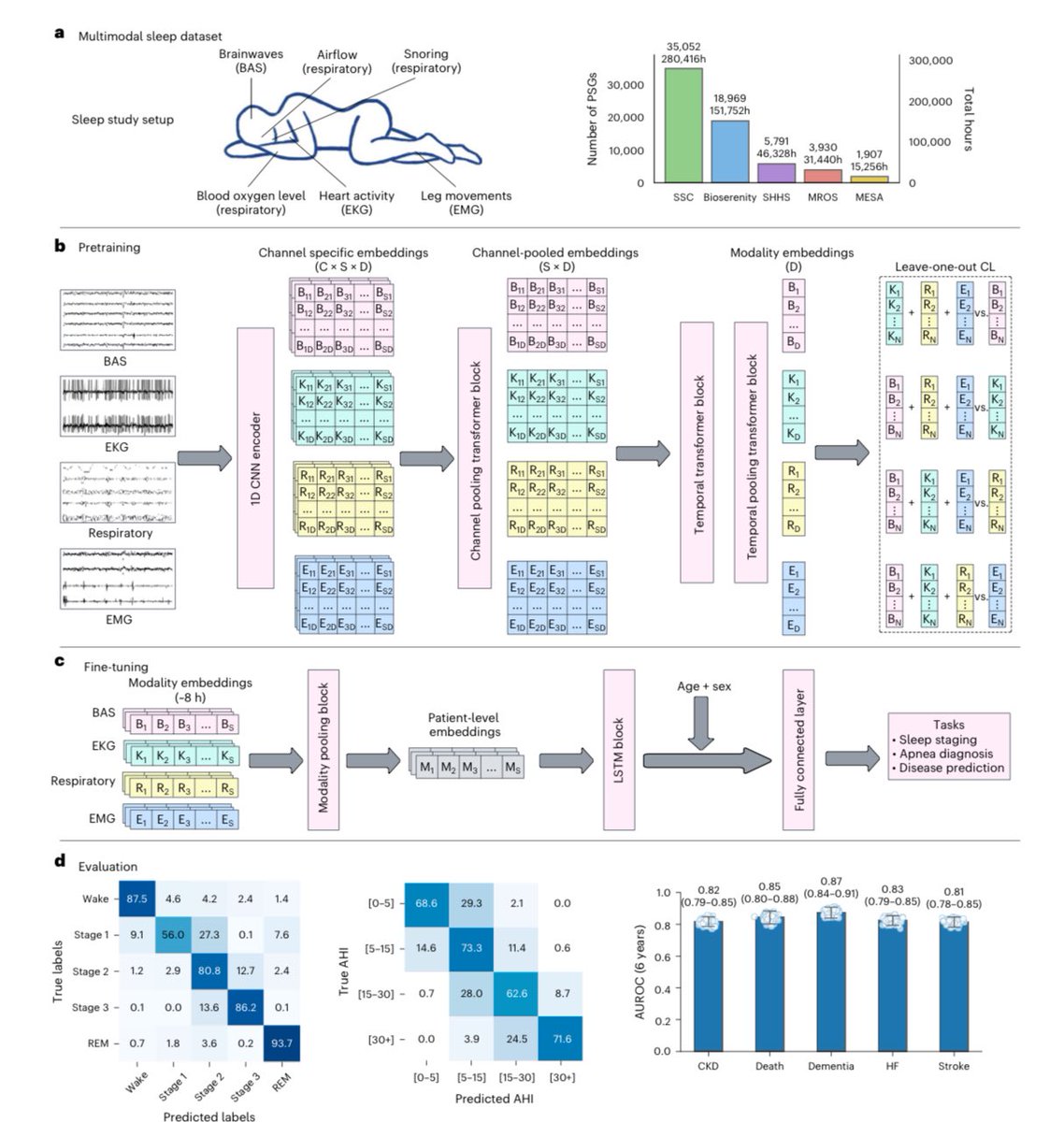
Circadian rhythm dysfunction is highly prevalent in ADHD Up to ~75% of patients have delayed sleep and wake timing, and shifting the clock earlier is linked to symptom improvement I just published a paper on what this means for treatment. Here’s what we found 🧵1/12
Brandon Luu, MD tweet media
English
190
1.4K
9.4K
3.6M
Sean Cronin retweetledi
Aadit Sheth
Aadit Sheth@aaditsh·
The most dangerous addiction today isn't a substance. Research on 100,000 people confirms that heavy short-form video use is just voluntary cognitive decline. We are actively training our brains to fail at hard tasks. If you can simply sit with a problem for 10 minutes without swiping, you have a massive competitive advantage. Basically, boredom is the new IQ.
Aadit Sheth tweet media
English
324
4.2K
19.8K
2.7M
Sean Cronin retweetledi
Jonathan Haidt
Jonathan Haidt@JonHaidt·
There is more and more evidence that putting computers and tablets on students' desks (1:1 devices) was a terrible mistake. I agree with @AdamMGrant that "it's time to remove laptops [and tablets] from classrooms."
Adam Grant@AdamMGrant

It's time to remove laptops from classrooms. 24 experiments: Students learn more and get better grades after taking notes by hand than typing. It's not just because they're less distracted—writing enables deeper processing and more images. The pen is mightier than the keyboard.

English
103
702
4K
258.8K
Sean Cronin retweetledi
Marc Brackett
Marc Brackett@drmarcbrackett·
I was speaking at a school about the role of emotionally intelligent leadership, teaching, and learning. At the same time, outside a neighboring school, ICE officers stood with rifles. That image has stayed with me. It’s still unsettling—especially knowing what I know about child development. Fear in early life doesn’t just fade; it shapes the brain and rewrites a child’s sense of safety and belonging. If we truly care about children’s mental health, the people with the greatest power and influence must become as educated in child development and humanity as they are in policy and enforcement. Because every child’s nervous system is taking notes.
English
0
2
10
761
Sean Cronin retweetledi
Brian Roemmele
Brian Roemmele@BrianRoemmele·
The average price of electricity per Kilowatt-hour in the United States. This is unsustainable.
Brian Roemmele tweet media
English
1.8K
1.9K
11.9K
2.9M
Sean Cronin retweetledi
Shivon Zilis
Shivon Zilis@shivon·
Sometimes the universe quietly cheers
Shivon Zilis tweet media
English
355
463
6.5K
258.2K
Sean Cronin retweetledi
Adam Grant
Adam Grant@AdamMGrant·
Intelligence depends on more than cognitive horsepower. It requires cognitive flexibility. The faster the world evolves, the greater the cost of rigidity. Stubbornness is a path to getting trapped in the past. The future belongs to those with the courage to change their minds.
Adam Grant tweet media
English
49
565
2K
181.7K
Sean Cronin retweetledi
Peter H. Diamandis, MD
Peter H. Diamandis, MD@PeterDiamandis·
Mentor and co-create, don’t lecture. AI should be a creative partner—not a shortcut. Google DeepMind’s Stefania Druga taught children using AI in tools like Cognimates to build games and train models—not just get answers.
English
2
2
18
1.2K