
David Hanacek retweetledi
David Hanacek
2.4K posts


David Hanacek
@SD_Cloudy
Solution Architect @ Red Hat - let's simplify clouds, apps and infrastructure. vExpert '14, '16-'18, '20-'22, VCP2-5 My tweets are my personal view.
Vienna Katılım Mayıs 2013
632 Takip Edilen523 Takipçiler


Part 5 🍿
(Final)
The divorce took five months.
That sounds fast unless you are the person living inside it. Then, five months is long enough to age a year every week.
May was depositions.
June was financial discovery.
July was custody evaluation reports, attorney letters, and Paige trying three different emotional strategies in the parking lot after exchanges. First, she was sorry. Then she was angry. Then she was nostalgic.
English
David Hanacek retweetledi

Sonja Pikart erklärt hier mal kurz mal die Gedankengänge von Lindemann, Connemann, Ploß, Merz, Spahn, Frey, Bilger, Hoffmann, ...
Deutsch
David Hanacek retweetledi
Katastrophen Montag...
Heute gegen Mittag, Handy klingelt:
"Hömma Maxi, kann man eigentlich heutzutage noch Autos anschieben zum Starten?"
Ich:
"Tendenziell ja...will ich wissen warum du mich das fragst?"
Er:
"Ach, meine Batterie ist tot, der Anlasser klackt nur noch und ich bin am Arsch von Nirgendwo, deswegen frag ich"
Ich:
"Achso, ja sollte aber gehen"
Er:
"Okay, danke dann probiere ich das jetzt"
*Legt auf
(So nach 5 Minuten hab ich irgendwie ein ungutes Gefühl im Nacken... irgendwas stimmt nicht...)
10 weitere Minuten später - Handy klingelt:
"Hömma! Ich komme anscheinend nicht schnell genug von N in D! Muss ich da noch irgendwas anderes machen? Oder ist..."
Ich grätsche ihm ins Wort:
"Du hast bitte NICHT versucht nen Automatik anrollen zu lassen???"
Er:
"Du hast doch gesagt das geht! Beim letzten Versuch hat auch alles blockiert und es hat ziemlich gekracht!"
Ich:
"Okay...Okay...also...du hast den Ofen in N angerollt und dann schnell in D geschaltet...richtig?"
Er:
"Ja..."
Ich:
"Bist du im ADAC?"
Er:
"Ja..."
Ich:
"Dann ruf den ADAC jetzt an, hoffentlich hast du das Getriebe nicht zerstört!"
Er:
"Okay..."
*Legt auf
(Ich schüttel den Kopf...sage zu mir selbst, dass ich zu alt werde für den scheiß...)
Vor ca 15 Minuten hat er mich nochmal angerufen und gesagt, dass der ADAC jetzt sein Auto aufgeladen hat...und zwar ohne das Automatikgetriebe in N zu schalten...denn das Fahrzeug ließ sich in P rollen...herzlichen Glückwunsch...
Zum Glück (für mich) lässt er es NICHT zu mir schleppen, sondern in eine andere Werkstatt...auch wenn ich mir den Gulasch den er im inneren des Automatikgetriebes produziert hat, gern ansehen würde
(Ich tippe auf eine gebrochene Welle oder abgerissenen Wandler...auf jeden Fall brachial)
Long Story Short:
Ihr könnt natürlich ein Fahrzeug MIT SCHALTGETRIEBE (!!!) im Notfall (Batterie tot oder Anlasser defekt) anrollen lassen:
-Zündung einschalten
-2. Gang einlegen
-Kupplung getreten halten
-Fahrzeug anschieben lassen
-Kupplung zügig kommen lassen
-leicht Gas geben
-Brummm
Das funktioniert NUR BEI EINEM SCHALTGETRIEBE!!
NICHT BEI EINEM AUTOMATIKGETRIEBE!!!
Ich mach mir jetzt mal Rheuma Salbe in den Nacken...der tut nämlich weh vom kopfschütteln...
Danke fürs Lesen
Euer Maxi 🔧⚙️
Deutsch
David Hanacek retweetledi

Wir haben in Deutschland verlernt systemisch zu denken!
Die Aussage von #LarsThomsen beim VDI in Karlsruhe trifft einen wunden Punkt der aktuellen Debatte. Er argumentiert sehr prägnant, dass wir in Deutschland oft in isolierten Problemen denken, anstatt die 𝘀𝘆𝘀𝘁𝗲𝗺𝗶𝘀𝗰𝗵𝗲𝗻 𝗩𝗼𝗿𝘁𝗲𝗶𝗹𝗲 der Energiewende zu begreifen.
Seine Kernpunkte aus dem Clip lassen sich gut zusammenfassen:
1. Das Trauma der Abhängigkeit
Thomsen erinnert an den Ölpreis-Schock von 1973. Damals wurde Deutschland schmerzhaft bewusst, wie abhängig es von externen Akteuren ist. Er kritisiert, dass wir über 50 Jahre später (im Jahr 2026) immer noch so agieren, als wäre diese Abhängigkeit von fossilen Brennstoffen alternativlos.
2. Die unterschätzte Dynamik der #Erneuerbaren #Energien!
Er nennt beeindruckende Zahlen, um die Dimensionen zu verdeutlichen:
- 𝗔𝘂𝘀𝗯𝗮𝘂𝗿𝗮𝘁𝗲: Deutschland baut derzeit alle 30 Tage etwa 1 𝗚𝗶𝗴𝗮𝘄𝗮𝘁𝘁 (GW) neue Photovoltaik-Leistung zu.
- 𝗞𝗮𝗽𝗮𝘇𝗶𝘁ä𝘁: Mit über 100 𝗚𝗪 Solarleistung haben wir an sonnigen Tagen bereits einen massiven Energieüberschuss, der die Strompreise mittags ins Negative treibt.
3. Das Effizienz-Argument (Systemisches Denken)
Sein Vergleich zwischen Photovoltaik (PV) und fossilen Brennstoffen ist das Herzstück seiner Kritik am "fehlenden systemischen Denken":
- 𝗘𝗶𝗻 𝗦𝗰𝗵𝗶𝗳𝗳 𝘃𝗼𝗹𝗹𝗲𝗿 𝗦𝗼𝗹𝗮𝗿𝗽𝗮𝗻𝗲𝗲𝗹𝗲 aus China liefert über deren Lebensdauer 85-𝗺𝗮𝗹 𝗺𝗲𝗵𝗿 𝗘𝗻𝗲𝗿𝗴𝗶𝗲 nach Deutschland als ein Tanker mit Öl oder Gas.
- 𝗗𝗲𝗿 𝗨𝗻𝘁𝗲𝗿𝘀𝗰𝗵𝗶𝗲𝗱: Fossile Brennstoffe werden einmal verbrannt und sind weg. Solarpaneele sind eine Investition in die Infrastruktur, die über Jahrzehnte hinweg "erntet".
4. Die psychologische Hürde
Thomsen beobachtet eine Art kollektives "Nicht-wahrhaben-Wollen". Trotz der technologischen Überlegenheit und der sinkenden Kosten klammern sich viele Menschen an alte Denkmuster ("Habt ihr noch was? Bitte... Öl!"). Er plädiert dafür, Energie nicht mehr als Verbrauchsgut zu sehen, das man ständig nachkaufen muss, sondern als 𝗜𝗻𝗳𝗿𝗮𝘀𝘁𝗿𝘂𝗸𝘁𝘂𝗿𝗮𝘂𝗳𝗴𝗮𝗯𝗲, die uns langfristig günstiger und unabhängig macht.
Es ist ein starkes Plädoyer für einen Perspektivwechsel: Weg vom kleinteiligen Verwalten von Krisen, hin zum Verstehen der neuen, exponentiellen Energiewelt.
#Energiewende
Deutsch
David Hanacek retweetledi

Lars Thomsen, renommierter Zukunftsforscher und Top-Redner, bietet wegweisende Keynotes zu den Herausforderungen der Zukunft. Seine Expertise umfasst Arbeit, Energie, Mobilität und KI. Mit brillantem Storytelling öffnet er neue Perspektiven.
Deutsch
David Hanacek retweetledi

If you recognize what's happening here, you're part of a generation that also spent endless hours fine-tuning autoexec.bat and config.sys files.
And if you're not sure what's going on in the video, I honestly envy your youth.
English
David Hanacek retweetledi

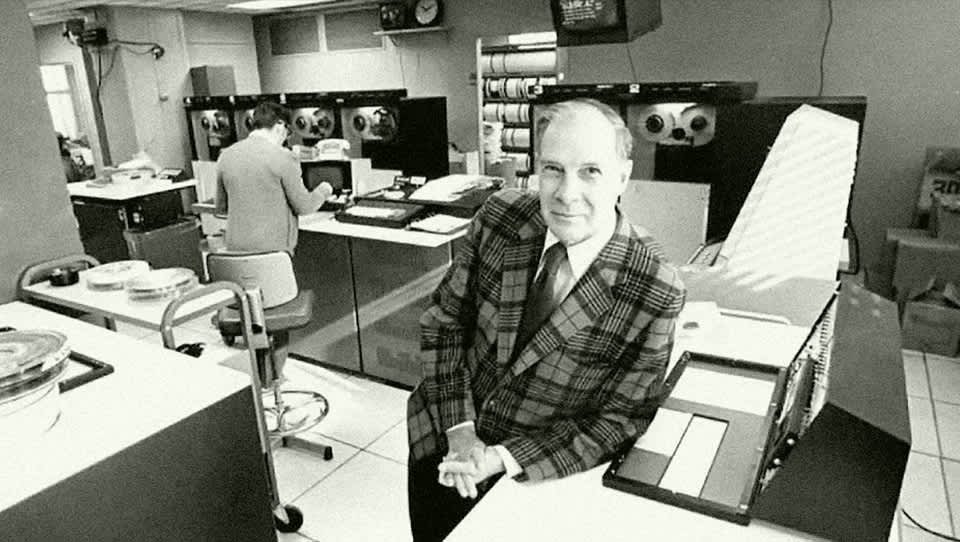
A mathematician who shared an office with Claude Shannon at Bell Labs gave one lecture in 1986 that explains why some people win Nobel Prizes and other equally smart people spend their whole lives doing forgettable work.
His name was Richard Hamming. He won the Turing Award. He invented error-correcting codes that made modern computing possible. And he spent 30 years at Bell Labs sitting in a cafeteria at lunch watching which scientists became legendary and which ones faded into nothing.
In March 1986, he walked into a Bellcore auditorium in front of 200 researchers and told them exactly what he had seen.
Here's the framework that has been quoted by every serious scientist for the last 40 years.
His opening line landed like a punch. He said most scientists he worked with at Bell Labs were just as smart as the Nobel Prize winners. Just as hardworking. Just as credentialed. And yet at the end of a 40-year career, one group had changed entire fields and the other group was forgotten by the time they retired.
He wanted to know what the difference actually was. And he said it wasn't luck. It wasn't IQ. It was a specific set of habits that almost nobody is willing to follow.
The first habit was the one that hurts the most to hear. He said most scientists deliberately avoid the most important problem in their field because the odds of failure are too high. They pick a safe adjacent problem, solve it cleanly, publish it, and move on. And because they never swing at the hard problem, they never hit it. He said if you do not work on an important problem, it is unlikely you will do important work. That is not a motivational line. That is a logical one.
The second habit was about doors. Literal doors. He noticed that the scientists at Bell Labs who kept their office doors closed got more done in the short term because they had no interruptions. But the scientists who kept their doors open got more done over a career. The open-door scientists were interrupted constantly. They also absorbed every new idea passing through the hallway. Ten years in, they were working on problems the closed-door scientists did not even know existed.
The third habit was inversion. When Bell Labs refused to give him the team of programmers he wanted, Hamming sat with the rejection for weeks. Then he flipped the question. Instead of asking for programmers to write the programs, he asked why machines could not write the programs themselves. That single inversion pushed him into the frontier of computer science. He said the pattern repeats everywhere. What looks like a defect, if you flip it correctly, becomes the exact thing that pushes you ahead of everyone else.
The fourth habit was the one that hit me the hardest. He said knowledge and productivity compound like interest. Someone who works 10 percent harder than you does not produce 10 percent more over a career. They produce twice as much. The gap doesn't add. It multiplies. And it compounds silently for years before anyone notices.
He finished the lecture with a line I have never been able to shake.
He said Pasteur's famous quote is right. Luck favors the prepared mind. But he meant it literally. You don't hope for luck. You engineer the conditions where luck can land on you. Open doors. Important problems. Inverted questions. Compounded hours. Those are not traits. Those are choices you make every single day.
The transcript has been sitting on the University of Virginia's computer science website for almost 30 years. The video is free on YouTube. Stripe Press reprinted the full lectures as a book in 2020 and Bret Victor wrote the foreword.
Hamming died in 1998. He gave his final lecture a few weeks before. He was 82.
The lecture that explains why some careers become legendary and others disappear is still free. Most people who could benefit from it will never open it.
English
David Hanacek retweetledi

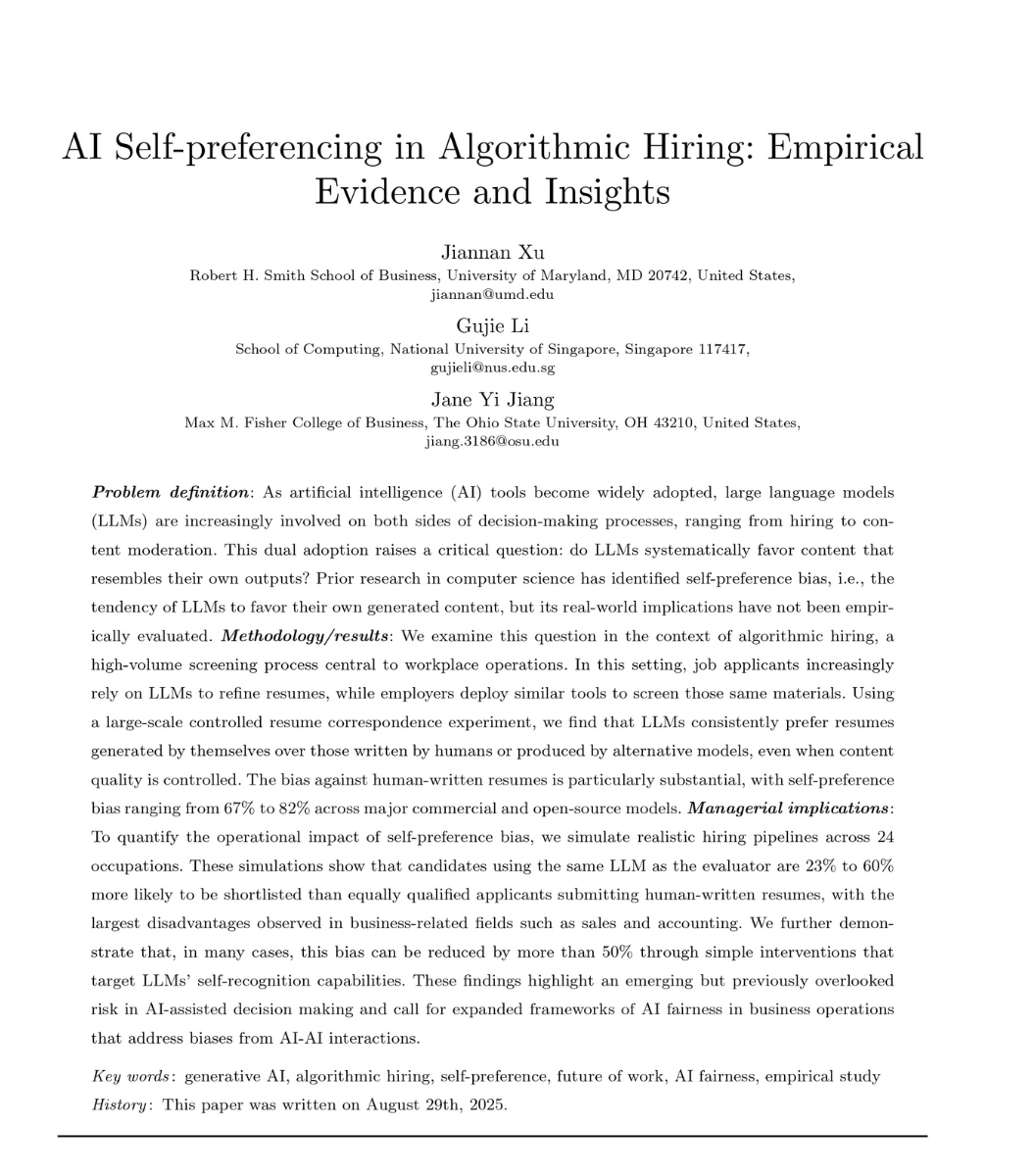
Researchers sent the same resume to an AI hiring tool twice. Same qualifications. Same experience. Same skills. One version was written by a real human. The other was rewritten by ChatGPT.
The AI picked the ChatGPT version 97.6% of the time.
A team from the University of Maryland, the National University of Singapore, and Ohio State just published the receipt. They took 2,245 real human-written resumes pulled from a professional resume site from before ChatGPT existed, so the human writing was actually human. Then they had seven of the most-used AI models in the world rewrite each one. GPT-4o. GPT-4o-mini. GPT-4-turbo. LLaMA 3.3-70B. Qwen 2.5-72B. DeepSeek-V3. Mistral-7B.
Then they asked each AI to pick the better resume. Every model picked itself.
GPT-4o hit 97.6%. LLaMA-3.3-70B hit 96.3%. Qwen-2.5-72B hit 95.9%. DeepSeek-V3 hit 95.5%. The real human almost never won.
Then the researchers tried the obvious objection. Maybe the AI is just better at writing. So they had real humans grade the resumes for actual quality and ran the experiment again, controlling for it. The result was worse. Each AI kept picking itself even when human judges rated the human-written version as clearer, more coherent, and more effective.
It gets worse. The AIs do not just prefer AI over humans. They prefer themselves over other AIs. DeepSeek-V3 picked its own resumes 69% more often than LLaMA's. GPT-4o picked its own 45% more often than LLaMA's. Each model can recognize and reward its own dialect.
Then the researchers ran the simulation that ends careers. Same job. 24 occupations. Same qualifications. The only variable was whether the candidate used the same AI as the screening tool. Candidates using that AI were 23% to 60% more likely to be shortlisted. Worst gap was in sales, accounting, and finance.
99% of large companies now run AI on incoming resumes. Most of them use GPT-4o. The paper just proved GPT-4o picks GPT-4o 97.6% of the time.
If you wrote your own cover letter this week, you did not lose to a better candidate. You lost to a worse candidate who paid OpenAI 20 dollars.
Your qualifications do not matter if the AI prefers its own handwriting over yours.
English
David Hanacek retweetledi

@astro_reid @Astro_Christina The closest humanity ever got to world peace was when astronaut Victor Glover spoke these words on his way to the moon.
"You are special in all of this emptiness"
English
David Hanacek retweetledi

In March 2020, Marriott's CEO was dying of pancreatic cancer.
He had to furlough 115,000 employees on camera.
The video he recorded that day is still studied in business schools.
Here's what he did that most CEOs won't:

English
David Hanacek retweetledi


David Hanacek retweetledi

Mo Gawdat spent years inside the machine at Google X.
Now he is saying out loud what the economists will not.
Gawdat: “The very base of capitalism, which is labor arbitrage, to hire you for a dollar and then sell what you make for two, is going to disappear.”
That is not a prediction. That is a coroner’s report on a system that has not stopped breathing yet.
Capitalism was never about innovation. It was about one equation. Buy human time cheap. Sell the output high. Pocket the spread.
Every empire. Every fortune. Every supply chain on Earth was built on that margin.
AI just closed it to zero.
A humanoid robot now costs $9,000. It does not sleep. It does not negotiate. It does not quit. It runs every hour of every day at a quality ceiling no biological worker will ever touch.
When production costs fall to nearly nothing, the entire pricing structure of the global economy falls with it.
But here is what every CEO celebrating margin expansion has not thought through for five minutes.
Gawdat: “Even if you can have all of the productivity gains in the world, by firing people consistently, nobody’s able to buy what you’re making.”
That single sentence should end every strategy meeting on the planet.
Capitalism is a closed loop. You pay workers. Workers become consumers. Consumers buy products. Revenue funds the next payroll.
Cut the worker and you do not just eliminate a cost. You eliminate the customer.
Every company racing to automate headcount out of existence is quietly engineering the death of its own demand.
They are building the most efficient production systems in human history to sell to a population that no longer has income.
50% unemployment is not a recession. It is the demand side of the economy going permanently dark.
You cannot push infinite supply into zero purchasing power. The math does not care about your earnings call.
Gawdat: “Wealth is going to have very little meaning for most of us in a few years’ time.”
This is where it turns on the people who think they are winning.
If production approaches zero cost, scarcity begins to dissolve. And scarcity is the only reason money holds value in the first place.
The billionaire class is stockpiling a currency that is quietly losing its reason to exist.
Gawdat: “So the entire capitalist model has to be rethought.”
He is right. And nobody in power is doing the rethinking.
Every board meeting about efficiency is a conversation about dismantling the very economic engine that made the board meeting possible.
The question was never whether AI could produce enough.
It was whether capitalism could survive its own success.
The machine does not just replace the worker. It erases the consumer.
And a system that can produce everything but sell nothing is not an economy.
It is a machine that perfected itself into extinction.
English
David Hanacek retweetledi
A Soviet psychologist walked into a café in 1927 and watched a waiter do something impossible.
He remembered every open order at every table. Perfectly. Without notes. Without effort.
Then a table paid their bill. She asked him to repeat the order.
He couldn't remember a single item.
She spent the next two years figuring out why. What she found is now the operating system underneath every platform fighting for your attention.
Her name was Bluma Zeigarnik, and she was a graduate student at the time, sitting with her professor Kurt Lewin, watching the waiters work the room. What caught her attention was something so ordinary that it had been happening in restaurants for centuries without anyone asking why.
The waiters could remember every open order with perfect accuracy. Table four wanted the schnitzel with no sauce. Table seven had changed their wine twice. Table twelve owed for three coffees and a dessert. Every detail, held without effort, without notes, without any visible system at all.
But the moment a table paid their bill, the information vanished. Completely. Lewin tested it on the spot. He called a waiter back minutes after a table had settled up and asked him to recite the order. The waiter could not do it. Not partially. Not approximately. The information was simply gone.
Zeigarnik went back to her lab and spent the next two years turning that observation into one of the most replicated findings in the history of psychology.
Here is what she proved, and why it changes how you think about attention, memory, and almost every piece of media you have ever consumed.
She gave participants a series of tasks. Some tasks they were allowed to finish. Others were interrupted before completion. Then she tested recall across both groups.
The unfinished tasks were remembered at nearly twice the rate of the completed ones.
Not slightly better. Nearly twice. The brain was holding the incomplete work in a state of active tension, returning to it, keeping it warm, refusing to file it away. The finished tasks were closed, archived, released. The unfinished ones were still running.
She called it the resumption goal. When the brain commits to a task and cannot complete it, it opens a file that stays open until resolution arrives. That open file consumes a portion of your cognitive bandwidth whether you are thinking about it consciously or not. It surfaces in idle moments. It pulls at the edge of your attention during other work. It is the thing you find yourself thinking about in the shower when you were not trying to think about anything at all.
This is not a flaw in human cognition. It is a feature. The brain evolved to finish things. An open loop is a signal that something important is unresolved. Keeping that signal active increases the probability that you will return to it and complete it. In an environment where most tasks had real survival stakes, this was an extraordinarily useful mechanism.
In the modern world, it is the most exploited vulnerability in human attention.
Netflix did not invent the cliffhanger. But it industrialized it in a way no medium before it ever had. When a show ends on an unresolved question, it does not just create curiosity. It opens a file in your brain that stays active until the next episode closes it. The autoplay countdown that begins at 15 seconds is not a convenience feature. It is a precise calculation about how long the average person can tolerate an open loop before the discomfort of not knowing overrides every other intention they had for the evening. One more episode is not a choice. It is your brain doing exactly what it was designed to do: return to what is unfinished.
The writers who built Lost, Breaking Bad, and Succession understood this intuitively without ever reading a psychology paper. Every episode ended on an open question. Every season finale answered three things and opened five more. The entire architecture of prestige television is a Zeigarnik machine running at industrial scale.
But television is not where this gets dangerous.
Every notification on your phone is an open loop. Every unread email is an open loop. Every task you wrote on a list and have not yet crossed off is an open loop. Each one is consuming a small but real portion of your available attention, pulling fractionally at your focus, degrading your capacity to be fully present in whatever you are actually doing right now. TikTok's algorithm does not just serve you content you like. It serves you content that ends one loop and immediately opens another, keeping the resumption system permanently activated so the cost of stopping always feels higher than the cost of continuing.
The research on this accumulation effect is striking. Psychologists studying cognitive load have found that unfinished tasks do not sit passively in memory. They actively interrupt. They surface at the wrong moments. They are the reason you are reading something and suddenly remember an email you forgot to send. The brain is not malfunctioning. It is running its resumption system exactly as designed. It is just running it across forty open loops simultaneously, in an environment that generates new ones faster than any human nervous system was built to process.
The most important practical implication Zeigarnik's research produced is one that most people use backwards.
David Allen built his entire Getting Things Done system on the insight that the only way to close a cognitive open loop is to either complete the task or make a trusted commitment to complete it later. Writing something down in a system you actually trust has the same effect on the brain as finishing it. The file closes. The bandwidth is released. This is why writing a task down feels like relief even before you have done anything about it. You have not solved the problem. You have simply told your brain that the loop is registered and will be returned to, which is enough for the resumption system to stand down.
The inverse is equally true and far more destructive. Every task that lives only in your head, unwritten and unscheduled, is an open loop burning cognitive resources around the clock. The mental cost is not proportional to the size of the task. A tiny nagging obligation consumes the same active tension as a major project. Your brain does not discriminate by importance. It discriminates by completion.
Zeigarnik published her findings in 1927. The paper sat in academic literature for decades before anyone outside psychology paid attention to it.
Then television got good. Then the smartphone arrived. Then the entire attention economy was engineered, largely by people who understood intuitively what she had proven scientifically: an open loop is the most powerful hook available to anyone who wants to hold human attention.
Netflix knew it. Instagram knew it. Every designer who ever made a notification badge red instead of grey knew it.
The café in Vienna is long gone.
The mechanism she discovered there is now the operating system underneath every platform fighting for your time.
Every "to be continued."
Every unread notification.
Every thread that ends with "part 2 tomorrow."
All of it is the same waiter, the same unpaid bill, the same brain refusing to let go of what it has not yet finished.
Zeigarnik noticed it over coffee in 1927.
A century later, it is the most valuable insight in the history of media.
And nobody taught it to you in school.

English
David Hanacek retweetledi

David Hanacek retweetledi

A team of 8 senior engineers had been debugging the same production issue for 6 weeks.
Daily incidents. Angry customers. Leadership pressure. Eight brilliant people. Zero answers.
Melly joined the company on a Monday. By Thursday afternoon she had found it.
Not because she was smarter than 8 senior engineers but
Because she asked a question — nobody had thought to ask. 🧵
English
David Hanacek retweetledi

I ACCIDENTALLY OPENED MY CTO'S PERSONAL NOTION WORKSPACE AND NOW I UNDERSTAND WHY HE SHIPS 5X FASTER THAN THE REST OF US.
He is 48. I am 26. He manages 3 products and never works past 5 PM.
I work 10 hours a day and barely clear my Jira board.
In his workspace, one specific document explained everything:
Most people panic when the workload scales. They work longer hours, burn out, and eventually drop the ball. High performers do not manage time. They manage boundaries.
The document was a list of strict operating rules. Here are 18 systems you can steal.
English