

Resilient in Solitude
35 posts
Resilient in Solitude
@SOARinSolitude
ERC-funded research "SOAR: Solitude, Alone and Resilient". Explored what makes some people more psychologically resilient to solitude or even flourish in it.
United Kingdom Katılım Mart 2020
36 Takip Edilen69 Takipçiler
Thank you for your important research!
Resilient in Solitude@SOARinSolitude
@belladepaulo, the author of many books about single life (e.g., Singled Out) wrote a piece on our recent research interviewing people's experiences with solitude during the pandemic. Growing, Learning, Connecting: The Benefits of Being Alone | PsychToday psychologytoday.com/us/blog/living…
English
@belladepaulo, the author of many books about single life (e.g., Singled Out) wrote a piece on our recent research interviewing people's experiences with solitude during the pandemic.
Growing, Learning, Connecting: The Benefits of Being Alone | PsychToday psychologytoday.com/us/blog/living…
English
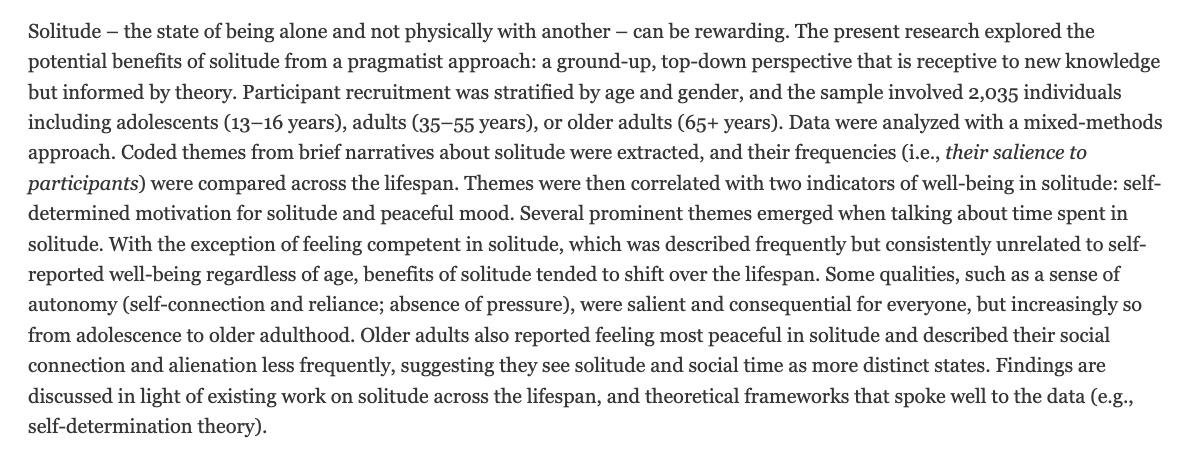
This research suggested that as people get older, there might be mixed reactions to solitude, and people recognise both costs and benefits. Therefore, future research is need to explore boundary conditions that distinguish when solitude is beneficial and when it is costly. End/
English
The difference in self-determined motivation across age groups could be explained by "the timing of this study...which limited choice and opportunities for many older adults who were self-shielding". Nonetheless older adults in this sample have found solitude to be peaceful. 5/
English
New ERC-funded open-access work by Netta Weinstein, @thuyvytnguyen, and @OurBestPlaces used mixed-method approach to study time spent in solitude during 3 months of the COVID-19 outbreak. doi.org/10.3389/fpsyg.…
English
Resilient in Solitude retweetledi
Love what Lahiri has to say about solitude. Haven’t read Whereabouts yet. If you have, what did you think?
#books @WeAreSoloLiving @Mike_JIS @PeterMcGraw @SOARinSolitude
belladepaulo.medium.com/the-powerful-a…
English
Resilient in Solitude retweetledi
They didn’t want to stay single. The pandemic could have been a disaster. I just love how their stories turned out.
@Steph_Spielmann @SinglehoodS @shanisilver @nsrodgers @CCF_Families @WeAreSoloLiving @Mike_JIS @PeterMcGraw @SOARinSolitude
psychologytoday.com/us/blog/living…
English
Resilient in Solitude retweetledi
For the #SingleAtHeart, the pandemic has reaffirmed our commitment to living single.
nbcnews.com/think/opinion/…
@thuyvytnguyen @CCF_Families @SinglehoodS @cisasite @WeAreSoloLiving @Mike_JIS @PeterMcGraw
@shanisilver @FamilyStoryProj @be975e7997b04c8 @ElyakimKislev
English
@belladepaulo @WeAreSoloLiving @Mike_JIS @PeterMcGraw @stephronyt A quote by Ester Buchholz: "The remarkable fact is that, despite bias in language, admonishments about evils of the solitaire, and the long-taught and sometimes unshakable fears associated with alonetime, a desire to be alone remains." (Buchholz, 1997, p. 31)
English
Resilient in Solitude retweetledi
Have I missed any of your favorite quotes?
@WeAreSoloLiving @Mike_JIS @SOARinSolitude @PeterMcGraw @stephronyt
#books #DontUnsingleYourself
belladepaulo.medium.com/solitude-is-th…
English
Resilient in Solitude retweetledi
I don’t know, for sure, the answer to the question of whether anyone can come to love being alone. But I feel immensely fortunate, esp these days, that I am among those who cherishes solitude.
@ThatVDOVault @WeAreSoloLiving @Mike_JIS @SOARinSolitude
belladepaulo.medium.com/can-anyone-com…
English
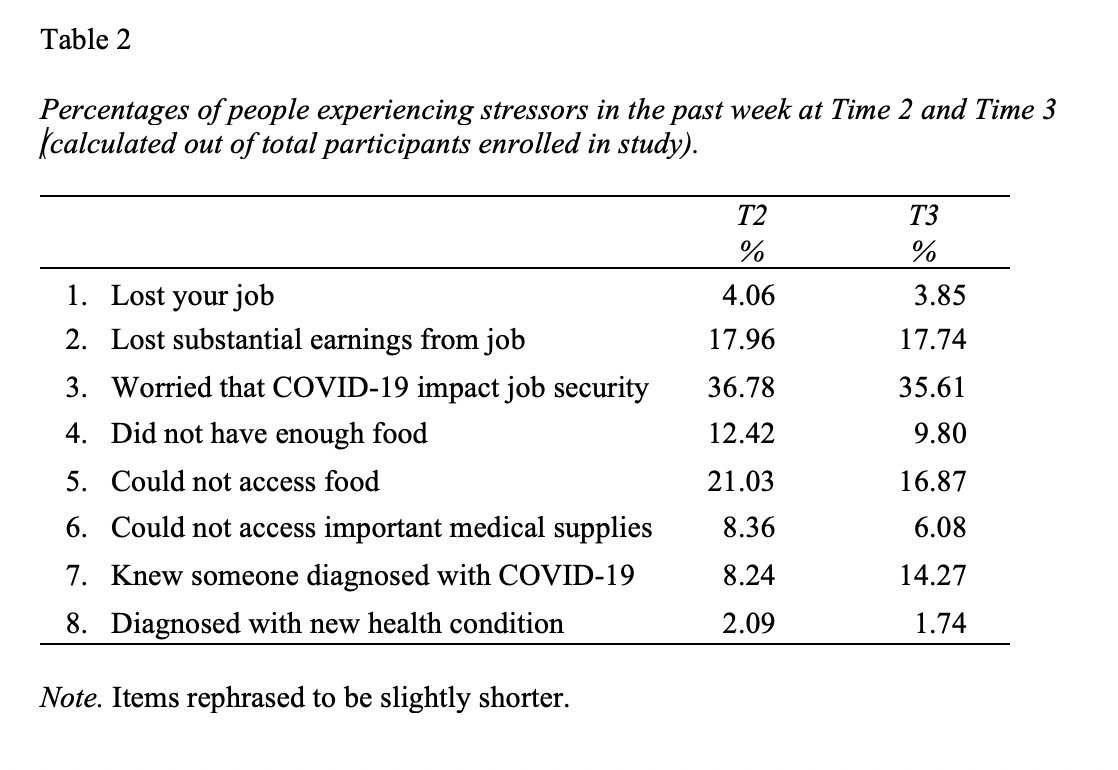
Two interesting tables in our paper reporting experiences of adults living alone in US & UK during lockdown.
When asked to check (x) which stressor(s) people have experienced in the past week, job security was the most frequently selected items, followed by access to food.
Chris Chambers@chrisdc77
UPDATE: We just accepted the first Stage 2 article as part of our #COVID19 @RegReports initiative Among other findings, Weinstein & @thuyvytnguyen cautiously report no evidence (in UK/US sample) that the early weeks of self-isolation harm mental health psyarxiv.com/pbgq7
English
Resilient in Solitude retweetledi

Is self-isolating alone actually bad for our mental health? We hear from the authors of a new #RegisteredReport in #RSOS ow.ly/qpUG50zJfjC @thuyvytnguyen @UniRdg_Psych @DurhamPsych @chrisdc77 @PsychCardiffUni

English
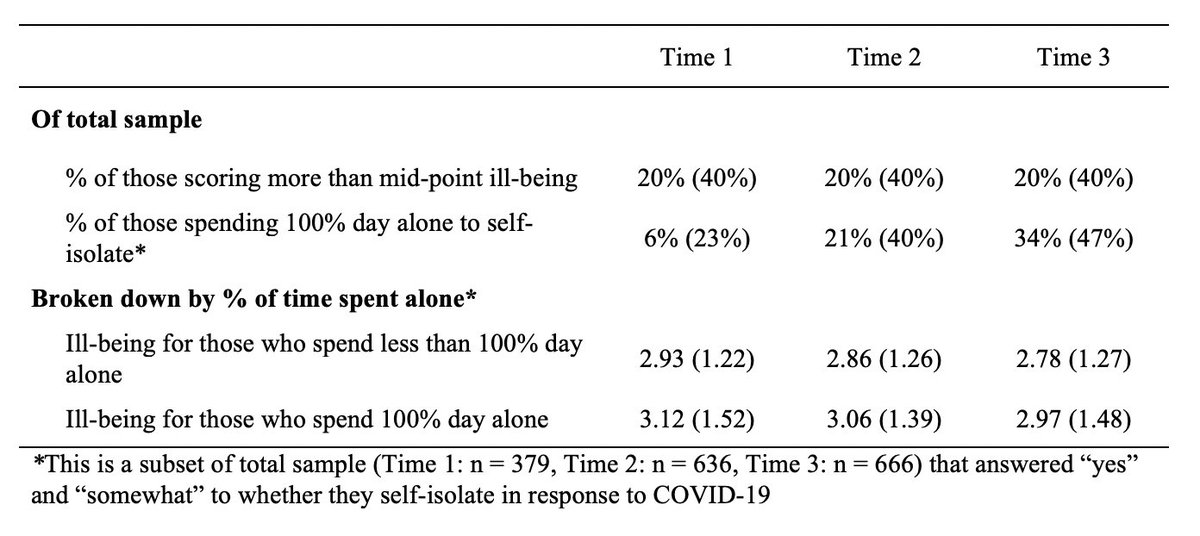
When focusing on those spending 100% of one's day alone to self-isolate in response to covid-19, descriptive data suggests increasing rates of those going into 100% self-isolation, yet little differences between averages of ill-being at T1 (~Mar12), T2 (~Mar22), and T3 (~Mar29).
English
Check out new paper from our research team, looking at change in ill-being as a function of motivation and preference for solitude among living-alone adults (Mage ~50).
We tracked participants beginning Mar12, Mar22, and Mar29
Accepted @RegReports at @royalsociety Open Science.
Chris Chambers@chrisdc77
UPDATE: We just accepted the first Stage 2 article as part of our #COVID19 @RegReports initiative Among other findings, Weinstein & @thuyvytnguyen cautiously report no evidence (in UK/US sample) that the early weeks of self-isolation harm mental health psyarxiv.com/pbgq7
English
Resilient in Solitude retweetledi

Are you aged 14-30 (or have children who are) & live in the North East? Our researchers would love to hear about your experiences of life under #lockdown for a new study.
Find out more & complete the survey 👉 fal.cn/37MN1 @YouthLockdown @Durham_SGIA @DurhamSociology

English