Sabrina Page

19.3K posts

Sabrina Page banner
Sabrina Page

Sabrina Page

@SabrinaPage33

Mystic, explorer of embodiment, avid researcher, lover of truth here to bring in the new earth community. THE NATURE OF US https://t.co/djYymCA1eW.

Albion, California, US Katılım Ekim 2020
386 Takip Edilen758 Takipçiler
Sabrina Page retweetledi
Dire Straits
Dire Straits@direstraitshq·
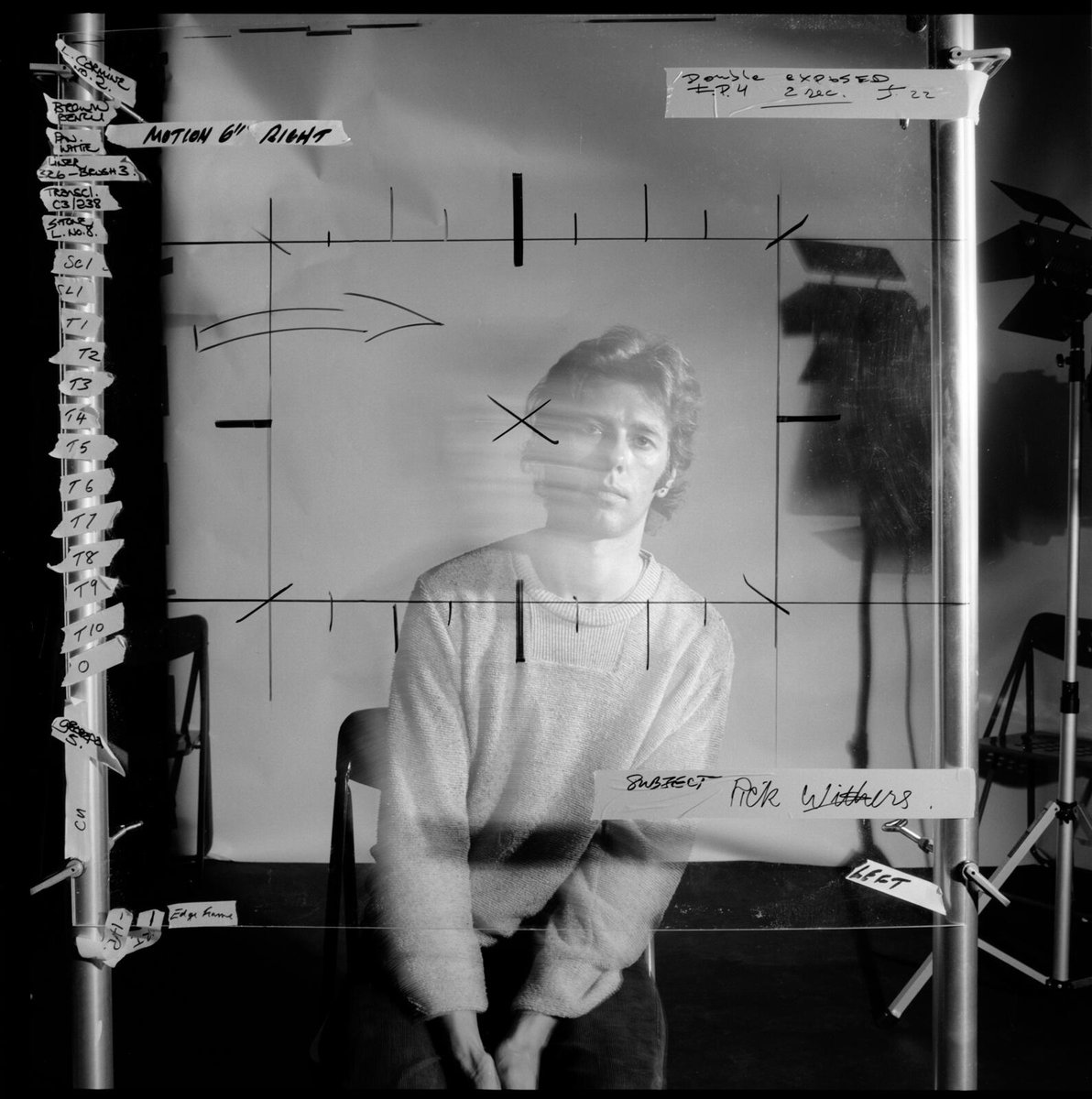
Mark, Pick and John photographed by Brian Griffin for the Making Movies album artwork in 1980.
Dire Straits tweet mediaDire Straits tweet mediaDire Straits tweet media
English
1
6
67
1.7K
Sabrina Page
Sabrina Page@SabrinaPage33·
Unexpected treasure down memory lane open.substack.com/pub/sabrinapag… The body keeps score, registering what happens to us in life, the injuries and trauma as well as the beautiful moments.
Sabrina Page tweet media
English
0
0
0
2
Sabrina Page retweetledi
B
B@QuantumTumbler·
I think some of the smartest people eventually split in two directions psychologically. Not because they’re irrational. Because they push hard enough against reality to eventually collide with the limits of their preferred framework. Some drift toward - metaphysics, - abstraction, - symbolic systems, - consciousness-first models, - transcendence, - or the feeling that “there must be something deeper.” Others react by becoming - hyper-rigid empiricists, - reductionists, - aggressively materialist, - or hostile to anything not directly measurable. Ironically, both are often responding to the same realization Reality is stranger, deeper, and less complete than our current models fully explain. What’s interesting is that intelligence alone does not protect people from drift. In fact, intelligence can amplify it. A very smart person can - build elegant internal narratives, - rationalize contradictions, - connect distant concepts, - and defend abstractions beautifully. A smart mind can generate - profound insight, or - extremely convincing nonsense. Sometimes both partially mixed together. The metaphysical drift often begins with legitimate boundary questions - Why does consciousness exist at all? - Why is mathematics so effective? - Why is there something instead of nothing? - What grounds identity? - Why does reality appear structured? These are real questions. But there’s a dangerous leap people sometimes make “This remains unresolved” becomes “therefore my speculative framework is probably true.” That’s where rigor starts dissolving. At the same time, hyper-rigid materialists can make the opposite mistake treating current measurement frameworks and operational science as if they completely exhaust reality itself. Which is also philosophically unjustified. Science is extraordinarily powerful. But it is still a model-building process operating inside finite observation constraints. Not a divine oracle. So you end up with two common failure modes 1. Metaphysical inflation Where unresolved mysteries become - simulation cosmologies, - universal consciousness theories, - hidden dimensions of meaning, - symbolic overreach, - or explanatory mythology. The danger ⚠️ emotionally satisfying narratives outrun evidence. 2. Reductionist closure Where anything subjective, emergent, unresolved, or difficult gets prematurely flattened into: “just neurons” “just chemistry” “just computation.” The danger ⚠️ reality becomes artificially narrowed to preserve epistemic comfort. The healthiest thinkers seem to occupy a much harder middle position - deeply curious, - philosophically open, - but operationally disciplined. People willing to explore possibilities without confusing speculation for established reality. Because there’s a huge difference between sensing mystery, and claiming certainty about the mystery. That distinction matters more than most people realize.
B tweet media
English
51
48
264
9.9K
Sabrina Page retweetledi
Ihtesham Ali
Ihtesham Ali@ihtesham2005·
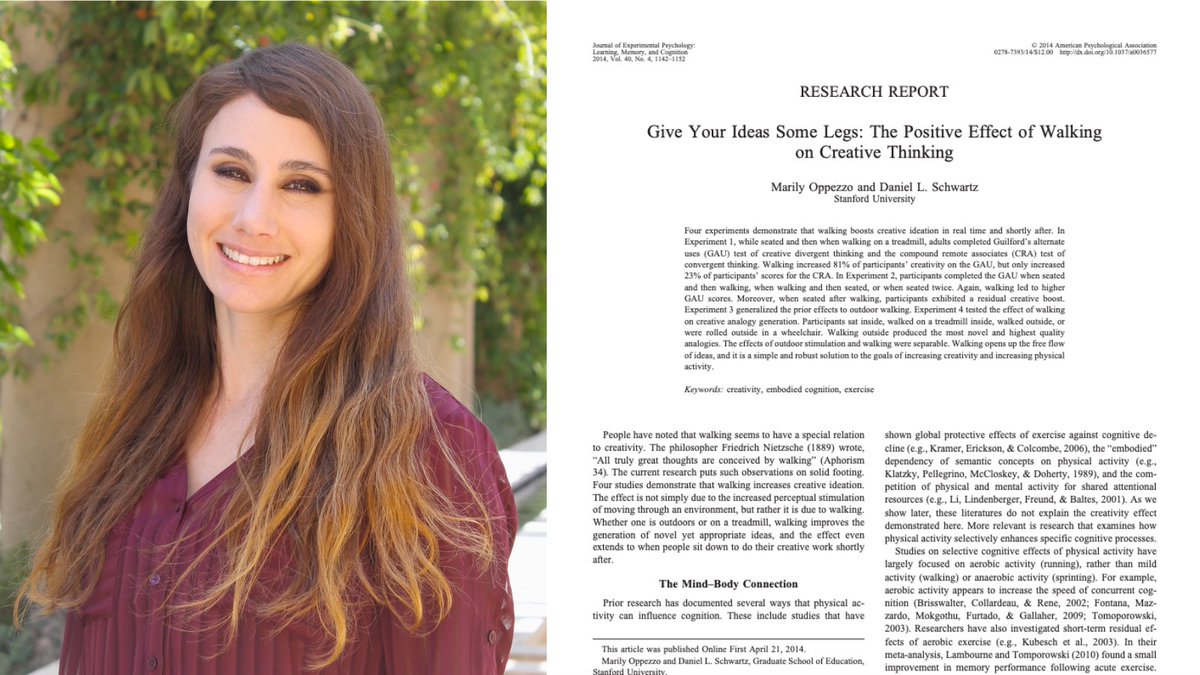
A Stanford psychologist spent 4 years proving that the simple act of walking generates 60% more creative ideas than sitting, and the experiment she designed to kill every alternative explanation is one of the most decisive findings in modern psychology. Her name is Marily Oppezzo. She got the idea for the study while walking with her advisor at Stanford to discuss her thesis topic, and the paper she eventually published in the Journal of Experimental Psychology in 2014 is sharp enough that it should have ended the seated meeting on the day it came out. She ran 4 experiments on 176 people. Same person tested twice. Once sitting, once walking. The creativity tasks were the standard ones psychologists have used for decades to measure how good a brain is at generating novel useful ideas. The result was almost too clean to publish. 81% of participants in the first experiment produced more creative ideas while walking than while sitting. In the second experiment, 88%. In the third, 100%. Every single person walked into a more creative version of themselves. On average, people generated 60% more novel useful ideas the moment their legs started moving. The skeptical question is the obvious one. Maybe it was the fresh air. Maybe it was the scenery passing by. Maybe it was the change of environment doing the work, not the walking itself. Oppezzo killed every one of those explanations with one experimental decision. She put people on a treadmill facing a blank wall. No scenery. No fresh air. No environmental change. Just legs moving in place while staring at white drywall. The 60% boost held. Then she ran the experiment that closed the case completely. She took participants outside in two conditions. Half of them walked through a Stanford courtyard. The other half were pushed through the exact same courtyard in a wheelchair. Same outdoor stimulation. Same scenery passing at the same speed. The only difference was whether the legs were moving. The walkers produced dramatically more novel high-quality ideas than the wheelchair group. The outdoors did almost nothing on its own. The walking did everything. This is the part of the study that hit hardest when I read it the first time. She also tested the opposite kind of thinking. Convergent thinking. The kind where there is one right answer and you have to narrow down to it. Word puzzles where 3 words share a hidden fourth word that connects them. The seated participants did slightly better on these. Walkers got slightly worse. Walking is not a general intelligence enhancer. It does one specific thing. It opens up the divergent search inside your brain. The part that generates options. The part that produces unexpected connections. The part that takes a problem and finds five ways into it instead of one. When you need to converge on the single right answer, sit down. When you need to find the answer in the first place, get up. The mechanism is now well understood. Walking selectively activates what neuroscientists call the default mode network, the system inside your brain that runs when you are not consciously focused on anything. The DMN is where mind-wandering happens. Where memories cross-reference each other. Where ideas that have been sitting in separate folders inside your head finally bump into each other. When you sit at a desk and force yourself to concentrate, you suppress the DMN. When you walk at a natural pace, the executive part of your brain gets just busy enough handling the walking that the DMN comes online and starts doing the work that focus was blocking. The most useful finding in the entire paper is the one almost nobody quotes. The boost did not turn off the moment people stopped walking. Participants who walked first and then sat back down stayed elevated. Their next round of seated creativity work was still significantly better than people who had been sitting the whole time. The rest lingered for at least several minutes after the legs stopped moving. You do not need to do creative work while walking. You need to walk before the creative work. The brain holds the state. The history of this is the part that should haunt anyone who still does meetings in chairs. Charles Darwin built a gravel loop behind his house in Kent called the Sandwalk and walked it 3 times a day for the rest of his life. The theory of evolution was developed one lap at a time on that path. Nietzsche walked up to 10 hours a day during the years he wrote his most important books and openly said the work was conceived on his feet. Beethoven composed for the morning and walked for 5 hours every afternoon with a pencil in his pocket for when something landed. Kahneman said the best thinking of his Nobel Prize-winning career happened on leisurely walks with Amos Tversky. Steve Jobs refused to take important conversations sitting down. He held them on foot. Every one of them was using the system Oppezzo would not measure until 2014. They just did not know what to call it. The question worth sitting with is the one almost nobody asks. Every meeting you have ever attended sitting around a table was a meeting held at a fraction of the brain power that was actually available to the people in the room. Every brainstorm that got stuck inside a conference room. Every problem you tried to solve at a desk and gave up on. Every idea you could not quite get to. The intervention is the easiest one in modern science. No supplement. No app. No subscription. No training program. Just a pair of legs and 15 minutes. The Stanford lab proved it. The philosophers knew it. The neuroscience explains it. And almost everyone reading this is still trying to think their way out of problems sitting completely still.
Ihtesham Ali tweet media
English
254
2.7K
10.6K
1.3M
Sabrina Page retweetledi
EKO
EKO@EkoLovesYou·
@Jackkk A 20-year study of nearly 30k women found that those who avoided sun had roughly double the mortality risk compared to those with the most exposure. Sun avoiders had shorter life expectancy (~2.1 years) and higher rates of cardiovascular and non-cancer deaths.
English
10
22
254
7.4K
Sabrina Page retweetledi
Antidepressant Content
Antidepressant Content@depressionlesss·
Just a sea turtle spitting out a bristle worm and slapping it because it's not tasty
English
44
260
3.3K
83.9K
Sabrina Page retweetledi
MAGA FOREVER AMEN 🇨🇦 🇺🇸 🇬🇷
Royal gossip; Prince William is officially the owner of the late Queen Elizabeth’s entire estate worth over 1.4 billion pounds. Camilla does not seem very pleased. The poor thing. I wish I was a fly on the wall at Meghan and Harry’s house. 🤔
English
189
526
3.8K
544.4K
Sabrina Page retweetledi
Sayer Ji
Sayer Ji@sayerjigmi·
Once considered a NEW AGE delusion, the science is clear: pineal gland calcification not only happens, it happens in most people to a measurable degree, and it CAN be reversed naturally to some degree as well… 👉 sayerji.substack.com/p/pineal-gland…
Sayer Ji tweet media
English
6
23
75
4.5K
Sabrina Page retweetledi
Dire Straits 🎸
Dire Straits 🎸@DireStraits77·
Mark Knopfler 🎼Brothers In Arms (A Night In London) 1996 🎻
English
2
44
201
3.1K
Sabrina Page retweetledi
Sophia Dahl
Sophia Dahl@sophiadahl1·
This clip of Yeadon, a former Pfizer Vice President and expert in allergies and respiratory diseases, is taken from an interview with @JMCDelingpole posted to the Delingpod Rumble channel on April 27, 2026: "We haven't got the sub-microscopic infectious particles called viruses. That's bullshit"‼️ "We don't have contagion of a sick person to a well person. That's bullshit"‼️ "Virus lie plus contagion lie equals vax lie"‼️ "A friend of mine pointed out that in 6,000 years of writing of every culture on the planet, you will find no mention of contagion. No mention of contagion... Funny, you would think they would have noticed that"‼️🙏👇 Full Interview 👇 👇 rumble.com/v792bn6-dr.-mi…
English
43
507
1.3K
25.4K
Sabrina Page retweetledi
Furkan Gözükara
Furkan Gözükara@FurkanGozukara·
Absolute bombshell. Prof. Rowlands confirms global power has completely shifted from sovereign states to a few tech billionaires. She exposes how elites secretly embed their own agendas into AI to build a terrifying new digital imperium to dominate humanity.
English
154
3.8K
6.3K
127.6K
Sabrina Page retweetledi
Kat A 🌸
Kat A 🌸@SaiKate108·
Richard Werner, the ex WEF young global leader shocked me yet again with his chilling insights. You may recall in 2023 he revealed that the purported end game was CBDCs implanted under the skin, using universal basic income to force acceptance. Now we’re being told UBI will be needed due to AI taking our jobs. And here’s the clincher!! He believes the real reason they’re building massive centralised AI data centres is for the implementation of CBDCs. If this is true, an agenda we thought we had defeated is still coming together in plain sight.
English
171
1.4K
2.8K
151.5K
Sabrina Page retweetledi
Catherine Austin Fitts
Catherine Austin Fitts@austin_fit76995·
“Mandatory investment” means they’ve already moved your money out of your control. Larry Fink is telling you the plan out loud: trillions for AI data centers and power grids, and it’s coming from your savings and pension accounts. He calls it “investment.” I would call it “involuntary conversion of assets.” 1. You don’t hold the asset, you hold a claim. Most people’s 401ks, pensions, and brokerage accounts aren’t held in their name. They’re held in street name at DTCC/Cede & Co. That means you’re a beneficial owner with a contract claim, not the legal owner of the stock or bond. Fink isn’t asking you to buy data centers directly. He’s reallocating the securities already pledged inside that system. 2. The collateral is being repurposed. The Great Taking shows how securities held in custody have been rehypothecated and pledged up the chain to support derivatives, repo, and central bank operations. Now that same collateral pool is being redirected into “strategic infrastructure” - AI, energy, digital grids. It’s the same plumbing, new destination. The secured creditors at the top still have first claim if there’s a crisis. 3. “Mandatory” means the choice is being removed. I have spent 30 years documenting how the system shifts from free markets to a controlled ledger. When investment becomes mandatory, it’s not markets allocating capital. It’s policy using your pension as the funding mechanism. The risk and the loss stay with you; the upside and control go to the entities building and operating the grid. 4. This is why control of the ledger matters more than the assets. Once everything runs through a centralized digital ledger and clearing system, the ability to move, freeze, or reallocate funds without your direct consent becomes trivial. AI infrastructure needs guaranteed, long-term capital. Your pension is perfect for that - if you can’t say no.
English
167
1.3K
1.9K
47.9K
Sabrina Page retweetledi
The Extreme Music Enthusiast
The Extreme Music Enthusiast@TheExtremeMusi1·
Brian Johnson & Mark Knopfler stopping to watch a street musician absolutely nail the solos to “Sultans of Swing” and “Thunderstruck.” Not many people can say they’ve played in front of those two legends. This kid will remember this day for the rest of his life.
English
37
528
6K
480.1K
Sabrina Page retweetledi
Wall Street Apes
Wall Street Apes@WallStreetApes·
Erin Brockovich has launched a website and has begun tracking all data centers in America and logging resident complaints In just 1 week it’s already logged 1,690 resident complaints For this who don’t remember Erin Brockovich was the paralegal responsible for winning out a case against PG&E, Hinckley in California, because their wastewater runoff was seeping into rural areas and creating a lot of health issues for, for the surrounding neighborhoods That case brought in a $333 million settlement that went to the families affected by the situation because a lot of them either had staggering medical bills due to their tap water was no longer safe So why is this important, well residents all over America are reporting their tap water and river water is being heavily polluted by data centers Her map of data centers is new, she just launched it The website features an interactive US map showing operational, under-construction, and proposed AI data centers, overlaid with community-reported complaints Residents can submit reports with details, photos, and locations. Within days of launch, it received a surge of submissions over 1,600 in the first week, and reports of 1,800+ from 47 states shortly after Common Resident Complaints Being Logged - Water usage - Raising utility bills for residents - Noise pollution: Constant 24/7 humming from fans, generators, and cooling systems disrupting sleep, daily life, and wildlife. - E-waste from frequent hardware upgrades, pollution including PFAS concerns
English
828
26.8K
66.2K
1.4M
Sabrina Page retweetledi
Shadow of Ezra
Shadow of Ezra@ShadowofEzra·
The CEO of BlackRock, Larry Fink, admits that the trillions of dollars being used to build data centers and power grids will come from ordinary people’s savings accounts and pension funds, and says it is mandatory. He says America needs trillions in AI infrastructure spending, and that people will be forced to “invest” in it. “Much of this will come from savings accounts and pension accounts.”
English
4K
19.1K
28.2K
2.6M