Sabitlenmiş Tweet

Three nights ago, something strange happened.
And before you ask, no, I was not watching a sci-fi movie. I was just on my laptop like a normal human being.
Then my screen flickered.
Time was 02:22 AM.
No notification.
No message.
Just one strange line blinking on my monitor like it had something important to say.
01010000 01010101 01011010 01011010
Now listen, I am many things, but a computer scientist is not one of them. So my first thought was simple.
“Ah. My laptop has finally decided to disgrace me.”
I was ready to restart the system and go back to sleep.
Then the second message appeared.
“The system was never meant to be orderly.”
At that point I sat up.
Because what do you mean the system was never meant to be orderly? Who is talking? And why are you talking through my screen at 2 in the morning like you pay my electricity bill?
So curiosity took over. I started tracing where the signal was coming from.
The trail led to one name.
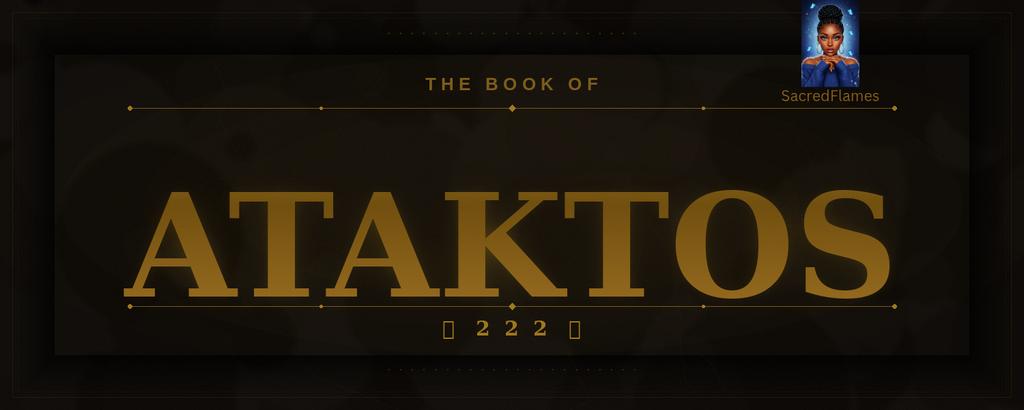
ATAKTOS.
I checked the meaning.
Ancient Greek.
“Unruly.”
“Without order.”
Now here is the funny part.
When people say chaos, you expect confusion. Randomness. Something that looks like a toddler was given a paintbrush and too much freedom.
But what I found was different.
222 fragments.
Not 200.
Not 300.
222.
Each one built from strange forms that look like mathematics arguing with anatomy while code sits in the corner taking notes.
Nine different structures.
None repeating.
Which means someone did not just throw shapes together and call it art.
No.
This looked like carefully engineered chaos.
The deeper I looked, the more it felt like each piece was passing through stages.
First the rough, unfinished edges.
Then shapes that looked compressed and structured.
Then pieces that started breaking themselves apart again.
Like a process moving through creation, structure, destruction, and balance.
Almost like someone was asking a dangerous question:
What happens when you trust the creative process completely… even when it looks messy?
The collection follows that journey.
➜ It starts with Rawforms.
Edges not cleaned. Lines escaping their boundaries. The kind of work most artists would hide.
➜ Then Crystallized pieces appear. Chaos folding inward, forming structure.
➜ After that comes Dissolved.
The work breaking itself apart again. Negative space doing half the talking.
➜ Then Convergents.
Different states existing together without fighting each other.
And finally…
➜ The Singulars.
Twelve pieces that refused to follow the system that created them.
Imagine building a machine and the machine suddenly says, “Thank you for your effort, but I will now do my own thing.”
Yes. That kind of rebellion.
The entire collection sits on Ethereum mainnet.
222 pieces. Permanently onchain. Fixed supply. Forever.
Then I looked deeper into who started this signal.
The trail pointed to @thegreatola.
If you have spent time in Web3, you know that name. Not the loud type chasing attention. More like the builder who quietly drops something interesting and lets curious minds find it.
And the entry into this entire experiment?
Free mint.
Yes. Free.
Which means this was not built around “pay first, understand later.” It was built around discovery.
Now let us talk about the part collectors care about.
Holding an ATAKTOS piece does not just mean you own art.
It means you become one of the first 222 collectors in the ecosystem.
➜ Early holders get OG collector status, which in Web3 usually means you are first in line when the world around the project expands.
➜ They also get access to future ATAKTOS drops and expansions. Whatever this experiment evolves into next, the early holders are already inside the room.
Cont'd 👇😊
English