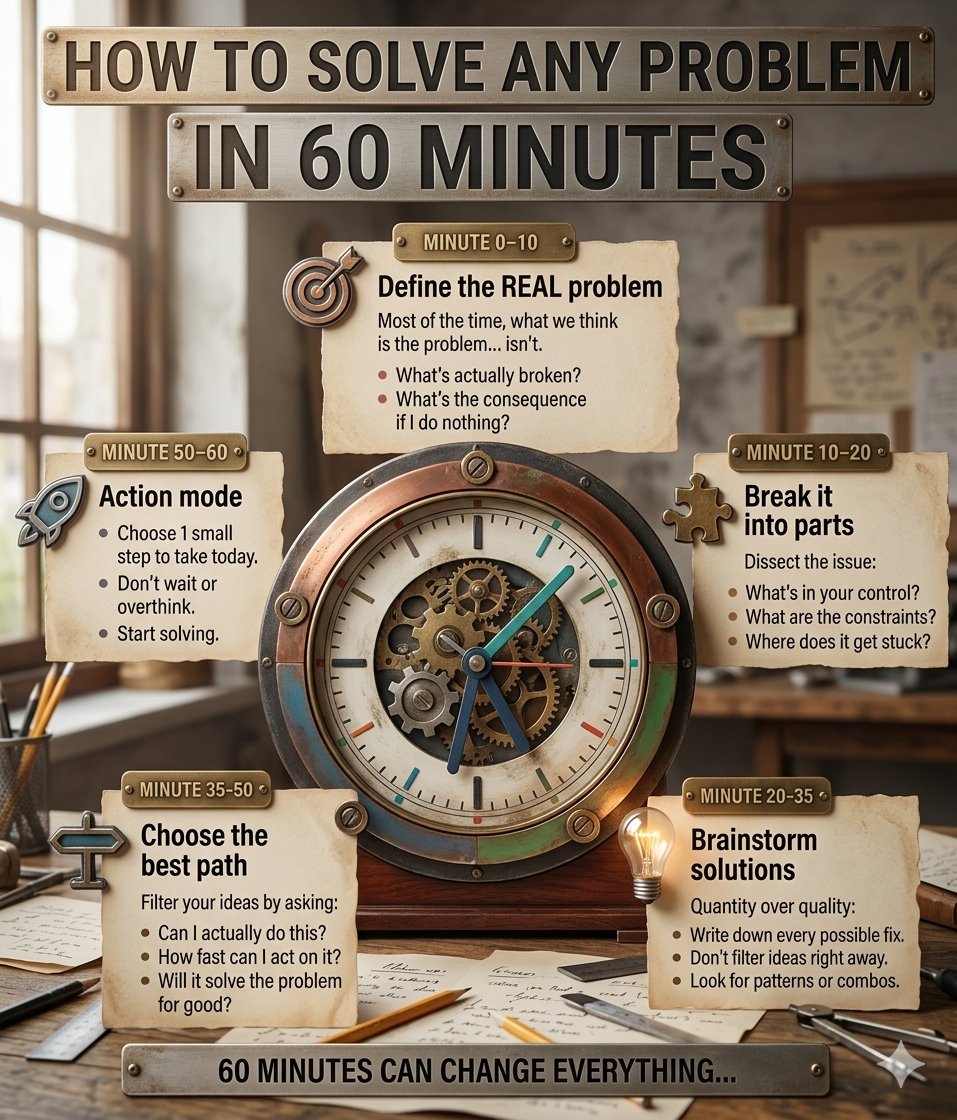
Discipline isn't restriction—it's freedom.
Master your mind, words, actions, mornings, habits, finances, and emotions. The strongest battles are won within. ⚔️
🧠 Overthinking won't solve it. Action will.
⏱️ 60-Minute Framework:•0–10 min: Define the real problem
• 10–20 min: Break it into smaller parts
• 20–35 min:Brainstorm solutions
• 35–50 min:Pick the best option
• 50–60 min:Take the first step
Stop overthinking.Start moving.🚀
Andrej Karpathy just explained the future of software engineering without directly saying it.
The best AI engineers are no longer “prompting.”
They’re building systems around the agents.
Karpathy’s biggest insight wasn’t:
“Claude can code.”
It was:
LLMs become dramatically better when you force them into disciplined workflows.
That’s why "CLAUDE.md" files are suddenly everywhere.
Not because they’re prompts.
Because they behave like an operating system for the agent.
Karpathy called out the exact problems with AI coding:
- models assume instead of asking
- they overengineer simple tasks
- they hide confusion
- they rewrite unrelated code
- they optimize for completion, not correctness
So developers started encoding rules directly into the workflow:
→ Think before coding
→ Simplicity first
→ Surgical edits only
→ Goal-driven execution
And the results are wild.
People are now running multiple Claude Code agents in parallel like engineering teams:
• one agent researching
• one debugging
• one writing tests
• one optimizing code
• one validating outputs
Not “AI assistance.”
Actual orchestration.
And this part from Karpathy changes everything:
“Don’t tell the model what to do. Give it success criteria and let it loop.”
That is the shift.
From:
“write this function”
To:
“here’s the goal, constraints, tests, and verification system — now iterate until correct.”
The craziest part?
This already feels like a phase shift in engineering.
A lot of developers quietly went from:
80% manual coding → to 80% agent-driven coding in just months.
Not because AI became perfect.
Because the leverage became impossible to ignore.
We’re entering an era where the highest leverage engineers won’t necessarily be the best coders.
They’ll be the people who build the best systems around AI agents.
Most teams rush to build AI agents before asking the most important question:
❓ Should you even build one?
Microsoft's Cloud Adoption Framework has a decision tree that cuts through the noise. Here's what it actually says:
🔷 Step 1 — Business Plan Check
If your task is structured or predictable → skip agents entirely. Use GitHub, Microsoft Fabric, or ML models instead.
If it's static knowledge retrieval → build a RAG app, not an agent.
🔷 Step 2 — SaaS Before Custom
Before writing a single line of custom agent code, ask: does M365 Copilot, GitHub Copilot, Azure Copilot, or Dynamics 365 already solve this?
If yes → use it. If no → now you can build.
🔷 Step 3 — Architecture Decision
Single agent or multi-agent?
Only go multi-agent if you're crossing security/compliance boundaries, involving multiple teams, or planning for serious scale.
Otherwise? Test a single agent first. If it passes → ship it. If it fails → then escalate to multi-agent.
The framework's core philosophy:
👉 Don't build what already exists.
👉 Don't over-engineer what can stay simple.
👉 Let the use case — not the hype — drive the architecture.
This is the kind of structured thinking that separates mature AI adoption from "we just used agents because everyone else is."
💬 Where does your team usually get stuck in this decision process? Would love to hear in the comments.
Anthropic just released a 24-minute workshop showing how the creators of Claude actually do it. 🚀
No paywall | No signup | No fluff
Just practical prompting techniques straight from the team building Claude.
I've seen entire courses charge hundreds of dollars and teach less than what's covered in the first few minutes.
If you're using Claude, this is one of the highest-ROI videos you'll watch this year.
📌 Bookmark it
🔄 Share it with someone building with AI
➕ Follow for more AI courses, agents, MCP, and automation resources
Top 100 AI Tools in 2026 (The Ultimate Cheatsheet)
Save this. You'll thank me later 👇
🤖 AI Assistants
→ Claude
→ ChatGPT
→ Gemini
→ Grok
→ DeepSeek V
→ Llama
→ Mistral
→ Cohere
→ google ai studio
→ Abacus.AI
💻 Coding
→ Cursor
→ GitHub copilot
How many times have you needed honest feedback but did not want to bother your colleague?
This Claude Code plugin just solved that problem.
It is called SynthTeam. Built by Nick Winder. Free. MIT licensed. And the idea behind it is one of the most original things I have seen in the Claude Code ecosystem this year.
Here is exactly what it does.
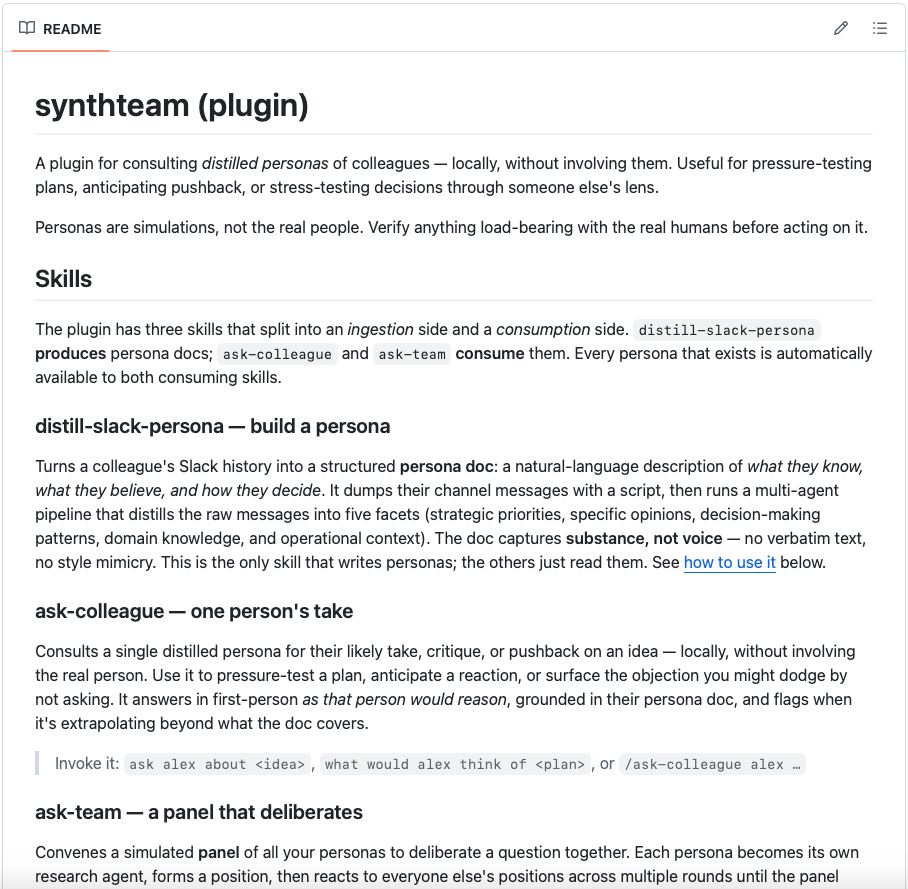
SynthTeam lets you consult distilled personas of colleagues built from their Slack history without involving the real people. It is useful for pressure-testing plans, anticipating pushback, or stress-testing decisions through someone else's lens.
Three skills. Two sides. One workflow.
Step 1: Build the persona.
Type: 'distill alex's persona'
The distill-slack-persona skill turns a colleague's Slack history into a structured persona doc, a natural-language description of what they know, what they believe, and how they decide. It runs a multi-agent pipeline that distills raw messages into five facets: strategic priorities, specific opinions, decision-making patterns, domain knowledge, and operational context. The doc captures substance, not voice, no verbatim text, no style mimicry.
Every persona lives locally on your machine under '~/.synthteam/'. Nothing is committed. Nothing leaves your device.
Step 2: Ask one colleague.
Type: 'ask alex about dropping the offline cache'
The ask-colleague skill consults a single distilled persona for their likely take, critique, or pushback on an idea locally, without involving the real person. It answers in first person as that person would reason, grounded in their persona doc, and flags when it is extrapolating beyond what the doc covers.
Here is what that actually looks like:
Alex (Staff Engineer) likely take:
I would push back. We added that cache after the Q3 outage
when the upstream API flaked for 40 minutes, dropping it
reintroduces a single point of failure. If the goal is bundle
size, I would argue for shrinking the cache, not removing it.
Extrapolating: the persona doc has no signal on the current
reliability numbers check those with the real Alex.
The pushback you were avoiding. Delivered in 10 seconds. At 11pm.
Step 3: Ask the whole team.
Type: 'ask the team about this architecture decision'
The ask-team skill convenes a simulated panel of all your personas to deliberate a question together. Each persona becomes its own research agent, forms a position, then reacts to everyone else's positions across multiple rounds until the panel converges. The output maps where the team agrees, where it genuinely splits and why, and what only the real humans can settle.
Cross-functional gut-check. No meeting scheduled. No calendar invite sent.
How to install it:
In Claude Code:
/plugin marketplace add nickwinder/synthteam
/plugin install synthteam@synthteam-marketplace
In Codex:
codex plugin marketplace add nickwinder/synthteam
The honest limitations worth knowing.
Personas are built from public Slack history only, they miss decisions made in DMs, meetings, docs, or code review. They reflect a point in time refresh monthly. Output is a simulation of reasoning, not a quote. Never attribute a persona's take to the real person.
This is not a replacement for talking to your colleagues. The README says it clearly and says it first.
It is a tool for the moment before that conversation when you need to pressure-test your own thinking, anticipate the objection you are not seeing, or find the flaw before someone else does.
The feedback you were avoiding is now one prompt away.
Source: Nick Winder · GitHub · MIT License · 2026
(Link in the comments)
Want to become a Claude Certified Architect in 6 weeks? 🚀
Here’s a simple roadmap to go from beginner → builder → certified 👇
📅 Week 1 — Learn the Basics Master the essentials: • Claude API
• MCP (Model Context Protocol)
• Claude Code
• Claude fundamentals
📅 Week 2 — Build Real Projects Stop watching tutorials. Start shipping: • Apps with Claude Code
• AI agents + APIs
• MCP workflows & integrations
📅 Week 3 — Study the Exam Understand what matters: • Real-world case studies
• 5 important domains
• Skills tested in the exam
📅 Week 4 — Advanced Practice Level up your projects: • Multi-agent systems
• Team collaboration workflows
• Research + automation pipelines
📅 Week 5 — Mock Tests Train under pressure: • Practice exams
• Analyze weak areas
• Aim for 850+/1000
📅 Week 6 — Certification Time Take the real exam. One attempt. One goal. 🏆
❤️ Like
🔁 Repost
🔖 Save for later
Follow for more AI learning content ⚡
Most people think better AI = better results.
Not true.
The real difference is context, examples, feedback, and clear instructions.
The best users don't ask better questions.
They build better systems around AI.
That's the real advantage.
#ClaudeAI#Productivity#AITools
Taking this down in 24 hours.
All my personal Claude prompts I use to create eBooks that generates $50,000/month.
It also includes, niche selection,writing and cover design prompts.
Comment “Claude” and I’ll DM you the blueprint for FREE.
INSTEAD OF WATCHING AN HOUR OF NETFLIX TONIGHT.
This 1 hour Stanford lecture by Joel Peterson will teach you more about negotiation and getting what you want than most people learn in years.
Bookmark it and give it an hour, no matter what.
🚨 Claude just changed the game.
All you need is:
💻 A laptop
🌐 Internet connection
⏰ 60 minutes a day
That’s enough to build a $7,200/month online income stream using AI.
No coding.
No expensive setup.
No years of experience.
Most people still use AI for fun…
But smart creators are quietly using Claude to:
• Create digital products
• Offer AI services
• Write viral content
• Automate work
• Build online income streams
Usually, I sell this detailed guide for $97…
But today you can get it FREE. 🎁
Inside you'll discover:
✅ The exact asset
✅ My full workflow
✅ The Claude prompts I personally use
✅ How to scale to $10K/month
✅ How beginners can start fast
Want it?
❤️ Like this post
💬 Comment “AI”
➕ Follow me to receive it in DM
@sumitdoriya21
⏳ Available FREE for 48 hours only.
🚀 The AI Secrets Most People Don't Know!
Want to finish 10 hours of work in just 10 minutes?
🧠
**Claude** can write code, analyze data, and create content like a pro. Stop working hard, start working smart.
Full guide below! 👇
#ClaudeAI#AI#Productivity#Tech
🚀 60 AI Tools you need in 2026
✍️ Writing
🎨 Image Generation
🤖 AI Agents
🎥 Video Editing
💻 Coding
📈 SEO & Productivity
The AI stack is growing fast.
The people learning these tools early will win big 🔥
Stop telling Claude, "do this."
Stop telling Claude, "write code."
Stop telling Claude, "fix this error."
You're actually treating a senior AI like a junior intern.
Here are 8 prompts you can copy and paste directly: